

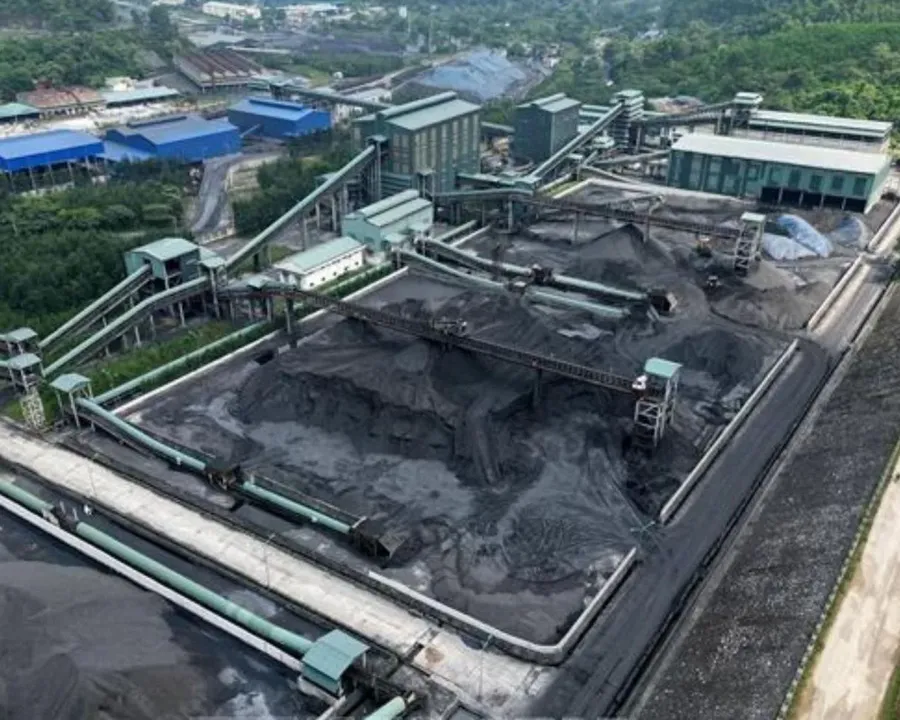
Coal moving from the mine to the washing plant is the stage the Government Inspectorate scrutinised most in its newly published conclusion on the Vietnam National Coal - Mineral Industries Group (TKV). Inspectors compared the output that mining companies sold to Hon Gai Coal Preparation (Vinacomin) and Cua Ong Coal Preparation (TKV) with those plants' post-washing output for 2020–2024, and found the output used to calculate resource tax differed by 4,950,278 tonnes of coal.CafeF
The same conclusion records that TKV preserved its equity, was profitable every year and met its tax and fee obligations to the State over 2020–2024.TheLEADER The fair reading, then, is a recommendation to recalculate, not a finding about a loss-making company or one that skipped its taxes.
For anyone holding coal stocks, the document touches two tickers: Vang Danh Coal JSC - Vinacomin (TVD) and Cao Son Coal JSC - TKV (CST), both traded on HNX. TKV owns 66.83% of TVD and 65.14% of CST. The TKV group itself is not listed.
The gap sits between the mine and the washing plant
According to CafeF, TKV treats the mining unit as the resource taxpayer. Those units calculate tax from output appraisal certificates, using the price at which the mining company sells to the washing unit. The Ministry of Finance circular, by contrast, defines taxable output as the coal obtained after washing. The Government Inspectorate found TKV's approach "not in line with the Ministry of Finance's regulations" and placed the finding under underpaid resource tax.Vietnam+
The accompanying recommendation is fairly clear. TKV should recalculate resource tax on post-washing output from run-of-mine coal, at the actual price TKV sells coal to the market and the statutory tax rate.CafeF In other words, both inputs to the tax formula move to the end of the chain: the volume after washing and the price when coal leaves the group.
The figure of 4.95 million tonnes is a volume, not an amount of money. The recalculation needs both post-washing output and the actual selling price for each year, so any additional coal tax will only become clear once TKV completes it.
What makes up the VND 129.1 billion
The Government Inspectorate recommended that TKV pay an additional VND 129.1 billion or more in taxes and fees.CafeF The breakdown, per TheLEADER:TheLEADER
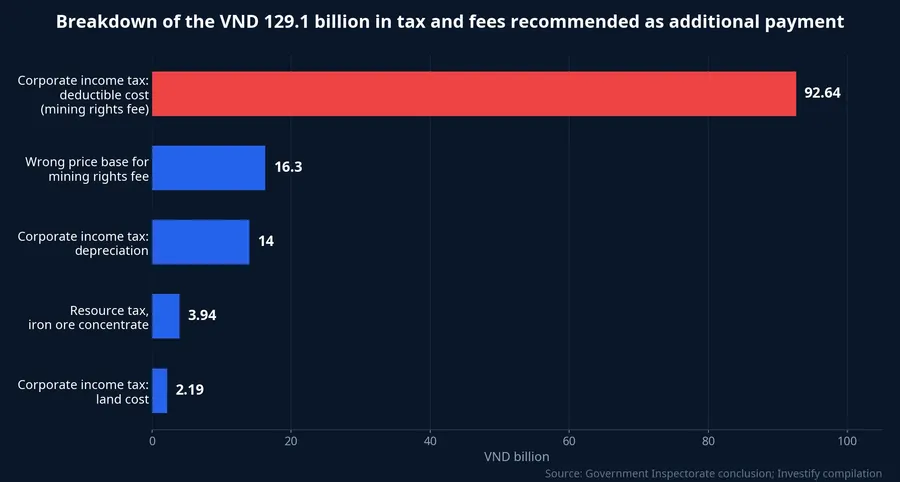
The largest piece, over VND 92.64 billion, is corporate income tax from wrongly calculated deductible costs tied to mineral mining rights fees. It links to another finding: applying the calculation method, the mining rights fee rates and the Corporate Income Tax Law inappropriately raised deductible costs at the 6 companies examined by more than VND 463 billion over 2020–2026.Vietnam+ Higher deductible costs mean lower taxable income. Once the amount is disallowed, taxable income rises again and the tax due rises with it.
The remaining items are smaller: over VND 16.3 billion from a wrong price base for mining rights fees, over VND 14 billion in corporate income tax from miscalculated fixed-asset depreciation, nearly VND 3.94 billion in resource tax on iron ore concentrate, and over VND 2.19 billion from wrongly booked land costs. On iron ore, in 2020–2021 the average selling price of Vinacomin Minerals Corporation was higher than the resource tax price set by Lao Cai Province's People's Committee, so it must pay over VND 3.9 billion more.Vietnam+ The land item belongs to the group itself: in 2020–2022 TKV booked nearly VND 11 billion in land-use payments for a plot at 2W Ung Van Khiem (Ho Chi Minh City) and a garment workshop plot in Cua Ong ward (Quang Ninh) as deductible costs, although neither plot had been put to use or generated business activity.CafeF
Keep this VND 129.1 billion apart from a near-identical figure: about VND 129 billion of 2021 retained profit that TKV must pay into the state budget under an earlier Ministry of Finance inspection conclusion. That one arose because financial-investment provisions were set higher than allowed. TKV paid it in 2023, but at the time of the inspection late-payment interest for 2021–2022 had still not been determined and paid.TheLEADER
Four companies over their permitted output, two of them listed
Inspectors reviewed coal mining at 13 mine sites of 6 TKV companies.CafeF The conclusion says 4 of the 6 mined above the annual capacity stated in their licences, by less than 15%, in breach of the Law on Minerals.Vietnam+ Two of those four are joint-stock companies with shares on HNX.
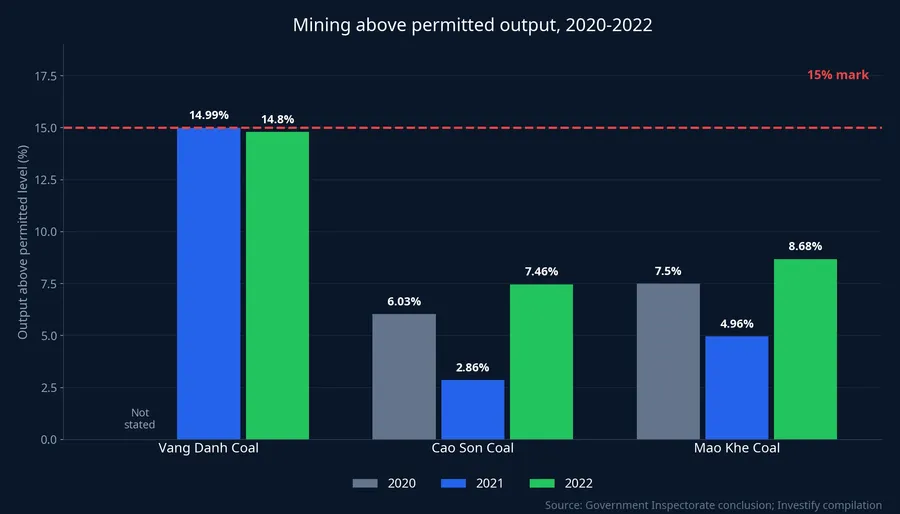
Vang Danh Coal (TVD), at the Vang Danh open-pit area, exceeded permitted annual output by 14.99% in 2021 and 14.8% in 2022.CafeF That is the highest overage of the four, just below the 15% mark. Cao Son Coal (CST), at the Khe Cham II mine, exceeded it by 6.03% in 2020, 2.86% in 2021 and 7.46% in 2022.CafeF
The other two have no listed shares. Uong Bi Coal - TKV, at the Dong Vong mine, exceeded its limit by 10.71% in 2022. Mao Khe Coal - TKV, at the Mao Khe underground mine, exceeded it by 7.5% in 2020, 4.96% in 2021 and 8.68% in 2022.CafeF
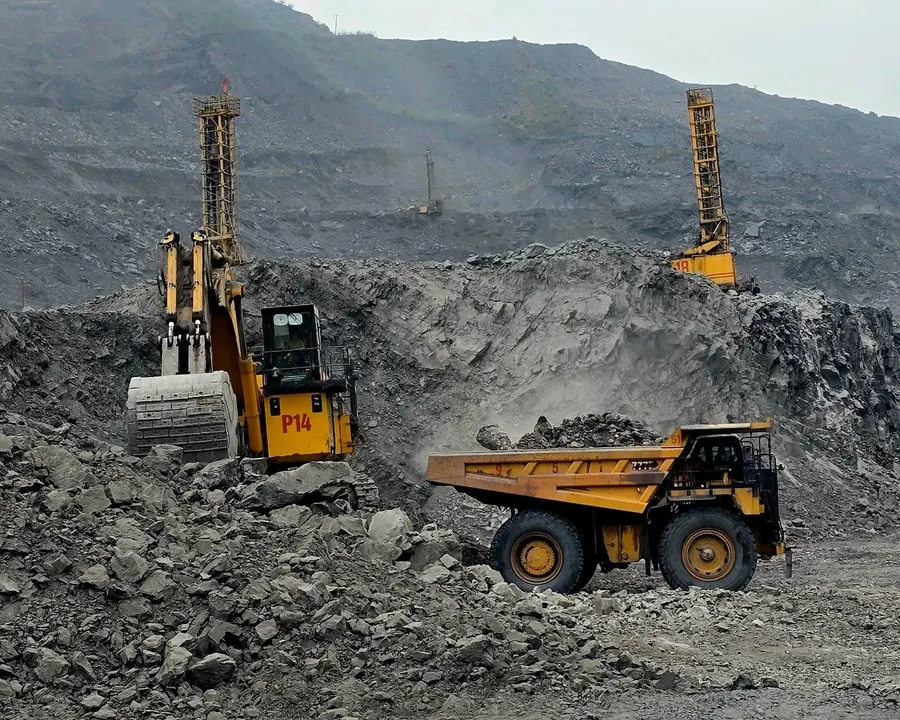
Per CafeF on November 22, Mao Khe Coal, Vang Danh Coal and Cao Son Coal also had no weighing stations installed as required by Government regulations.CafeF A weighing station measures the coal leaving the mine, which is exactly the quantity both the licence and the resource tax rest on.
Cao Son Coal also carries a finding that predates the inspection period. From 2012 to June 30, 2014, Tay Nam Da Mai Coal JSC, which merged with Cao Son Coal on August 5, 2020 to form Cao Son Coal - TKV, mined the Khe Cham II open pit under a TKV-assigned plan before holding a licence. Licence No. 1251/GP-BTNMT was issued on June 26, 2014.Người Quan Sát In a supplementary explanation dated May 18, 2026, Cao Son Coal said that halting mining in that period would have cost it about VND 653.75 billion of state capital and left it unable to pay over VND 246.7 billion in wages to more than 1,000 workers. It had paid taxes, fees and profit into the budget. The Government Inspectorate still ruled that mining before the licence breached Clause 2, Article 4 of the 2010 Law on Minerals, and asked the Ministry of Agriculture and Environment to review it and, if signs of a criminal offence appear, to refer the file to investigators.Người Quan Sát
What the conclusion gives subsidiaries' shareholders
The conclusion is not only about amounts owed. In 2020–2024, 8 TKV subsidiaries had not fully distributed dividends from after-tax profit, cumulatively nearly VND 1,988 billion by the end of 2024. All eight have over 50% state capital, and by regulation, after setting aside funds, the remaining profit must be distributed to contributing shareholders in full. The portion matching TKV's capital is over VND 1,634 billion.TheLEADER
In addition, 6 subsidiaries set aside development investment funds above the permitted ratio, a total of nearly VND 96.94 billion. That amount must be reversed into after-tax profit for dividends, of which TKV would receive about VND 83.1 billion more. The rest goes to the other shareholders of those six companies.CafeF
Where TVD and CST holders stand
The Government Inspectorate asked the Ministry of Agriculture and Environment, the Ministry of Industry and Trade, the Ministry of Finance, the Ministry of Construction and Quang Ninh's People's Committee to review and clarify the nature, extent, causes, consequences and specific responsibility of each organisation and individual over time, then consider responsibility and handling under the rules.Vietnam+
For TVD and CST shareholders, the findings name the two companies on above-permit output and missing weighing stations. The VND 129.1 billion is recommended at group level and is not assigned to either company. The tax on the 4.95 million tonnes depends on TKV's recalculation. For scale, at the November 20 session TVD closed at VND 9,000 with a market capitalisation of about VND 400 billion; CST closed at VND 14,100, about VND 600 billion.
There are two possible paths, measured by one yardstick: what reaches each company's own financial statements. If the ministries and Quang Ninh stop at a request to correct practices, and the tax recalculation mostly stays at group level, TVD's and CST's profit changes little. If tax authorities issue back-tax or penalty decisions to individual companies, the amount will appear under tax payable and corporate income tax expense. Conversely, the requirement to distribute remaining profit and reverse development investment funds, if applied to the company you hold, would show up in the profit distribution plan put to the shareholders' meeting.
The first document that could show which path is under way is the Q4 2026 financial statements of TVD and CST, due in January 2027. The lines to read are tax and amounts payable to the State, plus the notes on provisions or obligations arising after the inspection.