


On November 21, 2026, Standing Deputy Prime Minister Pham Gia Tuc signed Directive 40/CT-TTg on behalf of the Prime Minister, setting out measures to boost consumer spending through the rest of 2026 and the Lunar New Year (Tet) holiday in 2027. Day one of Tet falls on Saturday, February 6, 2027, about ten weeks away.
What stands out is how the document frames the problem. It says domestic goods markets will keep facing inflationary pressure in late 2026 and early 2027, driven by higher imported raw material and fuel prices, credit pressure and rising production and business costs, all of which will weigh on purchasing power.VnExpress
A stimulus document that names inflation as a risk explains most of what follows. The levers it picks all aim to hold prices and cut costs for buyers, rather than put more cheap money into the economy. This post takes the directive lever by lever and asks whose money each one touches before Tet.
Why the room is on the cost side, not in cheap money
Demand has not weakened. According to figures cited in the directive, retail sales of goods and consumer services for the first ten months of 2026 came to an estimated VND 6,618.9 trillion, up 13.5% from a year earlier.VietnamPlus The squeeze on buyers' wallets comes from prices.
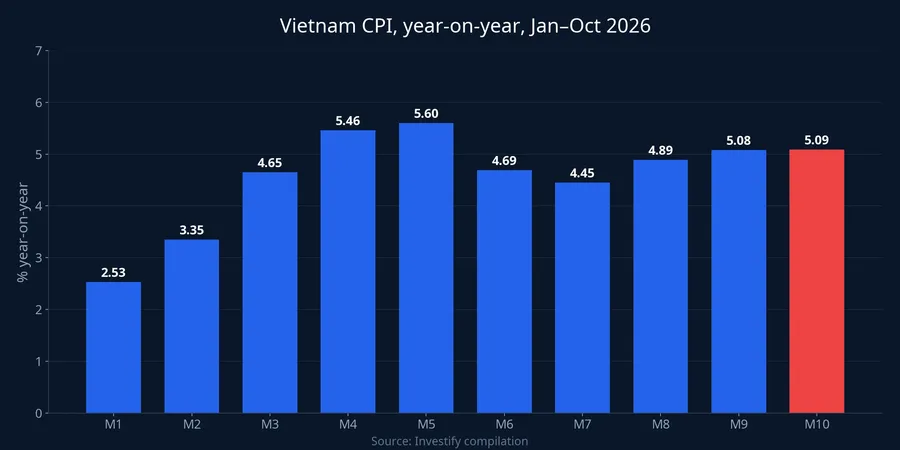
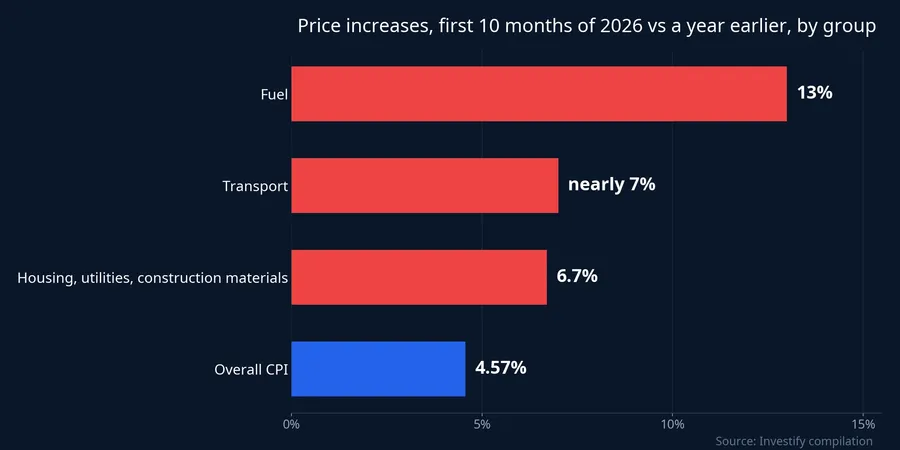
Average CPI for the ten months rose 4.57% year on year.VnExpress October alone came in at 5.09%, above July's 4.45% and close to May's 5.60% peak. The pressure sits in expenses that are hard to cut: housing, electricity, water and construction materials rose 6.7%, fuel prices rose 13% and pulled transport up nearly 7%, all year on year.VnExpress
In that setting, cutting the policy rate to make money cheaper would add demand just as prices are running hot. The policy rate has stayed at 4.50% in November, unchanged since at least December 2024. The directive tells the State Bank of Vietnam to run monetary policy "proactively and flexibly, helping to control inflation and support growth".VietnamPlus In that sentence, controlling inflation comes before supporting growth. So the room that remains is on the cost side: state-set prices, taxes and fees built into retail prices, and the operating costs of the banks themselves.
Lever one: state-set prices
The directive asks ministries, agencies and localities to review factors that push prices up, especially for essential goods, and to "manage prices of goods and services set by the state on an appropriate roadmap, limiting increases at year-end".VietnamPlus The wording is general, with no list of specific items. It is a direction to "limit increases" at year-end, not a pledge to freeze any particular price until Tet.
This lever reaches household bills first, since these are prices state agencies set directly. Part of it came before the directive: electricity prices fell 2% from the start of November.Dân trí Healthcare service prices have not risen in 2026.VnExpress
Market oversight comes with it. The Ministry of Industry and Trade is to track world fuel prices, secure fuel and power supply for year-end, and coordinate with the Ministry of Finance on fuel pricing. Market inspectors are stepping up checks on speculation, hoarding and price labeling, and localities are expanding price-stabilization outlets and taking goods to rural and remote areas.Thanh Niên
The limit is that this lever only directly touches state-set prices. Ordinary goods are priced by sellers. Many eateries in Ho Chi Minh City have kept prices unchanged even though fuel and electricity got cheaper, citing ingredient, gas and labor costs that have not come down. On the retail side, Saigon Co.op has stockpiled more than 12,000 tonnes of goods and runs a 59-day Tet campaign from early December, while MM Mega Market Vietnam has pledged to hold prices on about 300 essentials for three months from November.Dân trí Tet prices will therefore depend on competition among retailers as much as on official directives.
Lever two: taxes and fees
The Ministry of Finance is tasked with "managing tax and fee policy in a reasonable direction, helping lower living costs and raise household spending capacity".VnExpress That is a direction, not a specific tax cut.
To gauge the room left, look at what has already been done this year. The government cut VAT by 2 percentage points, extended deadlines for tax and land rent payments, set the special consumption tax on mineral gasoline, E5 and E10 to 0%, and cut electricity prices by 2%. Budget revenue is expected to fall by about VND 256,700 billion this year because of tax exemptions and reductions.VnExpress
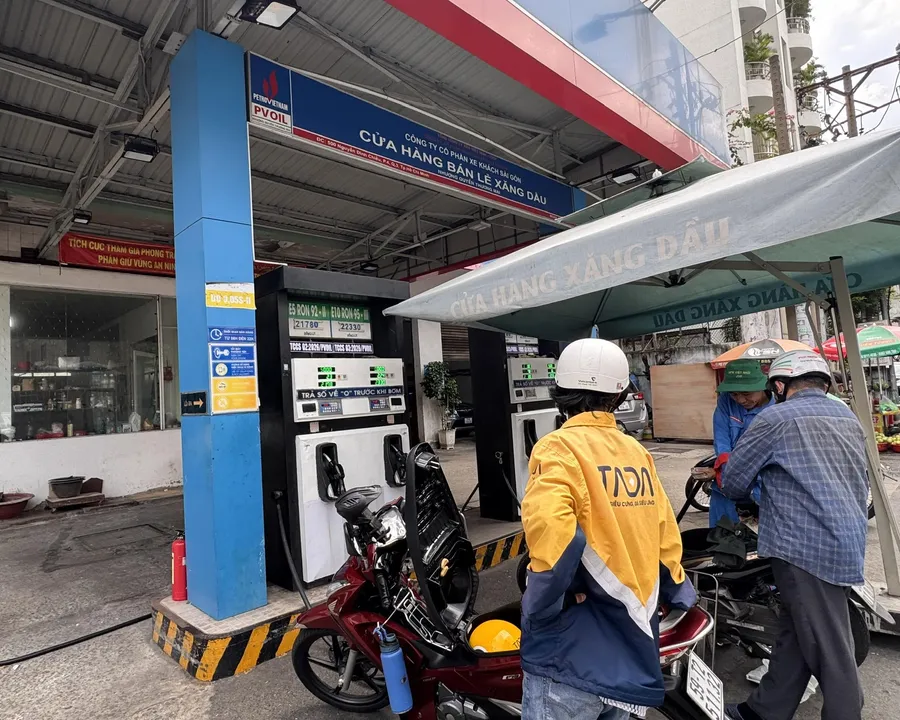
The most visible effect for households is at the pump. After five consecutive adjustments, E5 RON 92 has dropped VND 7,450 per liter and E10 RON 95-III has dropped VND 6,630 per liter. The decline comes from both sides: the special consumption tax at 0% and lower world fuel prices.Dân trí So the full drop should not be credited to tax policy. If world oil turns higher, pump prices will follow, because the tax cut has already been used up.
The date to watch on taxes falls right before Tet. Under Resolution 204/2025/QH15, the 8% VAT rate for eligible goods and services applies through December 31, 2026. Tet Day 1 is February 6, 2027, so most Tet spending lands in January 2027. Unless a new document extends the cut, eligible goods return to the 10% rate on January 1, 2027, just as shopping demand peaks. The directive's call to manage taxes and fees "reasonably" will be tested by a very specific decision in December.
Lever three: banks cut their own costs to lower loan rates
This is the part most easily misread. The directive asks the State Bank to instruct credit institutions to "continue reviewing, simplifying procedures and reducing costs in order to consider lowering lending rates, to support businesses investing in expanded production, business and technology upgrades".VietnamPlus
Three points deserve a careful read. Loan rates are pulled down through each bank's own costs, not through the policy rate. The verb is "consider", with no figure attached. And the borrowers named for lower rates are businesses borrowing to produce and trade. For households, the text uses a different verb: credit institutions are "encouraged to develop diverse consumer credit products" to support year-end and Tet shopping, "while continuing to tightly control credit risk".VietnamPlus
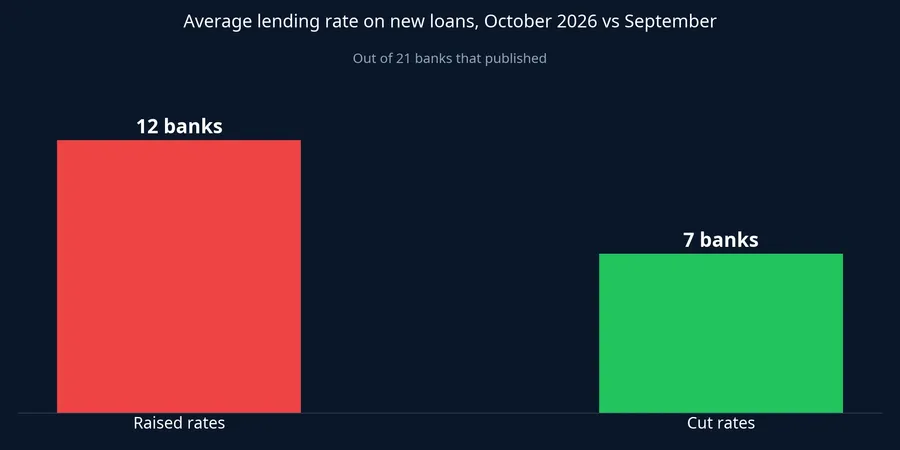
When loan rates move through each bank's own costs, the results will be uneven, and October's data already shows it. Of 21 banks that published average rates on new loans for October, 12 raised them and 7 cut them from the previous month. The spread between banks is wide: VietinBank at 6.1% a year, OCB at 11.63%.MarketTimes These are averages across all new loans, not just consumer lending, and October's figures still include the stretch before banks adjusted rates in mid-month.
Rate cuts may differ for at least three reasons. Funding costs differ: a bank that raises deposits cheaply has room to cut, one that pays more does not. Borrower mix differs: unsecured consumer loans always carry higher rates than secured production loans. And the accompanying demand for "tight control of credit risk" means expanding consumer lending goes through underwriting rather than opening the doors wide.
On timing, brokerages are forecasting cautiously. MBS says deposit rates could fall another 20–30 basis points by year-end, while VNDirect says domestic rates could fall more clearly from early 2027, depending on inflation, credit demand and Fed policy.MarketTimes If those forecasts hold, most of the drop in loan rates may arrive close to or after Tet.
Savers sit on the other side of the same equation. A bank that wants to cut lending rates and keep its margin needs funding costs to fall first. 46 banks have cut deposit rates since the start of November.MarketTimes Lower savings rates alongside October CPI of 5.09% thin out the real return on deposits.
Who gets touched first
In time order, the picture is fairly clear.
Households spending for Tet are reached earliest, and mostly already: petrol is VND 6,630–7,450 per liter cheaper after five adjustments, electricity is 2% cheaper since early November, and the directive points to limiting increases in state-set prices at year-end. The biggest risk for this group is the December 31, 2026 expiry of the 8% VAT rate.
Business borrowers are the group the directive names for lower rates, but the size of any cut depends on which bank they borrow from, as October's data shows.
Consumer borrowers get more products to choose from, with tight underwriting attached. Consumer loan rates are already above the general level, and the directive sets no separate cut target for this group.
Savers take the hit first, because deposit rates are usually cut before lending rates.
For equity holders, the reading is this. Retailers benefit from a shopping season in which nominal spending is still up 13.5% over ten months, but their margins depend on whether input costs fall in line with fuel and electricity. For banks, the call to cut costs to lower loan rates will be measured by net interest margin (NIM) in the fourth quarter. Banks with low funding costs have more room to cut rates without giving up margin.
The dates that will answer
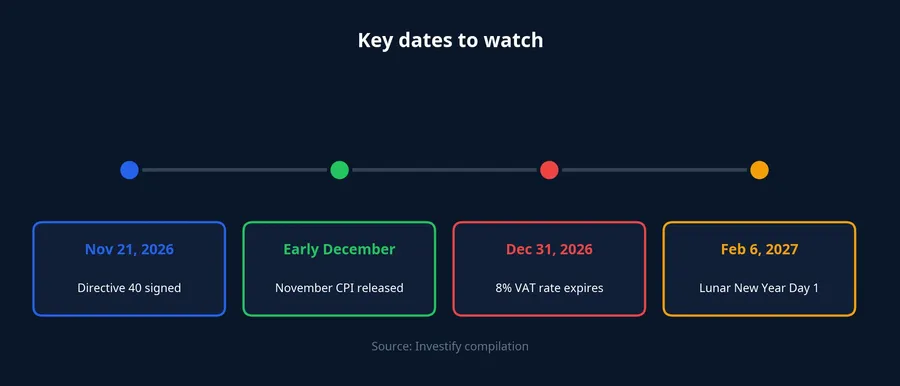
In early December, November CPI will be published. If the year-on-year figure drops below October's 5.09%, the price pressure the directive cites is easing, and there is more room to hold state-set prices until Tet. If CPI keeps rising, "limiting increases" becomes harder to sustain into the new year.
In December, the decision on the 8% VAT rate after December 31, 2026 will show whether the tax lever still works during the Tet season.
Around mid-December, banks will publish average lending rates on new loans for November, the first month to reflect the full post-adjustment period. If banks that cut outnumber banks that raised, the call to trim costs has begun to reach borrowers' funding prices. If the picture is still split as in October, the bank each person borrows from will decide their rate more than the directive itself.