

When the State recovers a plot of land, the first thing the owner wants to know is how much money they will get. The amended Land Law, passed by the National Assembly on the morning of Nov 21, answers with a formula that has a new component: a compensation ratio set by the provincial People's Committee, no lower than 1.
The law won 466 of 479 votes, runs to 13 chapters and 112 articles, takes effect on July 1, 2027, and replaces the 2024 Land Law.FireAnt Earlier Investify pieces covered the new rhythm of land price tables. This one looks at the rest of the payout: how it is calculated, which safeguards protect it, and which of those are actually new compared with the law in force today.
The formula: price table, coefficient, then a provincial ratio
Under the new law, land compensation rests on area, term of use, land type, the form of allocation or lease, the land price from the price table and the price adjustment coefficient, and the compensation ratio set by the provincial People's Committee.VnExpress The ratio is decided according to local conditions but cannot fall below 1.FireAnt
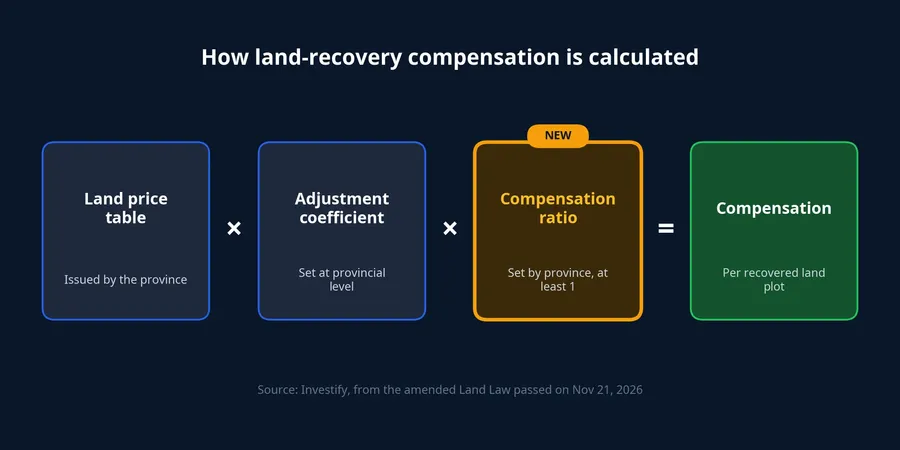
To see why the number 1 matters, compare it with the method in use now. The 2024 Land Law originally set cash compensation at the specific land price decided by the People's Committee when the plan is approved.Hệ thống pháp luật From Jan 1, 2026, Resolution 254/2025/QH15 switched to determining compensation from the price table and adjustment coefficient, without waiting for a specific valuation, with the coefficient issued annually by the provincial People's Committee.LSVN
The new law keeps the price-table-times-coefficient base and adds a layer on top. Because the minimum ratio is 1, the multiplication cannot push the payout below the price table times the coefficient. Anything above that is each province's call. In other words, the law sets a floor at today's level and leaves the ceiling open to localities.
That means the figure owners actually receive cannot yet be read from the law. A province that sets the ratio at exactly 1 pays according to the price table times coefficient, as now. A province that sets it higher pays more to people whose land is recovered. The gap between two neighboring provinces could come from this decision alone, not only from the price table.
Authority is also being split. Under the new law, the price table and adjustment coefficient will be decided by the provincial People's Council every 3 years, applying from Jan 1, 2028.Người Quan Sát The compensation ratio stays with the provincial People's Committee. Two bodies each hold a different part of the same payout.
When the price is locked, and the right to late-payment interest
The land price used for compensation is fixed at the time the compensation, support and resettlement plan is approved. If the plan has to be revised, the law requires applying whichever land or asset price is more favorable to the person affected.VnExpress
This safeguard is carried over, not new. The 2024 law already said that if prices at the time of revision are lower than in the approved plan, the compensation price in the approved plan still applies.Hệ thống pháp luật For residents the meaning is unchanged: delay does not shrink the payout.
The same goes for late payment. The 2024 law requires the compensating authority to pay within 30 days of the approved plan taking effect. If it is late, it must pay an extra amount equal to the late-payment charge under the Tax Administration Law, calculated on the amount and the days of delay.Hệ thống pháp luật The new law keeps this mechanism, tied to the deadline in the approved plan.VnExpress
The current late-payment rate is 0.03% per day on the overdue amount, under Tax Administration Law 108/2025/QH15, effective July 1, 2026.Annualized, that is about 10.95%. As an illustration, a VND 1 billion payout that is 60 days late would earn the recipient about VND 18 million on top. The tax law lets the Government adjust the rate over time,Xây dựng chính sách so the rate that applies after 2027 will follow the rules in force at that time.
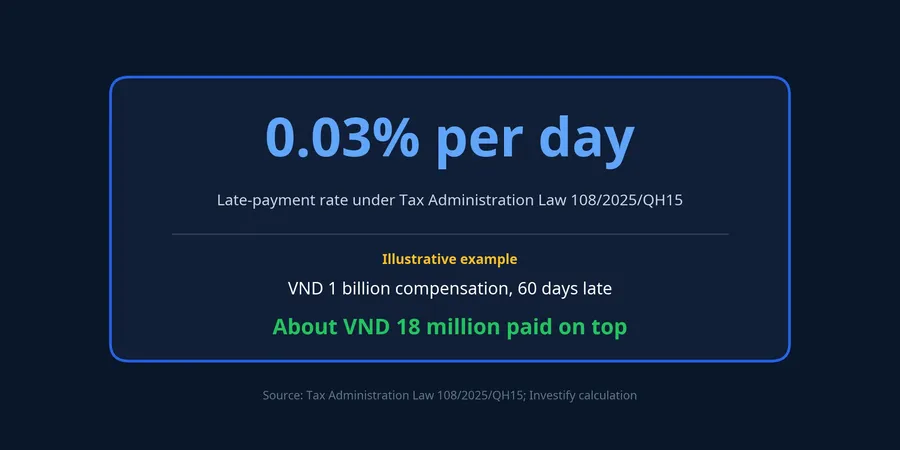
The notable feature is the symmetry: whatever rate the State charges a late taxpayer, a late-paying authority owes the same rate. Under the 2024 law, the late-payment cost comes from the budget of the level that approved the plan,Hệ thống pháp luật so the level of government answerable for the schedule is the one that pays for delay.
Housing: what is extended and what is inherited
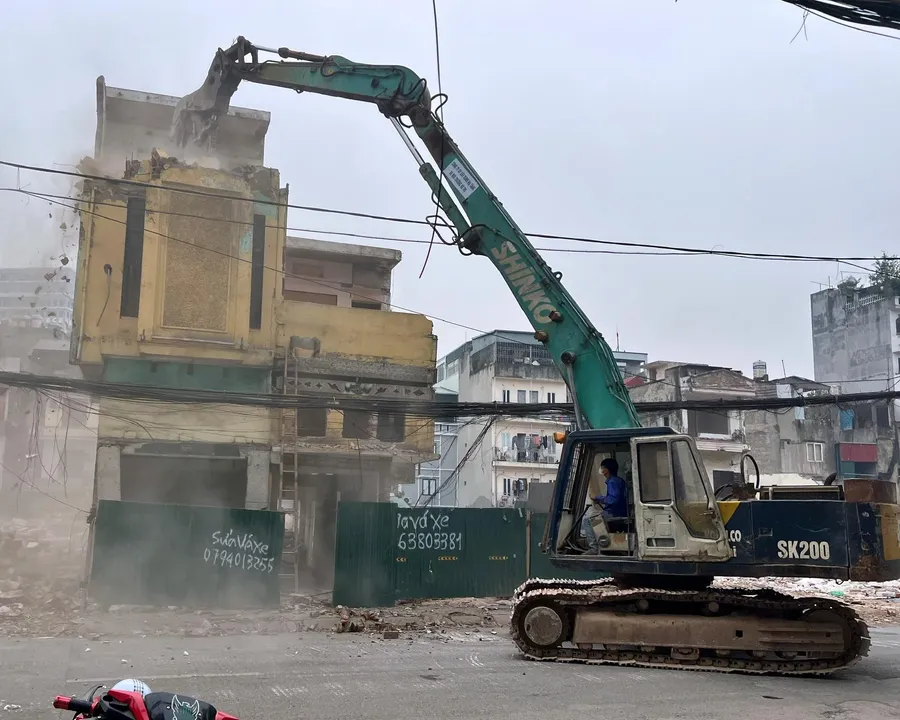
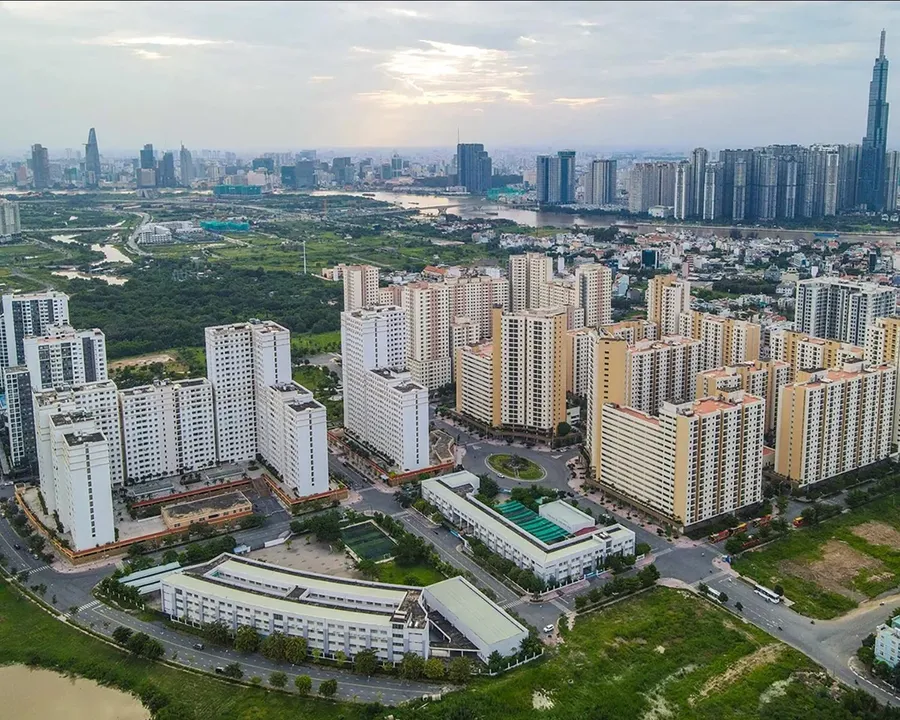
For urban-area projects, the 2024 law already gave residential-land owners compensation in the form of residential land or housing on site, plus temporary housing or rent support while they wait.Hệ thống pháp luật The new law extends this to rural residential areas and housing projects as well.VnExpress That is a real expansion, since housing projects are a fairly common reason for recovering residential land.
The remaining housing safeguards keep the spirit of the old law. If compensation for residential land is not enough to buy a minimum resettlement unit, the State covers the difference. The 2024 law already had this, with the minimum unit size set in detail by the provincial People's Committee.Hệ thống pháp luật People allocated resettlement land can defer land-use fees if they wish. The old law also allowed deferral, but with conditions set by the Government.Hệ thống pháp luật
On enforcement, the new law says that where resettlement is required, forced recovery is allowed only after resettlement housing or temporary housing has been arranged under the approved plan.VnExpress The 2024 law set a similar requirement at an earlier step: the plan must be approved and resettlement arranged before the recovery decision.Hệ thống pháp luật Meanwhile Resolution 254 lets certain projects, such as nationally important and urgent public-investment projects, recover land before resettlement is complete.LSVN The new law places the safeguard at the enforcement step, the point at which residents are most likely to lose their homes.
Livelihoods and leftover land: two new rights
Beyond the compensation ratio, what is genuinely new concerns income after recovery. When drawing up the plan, the authority must establish income from the land, employment status, and budget for livelihood-restoration support for at least 3 years after the recovery decision.VnExpress Each year, the commune People's Committee surveys the income and jobs of affected people to decide support for those whose income falls or who lose work. The funding sits inside the compensation plan.
The 3 years need careful reading. It is the period for which funding must be budgeted in the plan, not a fixed sum every person automatically receives for 3 years. Support depends on each year's survey, so someone who loses their job is assessed differently from someone who keeps their income.
The second new right is land swapping. A person whose residential land is recovered may swap the recovered area for the remaining part of the same plot, or for another plot they own in the same commune.VnExpress Leftover land that is too small or misshapen to use can be transferred, merged or split, with personal income tax and registration fees waived on those transactions. Those who do not want to keep it can ask the State to recover it too, and be compensated.
According to the Government's explanatory report, these provisions aim to shift from compensating only for lost property to securing housing, jobs and stable living conditions.VnExpress
The law tilts toward the affected owner; each province sets the angle
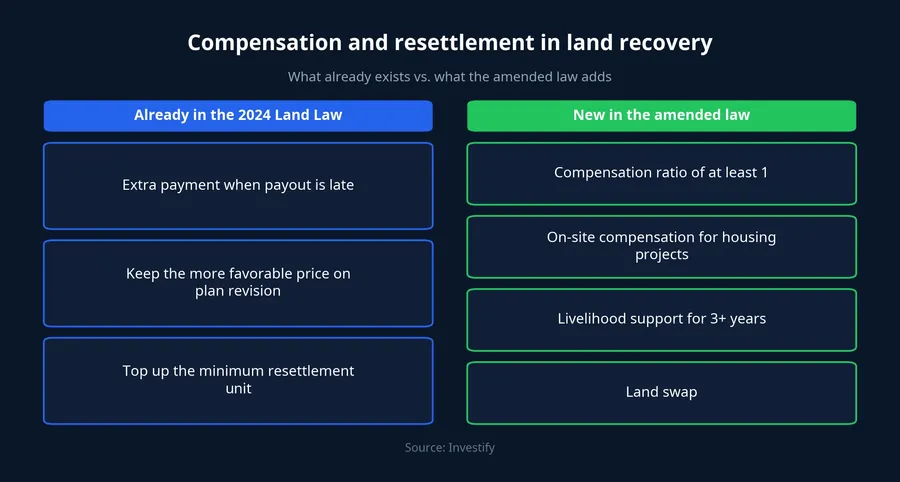
Set beside the law in force, the picture is fairly clear. Many safeguards mentioned this week, such as extra payment for late disbursement, keeping the favorable price when a plan is revised, and topping up a minimum resettlement unit, were already in the 2024 law. The new law keeps them and adds a ratio of at least 1, on-site compensation for housing projects and rural residential areas, at least 3 years of livelihood funding, and the right to swap land.
Of those additions, the compensation ratio is the only one that touches the payout directly. It cannot make anyone receive less than the price table times the coefficient, and it can make people receive more in any province that sets a ratio above 1. So the reasonable reading is that the law tilts toward the person whose land is recovered, while the actual tilt is up to each province.
The answer will come from each provincial People's Committee's decision on the ratio, and from the Government's implementing decree ahead of the July 1, 2027 effective date. Two figures are worth tracking for anyone with a home or land inside a planning zone: whether their province sets the ratio at 1 or higher, and the land price adjustment coefficient for their own area. Those two numbers, multiplied by the price table, determine the payout.