
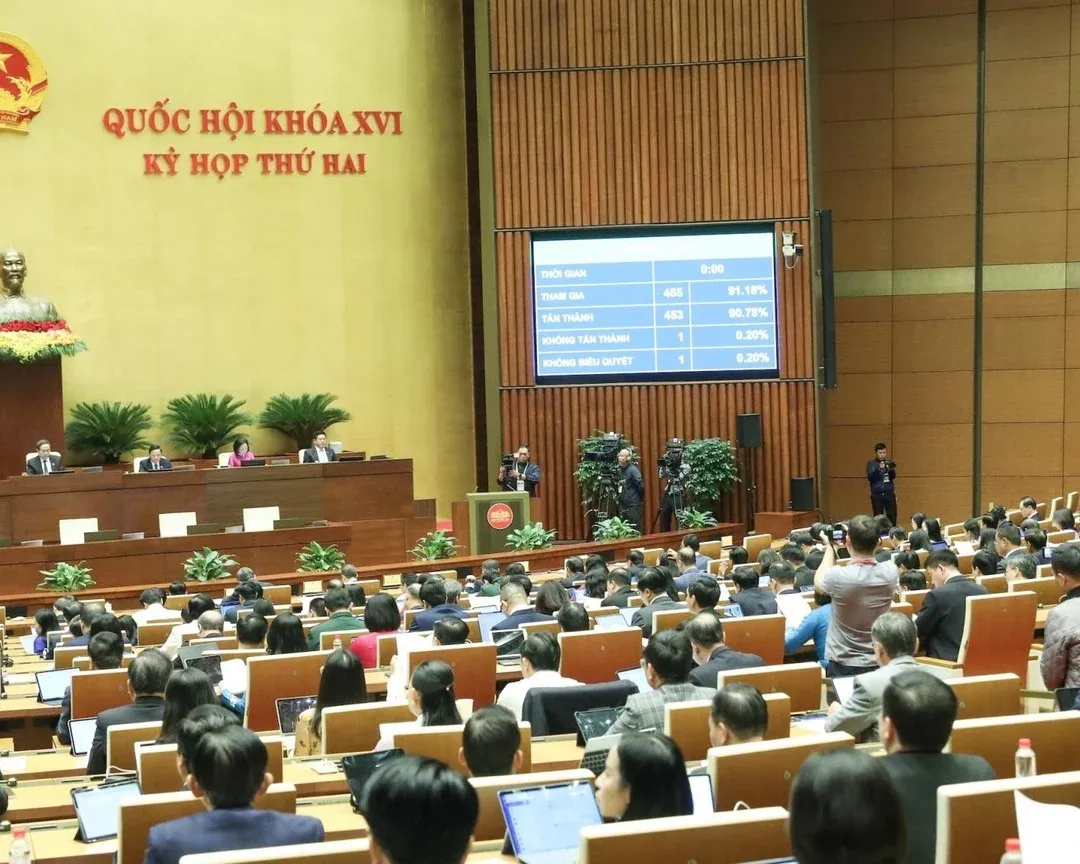

On the afternoon of 21 November 2026, the National Assembly passed a Resolution on special policies for handling business licence fee debt and late-payment interest, with 453 of 455 deputies voting in favour, or 99.56%.Báo Đại biểu Nhân dân The resolution takes effect from the day it was passed and runs through 30 June 2028.Báo Nhân Dân
The detail that matters most is that the Assembly did not tier the write-off by payment date. Someone who pays off the principal in December 2026 and someone who does so in June 2028 both have all in-scope late-payment interest erased, provided they meet the conditions before the deadline. If you are the named owner of a business or household business that stopped operating without closing its tax code, there is no midpoint to race toward. There is a single cut-off.
This post follows the questions you need to answer in order: whether you are covered, which debts are written off without you doing anything, which ones must be earned through paperwork, and who is excluded.

Who is covered
The resolution covers taxpayers that stopped operating but have not completed the procedure to terminate their tax code, or that are not operating at their registered address, as of the end of 23 October 2026. The tax authority makes that determination.Báo Đại biểu Nhân dân In the tax management system, these two groups correspond to tax-code status 03 and status 06.Tạp chí Tri thức
23 October 2026 is the cut-off for the list. Finance Minister Ngô Văn Tuấn explained that eligibility is set by status 03 and 06 through the end of that day, which is before the draft was published.Thời báo Tài chính Việt Nam A tax code that moved to status 03 or 06 only after that date is outside the scope.
The government's explanatory report counts 2,518,440 taxpayers in these two statuses as of 23 October 2026.Thời báo Tài chính Việt Nam Mr Tuấn stressed that this is the number of backlog cases to be reviewed, not a statement that all of them owe tax or will have debt erased.VTV Of that total, about 710,000 taxpayers have business licence fee debt recorded in the system.Dân trí
To check your tax code's status, use the public service section of the General Department of Taxation's website. For the exact amount owed, the tax office that manages your file is the most reliable place to reconcile.
Task one: licence-fee debt, written off by the tax office
For covered taxpayers, the resolution writes off business licence fee debt and the late-payment interest on it.Báo Nhân Dân Anyone who never filed or paid the fee no longer has to, and is not charged late-payment interest. The policy also covers licence taxes incurred before 2017, when the charge was still called a tax rather than a fee.VTV
You do not need to file a request for this part. The head of the tax authority uses data in the tax management information system to write off the debt, publishes the result on its website and, if the taxpayer has an electronic tax account, sends the information there.Thời báo Tài chính Việt Nam Put simply, if you have an e-tax account the result lands there; if not, you look at the tax authority's public listing.

One limit deserves a careful read. The write-off applies only to qualifying amounts that the taxpayer has not yet paid into the budget when the tax authority carries out the write-off (Clause 2, Article 1).Báo Nhân Dân Licence fees already paid fall outside it.
For context, the business licence fee was abolished on 1 January 2026, but obligations from earlier years remain on the books.VTV According to the government, this old debt is one reason taxpayers never came back to finish their tax-code procedures.
Task two: other late-payment interest, earned through paperwork
The larger amount is late-payment interest on other taxes and revenues. The government's report puts the interest within scope at about VND 9,990 billion, of which VND 9,715 billion is managed by the tax authority and VND 275 billion by customs.Dân trí That is the amount under review, not an amount certain to be erased.
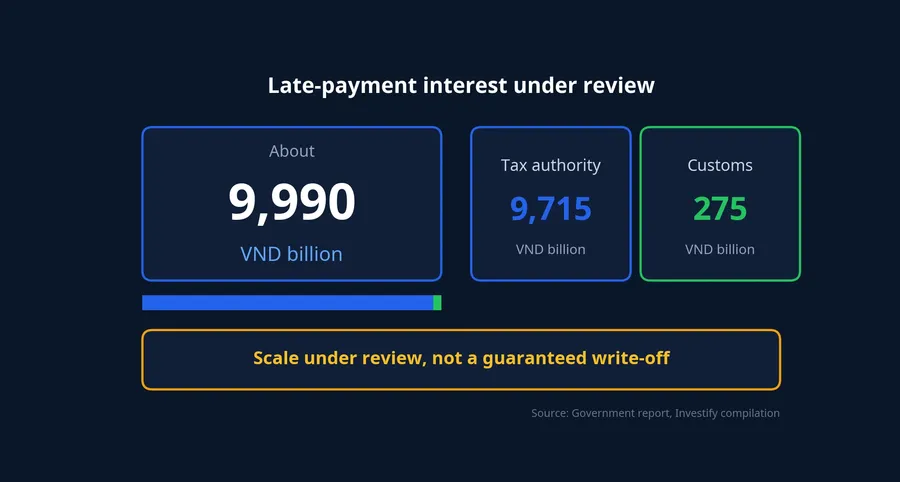
This part does not disappear on its own. Under Article 4, a taxpayer has late-payment interest written off only when all of the following conditions are met:Báo Nhân Dân
- The outstanding principal tax is paid in full, along with any administrative penalties.
- A valid file requesting restoration or termination of the tax code has been submitted and accepted by the tax authority.
- The taxpayer is not in an excluded category (see below).
The first two are on you. Restoration is for those who want to resume business; termination is for those who want to close for good. Either route counts, as long as the file is valid and the principal is fully paid by 30 June 2028 at the latest.
There is a transitional rule for people who cut it close. If a valid file has been accepted and the principal and penalties are paid into the budget by 30 June 2028 but the tax authority has not finished processing, it will continue to handle the case under the resolution.Báo Nhân Dân The deciding date is therefore the day you finish your part, not the day the tax office finishes its own.
Why the Assembly rejected a tiered write-off
Before the vote, the standing body of the Economic and Finance Committee proposed tying the write-off to when the principal is paid: pay by the end of 20 November 2027 and the interest is erased; pay between 21 November 2027 and 30 June 2028 and it is cut by only 50%.Báo Nhân Dân The stated reason was that a full write-off until the principal is repaid gives taxpayers no incentive to pay early.Báo Công luận
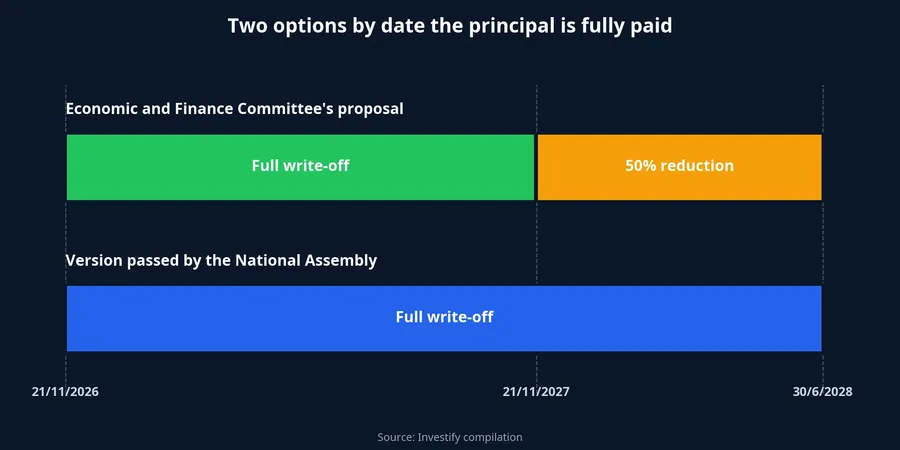
The version passed keeps the full write-off. Mr Tuấn gave two reasons. First, a 50% cut for later payers would leave a remaining balance that could stay a barrier, weakening the recovery of principal and the completion of tax-code procedures. Second, when an obligation can be settled also depends on restoring records, reconciling data and determining liabilities with other agencies, not only on the taxpayer's finances or willingness to pay early.Báo Nhân Dân
The second point comes with numbers. In the first ten months of 2026, through its tax-code clean-up campaign, the tax authority processed about 777,000 tax codes, roughly double the whole of 2025.Báo Nhân Dân Set against a backlog of about 2.5 million codes, that pace suggests the pile will take more than a year to clear. The government also argued that the assessment by the Global Forum on Transparency and Exchange of Information for Tax Purposes (GF) can use a results report through the end of 2027, so there is no need to force an earlier date.
Who is excluded from the write-off
The resolution excludes three groups.Báo Nhân Dân
People who evaded tax or committed tax fraud, including by using illegal invoices and documents or using invoices and documents unlawfully.
Branches and representative offices that stopped operating or are not at their registered address while the parent enterprise or organisation is still operating or only temporarily suspended for a fixed period. A dependent unit of a company that is still alive does not benefit from this mechanism.
People who actually kept producing or trading, or incurred tax obligations from such activity, during the period they were recorded as inactive or absent from their registered address. The exception is someone who only sold or liquidated remaining assets or goods to wind down, and has filed and paid the tax arising from it.
Beyond those three groups, the resolution has two further safeguards. If a valid file is submitted by 30 June 2028 but the person is under inspection, investigation, prosecution or trial, the tax authority does not yet consider writing off the interest.Báo Nhân Dân And if, after a write-off, a competent authority finds the taxpayer actually falls into an excluded category, the tax authority must reinstate the amount.VTV The provisions on continuing to process files and reinstating written-off amounts remain in force after 30 June 2028.
A write-off does not replace tax-code procedures
Having licence-fee debt erased does not close the tax code automatically. Under the resolution, restoring or terminating a tax code still requires a valid file accepted by the tax authority, which is also the condition for the larger late-payment interest write-off.
For people who lack documents to establish the principal, Mr Tuấn said the tax authority will work with the business registration office to verify the representative, state the obligation clearly and guide the completion of the file.Thời báo Tài chính Việt Nam He also said a draft decree proposes a mechanism to proactively terminate the tax codes of cases that have been inactive for more than 10 years and meet the conditions. That is a draft and has not been issued. Dissolving a company still follows enterprise law, which protects the rights of employees and creditors.
Three situations for the named owner
If you are not in an excluded category and complete both tasks by 30 June 2028 (principal and any penalties paid in full; restoration or termination file accepted), all in-scope late-payment interest is written off. Finishing in any month before then gives the same result, because the Assembly dropped the 50% option for later payers.
If you go past 30 June 2028, the resolution expires. You are no longer handled under this special mechanism and must pay the principal plus the accumulated late-payment interest.
If you fall into an excluded category, the interest is not written off, and if it was already erased before you were found out, the amount is reinstated.
The licence-fee debt is different: the tax office handles it from its data and you do not need to do anything. The first step is to check whether your tax code was in status 03 or 06 as of 23 October 2026, then set your remaining principal beside the late-payment interest. The larger the interest relative to the principal, the more the 30 June 2028 deadline is worth to you.
The government will track the principal recovered, the amount written off, the number of tax codes restored or terminated and the number of companies completing dissolution, then report to the National Assembly at its session at the end of 2028.Thời báo Tài chính Việt Nam That report will show how much principal the policy recovered and how many backlog tax codes it closed.