

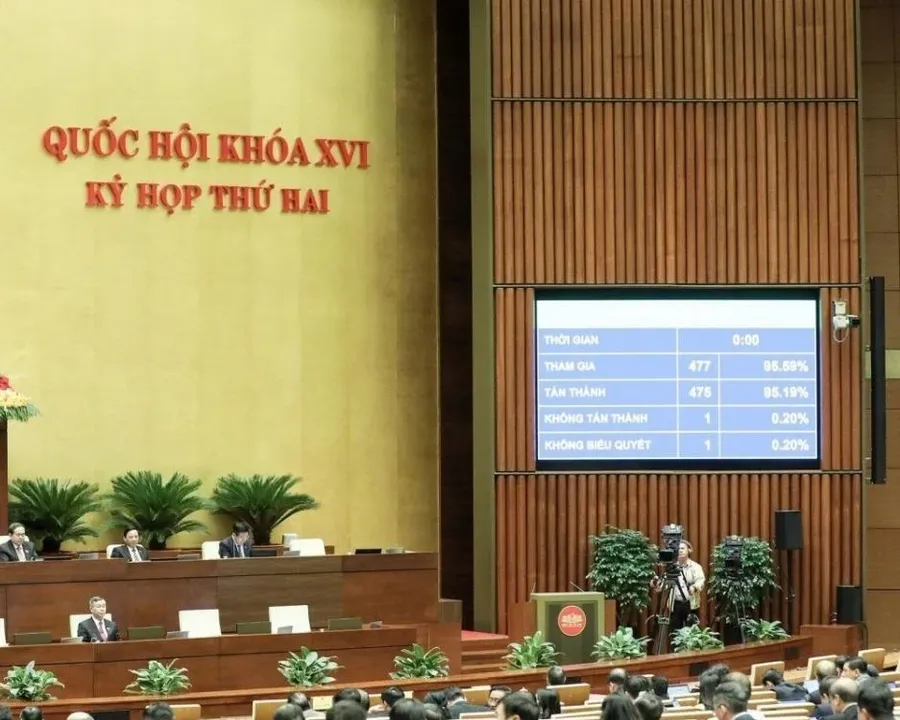
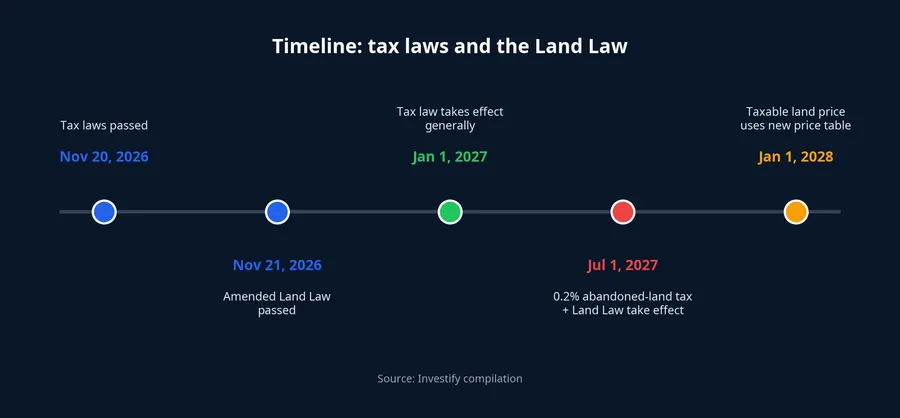
On the afternoon of November 20, 2026, the National Assembly passed a law amending the Corporate Income Tax Law, the Non-Agricultural Land Use Tax Law and the Personal Income Tax Law, with 475 of the 477 deputies present voting in favor.Người Quan Sát The headline number is 0.2%: the tax rate for abandoned land, with no quota, effective July 1, 2027.Thời báo Tài chính Việt Nam
The figure itself is not new to Vietnam's land tax system. Since the 2010 Non-Agricultural Land Use Tax Law took effect in 2012, a 0.2% rate with no quota has been on the books, but only for encroached land.Law 48/2010/QH12 What the new law does is move abandoned land into that same heaviest bracket, and change how the taxable area is measured. To know what an idle plot will cost each year, you have to look at the rate, the taxable area and the definition of "abandoned" together.
The rates: only one group actually changes
Under the law just passed, rates depend on how the land is used. Abandoned land pays 0.2% with no quota. Land used for the wrong purpose pays 0.15%. Land in phased investment projects, registered by the investor and approved by the competent authority, pays 0.03%.Thời báo Tài chính Việt Nam
Set against the 2010 law, the 0.15% and 0.03% rates already existed. Clause 6, Article 7 put land used for the wrong purpose and land not used as required at 0.15%, while approved phased-project land was "not treated as unused land" and paid 0.03%. Clause 7 set 0.2% for encroached land.Law 48/2010/QH12
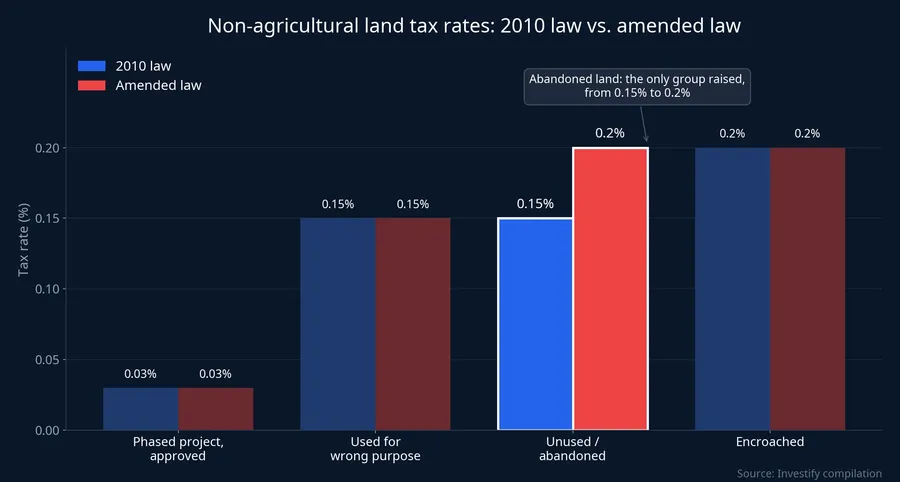
So the real rate change sits with idle land. It used to share the 0.15% bracket with misused land. From July 1, 2027, land determined to be abandoned splits off and moves to 0.2%, about a third higher than before. One caution: "land not used as required" in the old law and "abandoned land" in the new one are defined by two different documents, so not every plot that paid 0.15% will automatically move to 0.2%.
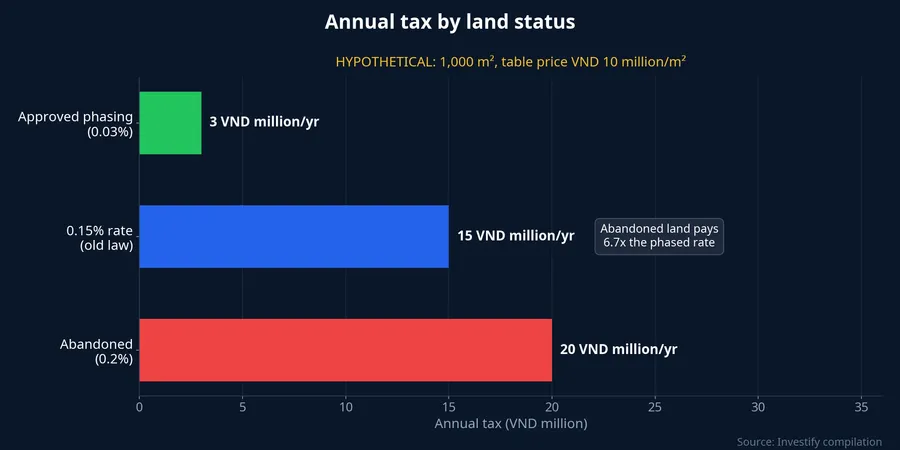
The "nearly seven times" comparison that circulates is 0.2% against 0.03%. That holds for one specific group: projects with land not yet developed. If the plot sits within an approved phasing schedule, it pays 0.03%. If it is judged behind schedule and abandoned, it pays 0.2%.
Taxable area is the bigger change
The 2010 law said in Article 6 that taxable land area is the area actually used. For a plot that was allocated but never used, that wording made the idle area hard to bring into the tax base.
The amended law rewrites it: taxable area is the area actually used or abandoned.Thời báo Tài chính Việt Nam In the explanatory report delivered before the vote, Finance Minister Ngô Văn Tuấn said the draft had been reviewed and abandoned land area added to the taxable area so the rule can be enforced.Người Quan Sát The new area rule and rate take effect together on July 1, 2027, while most other provisions of the law apply from January 1, 2027.

"No quota" also needs careful reading. For residential land the law currently uses brackets: the portion within the quota pays 0.03%, the portion up to three times the quota pays 0.07%, and anything above three times pays 0.15%.Law 48/2010/QH12 For abandoned land, the entire area pays 0.2%, with no portion getting a lower rate.Market Times
A hypothetical calculation
Take a hypothetical to see the scale: 1,000 m² of undeveloped land in a project, with a table price of VND 10 million per m², giving a taxable value of VND 10 billion. Before any exemptions or reductions, annual tax is VND 3 million if the plot sits within an approved phasing schedule (0.03%), VND 15 million at the 0.15% that unused land pays under the old law, and VND 20 million if it is judged abandoned (0.2%).
The charge repeats every year for as long as the plot stays in that state. For a project spanning tens of hectares, the numbers multiply by hundreds. Taxable land prices will change too: under the new law, the price per m² follows the land price table for the relevant use, with the stability period cut from 5 years to 3, applying from January 1, 2028.Người Quan Sát
Measured against land value, 0.2% a year is still low. For an investor expecting land prices to rise a few percent annually, this tax alone is unlikely to force a sale. The policy's weight comes from the tax working alongside other tools, and from whether a plot gets labeled abandoned at all.
Who gets called abandoned
The tax law does not define abandoned land itself. Determination follows land legislation.Market Times On the morning of November 21, the National Assembly passed the amended Land Law with 466 of 479 deputies in favor, effective July 1, 2027, the same day as the new tax rate.Thời báo Tài chính Việt Nam
According to Người Quan Sát, this is the first time the law defines abandoned land: land the State has allocated or leased but that is not put to continuous use for a set period. Land allocated for an investment project that falls behind its schedule also counts as abandoned.Người Quan Sát
That definition points to two groups hit directly: holders of allocated or leased land who leave it idle, and project owners who miss their committed schedule. The line between a "phased" project paying 0.03% and a "delayed" one paying 0.2% therefore comes down to paperwork: whether the phasing schedule was approved by the competent authority, and whether actual progress follows it.
The phrase "a set period" will be spelled out in guiding documents. During debate, some deputies asked for clear criteria, timeframes and the authority that determines abandonment, and for exclusions where land goes unused because of force majeure or objective obstacles. The Government responded that the draft Land Law already assigns People's Committees at all levels responsibility for inspecting, detecting, preventing and handling land abandonment, and that it will ask the Ministry of Finance and the Ministry of Agriculture and Environment to clarify the criteria and the cases eligible for extension or exclusion.Người Quan Sát
Tax does not stand alone
According to the explanatory report, the Government holds that abandoning land is prohibited conduct in land management. Land use tax is positioned as an independent financial tool, alongside economic tools (land use fees, additional land rent) and administrative tools (penalties, land recovery).Market Times
On the Land Law side, the report says the law specifies how to calculate additional land use fees and land rent for projects that do not put land to use or are late doing so. The State collects the extra charge on the area left undeveloped or behind schedule until the project is terminated, except in cases of force majeure or objective obstacles.Thời báo Tài chính Việt Nam
For a project owner, the two add up to a holding cost that runs with time: annual tax on land value, plus the additional charge on the delayed area. How the two interact on the same area, and the exact size of the additional charge, will be set by implementing decrees.
Who is less affected
Projects on an approved phasing schedule stay at 0.03%, unchanged from the 2010 law. Educational institutions are exempt from non-agricultural land use tax on land used for education and training from January 1, 2027.Người Quan Sát
For shareholders in real estate and industrial park companies, the impact therefore varies project by project, not across the whole sector. Developers with large land banks that proceed on an approved schedule face little pressure. Those with projects idle for years take on a recurring cost, plus additional land use fees. Industrial land has one special feature: taxable area excludes land used for shared infrastructure.Thời báo Tài chính Việt Nam
What to watch before July 1, 2027
The National Assembly has settled the rate. Which plots actually pay 0.2% still depends on the decrees guiding the Land Law and the tax law: how long land can go without continuous use before it counts as abandoned, which body makes the determination, and which cases are excluded for objective reasons.
If the timeframe is short and the delay criteria are applied tightly, the 0.2% group will be broad from year one, including projects delayed by approval bottlenecks. If the timeframe is long and the exclusion list wide, the tax will mostly hit projects frozen for years, and the real holding cost for most landowners will barely change. The guiding documents due before July 1, 2027 will show which scenario is closer.