

Picture someone who opened a small company a few years ago, saw it fail and walked away. Nobody filed a return, and nobody closed the tax code. The system can still add a business license fee each year, and late-payment interest keeps compounding on everything owed. By the time that person wants to close the company for good, or reopen it, the debt is far larger than when they left.
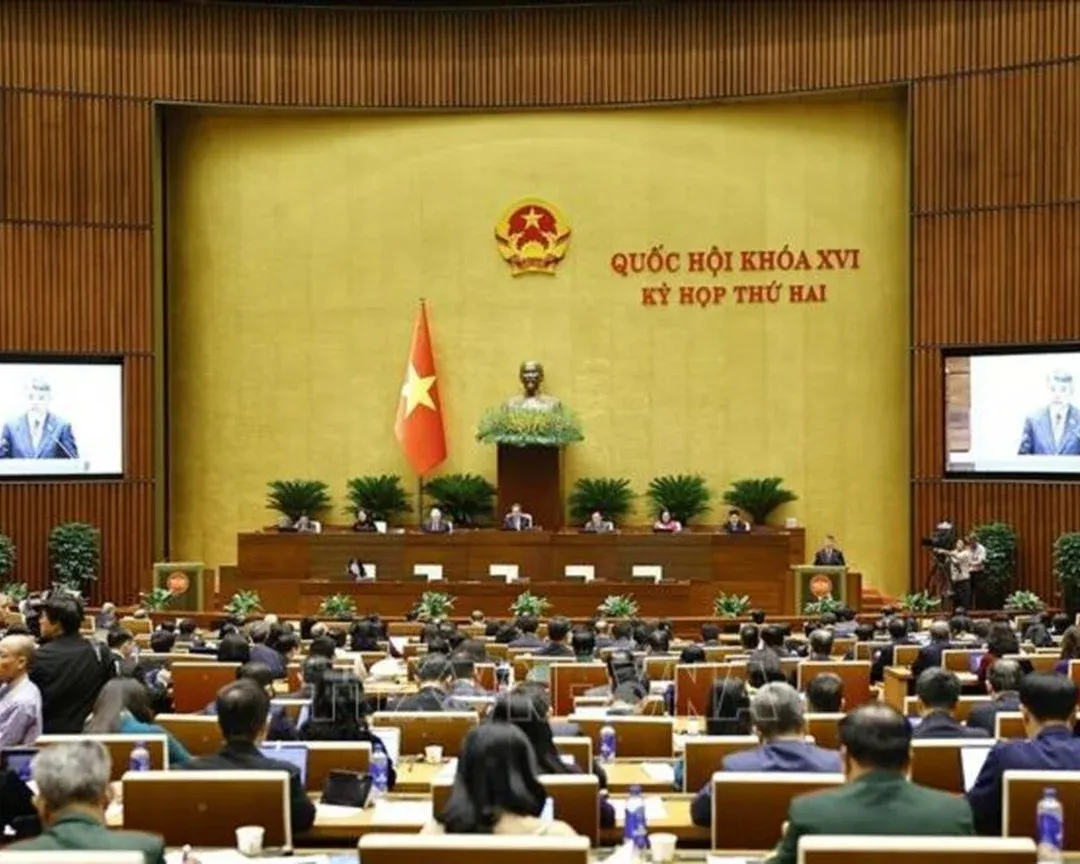
On the afternoon of 20 Nov, the Government submitted a draft resolution to the National Assembly aimed squarely at this group. Per Bnews (VNA), the item was added to the agenda of the Assembly's second session and is expected to be put to a vote on the afternoon of 21 Nov.Bnews It is still a draft, and the final text is certain only once lawmakers vote. The main point: the license-fee debt already has broad agreement, while late-payment interest on other taxes is where the Government and the reviewing committee differ.
Who is stuck
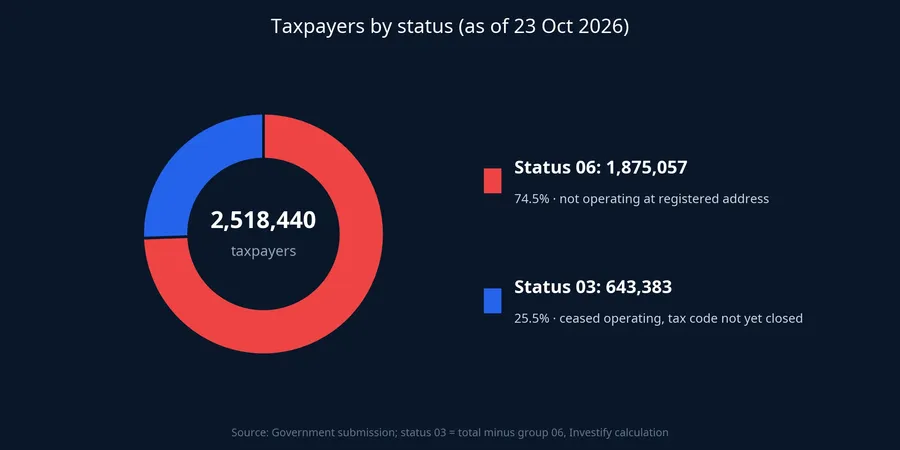
Finance Minister Ngo Van Tuan, acting on the Prime Minister's authorization, said that as of 23 Oct 2026 the country had 2,518,440 taxpayers in two statuses.Nhân Dân Status 03 means the business has ceased operating but has not completed the process of closing its tax code. Status 06 means it is not operating at its registered address, and this group is the larger one at 1,875,057.Dân trí

Since the start of the year, tax authorities have already processed more than 777,000 tax codes.Báo Tin Tức According to the Minister, most of the rest want to restart or close down properly but are stuck on paperwork and years of accumulated obligations, and many no longer have books or assets to pay with.
The license fee stopped being collected on 1 Jan 2026 under Resolution 198/2025/QH15, but obligations from before that date remain on the system. Per the submission, Tax Administration Law 108/2025/QH15 has no mechanism to write off license-fee debt and late-payment interest, or to waive interest conditionally for groups 03 and 06. The reviewing committee also noted that the Global Forum on Transparency and Exchange of Information for Tax Purposes, which the submission invokes, does not directly recommend writing off tax debt.Nhân Dân
What is waived automatically
Per the submission, the license-fee part is handled in three layers.Báo Tin Tức
- License-fee debt arising up to 31 Dec 2025 is written off, along with the late-payment interest on it.
- License-fee late-payment interest still owed as of 21 Nov 2026 is also written off.
- License-fee obligations through 2025 that the taxpayer never declared, never paid and that were never booked on the system no longer have to be declared or paid, and accrue no interest.
For the person whose name is on the tax code, the key point is that no application is needed. Tax authorities work from system data, publish the results and notify taxpayers through their e-tax account where they have one.
What the VND 16,688 billion figure is made of
Many headlines used a figure of nearly VND 16,700 billion. Per the Government's impact assessment, booked license-fee principal eligible for write-off is about VND 1,250 billion, and late-payment interest on it is about VND 438 billion.Báo Tin Tức In addition, nearly 2 million taxpayers in statuses 03 and 06 have not had license fees booked for the period they were inactive. If fully booked, that would amount to about VND 15,000 billion.Dân trí
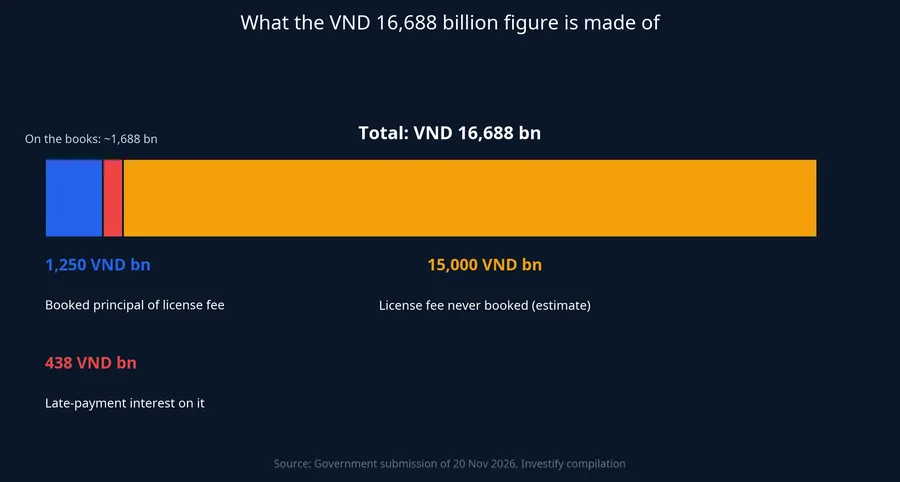
The three items add up to about VND 16,688 billion, an estimate that assumes all of those roughly 2 million taxpayers come forward to restore or close their tax codes.Nhân Dân In other words, nearly nine-tenths of the headline number is license fee that was never entered in the debt ledger. What is actually on the books is only about VND 1,688 billion. The headline is neither money certain to be waived nor revenue the budget would certainly collect otherwise: the Government itself rates the VND 15,000 billion as very hard to recover.Dân trí
The Economic and Financial Committee, which reviewed the draft, also recorded majority support for writing off license-fee debt. Its reasons: the fee has been abolished, booked debt is small, and collection costs could exceed what is collected.Công luận
The part that must be earned with principal
The second part is where taxpayers have to act. It covers late-payment interest on other taxes administered by the tax authority, such as value-added tax or corporate income tax owed from before the business went dormant. Per the submission, this interest is considered for write-off only if the taxpayer meets two conditions: pays the full principal plus any administrative fines, and files a valid request to restore or terminate the tax code, received by the tax authority no later than 30 Jun 2028.
Handling interest for groups 03 and 06 is expected to cut about VND 9,990 billion from tracked debt.Dân trí More than VND 3,000 billion of that relates to land-related revenues.Công luận The Government argues that this conditional design converts some hard-to-collect debt into actual receipts, because taxpayers have a reason to repay principal.
Two scenarios for the deadline
On the license fee, the Government and the reviewing body point in nearly the same direction. The difference lies in late-payment interest, specifically the date by which principal must be repaid.
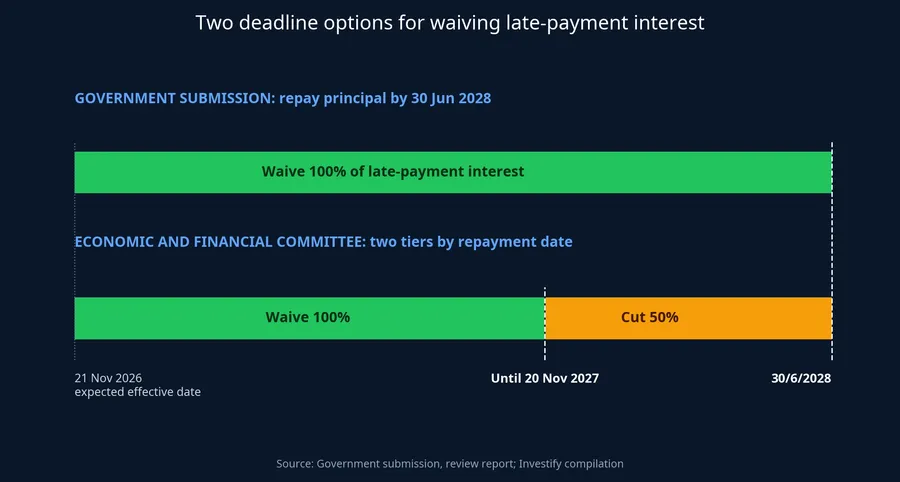
Scenario A: keep the submission's deadline. Those who owe principal have until 30 Jun 2028 to repay in full and file. Repay before that date and all interest accrued up to the repayment date is waived, whether they pay early or late in the window.
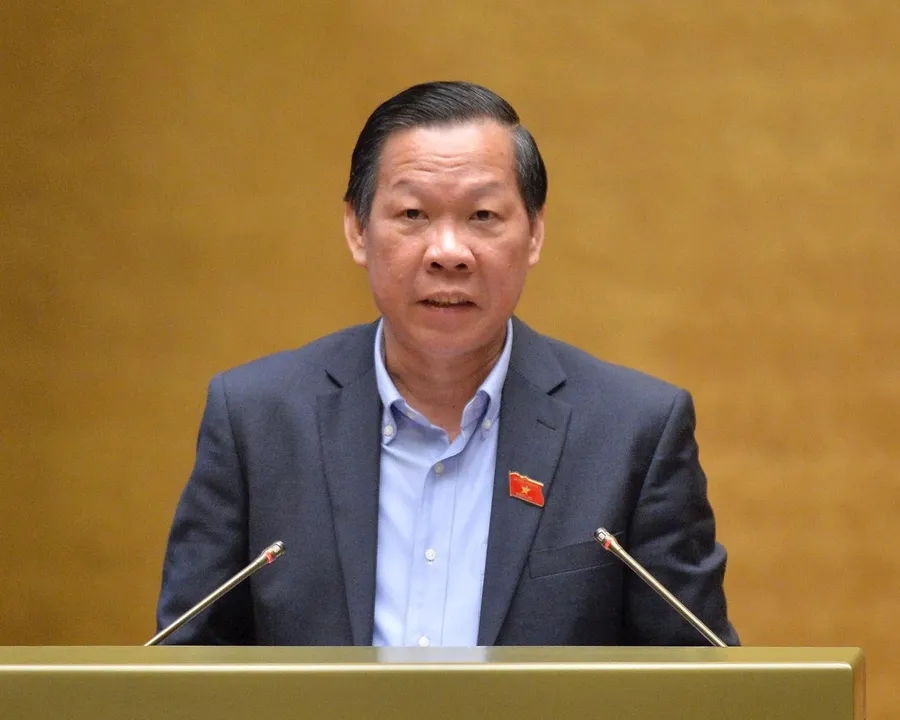
Scenario B: the Economic and Financial Committee's proposal. Phan Van Mai, Chairman of the National Assembly's Economic and Financial Committee, said the submission's design does not give taxpayers an incentive to repay early.Thanh Niên The committee asks lawmakers to consider two tiers. Repay principal in full by the end of 20 Nov 2027 and all interest is waived. Repay between 21 Nov 2027 and 30 Jun 2028 and interest is cut by only 50%.
The committee also proposes a clawback rule: waived amounts would have to be repaid if the taxpayer returns to business or sets up a new business.Nhân Dân If that enters the resolution, someone who restores a tax code to keep trading would be in a very different position from someone who simply closes it.
For a person who owes principal, the two scenarios play out very differently. Under A, they have about 19 months to raise the money at no extra cost. Under B, being one day late after 20 Nov 2027 means getting only half the interest waived. Those who owe only license fees are barely affected, since that part is waived from system data and is not tied to the repayment deadline.
Who is left out
The Government stresses that the write-off is not blanket.Dân trí The draft excludes:
- interest arising from principal tied to tax evasion, tax fraud or the use of illegal invoices and documents;
- debts tied to cases under inspection, investigation, prosecution or trial;
- branches, representative offices and business locations in status 03 or 06 whose parent entity is still operating or only temporarily suspended;
- taxpayers that actually kept operating or incurred tax obligations while in status 03 or 06, except those that only sold or liquidated remaining assets and goods to wind down and have paid all tax due.
The reviewing committee wants to tighten further. For group 06, which it rates as high fraud risk, it proposes writing off debt only after tax authorities cross-check invoice and filing data. For the more than VND 3,000 billion of interest tied to land, it proposes a separate assessment before applying the general mechanism. It also wants the policy stated as one-off, with no extension.Công luận
What the final text will settle
Per the submission, the resolution is expected to take effect on 21 Nov 2026 and apply through 30 Jun 2028. If the Assembly votes on the afternoon of 21 Nov, the license-fee part will most likely be waived, since both the Government and the reviewing body support it.
What remains open is the principal deadline. If the resolution sets 30 Jun 2028 for all late-payment interest, those owing principal get extra time at no cost. If it sets 20 Nov 2027 with a 50% cut afterward, the first 12 months become the decisive window, and anyone planning to return to business should read the clawback clause carefully before restoring a tax code.
For anyone holding a dormant tax code, the first step does not depend on the scenario: know whether you are in status 03 or 06, and separate your principal from your late-payment interest. Those two numbers show what will disappear on its own and what has to be paid before the deadline lawmakers are about to set.