


On the morning of November 20, the National Assembly passed the Law on SME Development with 485 of 485 deputies voting in favour.Vietnam+ That afternoon it passed a law amending three tax laws: corporate income tax, non-agricultural land use tax and personal income tax. This is where the actual tax figures sit, the ones the SME law only points to.Bnews
Read side by side, both laws carry the same "small and medium-sized enterprise" label, yet a household business owner who has just incorporated and a small company that has operated for years receive different packages. This post compares the two groups on four items: tax filing and bookkeeping, corporate income tax, sublease rent in industrial zones, and access to publicly funded tenders.
Who counts as an SME
Under the new law, a business must average no more than 300 employees in the previous year.CafeF It must also meet one of two tests: total capital of no more than VND 150 billion last year, or total revenue of no more than VND 400 billion last year.Vietnam+ SMEs are split into micro, small and medium enterprises across three sectors: agriculture, forestry and fisheries; industry and construction; trade and services. The Government will set the details for each group, including newly founded companies that have no financial statements for the prior year.
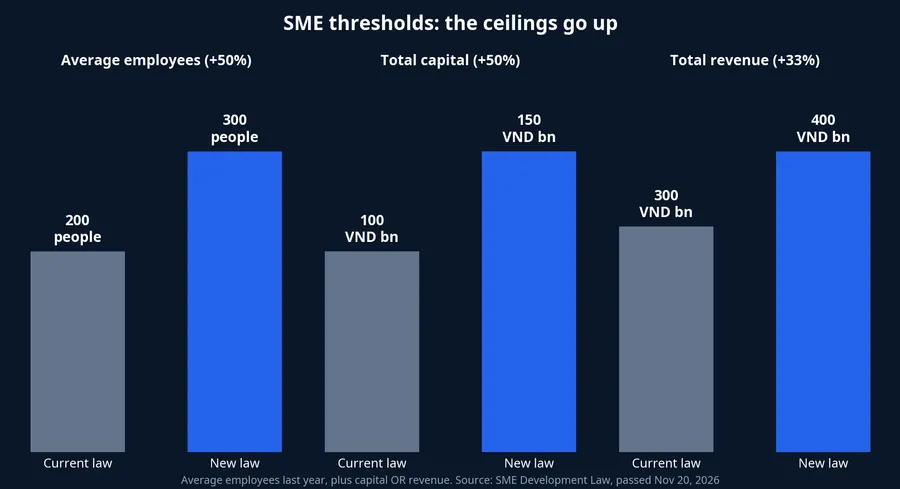
Compared with the current law, the employee ceiling rises by 100, the capital ceiling by VND 50 billion and the revenue ceiling by VND 100 billion.Vietnam Finance The headcount method changes too: the new law uses average employees during the year instead of the number of people enrolled in social insurance. The Government explained that many micro firms and technology companies outsource or use flexible labour. According to Vietnam Finance, the new method also discourages reporting fewer insured workers than actually employed in order to stay small.
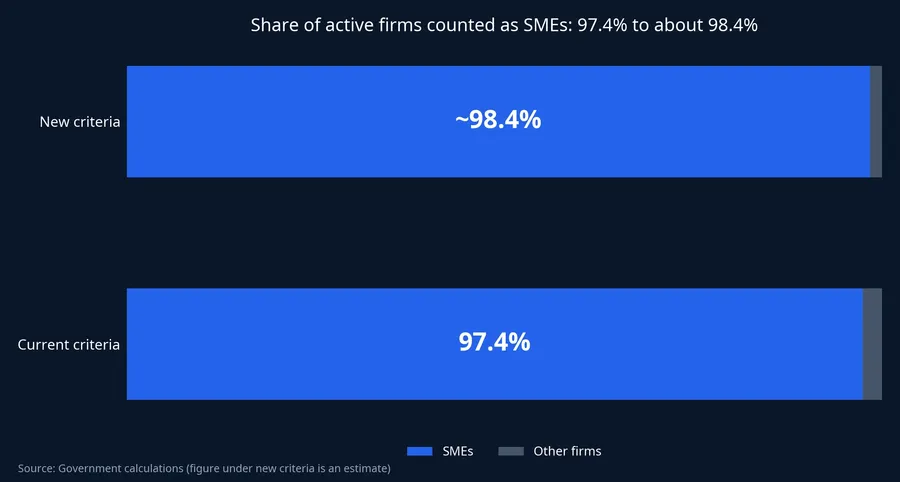
By the Government's calculation, the new thresholds lift the SME share to about 98.4% of active businesses, from 97.4% under current criteria.Vietnam Finance In other words, only about one percentage point of additional firms is pulled into the support net.
On timing, the law takes effect on July 1, 2027.Vietnam+ Using the new criteria to claim tax incentives starts earlier, from the 2027 tax period.
Item one: tax filing and bookkeeping
This is where the two groups diverge most.
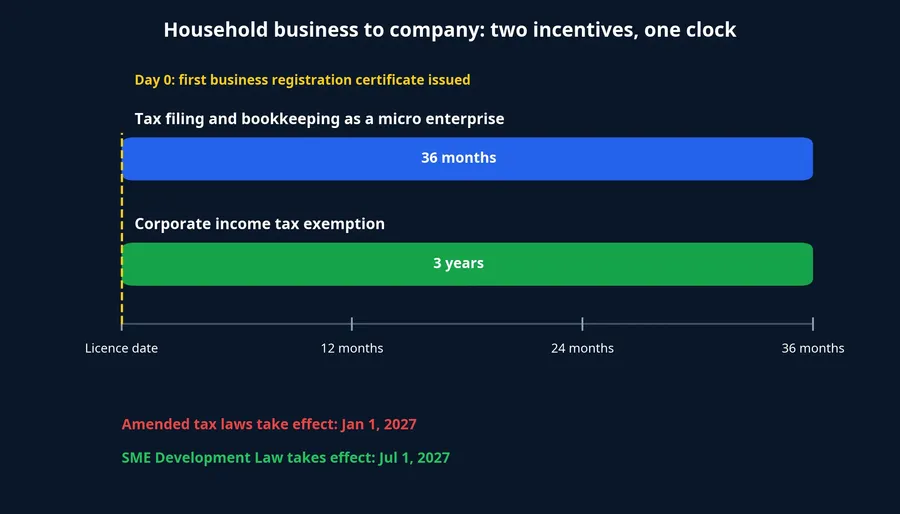
Household businesses and sole traders converting to companies get a dedicated package. The registration certificate is issued within 1 working day of the registry receiving a valid file, and the registration fee and the first-time publication fee are waived. For 36 months from the first certificate date, the company uses the tax declaration and accounting regime of a micro enterprise. During the same 36 months it gets free digital platforms and shared accounting software, plus support for accounting service costs.Vietnam+
Established SMEs do not get this package. The simplified accounting and tax procedures are for micro enterprises only, and firms in the higher tiers keep the standard accounting regime. What both groups share sits in the amended tax law: a business with annual revenue of no more than VND 10 billion may choose to pay corporate income tax as a percentage of revenue, from the 2027 tax period.Nhân Dân
Item two: corporate income tax
The SME law only sets the principle. Micro and small enterprises get a lower tax rate than the standard one, and SMEs get an exemption in their early years. Who qualifies, the conditions, the rate and the duration are passed to the tax law.Vietnam+
The amended tax law passed on the afternoon of November 20 fixes the exemption. According to Báo Lào Cai, SMEs are exempt from corporate income tax for 3 years from the date they first receive a business registration certificate.Báo Lào Cai That law takes effect on January 1, 2027.Nhân Dân
For a household business turning into a company, the clock starts on the day the certificate arrives. So the 36 months of simplified filing and the 3 years of tax exemption run in parallel, starting the same day. For a company whose certificate is more than 3 years old, the exemption window has already closed. What remains is the lower rate for micro and small tiers, with the specific rate set by the corporate income tax law.
Counting from the certificate date is a trade-off. Some deputies proposed counting the 3 years from when a company first turns a profit. The Government kept the current approach, arguing that the start-up phase is the hardest on capital, market access and cash flow. According to the Government, after one year of applying this approach the budget has supported businesses by nearly VND 10,000 billion a year. Switching to a count from first profit could cut 2027–2030 budget revenue by about VND 60,000–70,000 billion.Vietnam Finance The consequence for a new company: early loss-making years still count against the exemption period.
Item three: sublease rent in industrial zones and clusters
This item does not distinguish between a newly converted household firm and an established company. SMEs get a reduction of at least 30% on sublease rent for the first 5 years from the date they sign a sublease with the infrastructure developer of an eligible industrial zone, industrial cluster or incubator.Vietnam+
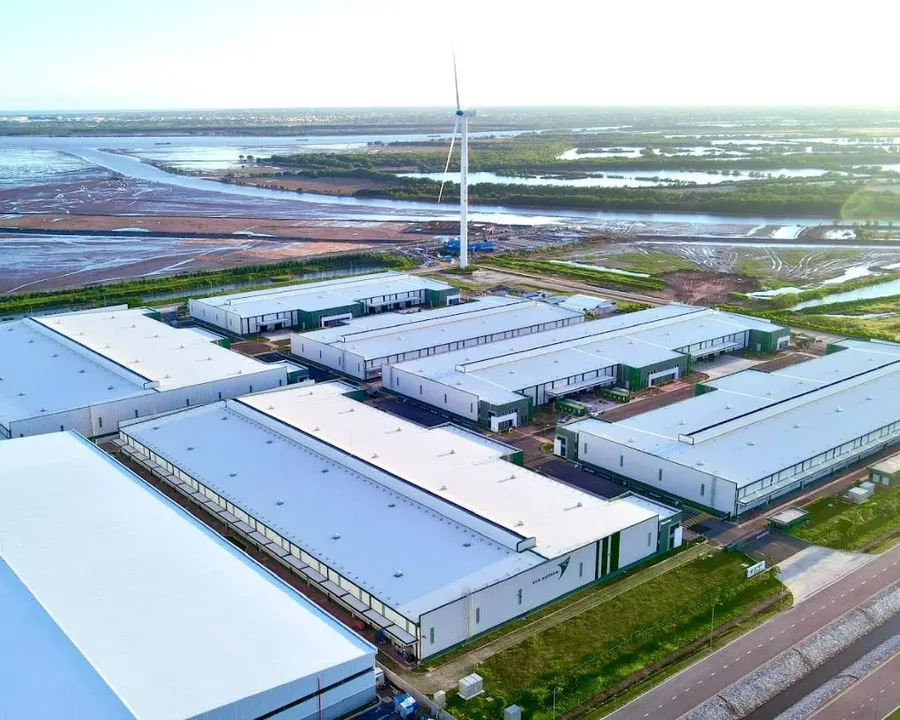
The conditions come in three parts. First, the zone must be among those eligible for support. Second, provinces implement it based on local conditions and their capacity to balance the budget. Third, the law requires the support to be deducted directly from the amount the company pays, and requires localities to publish land availability and rents before and after support. Funding sources, the maximum support level, the rent basis and the reimbursement procedure will be set by a guiding decree.Vietnam+
For anyone holding shares in an industrial-zone infrastructure developer, the decree's reimbursement procedure is the part to read: the reduction comes off the tenant's bill immediately, so the question is how and when the state makes the developer whole.
Item four: publicly funded tenders
This item also applies to both groups. Construction, goods procurement and mixed tender packages priced at no more than VND 20 billion are reserved for SMEs. Agencies and organisations must set aside at least 20% of the total value of budget-funded procurement packages in their annual contractor selection plan for this group, excluding international tenders.Vietnam+ The Government will set rules for when an agency misses the quota or has no package below VND 20 billion.
Unlike sublease rent, this item does not depend on a province's budget capacity: both the VND 20 billion ceiling and the 20% quota are already written into the law.
Beyond the four items
The law also introduces support vouchers, issued by state agencies in electronic or paper form, so businesses can choose goods and services within a set scope and amount. Vouchers cannot be transferred or traded, and are revoked, with payments refunded, if fraud or misuse is found.CafeF The Government must also review the SME Development Fund for merger or dissolution within 1 year of the law taking effect.Người Quan Sát
The two groups side by side
The package for converting household businesses is packed into the first 36 months: cheap and fast procedures, simple bookkeeping, free software, and a 3-year corporate income tax exemption running on the same clock. It is worth the most when the company turns a profit within its first three years. If the early years are loss-making, the exemption passes with little to use it on.
The package for established SMEs lies in markets and premises: access to budget tenders under VND 20 billion, a rent reduction if they sublease in an eligible zone, and lower tax rates for the micro and small tiers. Of those three, only the tender rule has hard numbers in the law. Rent depends on local budgets and a decree, while the tax rate depends on the tax law.
The actual money in both packages is waiting on two documents. One is the amended tax law, effective January 1, 2027. The other is the decree guiding the SME Development Law, which will set the criteria by sector, the maximum rent support and the reimbursement procedure for infrastructure developers.