


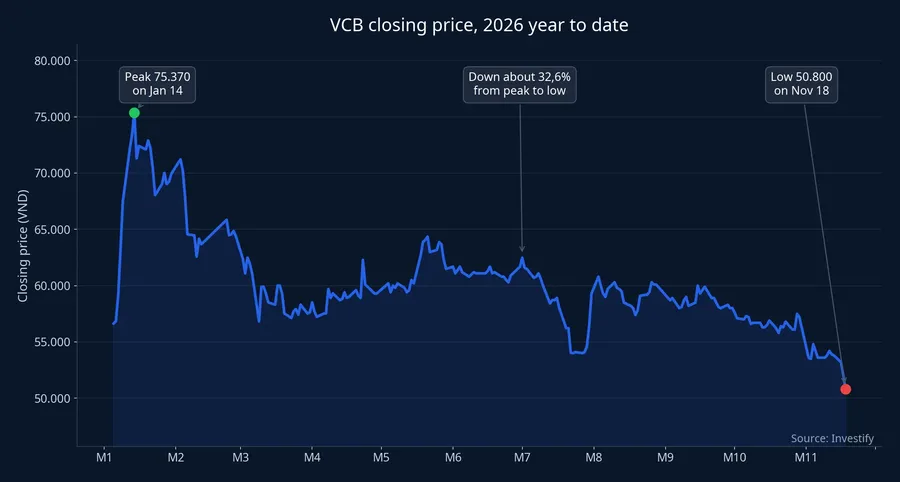
The market now pays about 1.7 times book value for each dong of Vietcombank (VCB) equity, the lowest in more than a decade and a level last seen in 2011–2014.FireAnt The stock closed at VND 50,800 on November 18, down 2.5% on the day, below the April 9, 2025 low of VND 51,690 and about 32.6% under the January 14, 2026 closing high of VND 75,370 (adjusted price).MarketTimes
The business has not followed the share price down. On consolidated accounts, Vietcombank's nine-month pre-tax profit came to about VND 40,440 billion, up more than 22% year on year and the bank's highest nine-month figure.CafeF That equals 87.5% of the full-year plan, with an NPL ratio of 0.71% and NPL coverage of 243%.Người Quan Sát So why does a bigger profit fetch a lower price per dong of equity? The answer sits in ROE, net interest margin and capital flows rather than in the absolute size of profit.
What P/B measures, and where Vietcombank used to sit
For banks, P/B is the most common valuation yardstick: how many dong investors pay for each dong of book equity. A bank earns a high P/B when the market expects that equity to generate more profit than investors demand.
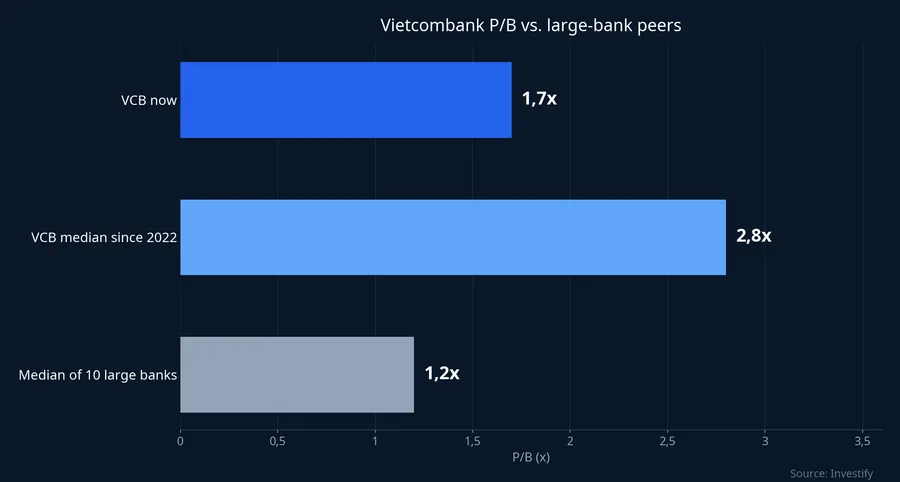
Vietcombank has long been among the highest-rated banks. Its P/B stayed above 3x for extended stretches and at times topped 4x, before sliding from mid-2024.MarketTimes According to Techcom Securities (TCBS), the current level is 36% below Vietcombank's own median of 2.8x since 2022.FireAnt
The number needs context. TCBS also says Vietcombank still trades 53% above the 1.2x median of the 10 large listed banks.MarketTimes The market still pays more for Vietcombank than for the sector, thanks to low bad debt, a thick provision buffer and a 31.8% share of current-account deposits. What has changed is that the gap to the rest of the sector has narrowed sharply.
This narrowing did not start this year. Per WiData figures compiled by CafeF, Vietcombank's market capitalization went from about VND 463,313 billion at end-2020 to VND 449,535 billion on November 13, 2026, a fall of nearly 3%, while the combined capitalization of 28 listed banks rose nearly 89%.CafeF Over those almost six years Vietcombank's profit nearly doubled, yet its market value barely moved.
Each dong of equity now earns less
The gap between rising profit and a flat share price is tied directly to ROE, the measure markets use to price banks more than absolute profit. TCBS puts Vietcombank's ROE at 17.5%, below the median of the comparison group and well below the 24.4% of 2022.MarketTimes
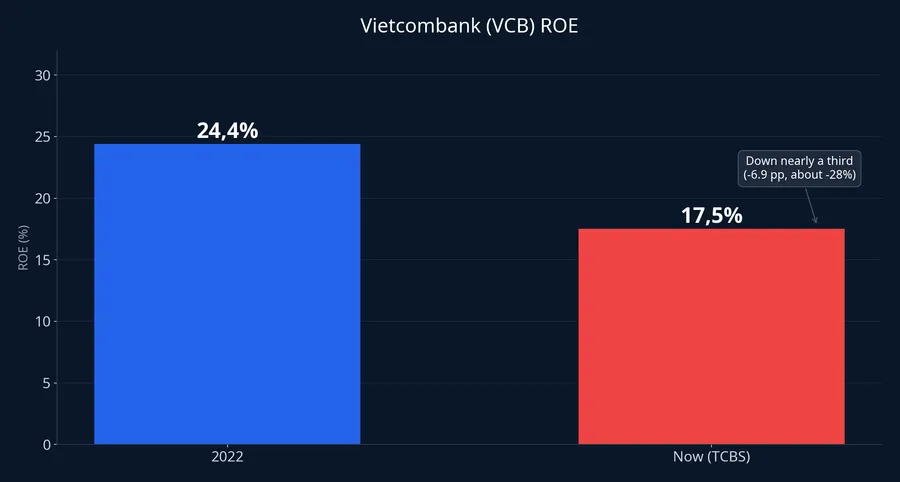
The mechanism is straightforward. Profit is still rising, but equity is growing faster, so each dong of capital earns less than before. In 2022 a dong of Vietcombank equity returned about 0.24 dong a year; today it returns about 0.175, a drop of roughly 28%. TCBS says the lower ROE makes the market more cautious on Vietcombank's valuation.FireAnt That is the main driver in the analyses cited here, but not the only one.
The third quarter adds another layer. Pre-tax profit was about VND 11,218 billion, close to VND 11,239 billion a year earlier,CafeF even though pre-provision profit grew 44.8%.Tin nhanh chứng khoán The difference is the provision charge of VND 6,184 billion, nearly eight times the year-earlier figure.Doanh nhân trẻ ACBS says about VND 5,000 billion of that was set aside for corporate bonds and treats it as a one-off. Excluding it, ACBS calculates third-quarter profit would have grown about 44% year on year.Người Quan Sát VPBank Securities flags fourth-quarter credit costs as the item to watch.Tin nhanh chứng khoán The two views do not conflict: a large provision can be a one-off, but the market only believes it once later quarters confirm.
Margin is improving; the pressure lies ahead
One popular explanation for the selloff is that net interest margin (NIM) is shrinking. Third-quarter data does not show that. ACBS puts Q3 NIM at 3.11%, up 12 basis points from the previous quarter and the highest since Q1 2024, because yields on interest-earning assets rose faster than funding costs.Người Quan Sát Net interest income reached VND 20,386 billion, up 39% year on year.Doanh nhân trẻ
The pressure belongs to coming quarters. ACBS forecasts Vietcombank's NIM at 3.06% for 2026 and 2.96% for 2027, as lending rates fall on State Bank of Vietnam guidance.Người Quan Sát TCBS names the main risk as NIM staying under pressure for longer than expected as lending rates decline.MarketTimes Vietcombank's loan-rate cut programme, running to year-end and only partly offset by lower deposit rates, is part of that picture. For a bank whose ROE is already lower than before, a few basis points off the margin is enough to make a ROE recovery harder.
Foreign investors have net sold most of the year
The third layer is capital flow. Per WiData figures cited by CafeF, foreign investors net sold more than VND 7,318 billion of VCB from the start of the year to November 17, about 121.37 million shares. The heaviest selling came in February at nearly VND 2,899 billion, followed by March and April at more than VND 1,200 billion each. May was the only net-buying month, at about VND 1,139 billion, before net selling resumed every month from June. In the first 12 sessions of November they net sold nearly VND 786 billion, with 11 of the 12 sessions on the sell side.CafeF
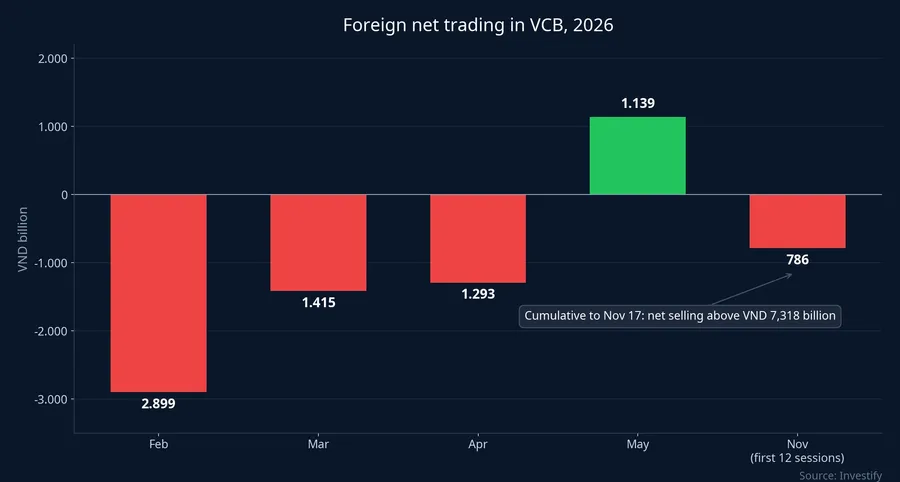
The selling is not a case of running out of room: ACBS says foreign ownership headroom at Vietcombank is about 10.2% below the 30% cap.Doanh nhân trẻ Foreign investors could still buy, yet chose to sell.
Causality needs care. The selling coincided with the price decline, and there is no basis to say which led the other. MarketTimes also notes that many large caps are sitting at long-term lows even though the VN-Index remains high,MarketTimes so part of the pressure is market-wide. Still, a market value that stood still for almost six years while the sector gained nearly 89% suggests the story is longer than foreign selling.
Two share issues ahead for VCB holders
Anyone holding VCB, directly or through funds and ETFs that include it, faces two share issues of different kinds.
The first is an issue of more than 1,068 million shares from the reserve fund to raise charter capital, already approved by shareholders. It moves an item within equity into charter capital, so total equity is unchanged. Holders receive more shares, the reference price adjusts accordingly and their ownership percentage stays the same.MarketTimes
The second is a private placement of up to 543.1 million shares, or 6.5%, to at most 55 investors. On November 2, Vietcombank received a State Bank of Vietnam document dated October 30 approving the plan.MarketTimes ACBS expects strategic shareholder Mizuho to take part. This issue brings new cash into the bank, so existing shareholders' ownership will be diluted somewhat on completion.
One detail needs working through. ACBS assumes an offer price of VND 55,000 and calculates that the capital raise could lift book value per share by 4.6% while diluting projected 2027 earnings per share (EPS) by about 5%.Doanh nhân trẻ Selling shares above book value raises the book value of each existing share. But equity rises before the new money has had time to earn, so near-term ROE is pushed down further. The raise therefore supports book value, while return on equity has to wait until the new funds are lent out.
Two data points will show whether the discount persists
For a leading state-owned bank like Vietcombank, valuation is following return on equity and margin rather than absolute profit. The highest nine-month profit the bank has posted was not enough to hold P/B, because the market is paying for the question of how much each dong of equity earns.
The first data point is the private placement price once announced. The price Mizuho and other investors accept is a direct gauge of what large buyers will pay per dong of Vietcombank equity. The further it sits from book value, the larger the uplift to existing shareholders' book value.
The second is the fourth-quarter 2026 financial statements, expected at the end of January 2027, with full-year NIM and ROE. If NIM holds near 3% and provisioning returns to normal as ACBS forecasts, ROE has grounds to recover and the discount to history has reason to narrow. If NIM falls faster than forecast while equity swells after the issue, ROE will struggle to rebound, and a P/B near 1.7x may prove a new baseline rather than a temporary level.