
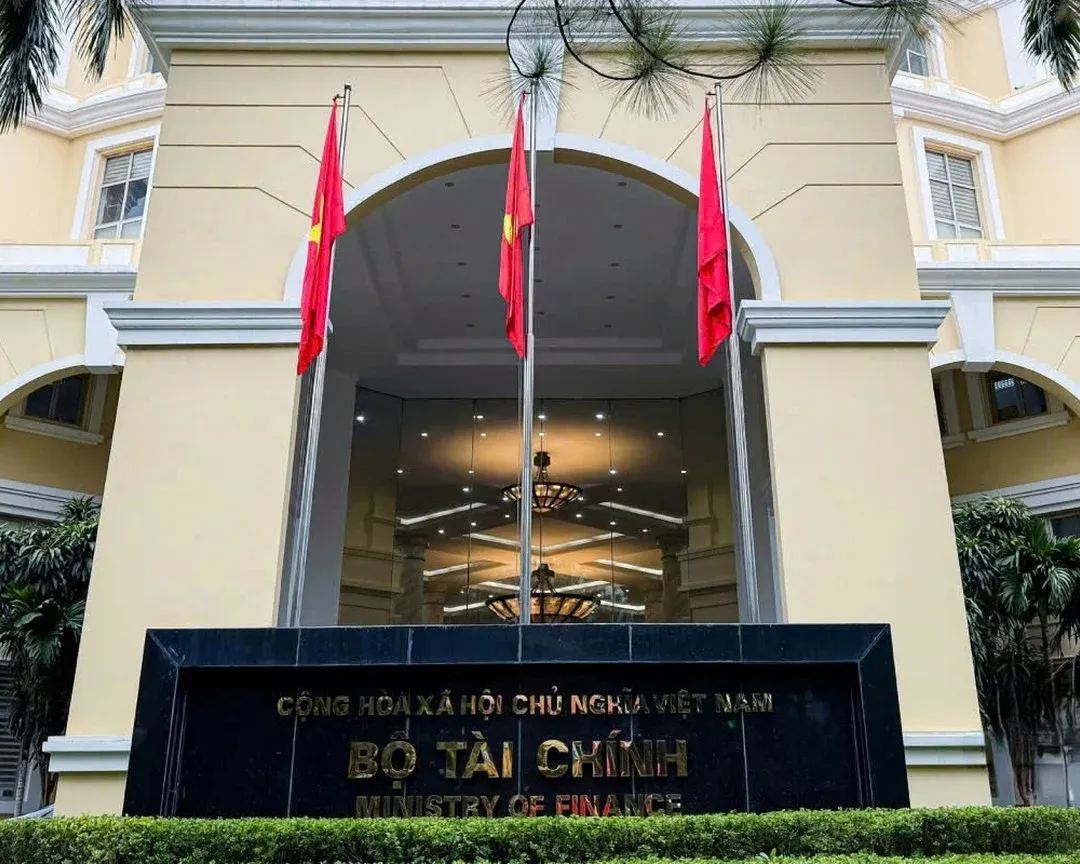

On November 19, the Vietnam Association of Financial Investors (VAFI) sent Document No. 7010/VAFI to the Prime Minister, the Ministry of Finance, the State Bank of Vietnam, the State Securities Commission and listed companies.Người Quan Sát The proposal that reaches straight into the pockets of people trading stocks is to cut the tax on each sell order from 0.1% to 0.05% of transaction value, half of today's rate.CafeF
Put simply, this is so far a proposal from an industry association. The 0.1% rate is still deducted from every sell order. This post puts the two rates side by side on the same sale so you can see how big the saving is, and who gets the most from it.
The tax is levied on the sale price, not on profit
The 0.1% rate is written into Personal Income Tax Law No. 109/2025/QH15, passed by the National Assembly on December 10, 2025 and effective from July 1, 2026. Under Article 13, income from a resident individual's securities transfers is calculated as the transfer price multiplied by a 0.1% rate on each transfer.Law 109/2025/QH15
The tax base is the value of the sell order. The law does not ask what you paid, or whether the trade made or lost money. Your broker deducts the tax before the proceeds reach your account. VAFI itself points out that investors still pay this tax when they sell at a loss.SGGP
One exception is worth knowing: the law exempts sales of open-ended fund certificates held for two years or more from the purchase date.Law 109/2025/QH15 Stocks have no such holding-period threshold.
Because 0.1% sits in the law itself, moving to 0.05% would require amending the law, not a quick administrative decision. VAFI's letter asks the Ministry of Finance and the Prime Minister to consider the cut.CafeF The association argues that budget revenue from this tax is not large, well below the tax on cash dividends and bonus shares, and that past crises saw the government use this tool with a stabilizing effect on the market.CafeF
The same VND 100 million sale at two tax rates
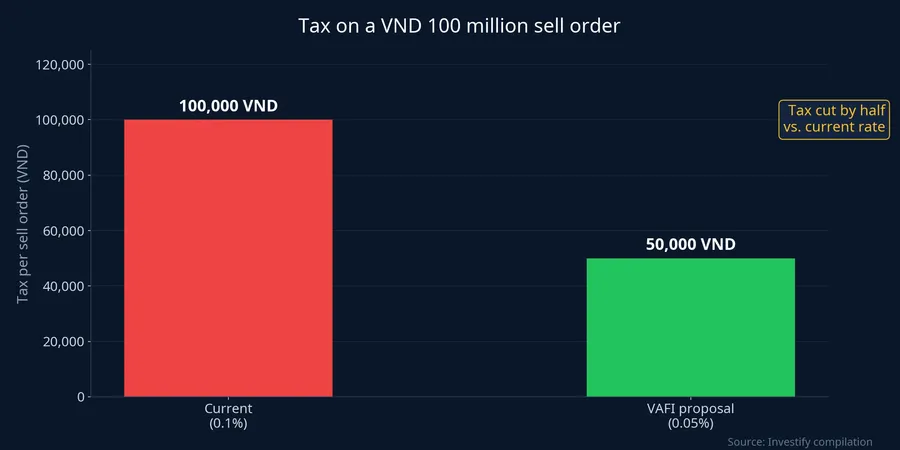
At today's 0.1%, a VND 100 million sell order owes VND 100,000 in tax. At VAFI's proposed 0.05%, it owes VND 50,000, a difference of VND 50,000 per VND 100 million sold. The calculations below are illustrations based on these two rates.
Selling at a profit. You buy for VND 90 million and sell for VND 100 million, a profit of VND 10 million. The VND 100,000 tax equals 1% of that profit. At the proposed rate it falls to 0.5%. For a seller in profit, the tax is small relative to the result.
Selling at a loss. You buy for VND 110 million and sell for VND 100 million, a loss of VND 10 million. You still pay VND 100,000, so the real loss becomes VND 10.1 million. At the proposed rate it is VND 10.05 million. The tax is identical in both cases, which is precisely VAFI's point: the loss-making seller pays tax on income that does not exist.
Selling at breakeven or on a thin gain. For a short-term trader who nets a few hundred thousand dong per VND 100 million, the VND 100,000 tax can take a large share of the gain. This is the group for which 0.05% changes the outcome most visibly on each order.
Frequent trading makes the tax add up
The tax applies to each sale, so the number of sales drives the total. Two people with the same VND 100 million of capital pay very different amounts.
A buy-and-hold investor sells the whole VND 100 million once a year and pays VND 100,000 in tax. If the proposal is adopted, that investor saves VND 50,000 a year. A trader who turns the same capital over 10 times a month sells VND 1 billion a month and pays VND 1 million in tax each month. Over a year that is VND 12 million, or 12% of the starting capital. At 0.05%, it falls to VND 6 million, or 6% of capital.
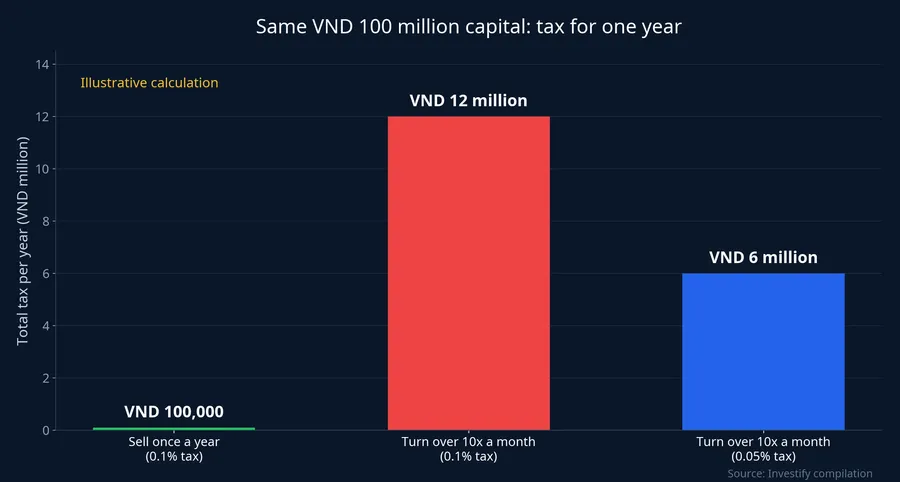
In other words, a heavy trader must earn roughly 12% a year just to cover the tax at today's rate. VAFI's proposal lowers that hurdle to about 6%. For margin users, the capital being turned over exceeds the cash actually in the account, so total sales value and the accumulated tax scale up in the same proportion.
Compared with brokerage fees
Tax is not the only cost of a sell order. Brokerage fees are set by each securities firm and vary across firms and service tiers. Some, such as Pinetree, say they have offered lifetime free trading since 2019.CafeF Brokerage fees apply to both buy and sell orders, while the 0.1% tax applies only to sales.
The difference is that you can choose your brokerage fee by switching firms or plans, but the tax is the same everywhere. For someone who has already found a low-fee broker, the 0.1% tax becomes the largest and most rigid cost on each sale. So the saving from this proposal matters most to frequent traders paying low fees. For high-fee, infrequent traders it is a small part of total costs.
How this proposal differs from 2025
This is not VAFI's first comment on the tax. In a letter dated July 14, 2025, the association asked the Ministry of Finance to switch to taxing realized gains: total sales value at the average selling price minus total purchase value at the average purchase price, multiplied by a 3% rate. Under that method, sellers at a loss would owe nothing.Tuổi Trẻ
The personal income tax law passed late in 2025 did not go that way and kept 0.1% on the transfer price of each sale.Law 109/2025/QH15 The November 19 proposal is therefore narrower: VAFI no longer asks to change the method, only to lower the rate within the existing one. Loss-making sellers still pay, just less. The trade-off is that changing a number is easier than changing a method, since brokers would keep withholding on order value as they do now, with no need to track each investor's cost basis.
Other recommendations in the same letter
In the same letter, VAFI recommends bringing deposit and lending rates to reasonable levels while keeping the exchange rate stable.CafeF It asks the Ministry of Finance and the State Securities Commission to hold a press briefing with securities firms, listed companies and funds, and to speed up procedures for bonus share issuance and treasury share purchases.Người Quan Sát
For listed companies, VAFI urges an early first cash dividend advance from 2026 business results, setting aside funds for share buybacks, and encouraging board members and executives to register to buy their own company's shares within their personal financial means.Người Quan Sát These recommendations are addressed to companies and are not binding.
The letter came on the day the VN-Index closed at 1,689.62 points, down 13.39 points (0.79%), below the 1,700 mark, with the index lower in all three sessions on November 17, 18 and 19. This post does not claim the index move is the reason for the proposal; the two simply coincide in time.
What to watch
The takeaway from the comparison is fairly clear. If you buy and hold stocks for months, this proposal changes almost nothing for your results: a few tens of thousands of dong per VND 100 million sold. If you sell several times a month, or are cutting losses, the tax is a meaningful cost and 0.05% would halve it.
Until an official change is made, every sell order is still charged 0.1%, including in the coming sessions. A reply from the Ministry of Finance or the government will show whether the proposal enters a roadmap for amending the law, and if so, from when it would apply.