
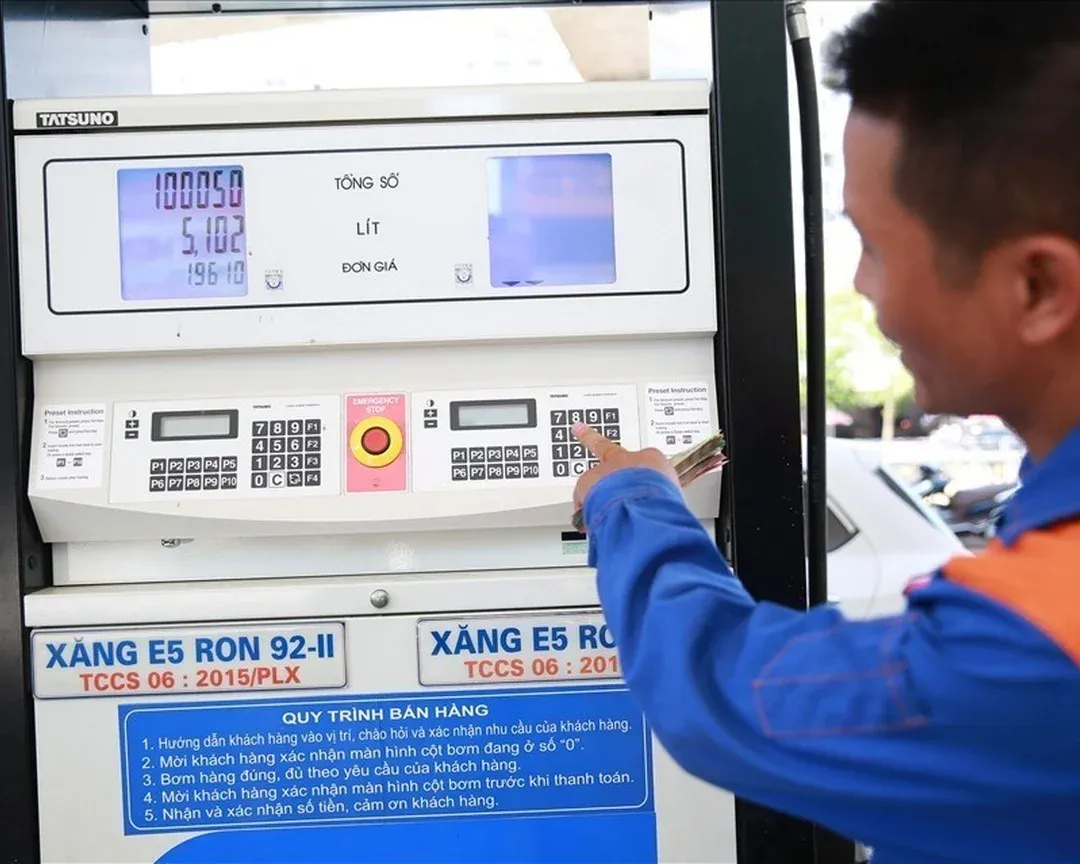

From 3pm on 19 November, the maximum retail price of E5RON92 petrol is VND 18,576 a litre, down VND 823 from the previous review. E10RON95-III drops VND 745 to VND 19,100. Diesel 0.05S falls VND 475 to VND 26,347. It is the fifth consecutive cut in November.
The new price still contains a charge that drivers never see on the pump display. Under Decision 3081/QD-BCT of 19 November 2026, signed by the Minister of Industry and Trade, the Ministry of Industry and Trade and the Ministry of Finance set aside VND 200 a litre for the Price Stabilization Fund on biofuel gasoline this round, plus VND 800 a kilogram on fuel oil. Diesel carries no charge, and the fund paid out nothing on any product. The money goes toward repaying VND 8,000 billion that the state budget advanced to the fund in late March. The charge explains why pump prices fell faster than world prices, and why a draft decree is now rewriting who bears the cost.
The pump price fell by more than world prices
According to the pricing notice published the same day, the average finished RON92 price (the base for E5) between the 12 and 19 November reviews was USD 100.784 a barrel, down USD 3.189, or 3.07%. RON95 fell 2.65%, diesel 2.33% and fuel oil 5.81%.
Meanwhile, E5's VND 823 cut equals about 4.2% of the VND 19,399 ceiling set on 12 November. Pump prices dropped faster than world prices, and the gap is explained in the pricing notices themselves.
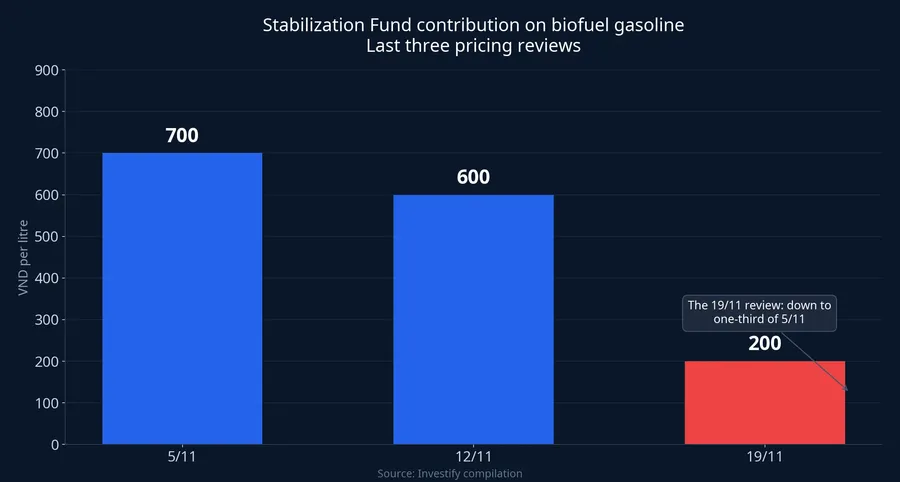
The Ministry states that prices are calculated. In other words, the charge is built into the ceiling. Over the last three reviews, the charge on biofuel gasoline has fallen steadily:
- 5 November:, no payout.
- 12 November: under Decision 2998/QD-BCT, no payout.
- 19 November: VND 200 a litre under Decision 3081/QD-BCT, no payout.
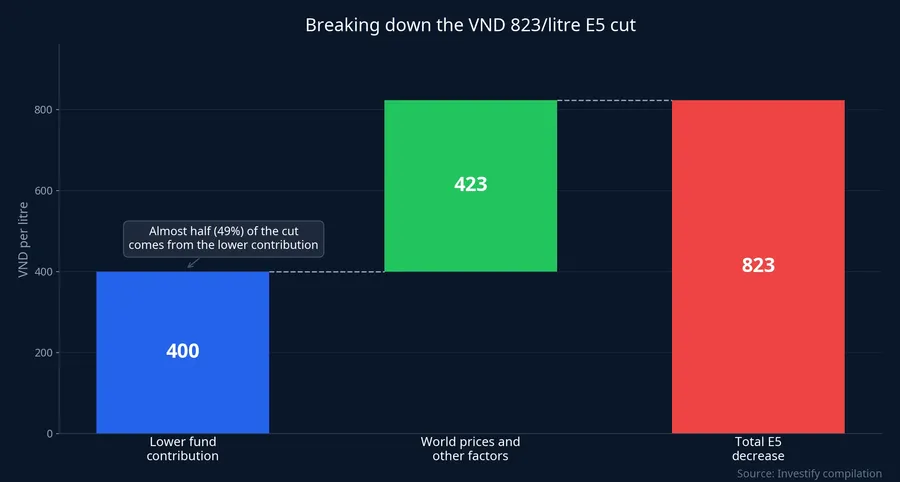
This round's charge is VND 400 lower than last round, nearly half of the VND 823 that E5 buyers gain. Arithmetically, the remaining VND 423 or so comes from world prices and other inputs to the base-price formula, such as the exchange rate and import logistics. The notice does not break these out, so the VND 423 is best read as a residual after the charge. Even so, the cut is not purely a reflection of crude: the authorities also chose to hold back less from each litre.
After five straight cuts, E5 is roughly VND 7,451 a litre cheaper in total: by the 12 November review the decline was VND 6,628 a litre, taking the price below its level before the Middle East conflict, plus the VND 823 from 19 November.
The VND 8,000 billion was born just after the price peak
In late March 2026, Petrolimex's Zone 1 retail price for E5 reached VND 30,110 a litre on 24 March, above the VND 30,000 mark. On 27 March 2026 the government issued Resolution 69/NQ-CP to advance money to the fund from the 2025 central-budget revenue surplus. The same day the Prime Minister signed Decision 483/QD-TTg adding VND 8,000 billion to the Ministry of Industry and Trade's 2026 spending estimate for that advance.
Implementing rules followed: Circular 19/2026/TT-BCT of 3 April 2026 on advances, contributions and repayment, amended by Circular 67/2026/TT-BCT of 20 October 2026, then Decision 2958/QD-BCT of 6 November 2026 on the plan for contributions and payouts from the budget-advanced portion.
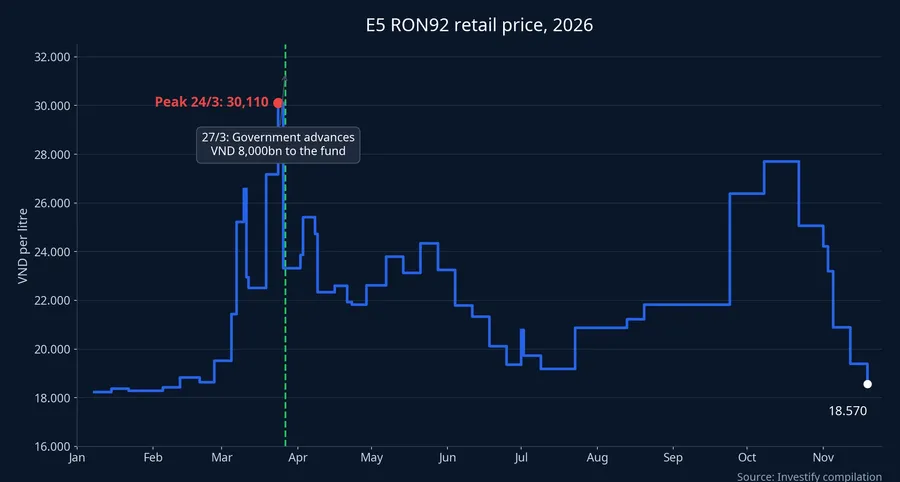
Resolution 69 set the repayment mechanism from the start: once world prices fall and the market stabilizes, the Ministry calculates contributions to the fund to repay the budget, with a maximum repayment period of 12 months from the date the Ministry decides on contributions. The advance was spent to hold prices down when they were high, and is being recovered through retail prices now that they have fallen. Today's petrol buyers are paying into that recovery. In the wider context, the Government Inspectorate has also recommended studying the fund's abolition after an inspection announced in early November.
A draft decree would end the fund and change who covers the gap
The Ministry of Industry and Trade has submitted to the government its 15th draft of the Decree on petroleum trading. Under the draft, from the day the decree takes effect, contributions to and use of the Stabilization Fund end. Management of balances, reconciliation, audit and settlement of earlier obligations continue.
The draft separates the fund's two pools of money. Contributions collected through retail prices go into a fund account opened by the Ministry of Finance at the State Treasury. The budget advance goes into an account for advanced funds managed by the Ministry of Industry and Trade. Distributors close their balances at the end of the day before the effective date and pay any positive balance within 30 days.
For the VND 8,000 billion, treatment follows the actual net balance, according to Tạp chí Tài chính Doanh nghiệp and Vninfor:
- If the fund has enough money: the budget is repaid VND 8,000 billion immediately. The remainder goes to the Ministry to buy national petroleum reserves.
- If the contribution pool is negative: the advance is used to compensate distributors with negative balances, and the rest goes to the budget.
- If there is not enough to repay VND 8,000 billion: the shortfall is proposed to be settled as budget spending to directly support fuel consumers, not treated as a debt to be recovered.
The notable point is the change from the earlier proposal. According to Tiền Phong, the Ministry had proposed halting contributions and payouts from 1 January 2027, with an exception: if by January 2027 the advance balances at distributors were still short of repaying the budget, the Ministry would keep charging until they were. In the new draft, the shortfall is no longer collected through retail prices but becomes budget spending. The party paying the remainder shifts from the fuel buyer to the budget.
Vietcap Securities, as reported by FireAnt, expects the decree to be approved in 2026 and take effect on 1 January 2027. It should be stressed that this is a draft that has been submitted, not a decree that has been issued.
Balances at each distributor will decide which branch applies. According to Vietcap's figures as of 12 November 2026, Vietnam National Petroleum Group (Petrolimex) has a positive balance of VND 1,075 billion in the contribution pool and a negative balance of VND 107 billion in the advance pool. PetroVietnam Oil Corporation (PVOIL) has a negative balance of about VND 1,440 billion in the contribution pool and VND 239 billion in the advance pool. These are only two of the distributors, so they do not show the fund's total balance.
What fuel buyers gain and lose if the fund ends
If the decree is issued as drafted, the consequences for drivers are fairly clear. A charge like today's VND 200 a litre would no longer sit inside the price. Pump prices would then follow world prices, taxes and costs, with no extra layer withheld to repay the advance.
The trade-off is that when world prices rise again, there would be no fund payout to soften the increase as in March, so rises would reach the pump faster. The Government Inspectorate has recommended replacing the fund with national reserves, mandatory reserves at distributors, tax policy and other regulatory tools. 2026 already has a tax precedent: the special consumption tax on petrol stands at.
For the budget, the outcome depends on balances. If the fund holds enough, the VND 8,000 billion returns in full. If not, the gap becomes spending to support consumers: the budget absorbs the cost on behalf of fuel buyers.
The thesis here is simple. Today's price cut reflects both world prices and the fund taking less, and if the draft is issued as written, the burden of any shortfall moves from fuel buyers to the budget. That changes only if the final decree keeps a continued-contribution mechanism like the earlier proposal. Until then, the number to watch every Thursday is the contribution line in the pricing notice. The higher the charge, the more buyers pay toward repayment and the less the budget must carry later. A charge of zero means whatever has not been recovered waits for settlement. The final decree and the audit of fund balances will show which approach is adopted.