


The nine-month numbers from Sacombank (ticker STB) show what the new organisation has delivered. The cost-to-income ratio fell from 46.1% a year earlier to 32.6%, and pre-provision operating profit rose 42.6% to VND 18,741 billion.CafeF Pre-tax profit still dropped 46.4% to VND 5,893 billion, because credit-loss provisioning nearly sextupled, from VND 2,152 billion to VND 12,848 billion.Nhịp sống kinh doanh
To be fair to both sides: nine-month pre-tax profit already equals nearly 73% of the full-year profit plan, based on third-quarter results published on 29 October.Tin nhanh chứng khoán This piece walks through the two forces that pushed the cost ratio down, then sets them against provisioning to see which one decides what reaches STB shareholders.
A workforce more than a quarter smaller
On 17 November Sacombank said it had completed its restructuring. The bank moved to a vertical management model with nine business divisions, removed intermediate management layers and raised the share of staff in direct sales roles. It set two targets: a cost-to-income ratio of 27% once the model is fully running, and average staff income at the top of the industry, up from seventh today.Nhịp sống kinh doanh
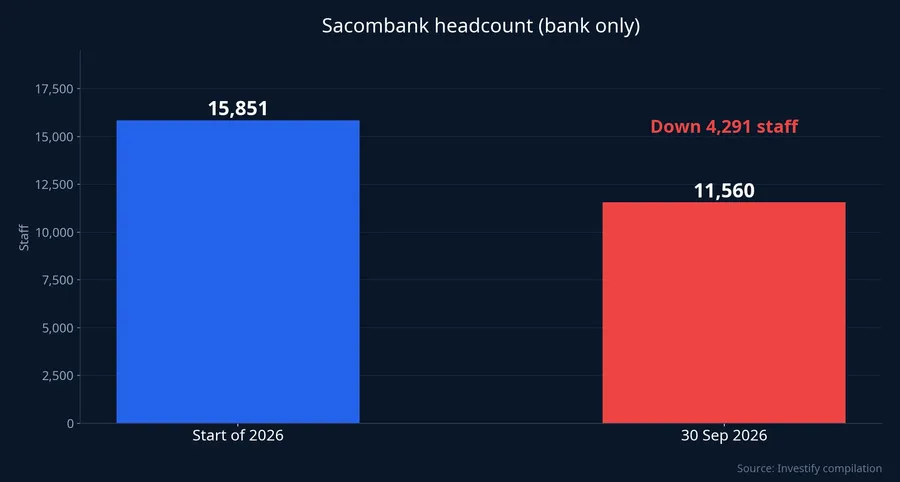
According to the standalone third-quarter statements, the bank alone had 11,560 employees at 30 September 2026, 4,291 fewer than at the start of the year, a drop of roughly 27%. Including subsidiaries, headcount was 12,553, down 25.4% from end-2025.CafeF The two figures differ because the reporting scope differs.
Nine-month staff costs were about VND 5,100 billion, down 17% year on year, of which salaries and allowances were over VND 4,476 billion, down 19%. Total spending fell more slowly than headcount, so average pay rose: about VND 43 million per person per month in salaries and allowances, against VND 39 million a year earlier.VietnamNet Those who stayed are paid more, which is also the direction of the top-of-industry income target.

Force one: operating costs down more than VND 2,000 billion
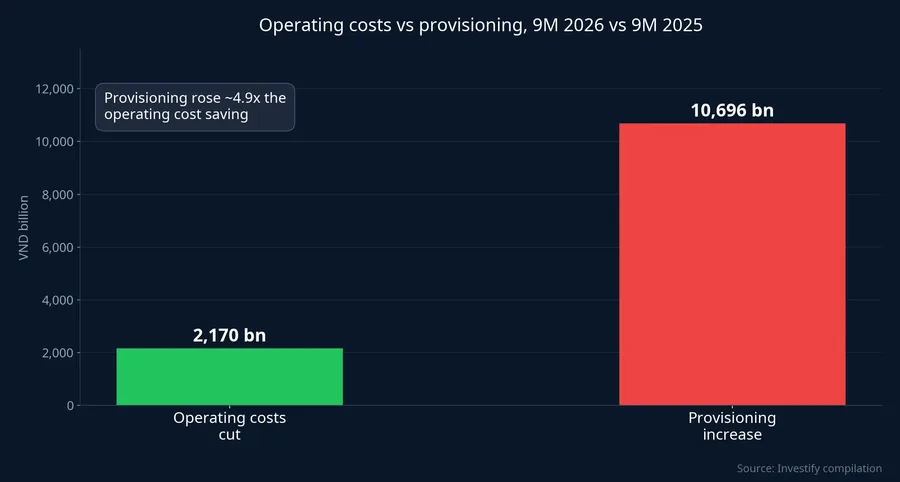
Nine-month operating expenses fell 19.3% to VND 9,053 billion, from VND 11,223 billion a year earlier.Nhịp sống kinh doanh The saving is roughly VND 2,170 billion.
If total operating income had stayed at last year's level, the cost cut alone would have pulled the cost-to-income ratio down to about 37%. Decomposing both sides, of the 13.49-point decline, lower costs account for 8.36 points and higher income for 5.14 points. The leaner organisation is therefore most of the story, with income playing a supporting role.
Force two: fees make up for interest
Nine-month total operating income rose 14.1% to VND 27,794 billion, even as net interest income fell 17.8% to VND 17,517 billion. On the interest decline, Sacombank said it deliberately narrowed its margin while rolling out preferential credit programmes to lower borrowing costs for businesses.Nhịp sống kinh doanh
The offset came from net fee income, at VND 8,206 billion, more than 3.5 times a year earlier, and net foreign-exchange income of VND 1,400 billion, up 92.3%. In money terms, fee income added about VND 5,886 billion while net interest income came in about VND 3,805 billion lower. SHS Securities assesses that the rise in fee income is tied to credit arrangement fees already collected in cash. The coming quarters will show how repeatable those fees are.
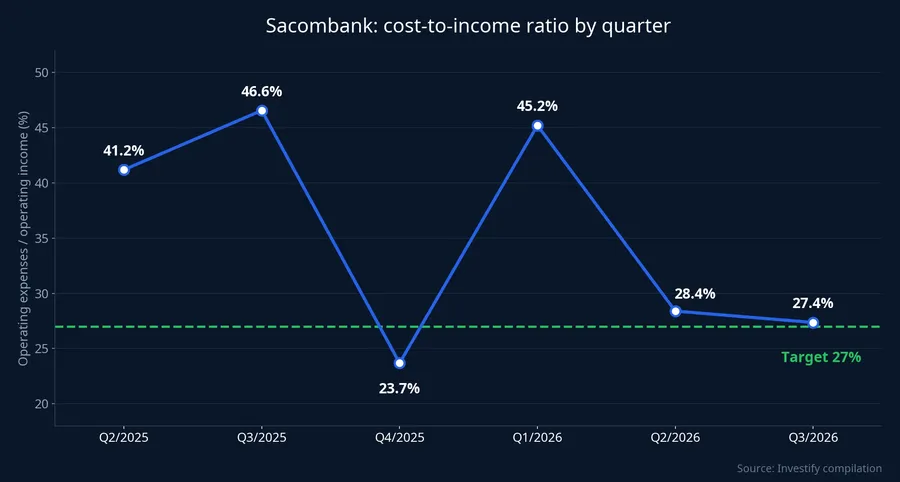
By quarter, the ratio was 28.39% in Q2 and 27.36% in Q3, close to the 27% target. In Q1 this year it was still 45.21%, and Q4 2025 dipped to 23.68% before rebounding. Two low quarters in a row are not yet a stable level.
Against peers, Sacombank's 32.57% ranks 14th of 30 banks, near the median of 33.76%. That is level with Vietcombank (32.01%) and BIDV (32.72%), and above SHB (19.21%) or VPBank (20.99%). A 27% target would therefore put Sacombank among the cheaper-to-run banks.
Provisioning nearly five times the saving
The cost savings and extra income lifted pre-provision operating profit to VND 18,741 billion, up 42.6%. At the provisioning line the picture reverses. Provisioning expense rose by nearly VND 10,700 billion year on year, close to five times the operating cost saving.
As a result, nine-month pre-tax profit stood at VND 5,893 billion, down 46.4%, and post-tax profit at VND 4,278 billion, down 50.8%.Nhịp sống kinh doanh That is the decline against the same period of 2025. Against the plan, the pre-tax figure is already nearly 73% of the full-year target.
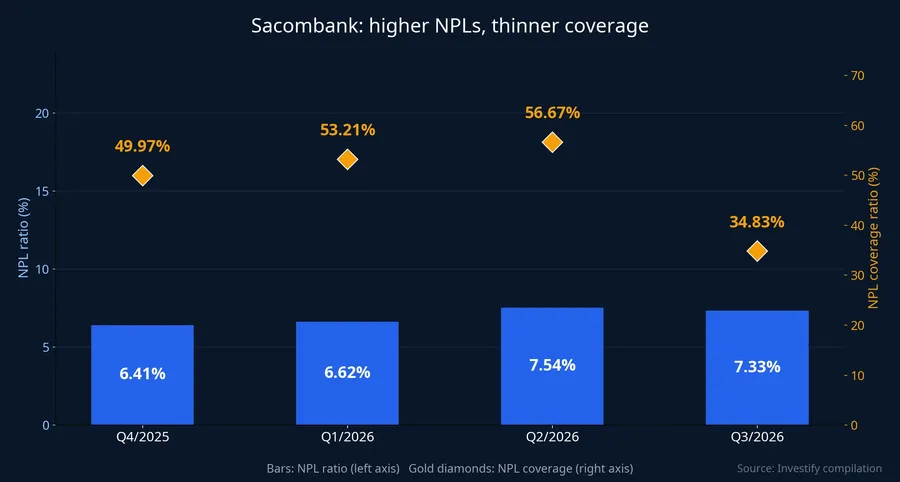
The heavy provisioning came alongside rising bad debt. At 30 September, Sacombank's NPLs were VND 51,367 billion, up 28% from VND 40,136 billion at end-2025, taking the NPL ratio to 7.33% from 6.41% at the start of the year. Against the previous quarter the ratio eased slightly from 7.54% at end-Q2. SHS says the bank used about VND 15,575 billion of provisions to work off bad debt in Q3. So despite the large charges, the loan-loss reserve balance fell 10.8% to VND 17,890 billion, and NPL coverage went from about 50% at end-2025 to nearly 35%.Nhịp sống kinh doanh
Special-mention (group 2) loans also rose, to VND 17,710 billion or 2.53% of loans, from VND 4,658 billion and 0.74% at end-2025. These loans are not yet bad but are being watched closely.
What STB holders should track in coming quarters
The new organisation has produced measurable results: costs down more than VND 2,000 billion, pre-provision profit up 42.6%. Operating cost is therefore no longer the big variable for Sacombank's profit in this period. What reaches shareholders now depends mainly on the provisioning line, that is, on the path of bad debt and group 2 loans.
If group 2 loans stabilise or decline and coverage edges back up in the Q4 2026 report, provisioning has room to cool, and the higher pre-provision profit would flow more fully into pre-tax earnings. If group 2 loans keep rising, provisioning will probably stay high and the cost savings will keep being overwhelmed by charges. Both branches use the same yardstick: group 2 loans and the coverage ratio.
For the 27% cost-to-income target, the first full test is the 2026 full-year result, then the quarters of 2027, when the nine-division model has run for a full year. That will also show how repeatable this year's jump in fee income is, because the denominator of the ratio depends on exactly that item.