


The price is free, but the bidders are chosen in advance. That is the core of the option for reselling social housing after 5 years that the Ministry of Construction reported on the afternoon of Nov 15, at a meeting on responding to lawmakers' comments on the draft amended Housing Law. According to Tuổi Trẻ, the option allows resale only to people who qualify to buy social housing, with the price negotiated between the parties. Deputy Prime Minister Hồ Quốc Dũng backs this direction, citing the need to protect the policy's goals and limit abuse of it.Tuổi Trẻ
Headlines split on the same option. Some stress that buyers are restricted; others stress that prices "still follow the market."Vietstock Both readings are half right. This piece takes up the other half: when the price is negotiated but only a limited group may bid, what decides how much the seller actually receives?
The Nov 15 meeting: an option reported, not settled
The meeting was chaired by Standing Deputy Prime Minister Phạm Gia Túc to align three draft real-estate laws with the amended Land Law. Nguyễn Văn Sinh, Deputy Minister of Construction, said the Ministry had in essence accepted and revised 11 items of the Housing Law in line with the Prime Minister's and cabinet members' views. Resale of social housing after 5 years is among the issues still under review, along with the obligation to build social housing inside commercial projects and incentives for rental housing.MarketTimes

In other words, this is an option that was reported and has the backing of one Deputy Prime Minister. It is not a settled provision. National Assembly Vice Chairman Nguyễn Hồng Diên asked the government to agree soon and choose one option for the issues where views still differ.Tuổi Trẻ Phan Chí Hiếu, Chairman of the National Assembly's Committee on Law and Justice, asked for clarity on ownership rights, freedom of contract, conditions for later transfers and transitional rules.MarketTimes The points Mr. Hiếu raised are the same ones that decide the money of today's social housing owners.
Three ways to treat price, three levels of seller rights
To see what the Nov 15 option changes, it helps to set it beside the two other approaches on the table.
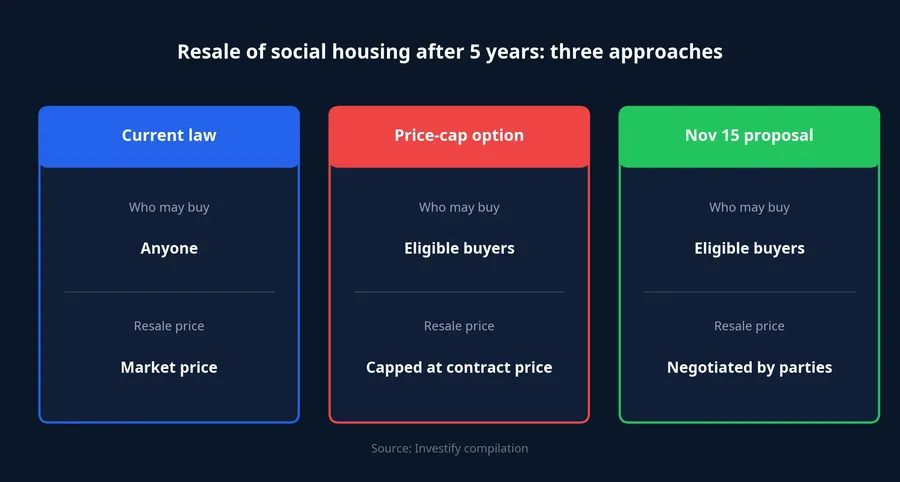
Current law. The Housing Law now in force lets an owner, after 5 years, transfer social housing to anyone who needs it under market mechanisms, meaning the buyer pool is not restricted. The seller sets the price and can sell to the highest bidder.Vietstock
Tightening both buyers and price. For the first 5 years, the draft allows resale only to the developer or to people eligible for social housing, at a price capped at the contract price.Tiền Phong On the floor in late October, some deputies proposed applying both the price limit and the buyer restriction to the period after 5 years. Their argument was that without a mechanism to control resale prices, genuine need-based buyers could lose access to social housing.Vietstock Under this approach the seller loses both the right to set the price and the right to choose the buyer.
The Nov 15 option. Buyers are restricted as in the second approach, while price is freed as under current law. The seller keeps pricing power, but only toward a narrow group of buyers. Side by side, it sits in the middle: against a price cap, the seller gains room to negotiate; against current law, the seller loses most potential buyers.
A free price in a narrow market
The word "negotiated" can suggest that the resale price will match a commercial apartment in the same area. That holds only if the highest bidder is allowed to buy. Under the Nov 15 option, permitted buyers are those entitled to social housing policy: people who rendered services to the revolution, poor and near-poor households, low-income earners, workers at enterprises or cooperatives, officers and professional soldiers, civil servants and public employees, people who have returned official housing, and people whose land was recovered by the State without compensation in the form of housing or residential land.MarketTimes
Beyond belonging to a group, buyers must also meet income and local housing conditions in the project's area. The economic consequence is fairly direct. A negotiated price has no ceiling on paper but has one in practice: what someone earning below the screening threshold can pay. A high-income family that wants the apartment to live in cannot join the bidding, and neither can an investor who wants to rent it out.
So the money a seller receives is likely to track the purchasing power of eligible buyers, not the price level of commercial units nearby. Where commercial prices have pulled far ahead of what low-income buyers can afford, the gap between the "negotiated" price and the wider market price could be large. Where the gap is small, this option would barely differ from current law in money terms. That is inference from how the option works; the option is not yet law, so there are no transaction data to test it.
This reading explains why the two opposing headlines are both right. The price is a market price, but in a market where the State has pre-selected the buyers.
Why the Ministry did not choose a price cap
The natural question is why the law does not simply set a ceiling on resale after 5 years. In its draft report on accepting and revising comments, the Ministry of Construction listed several difficulties. It cited ownership rights under civil law, which include the rights to possess, use and dispose of property. It also argued that regulating resale prices would create administrative procedures to determine prices, make it hard to assign responsibility if a determination proves wrong, and that valuation is hard in itself. It had also received many requests to reconsider the ban on selling at market price because it directly affects people's rights, and it warned that regulating resale prices could trigger social reactions.Vietstock
Developers raised a practical point too. In a letter to the Prime Minister on Nov 10, the Ho Chi Minh City Real Estate Association (HoREA) gave the example of a VND 1 billion loan at a preferential rate of about 5.9% a year: the borrower pays VND 59 million in interest in the first year, nearly VND 4.9 million a month, before any principal. HoREA argued that if resale is allowed only at the contract price, buyers would struggle to recover their costs, and a price cap could lead to two-price deals, that is, off-the-books sales in which the price difference is paid outside the contract.Tiền Phong
That argument does not rule out the opposite reading. Backers of tighter rules, such as Mr. Dũng, focus on limiting abuse of the policy. A representative of the Housing and Real Estate Market Management Department also told Tiền Phong that the Ministry is studying resale price rules on the basis of input from many parties, aiming to support low-income buyers and prevent speculation and profiteering.Tiền Phong The Nov 15 option therefore reads like a balance point: restrict buyers to keep the unit within the social-welfare pool, free the price to avoid a valuation bureaucracy and hidden deals.
Who gains and who loses if the option becomes law

Current owners who want to sell after 5 years. Compared with a cap at the contract price, they gain room to negotiate and can build loan interest and costs into the price. Compared with current law, they lose the highest bidders, so the price they receive could be lower than what they could get from an unrestricted buyer in the same area.
Buyers waiting to flip. This group is hit most directly. The gap between social housing and commercial prices can only be realized if a high-income buyer is available, and the Nov 15 option removes exactly that buyer.
Low-income buyers waiting to purchase. They gain a supply of resale units reserved for them, at prices negotiable within their own means. New supply is also expanding: through 2030 the government has assigned localities to build 899,857 social housing units, of which 708,834 are for sale or rent-to-own.MarketTimes
Social housing developers. HoREA said some companies have seen buyers withdraw purchase and rent-to-own applications since the draft was published.Tiền Phong The association worries that weaker demand will hurt developers' cash flow.FireAnt Freeing the price could ease some of that concern compared with a price cap, but the buyer restriction remains.
Land-use fees and owners who have passed 5 years
Two more details touch the seller's money. On land-use fees, HoREA says current rules do not require sellers of social-housing apartments to pay land-use fees, while sellers of standalone social housing must pay under government rules.FireAnt One option in the draft would exempt social-housing apartment owners from land-use fees on transfer, and HoREA backs that option.Tiền Phong
On transition, under the draft submission, social housing that is fully paid and passed the 5-year mark before the new law takes effect would not face limits on who can buy it, meaning it could still be sold under market mechanisms.Vietstock That is still only what is expected in the submission, and transitional rules are among the points Mr. Hiếu asked to clarify.
What comes next
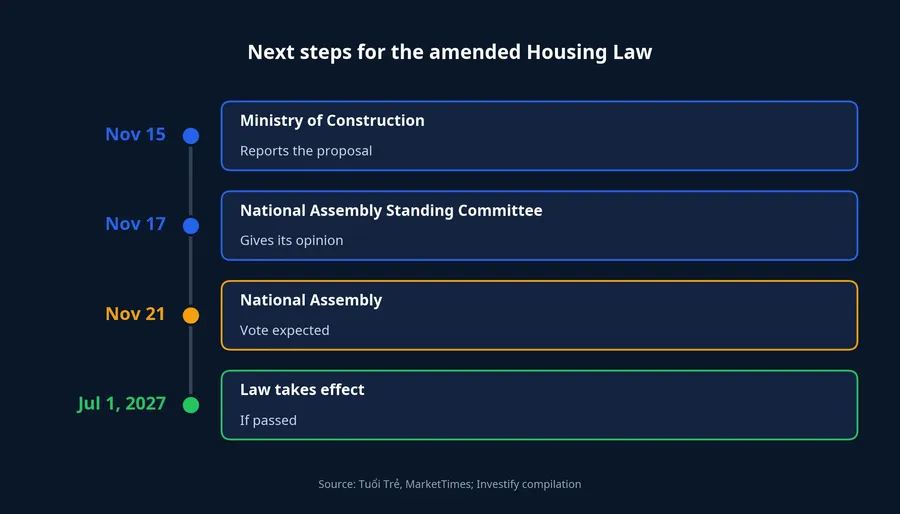
The revisions have to be ready in time for the National Assembly Standing Committee to give its opinion on Nov 17. The Ministry of Justice has been tasked with working with the Ministry of Construction and the Ministry of Agriculture and Environment to review and cross-check the three draft laws, clarify which provisions are and are not aligned, and prepare a file for the Prime Minister.Tuổi Trẻ The National Assembly is to consider and vote on the amended Housing Law at its Nov 21 session; if passed, the law takes effect on Jul 1, 2027.MarketTimes
Assessment
The Nov 15 option neither returns to market pricing as under current law nor goes as far as a price cap, as some deputies proposed. It moves the question of "how much can I sell for" from a state agency to a narrow market whose buyers earn within the screening threshold. If the National Assembly passes it in this form, the resale price of a social housing unit after 5 years will likely follow that group's purchasing power, and buyers waiting to flip will lose the most.
Two variables could change the picture. If the final text reverts to a price cap, sellers lose further room to negotiate. If the transitional clause stays as in the submission, owners who passed the 5-year mark before Jul 1, 2027 can still sell to any buyer. The Standing Committee's opinion on Nov 17 and the text put to a vote on Nov 21 will show which branch is kept.