


From the start of November through the close on November 13, 306.25 million shares of Lộc Phát Vietnam Commercial Joint Stock Bank (LPBank, HoSE: LPB) changed hands in negotiated deals, worth nearly VND 10,286 billion. That volume equals about 10.25% of shares outstanding, more than double the stake that the 2024 Law on Credit Institutions allows one individual to hold in a bank (5%).
The comparison is not a guess about who bought. It shows why the 10.25% figure has to be read carefully, and that the law already sets thresholds that force anyone holding a bank stake to be named.
Where the money went over nine sessions
There were no negotiated deals on November 2, the first session of the month. The first block appeared on November 3, at 15.5 million shares. Every session since has had negotiated volume, and it grew toward the end. The week of November 9–13 alone carried most of it: over 248 million shares, VND 8,351.6 billion.
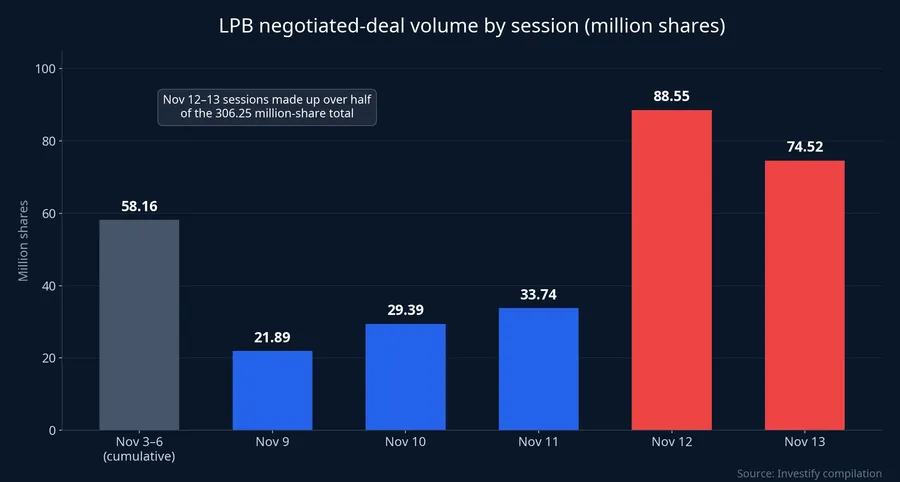
The last two sessions were the peak. November 12 saw 88.55 million shares, nearly VND 2,993 billion. November 13 added 74.52 million shares, nearly VND 2,534 billion. Those two sessions made up more than 66% of the week's negotiated value.
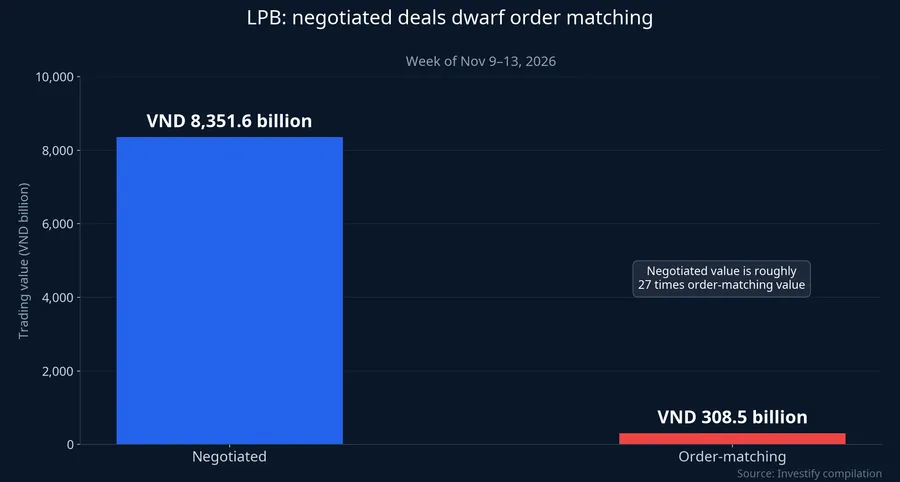
On the order-matching board, the scale is far smaller. Matched value for the week of November 9–13 was only about VND 308.5 billion, less than 4% of negotiated value. Across the whole period from November 2, order matching accounted for only about 19.25 million shares, while negotiated deals made up 94.09% of the stock's total volume. The closing price barely moved: VND 36,100 on October 30 and VND 36,250 on November 13, a difference of about 0.4%.
Negotiated prices were lower. The average price over the period was VND 33,586, about 7% below the November 13 close. Against the reference price, the average negotiated price in each session was roughly 5.8% to 6.7% lower. On HoSE, negotiated prices still have to stay within the daily price band, which is 7% for stocks. In other words, the large blocks were priced near the lower edge of each session's band.
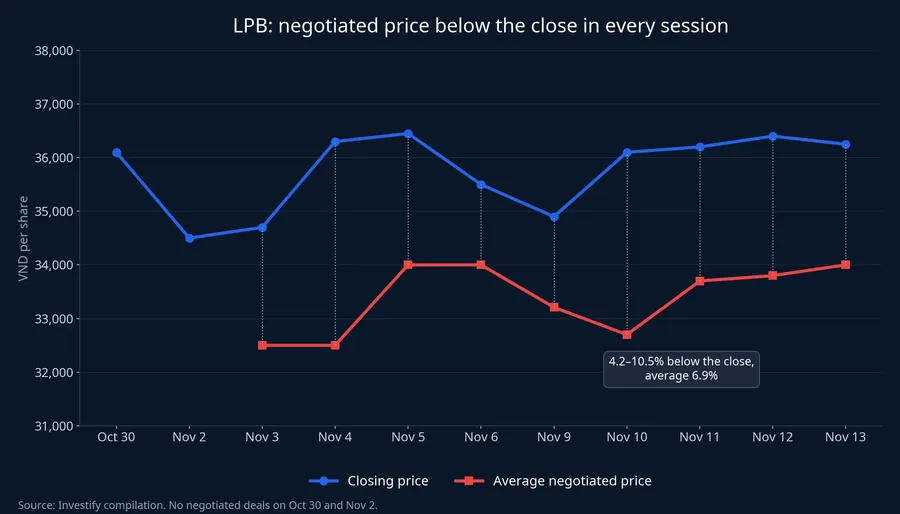
Two points follow. First, the daily matched price reflects very little of the money that changed hands, so the price board alone does not tell the story. Second, negotiated prices are set by the two parties. A price below the market therefore does not show whether the seller took a loss or the buyer got a bargain: that depends on cost basis and private terms that never appear on the trading board.
Why 10.25% is not 10.25% of the bank changing owners
Put simply: 306.25 million shares is the sum of volume across nine sessions, and each time a block changes hands, its volume is counted again. Suppose one block of shares moves from party A to party B on November 12, then from B to C on November 13. Total volume records it twice, while the capital that actually moved to a new owner is a single block. Người Quan Sát also notes that the 10.25% is calculated on traded volume and does not mean that much charter capital has moved to new owners.
The same number has three plausible readings. One: many different buyers, each taking a slice. Two: some blocks were bought and resold among parties within the same period. Three: shares moved between accounts of a group of related persons. The trading data cannot settle which, because the negotiated-deal table records volume and price, not accounts.
The law does rule out one possibility. Article 63 of the 2024 Law on Credit Institutions caps ownership at 5% of charter capital for an individual, 10% for an organization, and 15% for a shareholder together with related persons. So the full 10.25% cannot have stopped with a single individual. For one organization it would also exceed the 10% cap, except in cases the law exempts, such as state shares in an equitized bank.
The law forces names into the open at two thresholds
The first threshold is 1% of capital. Under Article 49 of the same law, a shareholder holding 1% or more of a bank's charter capital must give the bank information within 7 working days of crossing it. That covers their own holding and the holdings of related persons, in shares and as a percentage. If the ownership ratio changes by 1% of capital or more from the previous notice, the shareholder must report again. After receiving it, the bank has 7 working days to publish the shareholder's name and these ratios on its website.
At LPBank, 1% equals about 29.9 million shares, based on nearly 2.99 billion shares outstanding. A buyer above that level would have to appear on the list. Adding the two 7-working-day windows, for deals in mid-November the next update of the list could fall around early December.
The second threshold is 5%, the major-shareholder level. Under securities-market disclosure rules, a person who becomes or ceases to be a major shareholder must disclose within 5 working days. That report goes through the exchange's disclosure channel, so it arrives faster than the 1% list.
The current list and two earlier large sessions
Large negotiated deals are not new at LPB this year. The June 23 session saw over 146 million shares, about VND 6,725 billion, while full-session data shows 163.8 million shares. The July 21 session saw nearly 130 million shares, over VND 6,490 billion. Each of those sessions was larger than any single session in November. What sets the November run apart is that the volume was spread over nine consecutive sessions.
The most recent update of LPBank's list of shareholders holding 1% or more, dated July 27, shows Vietnam Post Corporation at 6.537%, Mr. Phạm Nhật Vượng (Chairman of Vingroup) at 4.894%, and Ms. Phạm Thu Hương (Vice Chairwoman of Vingroup) at 4.965%. According to Người Quan Sát, the two individuals' stakes sit in their personal financial investment portfolios, and neither holds a governance or executive role at the bank. This article does not link the November deals to any shareholder on the list.
The July 27 list is the baseline. The next update will show whether the names already there held steady, rose, fell, or were joined by someone new.
What LPB holders should read
The price on the exchange barely moved while more than VND 10 trillion changed hands off the order book. For someone holding or following LPB, the point to watch is what the shareholder structure looks like after these deals, not the price swings of individual sessions. The answer has a fairly clear timetable.
In the next few working days, if anyone crosses or drops below 5%, a major-shareholder report will appear on HoSE's disclosure channel. Around early December, the next update of the 1% shareholder list on LPBank's website will show whether there is a new name, and whether existing holders' ratios changed by 1% of capital or more.
If the list adds a new name with a significant stake, the negotiated deals created a new shareholder in the bank. If the list stays almost the same, most of those shares were split below the 1% threshold among many holders, or traded back and forth between parties. Either way, the answer can be read from public filings, with no guessing.