

Start with a simple multiplication. Dien May Xanh (DMX, HoSE) plans to sell 1,000 bonds, each bundled with 100 warrants, and each warrant gives the right to buy 1,267 shares. That works out to 126.7 million new shares, roughly one-tenth of DMX's shares outstanding. The bond itself raises only VND 100 billion.
The company will close its shareholder list on 24 November to collect written votes on amending the bond's collateral arrangement and other terms of the private placement that the extraordinary shareholder meeting approved on 29 October 2026. According to Báo Đầu tư Chứng khoán, the voting window will be set in the consultation notice. This post explains how the bond issue works and where it touches existing shareholders.
Two products in one package
Put simply, a bond with warrants is a package of two separate things. Unlike a convertible bond, where the buyer can swap the debt itself into shares, here the bond stays a loan with principal and interest owed. The warrant is a right to buy new shares with separate cash at a price fixed in advance.
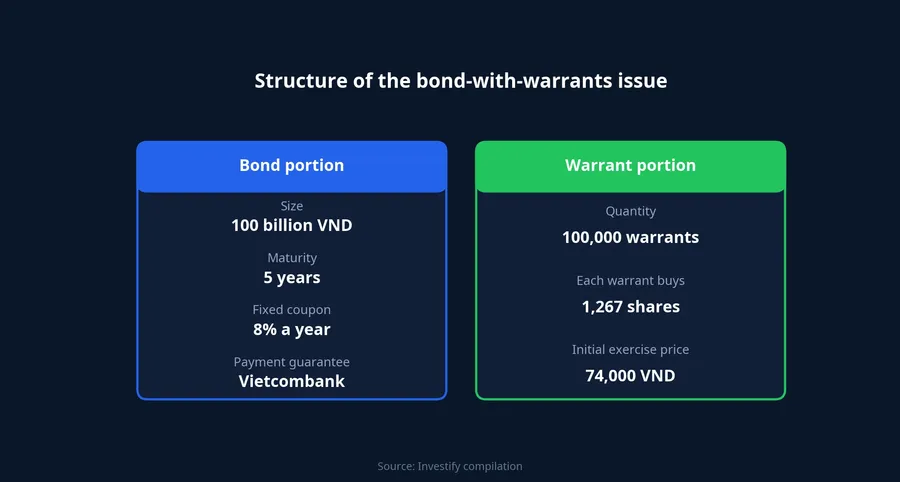
The bond leg of DMX's deal is fairly ordinary. According to An ninh tiền tệ, the company is offering up to 1,000 bonds with a face value of VND 100 million each, VND 100 billion in total, with a five-year term and a fixed 8% annual coupon paid yearly. Principal is repaid in one payment at maturity or on early redemption. DMX would pay about VND 8 billion in interest a year on the issue. The bonds are non-convertible and carry no collateral, but Vietcombank's Tan Binh branch guarantees payment of all principal and interest. Issuance is planned between Q4 2026 and Q2 2027.An ninh tiền tệ
Proceeds are earmarked to restructure part of a loan from MUFG Bank's Ho Chi Minh City branch. That loan stands at about VND 113.9 billion, was disbursed on 4 August 2026 with a 184-day term, and funds working capital.An ninh tiền tệ A 184-day term from 4 August lands in early February 2027, in line with the repayment schedule planned for Q1 to Q2 2027.Tin nhanh chứng khoán In other words, a roughly six-month loan would be largely replaced by a five-year loan with a bank guarantee behind it.
The warrant math
The second leg is where the scale changes. Each bond carries 100 warrants, so 1,000 bonds bring 100,000 warrants. Each warrant entitles the holder to buy 1,267 DMX shares. If every warrant were exercised, DMX could issue up to 126.7 million additional shares.An ninh tiền tệ
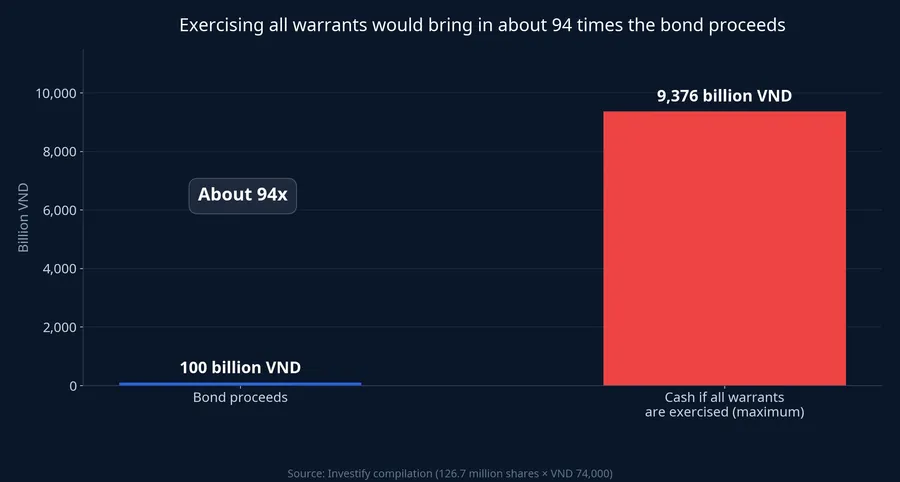
The initial exercise price is VND 74,000 per share. If all 126.7 million shares were bought at that price, warrant holders would pay DMX about VND 9,375.8 billion, roughly 94 times the proceeds of the bond itself.
The 1,267-share ratio is not arbitrary. DMX has more than 1.26 billion shares outstanding. The interim dividend of VND 2,000 a share is expected to cost about VND 2,535.4 billion, which implies about 1,267.7 million shares.Tin nhanh chứng khoán So 126.7 million new shares equal about 10% of the current count.
Take the largest buyer, Đoàn Văn Hiểu Em, general director of Dien May Xanh Investment Joint Stock Company (DMX). He bought 395 bonds, or VND 39.5 billion, with 39,500 warrants attached. If fully exercised, those warrants would give him the right to buy about 50 million shares, nearly 4% of the shares outstanding, at an extra cost of about VND 3,703 billion at VND 74,000. The whole issue is allocated to 15 senior executives. The smallest buyer took 12 bonds and the largest 395, which is 39.5% of the total.Tin nhanh chứng khoán The right to buy is not free stock: a warrant holder still has to put up real money at the agreed price.
Why VND 74,000, and when can the right be used
The board explains the price as the VND 80,000 IPO price minus the VND 4,000 cash dividend for 2025 already paid and the VND 2,000 dividend for 2026 about to be paid. On that logic, warrant holders buy at the same level IPO investors paid, after netting out the cash the company has handed back. The exercise price may also be adjusted under anti-dilution provisions.An ninh tiền tệ
On 13 November, DMX closed at VND 75,100, VND 1,100 or about 1.5% above the exercise price. That is a thin gap. The stock fell 12.4% from 12 August to 10 November, according to Báo Đầu tư Chứng khoán.Tin nhanh chứng khoán
The right does not open immediately either. According to An ninh tiền tệ, DMX will assess the exercise conditions each year, based on after-tax profit growth and DMX's share price performance against the VN30 index.An ninh tiền tệ For any target that is missed, the holder does not get the corresponding right to buy.
The two conditions currently point in different directions. On profit, DMX has strong momentum: nine-month after-tax profit reached VND 7,700.79 billion, up 83.4% from a year earlier.Tin nhanh chứng khoán On price, from the 6 August listing session to the 13 November session, DMX fell about 4.1% after adjusting for dividends, while the VN30 fell about 3.0%.
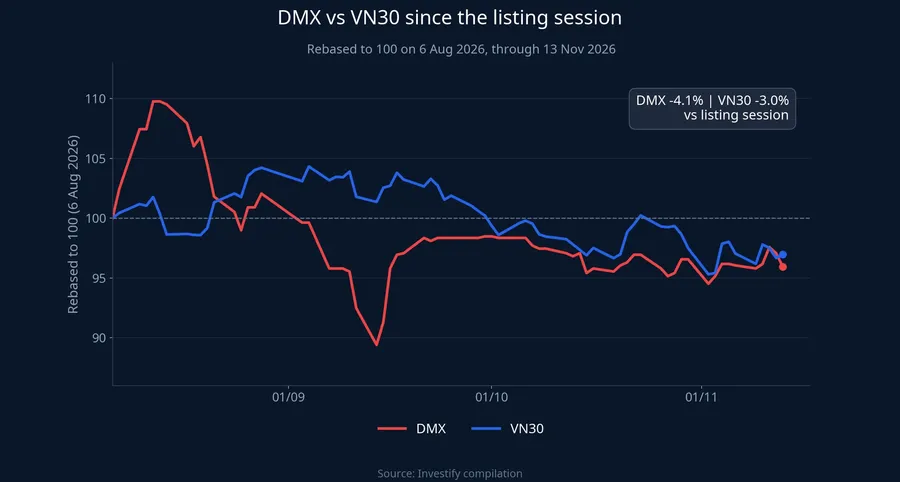
The formal test is annual, so this is not a ruling on the warrants. The chart only shows that the price condition does not pass automatically just because the company is earning more. The design ties the right to buy to two yardsticks shareholders also care about: rising profit, and share price against the large-cap VN30 group. Any target that is missed removes the matching portion of the right, while the 8% bond remains a bank-guaranteed loan.
Where existing shareholders stand
Anyone holding DMX has two separate matters to keep apart.
The first is the vote. Shareholders on the 24 November list will be asked for their views on amending the collateral arrangement and other terms of the plan. This is a voting right over a plan that has already been approved and is now being revised.
The second is ownership. If all 126.7 million shares were issued, the share count would rise from about 1,267.7 million to about 1,394.4 million. A shareholder holding 1% of DMX would be left with about 0.91%. MWG, which holds nearly 86% of DMX, would fall to about 78% if it did not buy more.
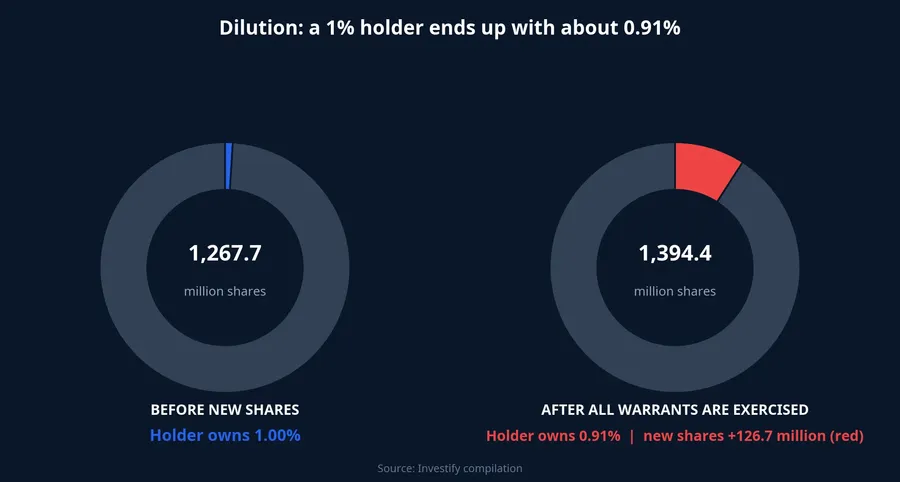
Dilution in percentage terms does not mean losing money at the same rate. When all warrants are exercised, the company receives about VND 9,375.8 billion in cash. The real cost to existing shareholders depends on the gap between the market price at exercise and VND 74,000. The further the market price sits above VND 74,000, the more value moves to warrant holders. With the price near VND 74,000, the transfer is almost negligible.
What to watch
The consultation notice DMX sends to shareholders after 24 November will show how the collateral arrangement is being changed and the deadline for returning votes. After that, the simplest gauge is to set DMX's price against VND 74,000 at each annual board review of the warrants. The gap multiplied by the number of shares unlocked is the value moving from existing shareholders to the group of 15 executives. If both profit and share price miss their targets, that portion of the rights is not exercised.