
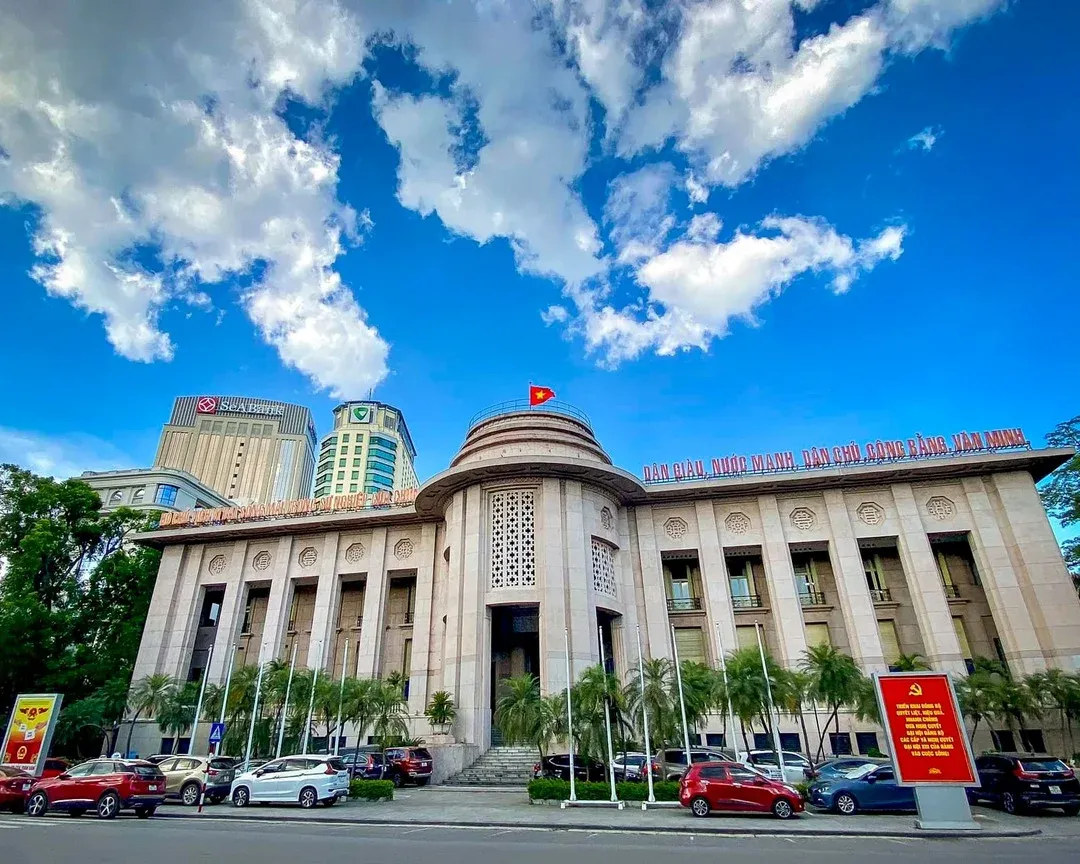

Wednesday, Nov 11 was the first day the State Bank of Vietnam (SBV) stood ready to buy USD spot at VND 25,500 per dollar. According to a note from Ho Chi Minh City Securities (HSC), cited by Vietnam Financial Times on Nov 13, no bank registered to sell USD to the SBV in that session.Thời báo Tài chính
The result matters because the spot channel differs from open market operations and swaps in one respect: the dong it injects does not have to be returned at maturity. It stays in the system.FireAnt With no sellers, the first session added no new dong through this channel. The next two scheduled sessions are Monday, Nov 16 and Wednesday, Nov 18.
Why no bank sold
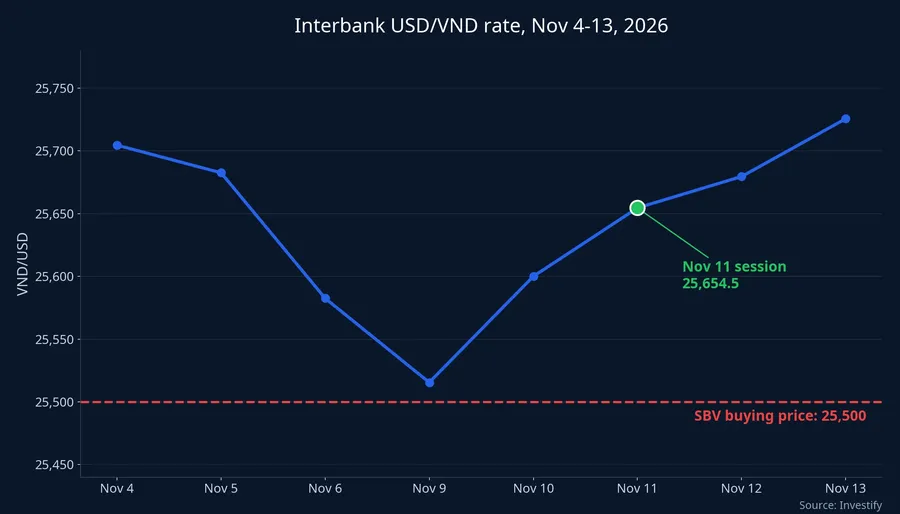
HSC's explanation is straightforward: the USD price on the interbank market was already above the SBV's price. Per HSC, the interbank USD/VND rate reversed and rose about 150 points after the announcement, and is trading above VND 25,500.Thời báo Tài chính A bank with spare USD gets a better price selling interbank, so it has no reason to sell to the SBV.
The gap widened steadily. On Nov 9, before the channel opened, the interbank rate was 25,515.5, only 15.5 dong above the SBV's buying price. It closed Nov 11 at 25,654.5 and reached 25,725.5 on Nov 13, about 225 dong above the 25,500 level.
HSC points to a second force. Citing its sources, HSC says the banking system's overall foreign-currency position is fairly tight. Banks holding short USD positions have an incentive to buy USD interbank, and so compete directly with the SBV for the same pool of dollars.Thời báo Tài chính
The external backdrop pushes the same way. The US dollar index (DXY) ended the week at 103.41, up 1.09% and its highest since April 2025. Federal Reserve Board Governor Christopher Waller raised the possibility of a 50-basis-point rate hike as early as December.Thời báo Tài chính
The data has limits. The domestic rate's rise this week could come from both forces, and the numbers cannot separate how much is due to banks short of dollars and how much to a stronger dollar globally. There is another reading too: the SBV's 25,500 floor may itself have eased fears of a deeper USD drop, lifting the interbank rate off that zone. HSC leans toward explaining it through USD supply and demand inside the system, and calls the interbank rate the most practical indicator because foreign-currency flows are hard to observe directly.
What USD holders are getting
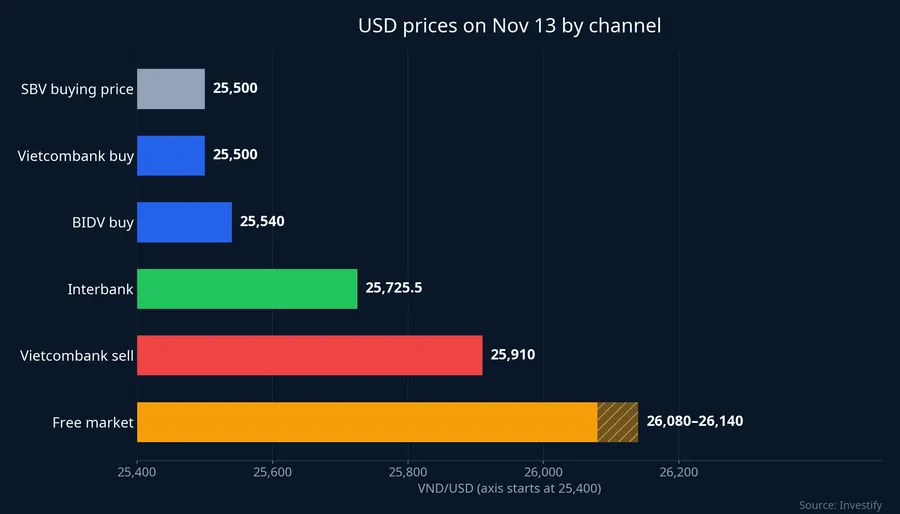
Individuals cannot sell USD to the SBV. Only credit institutions with a positive foreign-currency position can. For someone holding dollars, the number to watch is the buying rate at commercial banks. On Nov 13, Vietcombank quoted VND 25,500 to buy and 25,910 to sell, and BIDV bought at 25,540. On the free market, USD traded around 26,080–26,140.Thời báo Tài chính Vietcombank's buying rate at the week's close thus matched the SBV's price exactly, and BIDV's sat 40 dong higher.
Where this week's dong came from
The spot channel has not run, but the system is not entirely short of dong supply. The USD/VND swap with a 182-day tenor, capped at USD 2 billion, put about VND 48,800 billion into the system, according to VDSC.Thời báo Tài chính Unlike spot purchases, that money must be returned when the contracts mature in May 2027.VnEconomy
On the open market the flow ran the other way. During Nov 9–13, winning bids in the valuable-paper pledge channel totaled VND 41,111.59 billion, while maturing volume reached VND 66,347.58 billion. Overall, the SBV drained a net VND 25,235.99 billion through this channel.Thời báo Tài chính
Interbank rates show the two ends of the curve moving in opposite directions. The overnight rate fell to 4.8% a year on Nov 12, 1.27 percentage points below the 6.07% of Nov 6. The 1-month rate, by contrast, rose to 5.5% and the 3-month rate to 7.45%.Thời báo Tài chính
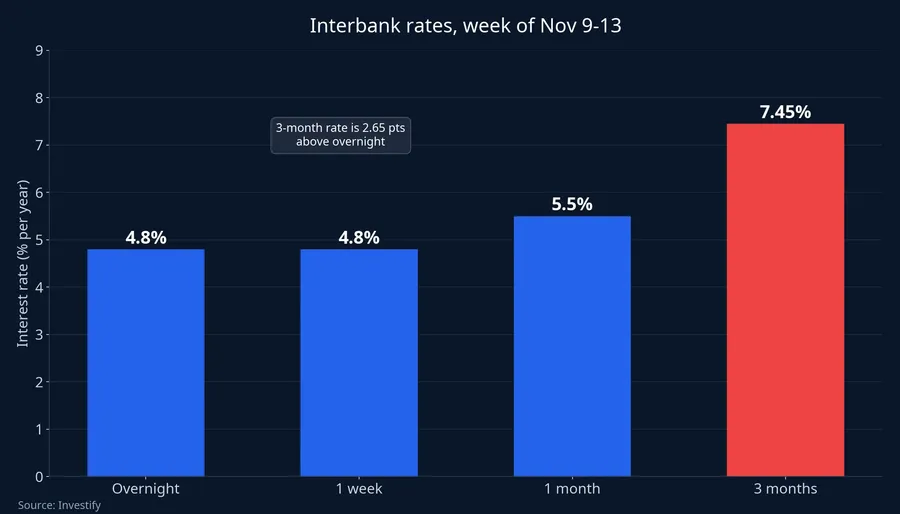
Short-term money has eased, but borrowing between banks for the next few months, through the year-end credit peak and Tet, is still expensive. The deposit and loan rates ordinary people see usually follow banks' term funding costs rather than overnight rates. The spot channel was expected to be a long-lasting source of dong to pull that term segment down, and this week it supplied none.
Who has USD to sell if the price falls back
According to VDSC, at the end of Q3 2026, 11 listed banks held positive on-balance-sheet USD positions worth VND 39,605 billion, about USD 1.55 billion. Concentration is very high: VietinBank alone accounts for 49%, and VietinBank and Vietcombank together for 68%.Thời báo Tài chính The other side exists too: Nam A Bank is short about VND 4,930 billion and VPBank about VND 4,774 billion.FireAnt This is a quarter-end snapshot of the balance sheet, not the same as the daily trading positions HSC refers to, and the VND 39,600 billion figure is VDSC's estimated ceiling, not the amount banks are ready to sell right away.
VDSC and HSC read the channel differently. VDSC argues that because the price is set close to the market and foreign-currency inflows are fairly healthy thanks to FDI and a USD 7.31 billion trade surplus in October, the operation could be highly effective.Thời báo Tài chính HSC says the SBV's ability to buy depends largely on the size of incoming foreign-currency flows. The first session leans toward HSC's view, and next week's two sessions will show whether it was a one-off or a lasting state of affairs.
Two branches for next week
The condition separating the two branches is clear, and HSC has named it: the interbank rate against VND 25,500. Per HSC, a drop to near or below the SBV's buying level would signal that USD supply is improving.
Branch one: the interbank rate falls back to near or below 25,500. Selling to the SBV then no longer costs a bank anything versus selling on the market, and banks with spare USD, mostly concentrated at VietinBank and Vietcombank, have reason to sell. Dong that does not have to be repaid enters the system and foreign exchange reserves rise. The first pull would show up in term interbank rates, and only later in deposit and loan rates.
Branch two: the interbank rate stays above 25,500. The spot channel keeps drawing no sellers, and dong supply has to rely on the open market, where the SBV just drained funds this week, and on swap money that must be returned after 182 days. Depositors and borrowers would then get no extra downward pull on rates from this channel. HSC adds one risk: if foreign-currency inflows do not improve, banks with short positions may have to buy USD from the SBV at a higher price to close them out.
This post does not say which branch will happen. Last week's data shows both forces are real: foreign-currency inflows from the trade surplus and FDI on one side, and the USD demand of dollar-short banks and a stronger dollar on the other.
The dates that will answer
The SBV's purchase sessions on Monday, Nov 16 and Wednesday, Nov 18 are the most direct markers. Before each one, the interbank rate against 25,500 is the early indicator. On the US side, Federal Reserve Chair Kevin Warsh gives the opening speech at a conference at midnight on Nov 18, Vietnam time.Fed The minutes of the Oct 27–28 FOMC meeting come out in the early hours of Nov 19, Vietnam time. These two dates will decide whether the dollar still has the strength to push the domestic rate higher.
If the interbank rate settles near 25,500 before the Nov 18 session, the spot channel has a chance to run for the first time, and dong that need not be repaid begins to enter the system. If it stays above 25,700, as at the end of this week, the next sessions will likely repeat the first one's result, and whether longer-term rates come down will depend on the open market.