


On November 13, according to the press, the State Bank of Vietnam (SBV) sent Official Letter No. 10488/NHNN-TTNH to its regional branches, asking them to set up thematic inspection teams on interest-rate cuts at credit institutions. The inspections must start within November 2026, and the results must reach the SBV through its Banking Inspection Agency in the same month so the central bank can report to the Prime Minister.Tin nhanh chứng khoán
Rate policy now has something it lacked until this week: a calendar for checking compliance. To see what this means for borrowers, savers and bank shareholders, it helps to trace the chain of documents that began in mid-October.
The chain since October 17: two different yardsticks
The first step was Notice 532/TB-VPCP of October 17, 2026 from the Government Office, relaying the conclusions of Deputy Prime Minister Nguyễn Văn Thắng at a meeting on monetary policy management. The November inspection letter cites this notice as its basis. The inspections are therefore not an SBV initiative of its own but the carrying out of a conclusion reached at Government level.
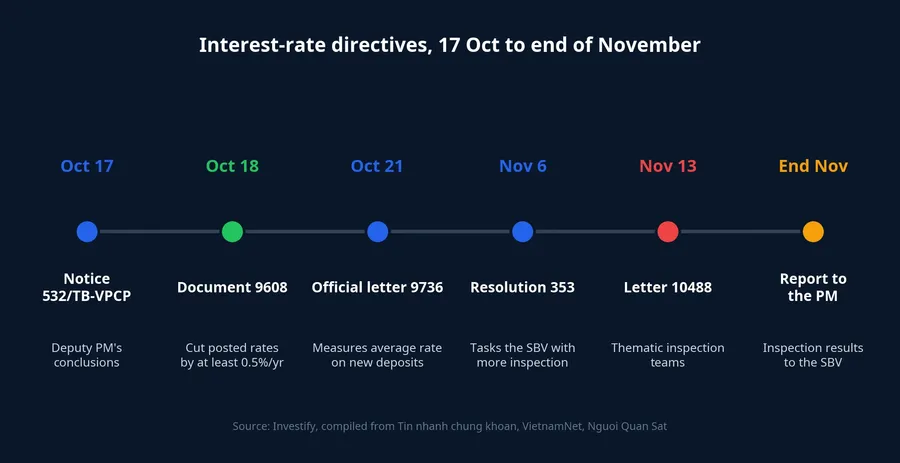
A day later the SBV issued Document No. 9608/NHNN-CSTT, which makes three demands. First, cut posted deposit rates by at least 0.5% a year for terms of six months or more, with no race to raise funding rates. Second, cut lending rates, focusing on 1.5–2% a year for production, business and priority sectors. Third, trim operating costs and share profits with customers.
On October 21 the SBV followed with Official Letter No. 9736/NHNN-CSTT, which uses a different yardstick. It asks commercial banks to cut the average rate on newly originated deposits of six months or more by at least 0.5 percentage point in the final months of 2026, measured against that bank's own rate, across all sales channels.
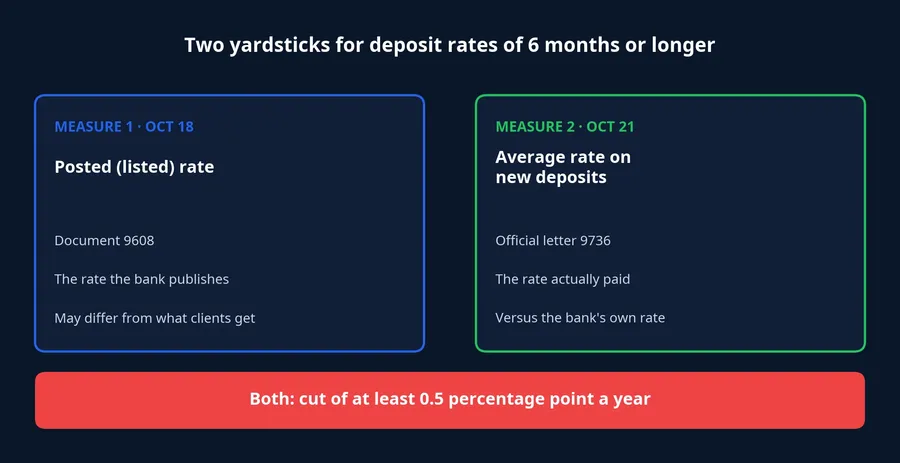
The difference is easy to miss. A posted rate is the one the bank publishes, while the rate a customer receives can vary with the deposit and the channel. The average-on-new-deposits measure tracks the interest actually paid on newly originated deposits, and each bank is compared with itself, not with the market average.
November 6 and 13: from directive to inspection calendar
A week before the inspection letter, Resolution No. 353/NQ-CP of November 6, 2026, on the Government's regular October meeting, tasked the SBV with stepping up inspection and supervision of compliance with rate directives. Credit institutions that do not cut lending rates as directed, or that compete unhealthily on rates, are to be corrected and dealt with strictly.
Letter 10488 turns those demands into a task with a deadline. According to Tin nhanh chứng khoán and VietNamNet, regional branches are to use available resources, monitoring results and the situation on the ground to form inspection teams at selected credit institutions. The subject is compliance with the law and with SBV directives on rate cuts. On the basis of the conclusions, the units must correct and strictly handle any violations.
The round will not necessarily cover every bank. Because branches pick targets from their monitoring and supervision results, the rate data each bank has reported in recent weeks feeds directly into that choice. Meanwhile, deposit rates have already started to move: Tiền Phong reports that 46 commercial banks have cut deposit rates since late October, mostly for terms of six months or more. The inspections will show whether those cuts reached actual transactions or stayed on the posted board.
Penalties tied to credit growth targets
Document 9608 spells out the consequences through the end of 2026. For a credit institution that does not strictly follow the rate directive or competes unhealthily, the SBV may, on top of handling under the law and depending on the nature and risk level, consider applying two groups of measures: revisiting the remaining 2026 credit growth target and setting a low target for 2027, or requiring one or more safety ratios above the regulatory minimum.
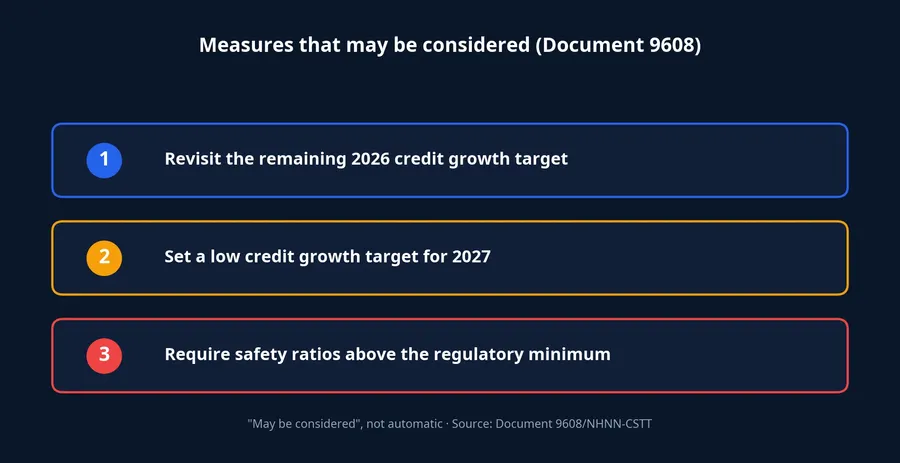
The key phrase is "may consider applying": these are not automatic penalties. Their direction is still clear. A credit target decides how much more a bank can lend, which is the scale of its largest income source. A bank handed a low target has to cede growth to its peers. Higher safety ratios force a bank to hold more capital or liquidity for the same amount of lending.
Who is affected, group by group
Borrowers in production and business. This group is asked for the biggest cut, 1.5–2% a year, and from now on inspectors can check it. The document does say "focus on cutting", though. Borrowers should read it as pressure on banks, not an automatic reduction on every loan.
Savers with terms of six months or more. This side receives less interest. On a new VND 500 million deposit for 12 months, a rate 0.5 percentage point lower means VND 2.5 million less interest over the year. Existing deposits usually keep the agreed rate to maturity, because the documents address posted rates and newly originated deposits.
Bank shareholders. The 2027 credit target becomes a new variable when judging growth prospects. Two banks of similar size with different targets will follow different lending paths.
Limits of the policy
Rates do not follow documents alone. Fast credit growth leaves banks needing more deposits, which is why Document 9608 bans a race to raise funding rates. If a bank's cost of funds does not fall, lending-rate cuts will struggle to approach 1.5–2% even with inspections. The inspections show which banks comply, but they cannot pull funding costs down on their own.
The next milestone
The nearest milestone is the end of November, when regional branches send results to the SBV and the SBV compiles its report to the Prime Minister. If that report names violating banks or attaches penalties, the "may consider applying" clause of Document 9608 begins to enter practice. If it stops at general corrective notes, pressure on banks remains at the next milestone, because Document 9608 has tied the 2027 credit target to compliance with the rate directive through year-end. Any specific cut to a target or increase in a safety ratio will become clear only when a decision is made for an individual bank.
For savers, the signal to watch is their bank's 6- and 12-month rate sheet in December against mid-October. For bank shareholders, it is the 2027 credit target the bank is given, set beside those of banks of similar size.