
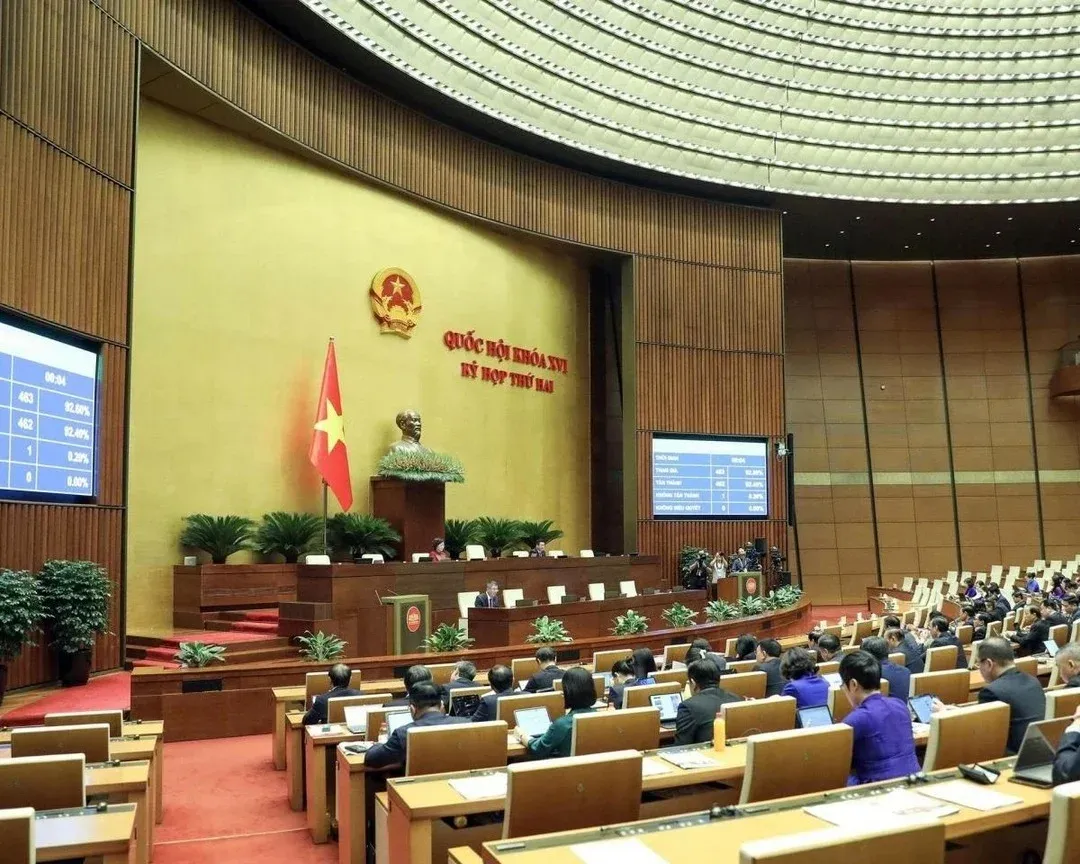

On the morning of 13 November, the National Assembly passed the law amending and supplementing several articles of the Securities Law, effective 1 March 2027.VnExpress The part that touches anyone subscribing to an initial public offering (IPO) is the set of conditions a company must meet before it can sell shares to the public.
The new law can be summed up in one line: it drops the rule that an IPO issuer must sell a minimum share of its stock to investors. That is accurate for the offering filing. It does not mean IPO buyers lose the safeguard on how many people hold the shares, because according to Tuổi Trẻ the same threshold remains in the law, just at a different point.Tuổi Trẻ
Current rules: the free-float threshold is a condition to offer
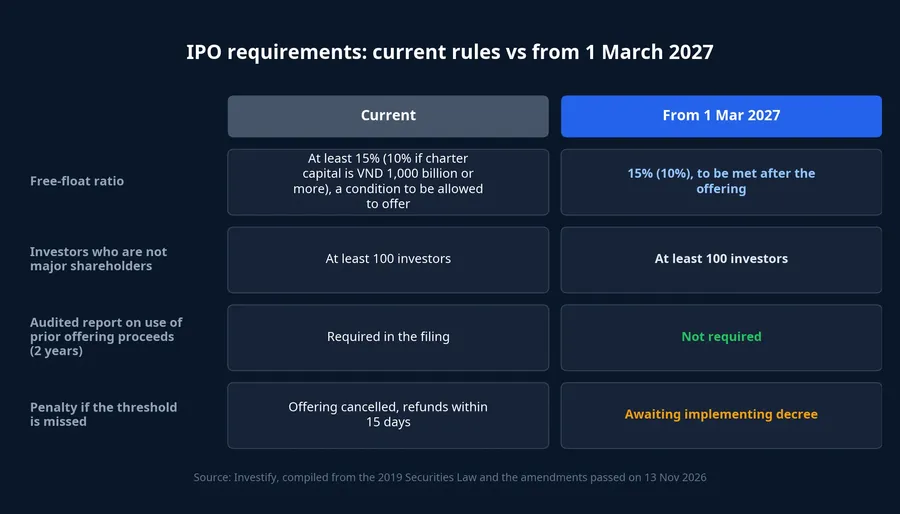
Under point d, clause 1, Article 15 of the 2019 Securities Law, one condition for a joint-stock company to hold an IPO is that at least 15% of its voting shares be sold to at least 100 investors who are not major shareholders. A company with charter capital of VND 1,000 billion or more faces a lower ratio of 10%, but still needs 100 investors.2019 Securities Law
A major shareholder, under the same law, is anyone holding 5% or more of the voting shares. The condition therefore targets a broad base of individual and small institutional investors. It forces a meaningful share of the stock into many hands, so that once listed the shares have real buyers and sellers rather than sitting with a few holders.
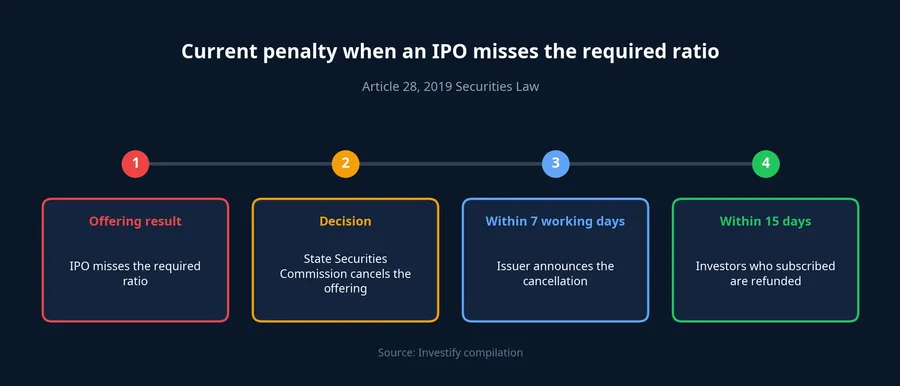
The condition carries a concrete penalty. Point b, clause 1, Article 28 lets the State Securities Commission cancel an IPO that misses the ratio. Under clause 3 of the same article, the company must then announce the cancellation within 7 working days, recall the issued shares and refund investors within 15 days; past that deadline it owes compensation as committed.2019 Securities Law A person who has paid for IPO shares has an exit written directly into the law if the sale is not broad enough.
In addition, an IPO filing today must include an audited report on the use of proceeds from the most recent offering, covering the two years before the filing date.VnExpress
From 1 March 2027: out of the filing, into the post-offering stage
Before the vote, Finance Minister Ngô Văn Tuấn, acting on the Prime Minister's authorization, presented the report on revisions to the draft law and said it had dropped the rule on the share of stock sold to investors in an IPO.VnExpress VnExpress adds that for IPO filings under the new law, issuers need not commit to that ratio and need not submit the audited report on use of proceeds from the latest offering.

Tuổi Trẻ reports the rest of the provision. After the IPO closes, the issuer must ensure that at least 15% of its voting shares are held by at least 100 investors who are not major shareholders. A company with charter capital of VND 1,000 billion or more at the time of registering the offering faces a 10% ratio, again with at least 100 investors.Tuổi Trẻ
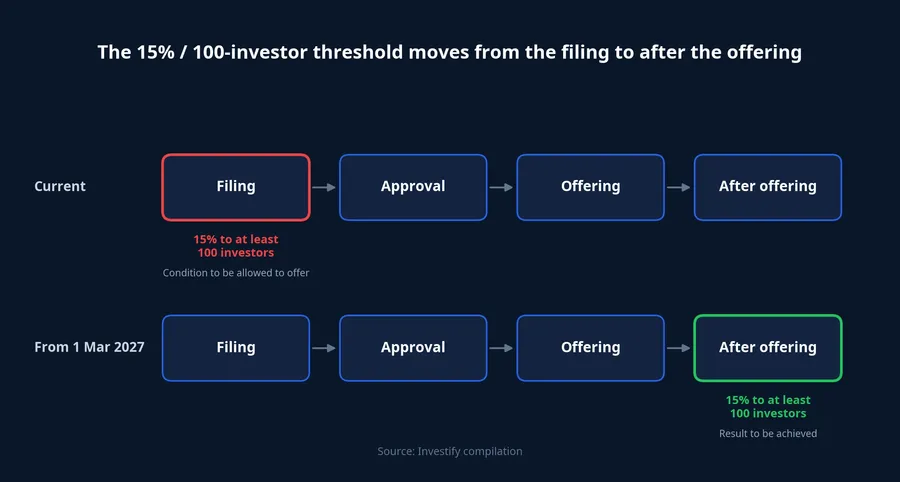
Read side by side, the numbers do not change. What changes is where they sit in the process: from a condition the issuer must commit to in its filing to win approval for the offering, to a result it must achieve once the sale is done. The regulator drops one up-front check and moves that check to the back end.
Criterion by criterion: who gets relief, what buyers keep
Share of stock that must reach a broad base. Current rules: 15%, or 10% for charter capital of VND 1,000 billion or more, as a condition to offer. From 1 March 2027: still 15% or 10%, but as an obligation after the sale. Issuers get lighter paperwork at the filing stage, while buyers still have a standard for how broad the shareholder base is when the stock reaches the market.
Minimum number of investors. Today it is at least 100 investors who are not major shareholders. From 1 March 2027 it is still at least 100. On this measure, IPO buyers lose nothing in numerical terms.
Audit report on use of prior proceeds. Today it must be filed. From 1 March 2027 it need not be. This is the change IPO buyers will notice most. A company that raised capital in the two years before its IPO, for example through a private placement, will no longer have to include a report, confirmed by an auditor, showing where that money went. Buyers can still read the use-of-proceeds plan for the IPO itself, since the shareholders' meeting must approve it under point c, clause 1, Article 15. What they no longer get in the filing is the cross-check between the promise of the earlier raise and what was actually done.
Financial statements with a qualified opinion. According to Tuổi Trẻ, the law also adjusts the condition on annual financial statements in public offering filings. If the auditor gives a qualified opinion, the qualification must not affect the offering conditions, and the issuer must provide an explanatory document, confirmed by the audit firm, on the effect of the qualification.Tuổi Trẻ For anyone reading a prospectus, that is a document worth opening whenever the financial statements carry a qualified opinion.
The rest of the law
The law adds a controlled sandbox for securities. According to Tạp chí Tài chính, the competent authority may run tests limited in scope, participants, space and time for technologies, products, services and business models that the law does not yet cover or treats differently.Tạp chí Tài chính Participants bear their own responsibility, and the National Assembly has tasked the government with setting the procedure, risk controls and handling of post-test results.VnExpress
The law also amends the conditions for establishing and operating securities companies and fund management companies. Practicing certificates are set at three types: securities brokerage, financial analysis and fund management. A certificate can be revoked if the holder skips the annual training, or does not work at an organization that employs certificate holders for 3 consecutive years.Tuổi Trẻ Securities and fund management companies that lack at least one qualified legal representative get a 2-year transition from the date the law takes effect.Tạp chí Tài chính
Conclusion: the free-float standard stays, the cross-check on old proceeds goes
For IPO buyers, the picture after 1 March 2027 is not a market that has stopped requiring a broad shareholder base. The 15% (or 10%) for at least 100 investors is still there. The clearest change is that the offering filing loses the audited report on how the previous raise was spent. Checking that history can now only be done from the public resolutions and financial statements covering the years in which the company raised money.
What decides the real value of the safeguard is the penalty. If the implementing documents keep the mechanism of cancelling the offering and refunding money when the result misses the threshold, the protection for buyers stays almost intact, with only the timing of the check changed. If it is replaced by an obligation to cure the shortfall after the sale is done, those who have already paid could hold a thinly held stock while the issuer works to meet the standard. The full text of the law and the decree amending Decree 155/2020, one of three draft guiding documents prepared alongside the bill, will show which scenario applies, before the first IPO under the new law opens its books.Tuổi Trẻ