

On November 12, shares of Thang Long Investment Group (TIG) closed at VND 3,000, their fifth straight limit-down session on the HNX exchange.MarketTimes The same day, Ms. Nguyen Ho Huong Ly, daughter of Chairman Nguyen Phuc Long, registered to buy 5 million TIG shares, ten times what she holds today.VnBusiness
Many outlets reported the two facts side by side, but they are only the last two marks in a chain of events packed into less than a week. For anyone holding TIG, especially anyone borrowing on margin against it, the order of those marks matters more than any single headline. This post goes through them by date, explains each mechanism as it comes up, and then sets the company's operating picture alongside. That picture has both sides: Q3 gross profit rose almost 59%, yet consolidated after-tax profit still fell 11.9%.
September and October: A first shareholding
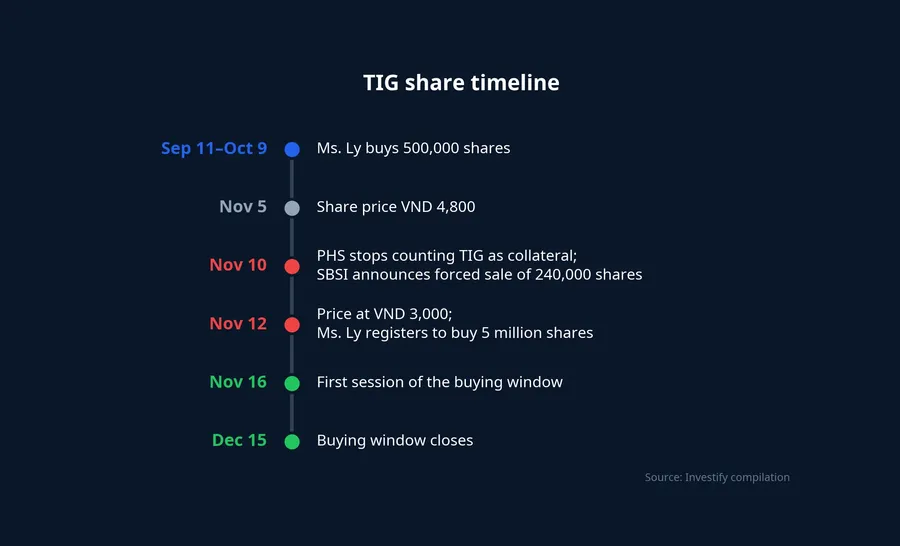
Between September 11 and October 9, Ms. Ly bought 500,000 TIG shares, equal to 0.26% of charter capital.VnBusiness According to MarketTimes, it was the first time she had become a shareholder of the company her father founded.
Mr. Long's family already held the largest block. In the corporate governance report cited by VnBusiness, Mr. Long holds 38.1 million shares, or 19.7% of capital, and his relatives hold 2.66% between them.VnBusiness
By then the share price had been sliding for a long time. At the start of 2026 each share stood at VND 8,500, and on November 4 it closed at VND 5,000.
November 5 to 12: Five limit-down sessions
On November 5, more than 5.7 million shares changed hands, the highest volume in a year according to 24hMoney, and the price closed at VND 4,800.24hMoney From the next session TIG fell by the full daily limit five times in a row: VND 4,400 on November 6, VND 4,000 on November 9, VND 3,600 on November 10, VND 3,300 on November 11 and VND 3,000 on November 12.
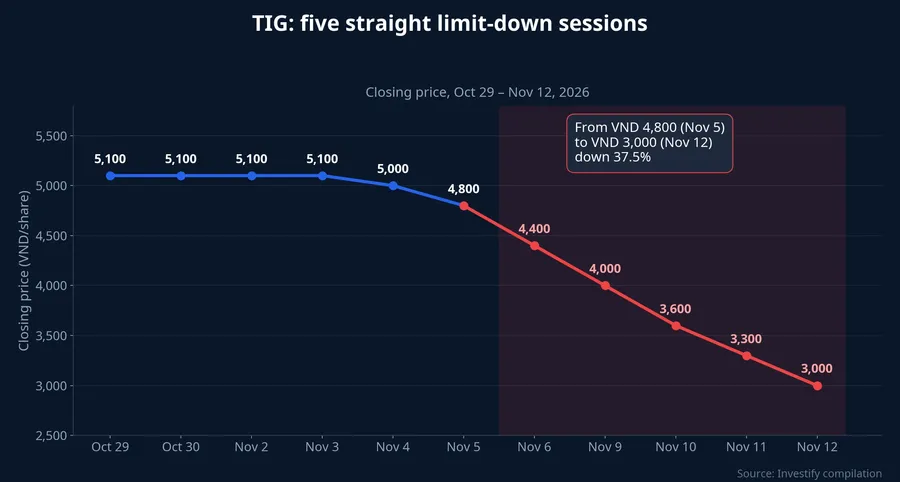
Measured from VND 4,800, the price fell 37.5% over five sessions. Against the start of the year, the drop is almost 65%, and market capitalization is about VND 581 billion.FireAnt
What matters most to someone who wants to sell is the queue at the floor price. At the close on November 12, matched volume was just 688,900 shares, while sell orders at the floor stood at almost 19.4 million and there were no buy orders.MarketTimes What got matched was less than 4% of the shares waiting to sell. Put simply: when a stock sits at the floor with the buy side empty, a sell order only fills to the extent that someone is willing to buy. Anyone who places an order later has to wait, even after accepting the lowest price allowed that day.
By date order, the limit-down run began on November 6, before the two brokerage notices of November 10.
November 10: Two notices from two brokerages
The first came from Phu Hung Securities (PHS). According to VnBusiness, on November 10 PHS removed TIG from its list of securities accepted as collateral, effective that same day.VnBusiness
For margin borrowers, a notice like this hits the account directly. When you borrow on margin, the shares in your account act as collateral for the loan. The brokerage uses their value to work out your buying power and your margin ratio, meaning your own cash as a share of total assets in the account. Once a stock is dropped from the collateral list, those shares no longer count toward the collateral, even though you still own them. An account borrowing against that stock sees its margin ratio drop immediately, with no further fall in price needed. If the ratio slips below the maintenance threshold, the brokerage asks for more cash or for assets to be sold, which is a margin call. The exact effect on any one account depends on the contract and on the other stocks held in it.
The second came from Stanley Brothers Securities (SBSI). The same day, SBSI announced it planned to force-sell 240,000 TIG shares belonging to Ms. Ly, starting November 11 and continuing until the debt is recovered. That is about 48% of the shares she holds.MarketTimes SBSI stated that the actual quantity sold may change, or the sale may not go ahead, depending on price movements and the brokerage's own decision.
A forced sale means the brokerage sells the pledged shares itself to recover its loan. With TIG at the floor and no buy orders, this sale also has to join the same queue as every other seller.
November 12: A registration ten times the current holding
Two days later, Ms. Ly registered to buy 5 million TIG shares for personal financial investment. The trades are planned for November 15 to December 15, 2026, through order matching and/or negotiated deals.MarketTimes November 15 falls on a Sunday, so the first session inside the window is Monday, November 16.
If she buys in full, her holding rises from 500,000 to 5.5 million shares, or 2.85% of charter capital. At the current market price, the cost would be roughly VND 15 billion. Per VnBusiness, if the deal is completed, the Chairman's family group could approach 25% of charter capital.VnBusiness
Newer investors should read this type of filing correctly. A trade registration by a related person is only the maximum planned quantity within a time window. The registrant may buy all of it, part of it, or none. The real figure appears in the trade results report, published after the window closes, in this case after December 15. On the previous registration Ms. Ly bought the full 500,000 shares, but the last result does not tell you the next one.
It also helps to separate two things done by the same person: part of her existing shares may be force-sold from November 11, and she has registered to buy more from November 16. The two are not mutually exclusive, because the loan at SBSI and the new purchase order are separate transactions.
Where the company stands after nine months
The consolidated Q3 2026 financial statements point in two directions. Net revenue was almost VND 106 billion, down 38% year on year. Gross profit, on the other hand, rose almost 59% to more than VND 40 billion.VnBusiness That works out to about VND 38 of gross profit per VND 100 of revenue, against about VND 15 in Q3 2025.
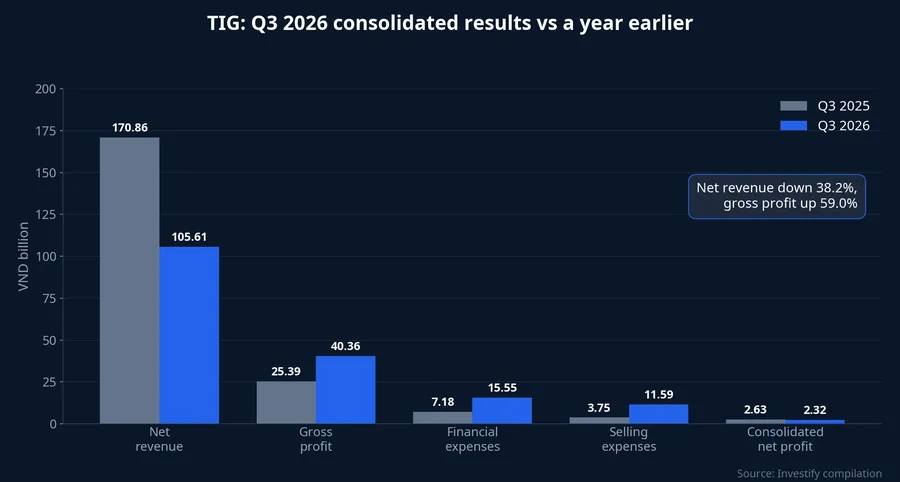
Two cost lines absorbed all of the roughly VND 15 billion of extra gross profit. Financial expenses more than doubled to VND 16 billion, and selling expenses more than tripled to almost VND 12 billion.VnBusiness As a result, Q3 consolidated after-tax profit came to VND 2.32 billion, down 11.9% from VND 2.63 billion a year earlier. Profit attributable to TIG shareholders (excluding minority interests) was VND 1.36 billion, down 61%, in line with the almost VND 1.4 billion that 24hMoney reported.24hMoney
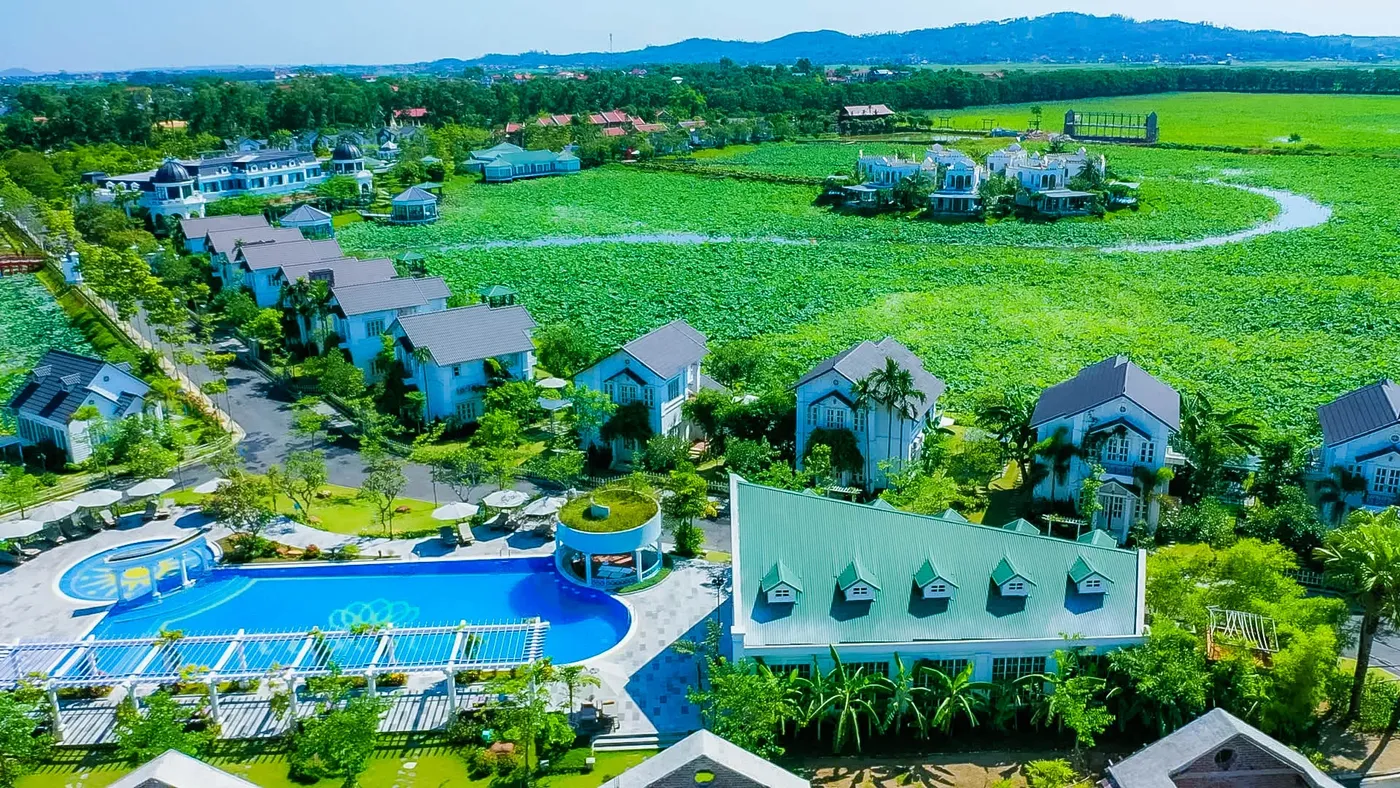
On the reasons, TIG told MarketTimes that revenue from sales and services fell markedly against Q3 2025 and was the main cause of the lower profit.MarketTimes Earlier, per 24hMoney, Mr. Long explained that revenue was lower while the group stepped up investment, asset purchases and construction, and that costs from acquisitions weighed on short-term profit.24hMoney The two projects absorbing the group's capital are the Vuon Vua resort in Phu Tho and TIG Infinity at 108 Nguyen Trai, Hanoi.
For the first nine months, revenue was VND 404 billion, down about 50%.VnBusiness After-tax profit was almost VND 6 billion, down about 87% from more than VND 45 billion a year earlier.MarketTimes Looking further back, per 24hMoney, nine-month net profit went from VND 179 billion in 2024 to VND 47 billion in 2025, and to a little over VND 5 billion this year.24hMoney
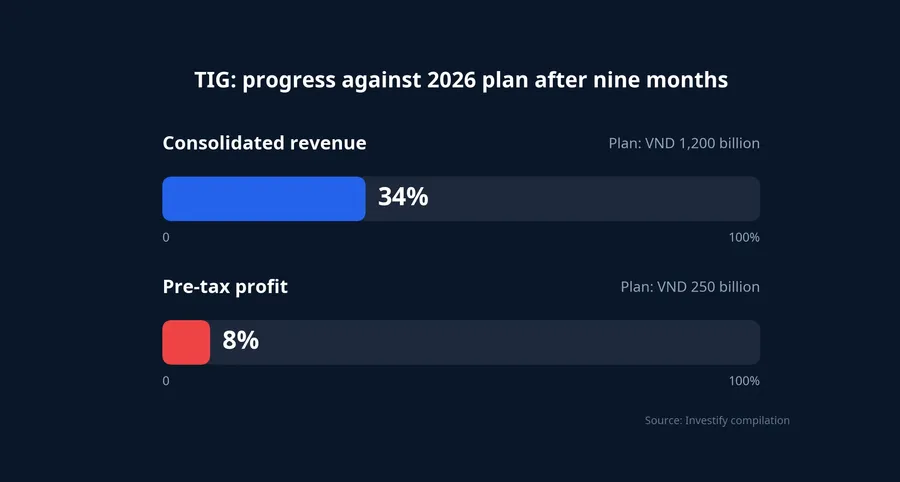
For 2026, TIG set a consolidated revenue plan of VND 1,200 billion and a pre-tax profit plan of VND 250 billion. After three quarters it has delivered 34% and 8%.24hMoney Nine-month pre-tax profit is about VND 20.2 billion, so Q4 would need to produce roughly VND 230 billion more to reach the profit plan.
On the debt side, as of September 30, 2026, total consolidated borrowings were VND 933 billion, down almost VND 122 billion from the start of the year. Of that, short-term loans are VND 249 billion, current portion of long-term debt is VND 398 billion and long-term loans are VND 286 billion.VnBusiness
What comes next
Anyone holding TIG has three documents that will answer what is unclear today.
The first is Ms. Ly's trade results report once the November 16 to December 15 window closes. It will show how much of the 5 million registered shares she bought, and by which method.
The second is information on how many of the 240,000 announced shares SBSI actually force-sold. That figure will show how much of the sale was carried out while the stock sat at the floor.
The third is the Q4 2026 financial statements. With 8% of the profit plan done after three quarters, they will show whether the VND 250 billion plan holds or whether the group must ask shareholders to revise it. Two lines to read side by side in that report are gross profit and financial expenses. If gross profit grows faster than financial expenses, the higher gross margin of Q3 will begin to show up in bottom-line profit. If financial expenses keep growing faster, the extra gross profit continues to be absorbed, as it was in Q3.