

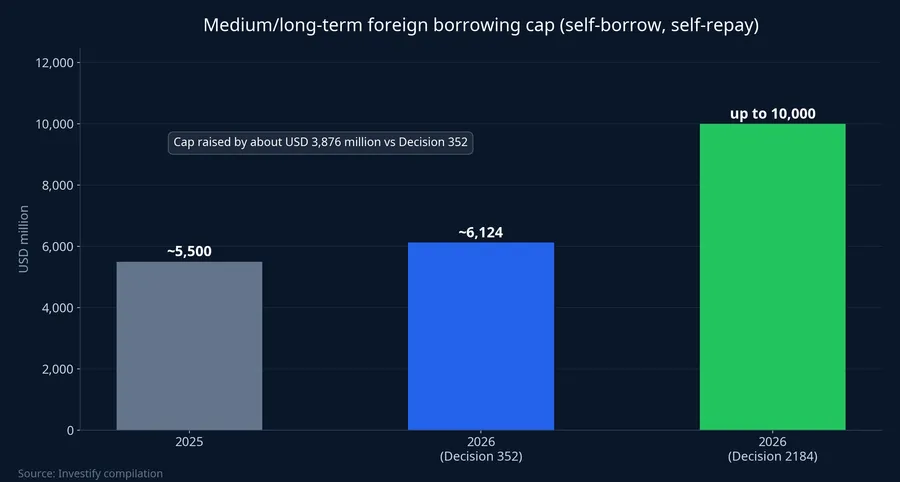
On November 11, Deputy Prime Minister Nguyễn Văn Thắng signed Decision 2184/QĐ-TTg, amending Decision 352/QĐ-TTg of February 27, 2026 on the 2026 public debt borrowing and repayment plan. It took effect on signing. The cap on medium- and long-term commercial foreign borrowing by companies and credit institutions on a self-borrow, self-repay basis rises to up to USD 10 billion a year, from about USD 6,124 million in the February plan.
The new ceiling is almost USD 3.9 billion higher, an increase of about 63.3%. Growth in short-term foreign debt may now reach up to 27% of end-2025 outstanding debt, versus about 19–20% before. The detail that matters sits in the heading over both targets: this is commercial foreign borrowing without a government guarantee. For anyone holding bank shares or a company with USD debt, three questions follow: what the cap measures, when the new room arrives, and who pays when the exchange rate or USD interest rates move the wrong way.
What the cap measures
Each year the public debt borrowing and repayment plan, approved by the Prime Minister, carries a separate line for companies and banks that borrow abroad on their own account. These are loans the borrower signs directly with foreign banks, funds or financial institutions and repays itself, principal and interest. The state does not stand behind them, unlike government-guaranteed loans, which have their own limit.
Under Decree 219/2013/NĐ-CP, the medium- and long-term cap is a ceiling on net borrowing: cash actually drawn minus principal repaid in the year. Two consequences follow. First, USD 10 billion is not the total value of contracts signed. A loan signed this year but drawn next year does not count for this year, and a company that borrows new money while repaying old debt uses only the difference. Second, the figure set at the start of the year is a demand forecast, fixed in late February, while the USD 10 billion is a November revision.
Last year's plan shows how big the jump is. The 2025 plan under Decision 1940/QĐ-TTg set the medium- and long-term cap at about USD 5,500 million and short-term debt growth at about 18–20% of end-2024 levels. The revised 2026 ceiling is therefore about 82% above 2025.
New room arrives with seven weeks left
Decision 2184 took effect on November 11, so 2026 has about seven weeks to run. The extra near-USD 3.9 billion mainly suits loans already arranged and waiting to be drawn, not contracts only now entering negotiation. For the short-term target, the 27% is measured against end-2025 debt, so it loosens the amount already borrowed since January, not only what is borrowed between now and December 31.
Banks already hold several such loans. According to VnBusiness on November 5, syndicated international loans announced by Vietnamese banks in 2026 include:
- VPBank signed USD 1.44 billion with 15 international institutions in late June.
- Techcombank closed USD 1 billion in the third quarter.
- HDBank completed USD 721 million in late July, with the Asian Development Bank and Standard Chartered taking part.
- ACB completed a three-year USD 500 million loan in the third quarter, with drawdown planned for the fourth.
- SHB announced a three-year USD 340 million loan on October 12.
- VIB received USD 285 million from nine Asian financial institutions in early October.
On November 10, VPBank announced another USD 730 million loan arranged by IFC and SMBC, with tenors of 3, 5 and 7 years.
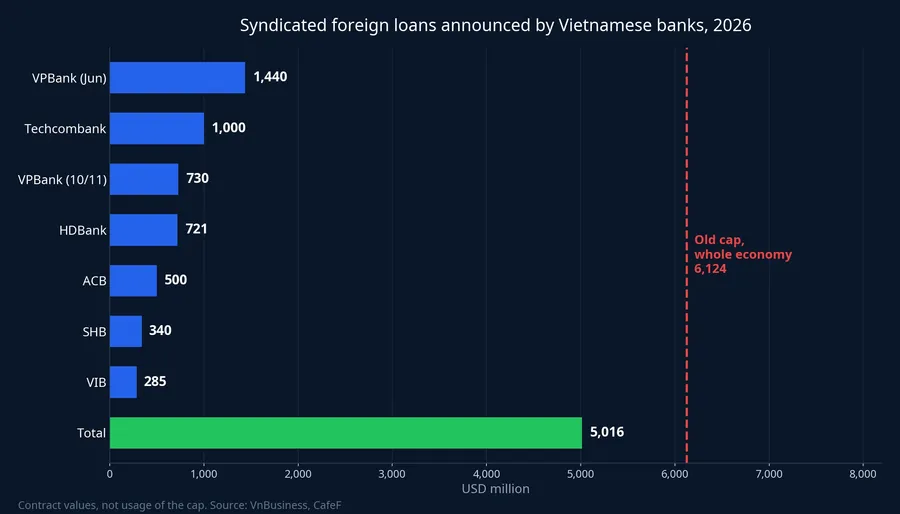
Together these come to about USD 5 billion, roughly 82% of the old USD 6,124 million cap that covers all companies and banks. The comparison shows scale only. These are contract values for banks alone, before repayment of older principal, and each loan is drawn at a different time. The cap measures net borrowing while contract values are gross, so the two figures measure different things and do not tell us how much of the old cap has been used.
What they do show is that banks' demand for long-term foreign-currency funding this year was already close to the cap set in February. Banks go to this source for tenor: three-, five- and seven-year loans from foreign institutions run longer than most domestic deposits. VnBusiness reports that VIB's early-October loan cut borrowing costs by about 30 basis points.
Who pays when the exchange rate turns
"Self-borrow, self-repay" is the most important phrase in the decision for shareholders. According to VietnamFinance, these loans carry no government guarantee, so companies and credit institutions bear responsibility for repayment as well as exchange-rate and interest-rate risk.
On a guaranteed loan, if the borrower cannot pay, the lender can turn to the state and the debt counts as public debt. On a self-borrow loan the lender has only the borrower. The full cost of repayment runs through that company's or bank's income statement, and so through the profit that belongs to its shareholders.
Borrowing in dollars rather than dong gives a company longer tenor and a funding source outside the domestic banking system. The trade-off is that it earns dong and repays in dollars, so each time the dong weakens, more dong is needed to repay the same USD amount. International loans are usually floating-rate, tied to USD rates, so interest rises when USD rates rise.
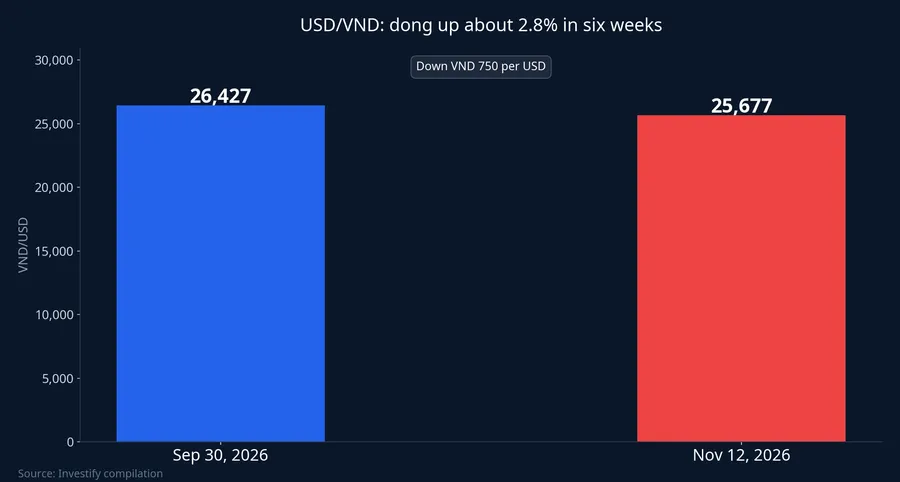
Recent weeks show the swing is real, in both directions. USD/VND stood at 26,427 on September 30 and 25,677 on November 12, a dong gain of about 2.8% in six weeks. That helps borrowers with USD debt. On a USD 100 million loan, a gap of VND 750 per dollar equals about VND 75 billion in repayment. The same move in the other direction adds that amount to the cost.
Banks have hedging tools that companies often lack. According to VnBusiness, the 182-day USD/VND swap session run by the State Bank of Vietnam on November 6 was open only to credit institutions with medium- and long-term foreign loans or international bonds with at least 12 months remaining. Hedging locks in a rate, but it has its own cost, and that cost also runs through earnings.
Where to read the number
For shareholders, extra borrowing room is not extra profit. The direct beneficiaries are companies and banks creditworthy enough to borrow long-term from foreign institutions: they gain long-tenor funding in the final weeks of the year. Because the extra borrowing has no state behind it, the final outcome depends on USD/VND and USD interest rates over the life of the loan, usually 3 to 7 years.
Financial statements are where this shows. According to VnBusiness, VPBank's standalone financial statements at September 30 recorded foreign-currency borrowings from other financial institutions of about VND 161,729 billion. At that scale, the notes each quarter on foreign-currency debt and on exchange-rate gains and losses tell shareholders how the risk is being managed.
The thesis of this piece: the decision widens funding room but does not shift risk onto the budget. If the exchange rate stays in a narrow band as in the past two months, long-tenor USD loans are stable funding for borrowers. If the dong weakens by a few percent next year, the difference will surface as FX losses or hedging costs, and shareholders of the borrower will bear it. The signal to watch is the notes on foreign-currency debt and exchange-rate differences in fourth-quarter reports.