
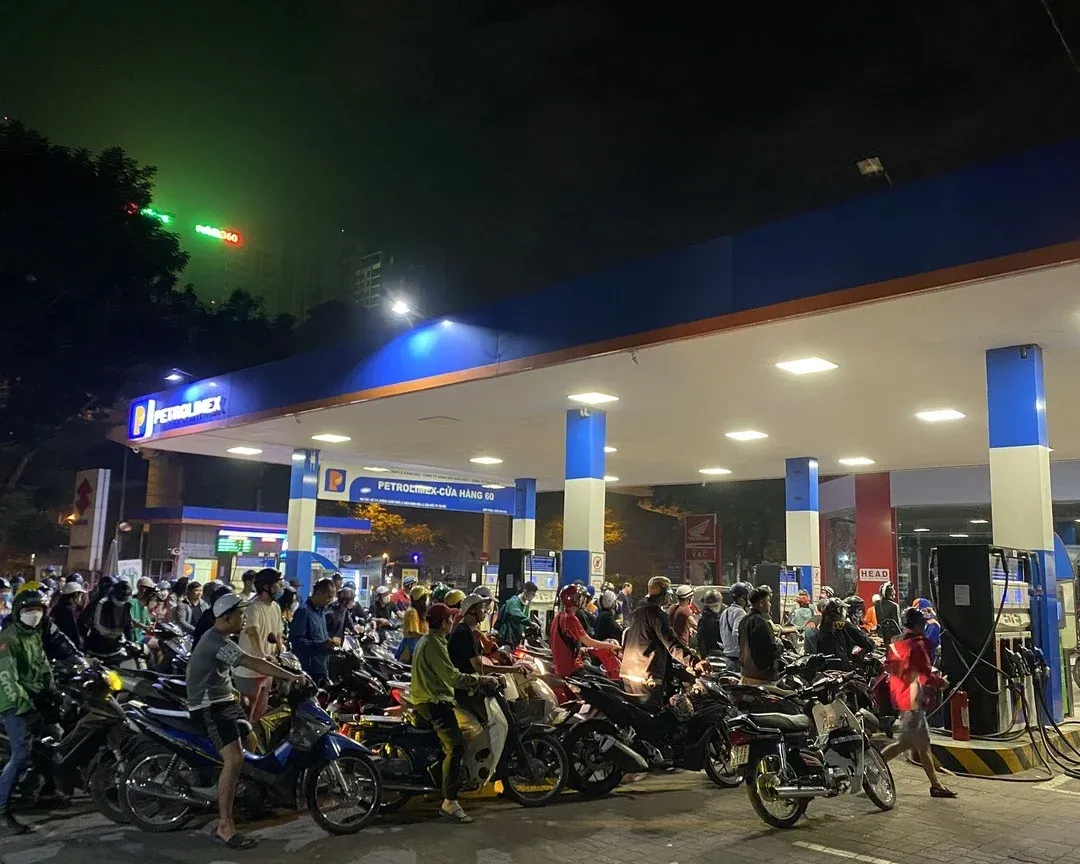

Vietnamese fuel companies traded roughly 34 billion litres among themselves, adding about VND 46,779 billion in intermediary discount costs. The figures come from Conclusion 769/KL-TTCP of 28 October 2026, a wide-ranging thematic inspection of the fuel business signed by Government Inspector General Nguyễn Quốc Đoàn and made public on 10 November.Người Đưa Tin
On that basis, the Government Inspectorate recommends that the Prime Minister direct a study into ending the current Price Stabilization Fund and a study into scrapping the state-announced base price. This is a recommendation to study, not a decision. To see why the inspectors got there, it helps to trace the fuel backwards from the pump to the depot.
Which hands a litre passes through
The inspection ran from 10 July to 5 October 2026 and covered 260 companies: 23 core distributors and 237 distribution traders.Vietstock Core distributors import fuel or buy it from domestic refineries, hold large depots and must keep mandatory reserves. Distribution traders buy from them and resell to dealers and stations. Each time fuel moves down a tier, the seller leaves the buyer a discount, the gap between wholesale and retail price. That is how each tier earns its margin.
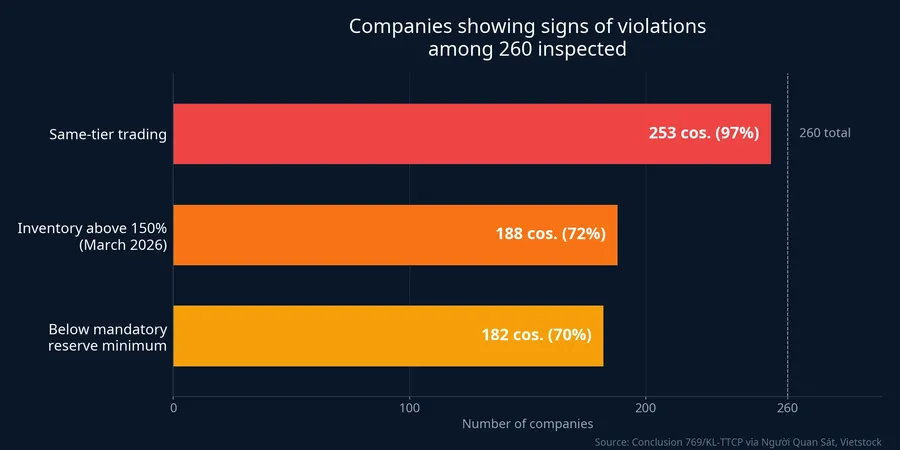
The trouble is that fuel does not only move down. The conclusion records core distributors selling to core distributors and distribution traders selling to distribution traders, which it calls "same-tier trading" (mua bán ngang). According to Người Quan Sát, 253 of 260 companies engaged in it, across nearly 7,760 transactions, about 34 billion litres and roughly VND 573,777 billion in total value. That activity added about VND 46,779 billion to discount costs at the intermediary level.Người Quan Sát
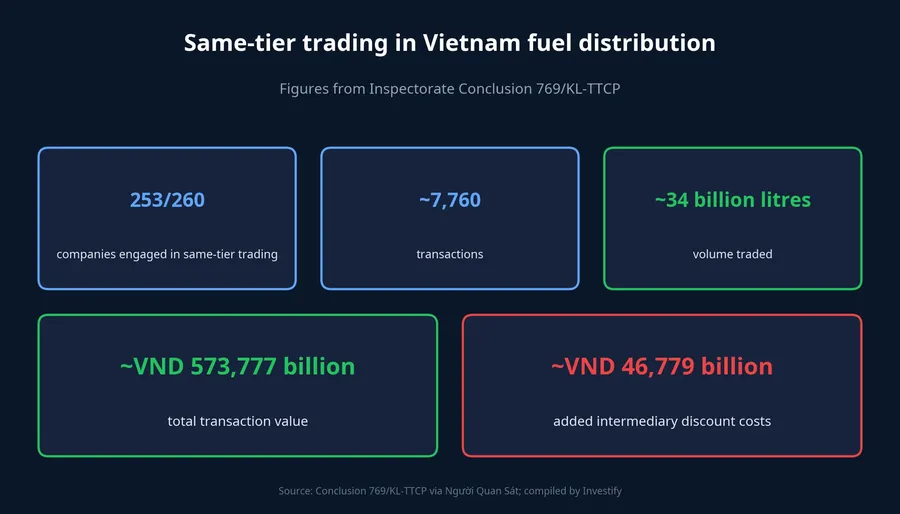
Techz estimates that 34 billion litres equals roughly one to one and a half years of national fuel consumption.Techz The figure needs careful reading. It is the total volume recorded across company-to-company transactions, not what end users bought, because one consignment can change hands several times. Likewise, the VND 46,779 billion reflects costs arising at the intermediary level; it should not be taken as pure loss or as an amount added straight onto the retail price. The mechanism is still clear: the more tiers in the middle, the more discounts must be shared before a litre reaches the tank.
When same-tier trading is used to launder fuel of unclear origin
The conclusion does not stop at cost. The Government Inspectorate says some companies exploited same-tier trading to trade invoices, evade tax and deal in smuggled fuel and fuel of unclear origin. Seven cases showing signs of criminal conduct were recommended for referral to the Investigation Police Agency of the Ministry of Public Security for consideration.Công lý These are signs of violations according to the inspection conclusion, not findings by prosecuting authorities.
The largest case involves Thanh Bình Petroleum Trading Co., Ltd. According to the conclusion, from January 2024 to June 2026 the company used 4,692 input invoices from 12 "ghost" companies, representing purchases of about 2.6 billion litres worth VND 42,600 billion. Those invoices were used to legitimise about 2.8 billion litres sold, worth roughly VND 46,000 billion. To pay, Thanh Bình used 15 accounts to transfer about VND 48,100 billion to 23 accounts of those 12 companies, after which the money moved on through intermediary firms and personal accounts.Công lý
A separate file concerns Dương Đông Group Joint Stock Company, under Conclusion 768/KL-TTCP. The cumulative balance in its accounting software on 31 March 2026 showed the source depot booked at negative roughly 123 million litres, a gap valued at about VND 2,078 billion.Vietstock In other words, the books record more fuel going out than invoices and customs declarations can support. From 2022 to March 2026, Dương Đông together with its subsidiaries and branches was also cited for declaring environmental protection tax on the wrong basis, about VND 720 billion. The two files connect: Thanh Bình bought roughly 114 million litres from Dương Đông over the same period.
The two cases show why multi-tier trading chains are hard to police. When a consignment can pass through several legal entities on invoices alone, the distance between paperwork and fuel actually in the tank can be very large.
The Stabilization Fund: contributions and payouts follow invoices, not fuel sold
The second layer of the conclusion is the Price Stabilization Fund. The fund collects a contribution on each litre sold when world prices are low and pays out to hold down prices when world prices are high, calculated on volume. The key question is which volume.
According to An ninh Thủ đô, clause 26, Article 1 of Decree 95/2021/NĐ-CP uses "actual consumed volume". Circular 103/2021/TT-BTC and Circular 19/2026/TT-BCT, meanwhile, say "domestic consumed volume" at the time the invoice is issued, without spelling out how to determine it.An ninh Thủ đô As a result, 20 core distributors made contributions and drew payouts at the point of invoicing and received about VND 2,209 billion even though the corresponding fuel had not yet been consumed.Vietstock According to Dân trí, some companies issued invoices to their own subsidiaries in order to draw from the fund while the fuel had not left the company's own system.Dân trí
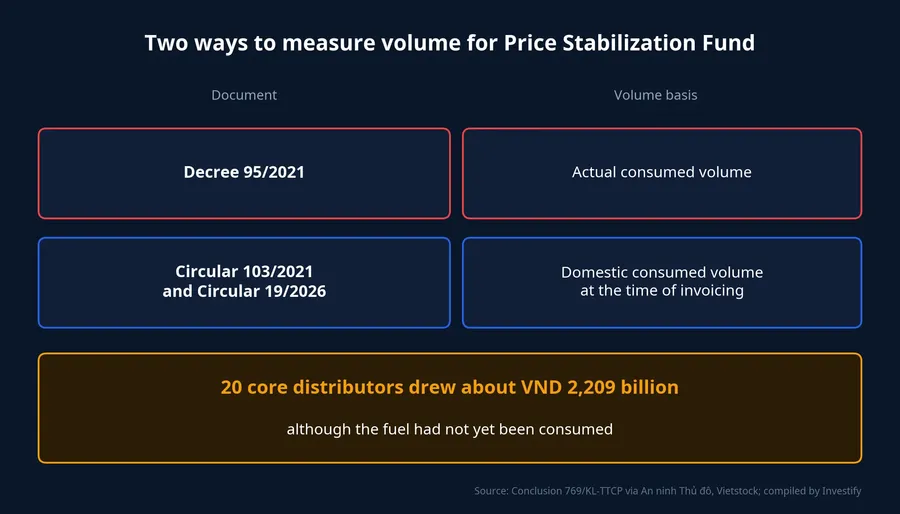
Two points belong next to the VND 2,209 billion. The inspectors have not determined whether the conduct was intentional or unintentional, nor the specific damage. The Government Inspectorate also says part of the cause lies in the rules themselves: the volume used for contributions and payouts is not unified and has no specific calculation method. One company that contributed and drew in the wrong period, about VND 6.63 billion, has already repaid the money into the fund at the time of the inspection.An ninh Thủ đô
So the fund is not just faulted for how companies used it. Its own way of measuring volume left the door open to several readings.
The proposed replacements lack a yardstick too
The Government Inspectorate proposes replacing the fund with national reserves, mandatory reserves at core distributors, tax policy and other regulatory tools. Notably, reserves themselves appear in the conclusion. 182 of 260 companies, or 70%, showed signs of not maintaining the minimum mandatory reserve: 14 core distributors and 168 distribution traders. The current minimum is 20 days of supply for core distributors and 5 days for distribution traders.Người Quan Sát
The conclusion also finds that 188 of 260 companies had at least one day in March 2026 when inventory exceeded 150% of the prior three-month average, a sign of hoarding under the rules. The companies explained that they had to buy large lots to secure supply, that vessels waiting at anchor caused cargo to arrive in clusters, or that they had to take delivery under signed contracts. The Government Inspectorate judged that for core distributors required to hold up to 20 days of reserves, inventory above the 150% threshold at certain moments is hard to avoid.Vietstock The conclusion further notes that current rules have no method for determining days of supply for inspection and no sanction for distribution traders that fall short on reserves.Người Đưa Tin
That means scrapping the fund only works if reserves are measured and policed more tightly than today. Otherwise the job of smoothing prices passes to a tool that also lacks a yardstick.
The recommendations sit beside a draft already in progress
Beyond the fund and the base price, the Government Inspectorate recommends restricting distribution traders to the minimum or keeping only a few in locations where they are needed, letting dealers and stations buy from several core distributors, and requiring prices to be disclosed through information technology across the whole system.An ninh Thủ đô
That direction overlaps with a document being drafted. On 15 October, VietnamPlus reported that the Ministry of Industry and Trade's draft fuel decree proposes that the state stop announcing periodic base prices, let traders set their own selling prices and announce new prices at least 30 minutes in advance. The draft also proposes removing the Stabilization Fund from the list of stabilization measures and ending contributions and payouts from 1 January 2027.VietnamPlus That is the draft's content at the time of reporting and it may change before issuance.
Conclusion 769 is therefore best read as a body of evidence placed on the table just as the new decree is being finalised. It does not create a new mechanism. The decree replacing Decree 83/2014/NĐ-CP, if issued, will be the document that decides.
Who shrinks, who carries more if the recommendations become rules
If the new decree follows the inspectors' recommendations, three groups would change in different ways.
Intermediate distribution traders shrink most clearly. The recommendation to restrict their number targets the tier between core distributors and stations, where most same-tier trading takes place.
Core distributors gain the right to announce their own prices but carry more. The recommendations call for maintaining and raising mandatory reserves for them while concentrating on developing core distributors with large scale and real financial capacity. Holding more stock means needing more working capital. For shareholders of listed core distributors such as Petrolimex (PLX) or PV Oil (OIL), what to read in the new decree is the mandatory reserve level and how business costs are counted in the price formula.
Fuel buyers would see prices track world prices more directly. With no fund to cushion them, a rise in world prices would reach the pump faster unless the state applies a ceiling price or price band. Conversely, if the number of intermediary tiers falls and prices are disclosed system by system, buyers gain a better basis for comparing stations.
What to watch
The deciding signal is the content of the decree replacing Decree 83/2014/NĐ-CP when it is issued. If it keeps the 1 January 2027 end date for the Stabilization Fund and drops the base price, the recommendations in Conclusion 769 enter practice from the start of next year, and the mandatory reserve becomes the main tool for keeping supply stable. If the decree keeps the fund, the question shifts to whether the rules can unify how volume is calculated, since that is where the roughly VND 2,209 billion in invoice-based payouts came from.