
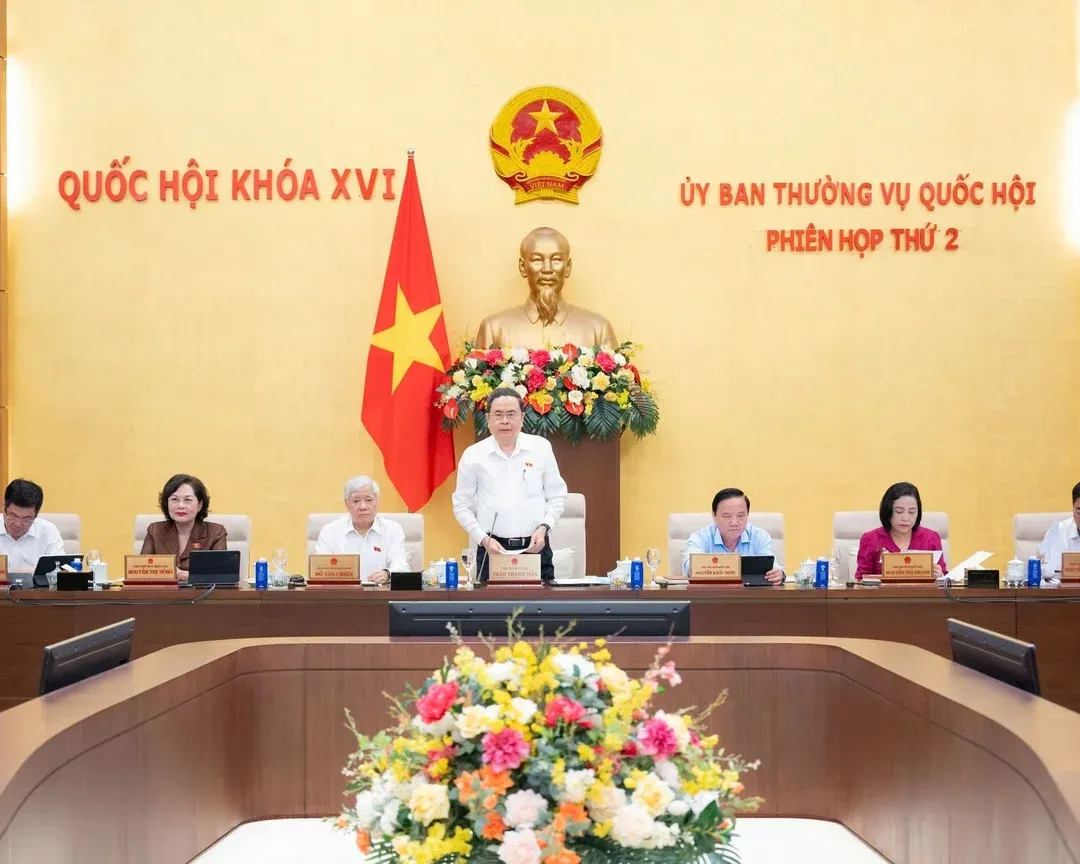

On the morning of November 11, at the second session of the 16th National Assembly, Minister of Justice Hoàng Thanh Tùng, on behalf of the Prime Minister, presented the Government's submission on the draft Law on Commodity Derivatives Trading.Hà Nội Mới According to Tinnhanhchungkhoan, it is the first time the market for coffee, oil, metals and agricultural contracts in Vietnam has had a dedicated law put before the Assembly.Tinnhanhchungkhoan
The proposal that touches active traders most directly is a Clearing Center independent of the commodity exchange, which would handle clearing, hold margin deposits and manage risk. One point up front: this is a draft that has just been submitted. It has not been passed. To see why it appears now, it helps to retrace the market's path from the beginning.
2005: a market that grew inside the Commercial Law
For more than 20 years, exchange-based commodity trading in Vietnam has run under the 2005 Commercial Law.Hà Nội Mới That law treats exchange trading as a commercial activity, not as a financial market handling millions of contracts a year.
For newcomers, a commodity derivative is an agreement to buy or sell a quantity of goods such as coffee, soybeans or crude oil at a price fixed in advance, for a date in the future. Participants do not pay the full value. They post margin, a good-faith deposit that backs their obligations, and gains and losses are settled daily as prices move. So the question of where the margin sits, and who controls it, is really a question about the safety of the money traders have already paid in.
2019 to 2025: volume up about 26 times
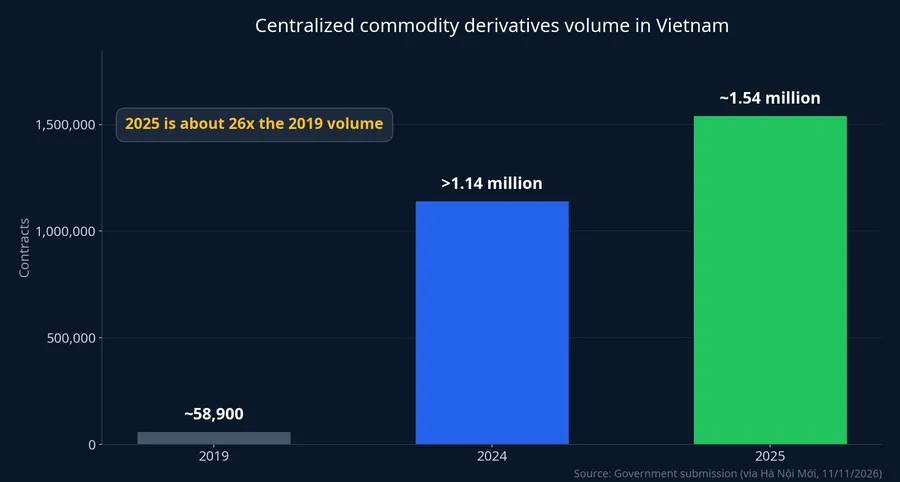
According to the submission, centralized trading volume rose from about 58,900 contracts in 2019 to more than 1.14 million in 2024 and about 1.54 million in 2025.Hà Nội Mới Comparing the first and last points, 2025 volume is roughly 26 times that of 2019.
Average notional trading value is about VND 7,500 billion a day, across roughly 38 commodities and more than 40 contract types.Hà Nội Mới Notional value is the total worth of the goods named in the contracts, not the cash traders actually put up. The real money in an account is the margin, a fraction of that figure. That leverage is exactly why margin handling matters: a sharp price move can produce a loss larger than the deposit, and a clear mechanism is needed to deal with it.
The submission also acknowledges the market's limits: scale, liquidity and clearing infrastructure are still modest, and few producers use the market to hedge. Most products are linked to foreign exchanges, with few contracts based on Vietnamese goods or domestic reference prices.Hà Nội Mới In other words, Vietnamese traders are mostly dealing in contracts priced on overseas exchanges.
Gaps in the old framework: margin, clearing, insolvency
Now that volume has passed a million contracts a year, the Government says in the submission that current rules are fragmented. They do not fully cover all types of derivative contracts, the over-the-counter (OTC) market, margin, clearing, the handling of a party that cannot pay, or real-time market surveillance.Hà Nội Mới
The submission's logic is that the market grew fast inside a legal framework written for a much smaller one, so the areas most sensitive to traders' money are the ones without full rules. That is the drafting body's own assessment, not a conclusion drawn from a specific incident in the market.
September 30 and November 11: an 8-chapter, 57-article draft
Under Conclusion No. 283/KL-UBTVQH16 of September 30, 2026 from the National Assembly Standing Committee, the draft goes to the Assembly for comments at the second session, with review and passage expected at the third.Tạp chí Công Thương The morning of November 11 was that first step. The draft has 8 chapters and 57 articles, was prepared under the Ministry of Industry and Trade, and names the ministry as the overall regulator.Báo Pháp Luật Việt Nam
For people posting margin. The draft splits the market in two: a centralized market through commodity exchanges, and an OTC market through intermediaries. The most notable new element is the Clearing Center, independent of the exchange, which would clear trades, manage margin and risk, and guarantee performance of trading obligations.Hà Nội Mới An exchange may run spot and derivatives markets at the same time, but must keep products, members, accounts, settlement and risk management clearly separate.Báo Pháp Luật Việt Nam For OTC trades, clearing through the center is voluntary, for contracts that meet the clearing rules' criteria.Thời báo Tài chính Việt Nam
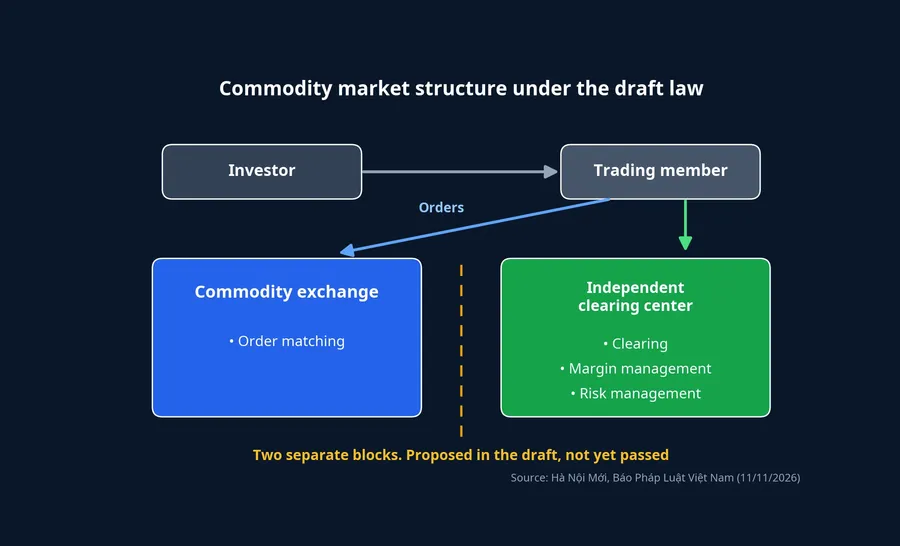
The point of splitting the two institutions is that the place that matches orders and the place that holds the collateral are no longer the same. The draft also sets out early warning, stress testing and emergency intervention to protect system safety.Báo Pháp Luật Việt Nam
For state-owned enterprises. The draft lets state-owned enterprises trade commodity derivatives to hedge risks arising directly from their production and business. Performance would be judged on the whole of the hedging instruments and the risk being protected, not just on the profit or loss of the derivative trades alone.Hà Nội Mới
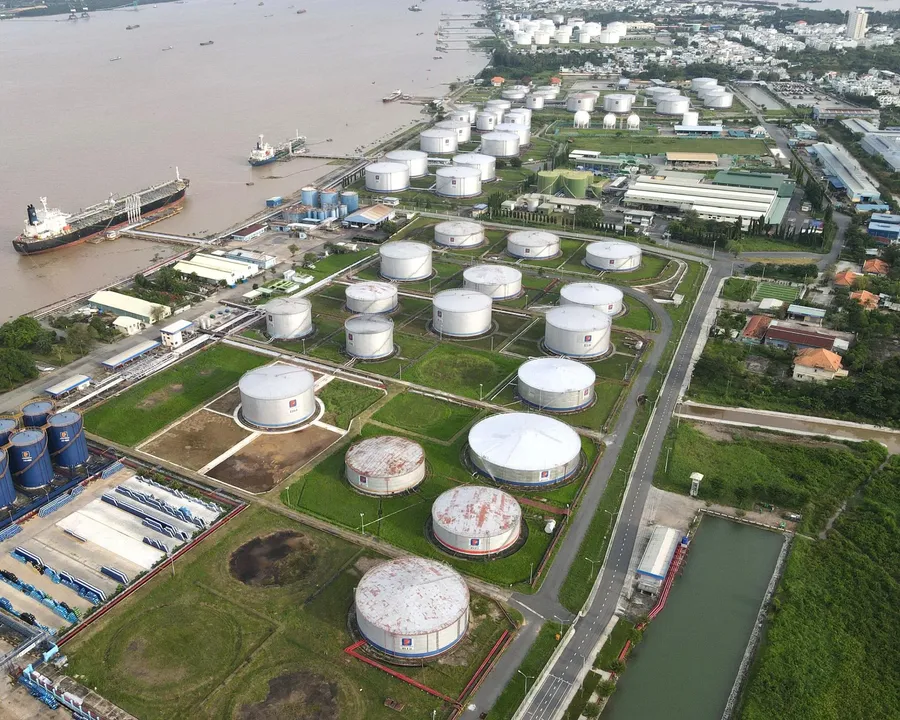
An illustration: a company buys a fuel contract in advance to lock in its cost. If world prices then fall, the derivative loses money, but the physical fuel it buys gets cheaper. Judging performance on the whole looks at both sides at once. For shareholders of listed state-owned firms whose inputs or outputs are commodities, this is a provision to read closely once the law is passed.
For agricultural producers. The draft states its aim as giving businesses, cooperatives and producers a way to hedge price swings, tying derivatives trading to production, processing and exports.Báo Pháp Luật Việt Nam The Ministry of Industry and Trade's 2026–2030 market development plan targets 10 domestically produced commodities on the market by 2030, reference prices for 3 to 5 of them, and 8 to 10 million contracts a year.Báo Pháp Luật Việt Nam Against about 1.54 million contracts in 2025, that means the market growing roughly 5 to 6.5 times in five years.

What the review committee wants changed
Phan Văn Mãi, Chairman of the National Assembly's Economic and Financial Committee, presented the review report. The committee agrees the law is needed but asks for changes on several points.Tạp chí Công Thương
On investor protection, the committee asks for a review of how investors are classified by their ability to understand products, bear risk and their purpose in trading, for safeguards against information asymmetry between product providers and investors, and for segregated, safe handling of clients' cash, margin assets and rights.
On structure, it asks for a comparison of ownership options for the exchange and the clearing center, and a review of foreign ownership limits and conflicts of interest to keep the two institutions independent. It also stresses that participation must be voluntary: the state should not require trading through the exchange, as that would weaken competing channels and raise intermediary costs.
On cross-border links, where most products pass through today, the committee asks for a review of how foreign counterparties are chosen, and of foreign exchange and margin flow monitoring. For the controlled sandbox, it asks that the law itself set margin levels, which investors may take part, and the separation of sandbox assets from ordinary trading assets.
Next step: from draft to law
The market sits in the middle: there is a draft, not yet a law. Under the Standing Committee's plan, the draft gets comments at this session and is expected to be reviewed for passage at the third. In between, the drafting body will absorb delegates' comments and the review report to revise the text. Only when the law is passed and takes effect will the Clearing Center and the margin rules apply. Until then, traders remain under the current framework.
The draft's direction is clear: separate the place that matches orders from the place that holds collateral. How much protection margin traders actually get will depend on the revised draft at the next session, and two points deserve a close read. First, whether the proposal to segregate clients' cash and margin assets is written into specific articles. Second, whether investor classification comes with product limits or margin levels for individuals. If both are spelled out, traders will have a concrete provision to rely on. If the law stays at general principles, the details may wait for an implementing decree, and the date worth waiting for moves further out.
What investors may consider: ask the member firm where your account sits which account your margin is held in, and whether it is kept separate from the firm's own money.