

On November 6, 2026, the board of Vinhomes JSC (VHM) issued Resolution No. 61/2026/NQ-HĐQT-VH, revising the projected total investment for the Hanoi International Sports City (formerly the Olympic Sports City). The figure moves from about VND 925,651 billion, set by a board resolution dated March 18, 2026, to about VND 1,225,011 billion.CafeF That is an increase of nearly VND 299,360 billion, or more than 32%.Người Quan Sát
For Vinhomes shareholders, the question is how much the company's own share rises. The company starts from a solid position: third-quarter profit topped VND 23,000 billion, about five times the same period last year.Viettimes This post sets the new equity obligation against that balance sheet.
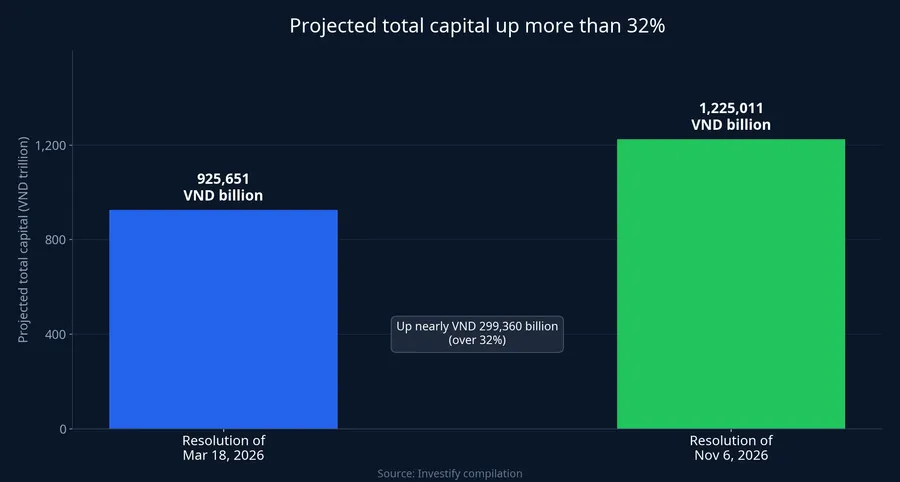
One caveat first: the figure is still a projection. Vinhomes states in its disclosure that actual total investment will be decided by the competent state authority.Market Times
The capital split is unchanged, so Vinhomes' share rises with it
What the new resolution does not change is how funding is divided. The investor consortium's equity is at least 15% of total investment, and Vinhomes contributes 35% of that equity. Mobilized capital is capped at 85% of the total.CafeF With the ratios fixed, every component grows with the total. The table below is Investify's calculation, applying the disclosed ratios to both totals.
| Item | Old scale | New scale | Difference |
|---|---|---|---|
| Projected total capital | about VND 925,651bn | about VND 1,225,011bn | nearly VND 299,360bn |
| Consortium minimum equity (15%) | about VND 138,848bn | about VND 183,752bn | about VND 44,904bn |
| Vinhomes' minimum equity (35% of 15%) | about VND 48,597bn | about VND 64,313bn | about VND 15,716bn |
| Mobilized-capital ceiling (85%) | about VND 786,803bn | about VND 1,041,259bn | about VND 254,456bn |
Rounded, Vinhomes' minimum equity goes from about VND 48,600 billion to about VND 64,300 billion, up nearly VND 15,700 billion. The mobilization ceiling moves from about VND 786,800 billion to about VND 1.04 quadrillion, past the VND 1 quadrillion mark.
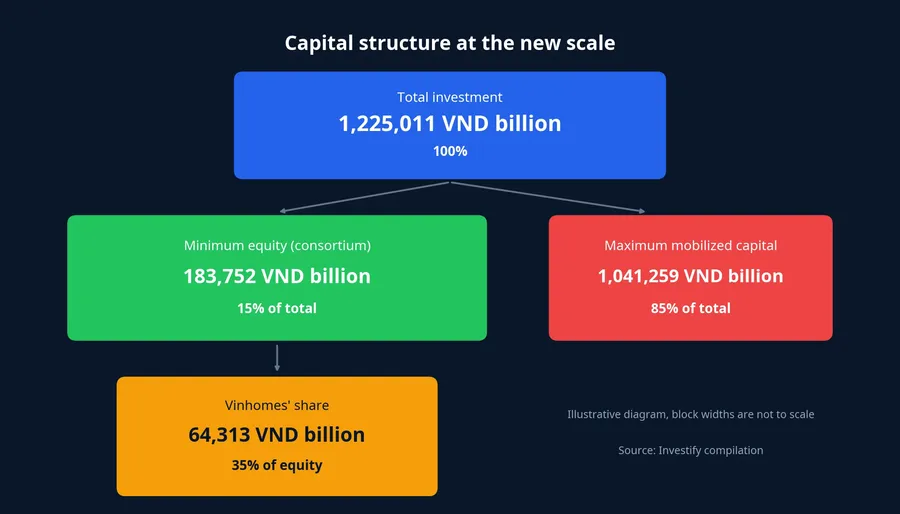
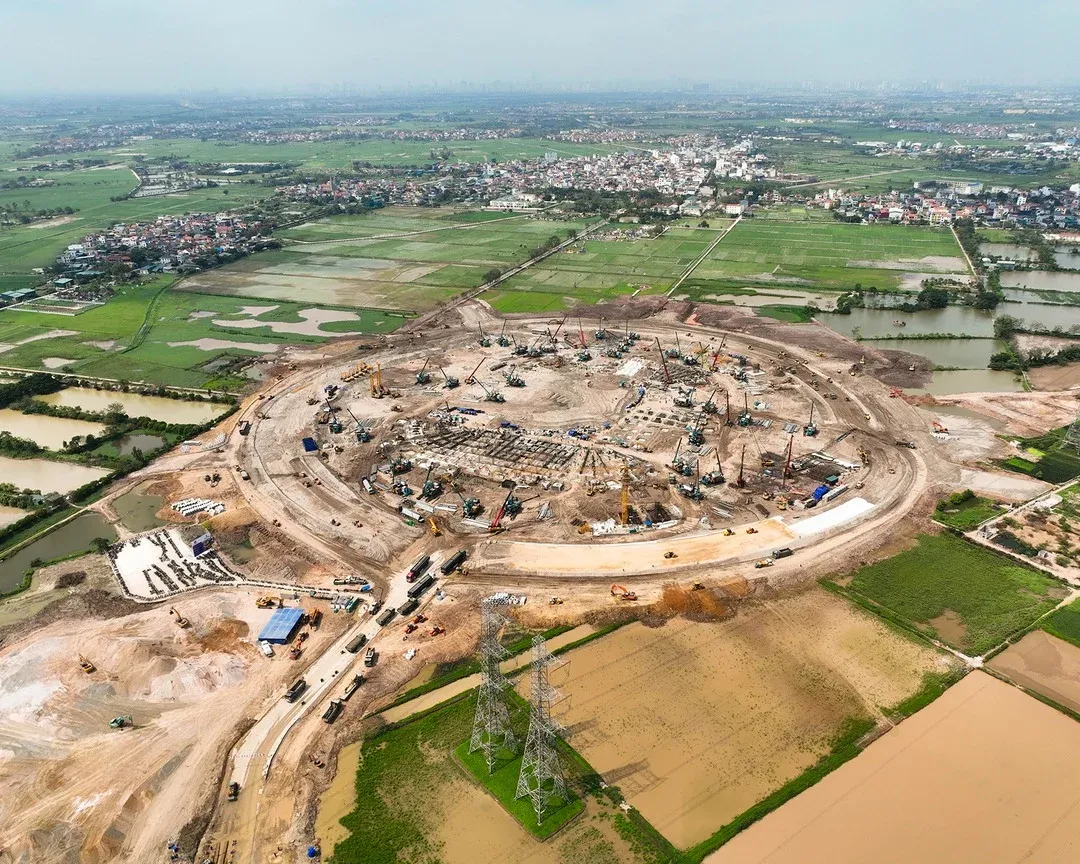
The VND 64,313 billion needs to be read for what it is: a minimum calculated from ratios, on a total still awaiting approval, contributed gradually over the project's life. Construction began on December 19, 2025, and the target is full completion in Q4 2030.Market Times It is not a sum Vinhomes pays in one go.
Who sits alongside Vinhomes in the consortium
On October 19, 2026, the Vinhomes board issued Resolution No. 55/2026/NQ-HĐQT-VH amending the investor consortium contract signed on December 10, 2025. The reason: two original members had merged into VinFast-named companies. Ngọc Hồi Real Estate Investment JSC merged into VinFast Vietnam JSC, and Tương Lai Research, Investment and Development JSC merged into VinFast Manufacturing and Trading JSC, now renamed Tương Lai Manufacturing, Investment and Development JSC.CafeF
The surviving companies inherit all rights and obligations in the consortium. It now comprises Vinhomes, VinFast Vietnam, Tương Lai Development and Ngọc Quý Investment and Trading Development Co. Ltd. Per the disclosure, VinFast Vietnam and Tương Lai Development are related parties of Vinhomes, and each member is responsible for, and may represent the consortium in, raising capital for the project.
The resolution also contains a collateral clause. If the other members agree, Vinhomes may use project assets or asset rights to secure its own obligations. It may also use the portion of project assets allocated to its 35% stake to secure the obligations of any consortium member, including VinFast Vietnam and Tương Lai Development. The value of secured obligations must fall within the board's approval authority.CafeF For shareholders, this opens the possibility that Vinhomes' share of project assets backs a loan taken by a related company. Each use must go through the board, so future board resolutions are where shareholders can check.
Set against Vinhomes' balance sheet
According to the Q3 consolidated financial statements, Vinhomes' consolidated equity at September 30, 2026 was VND 307,792 billion, up 24% from the start of the year. Total assets exceeded VND 1.3 quadrillion, up 69%.Viettimes
The project's new projected total is about 3.98 times Vinhomes' consolidated equity, but that comparison misleads: VND 1,225,011 billion is the whole consortium's capital, mostly borrowed or mobilized. The closer comparison is Vinhomes' minimum equity. About VND 64,313 billion equals roughly 20.9% of consolidated equity at September 30, and the increase of about VND 15,716 billion equals roughly 5.1%.
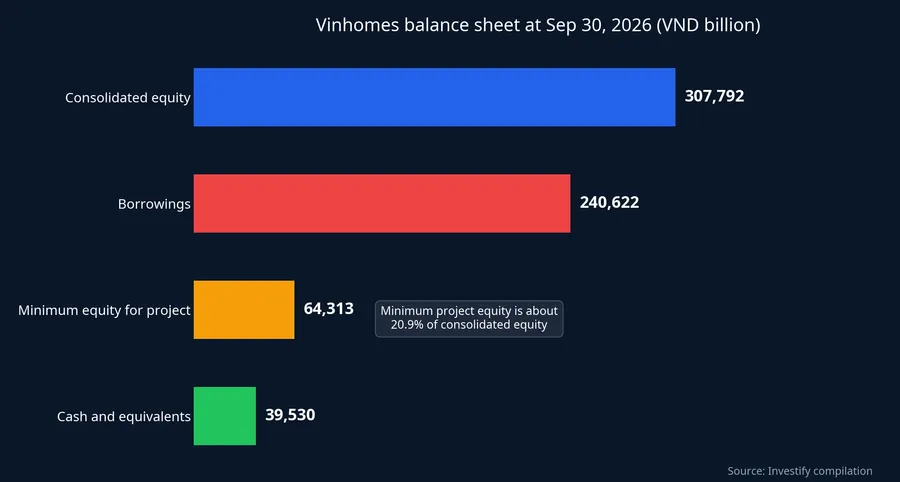
On cash, Vinhomes held VND 39,530 billion in cash and equivalents at September 30, down 19% from the start of the year. Short-term borrowings and finance leases were VND 65,251 billion and long-term ones VND 175,371 billion, together about VND 240,622 billion.Mekong ASEAN Vinhomes says borrowings equal 0.18 times total assets and interest coverage is 11.3 times, both improved from 2025.Viettimes On the inflow side, sold-but-undelivered sales stood at VND 185,600 billion at the end of Q3. Customers pay that amount in installments, so it is a source of cash for projects under way.Viettimes
On that evidence, Vinhomes' own equity share is a sum the balance sheet can carry: large, but contributed gradually through 2030. What matters more is the rest of the project, the mobilization ceiling above VND 1 quadrillion, and where and how fast it will come from.
Mobilized capital is the bigger variable
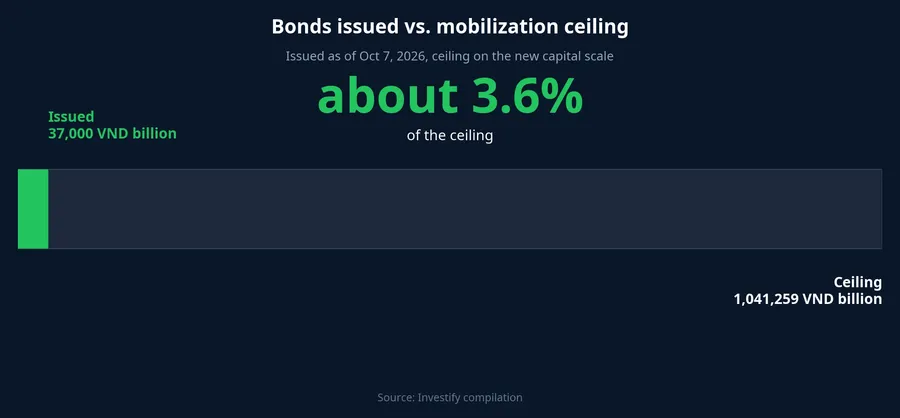
According to Hanoi Department of Construction data published by Vietstock on November 5, the developer had issued VND 37,000 billion in bonds for the project as of October 7, 2026. The mobilization plan is VND 237,000 billion for residential works and VND 138,000 billion for non-residential real estate, both drawn up on the old capital scale.Vietstock
Set against the new ceiling of about VND 1,041,259 billion, the VND 37,000 billion raised is about 3.6%. That is normal for a project under 11 months into construction, whose first phase centers on the 135,000-seat stadium, about 60% complete by volume per the October 2026 progress report.Market Times Still, the gap shows most of the project's funding need lies ahead.
The larger commitment makes two cash flows matter more to Vinhomes: the pace of consortium bond issuance and borrowing, and the pace of collections from the residential portion once sales open. If both keep up with construction, Vinhomes' equity can be contributed gradually without heavily drawing on corporate cash. If mobilized funds arrive slower than construction, consortium members, Vinhomes included, will have to advance more or borrow more.

Conclusion and milestones to watch
The thesis is straightforward. With the 15/85 split unchanged, Vinhomes' minimum equity obligation rises more than 32% in line with the total, from about VND 48,600 billion to about VND 64,300 billion, yet it stays within reach of a balance sheet with VND 307,792 billion in equity and 11.3 times interest coverage. The deciding variable is capital mobilization, not the equity figure.
The next milestone is the competent authority's document fixing actual total investment. It will show whether VND 1,225,011 billion stands, and with it Vinhomes' official minimum equity. In coming quarterly reports, the two lines to read side by side are customer collections and borrowings. If collections grow faster than borrowings, the project is largely funding itself. If borrowings grow faster, more of the project's capital is shifting onto Vinhomes' balance sheet.