
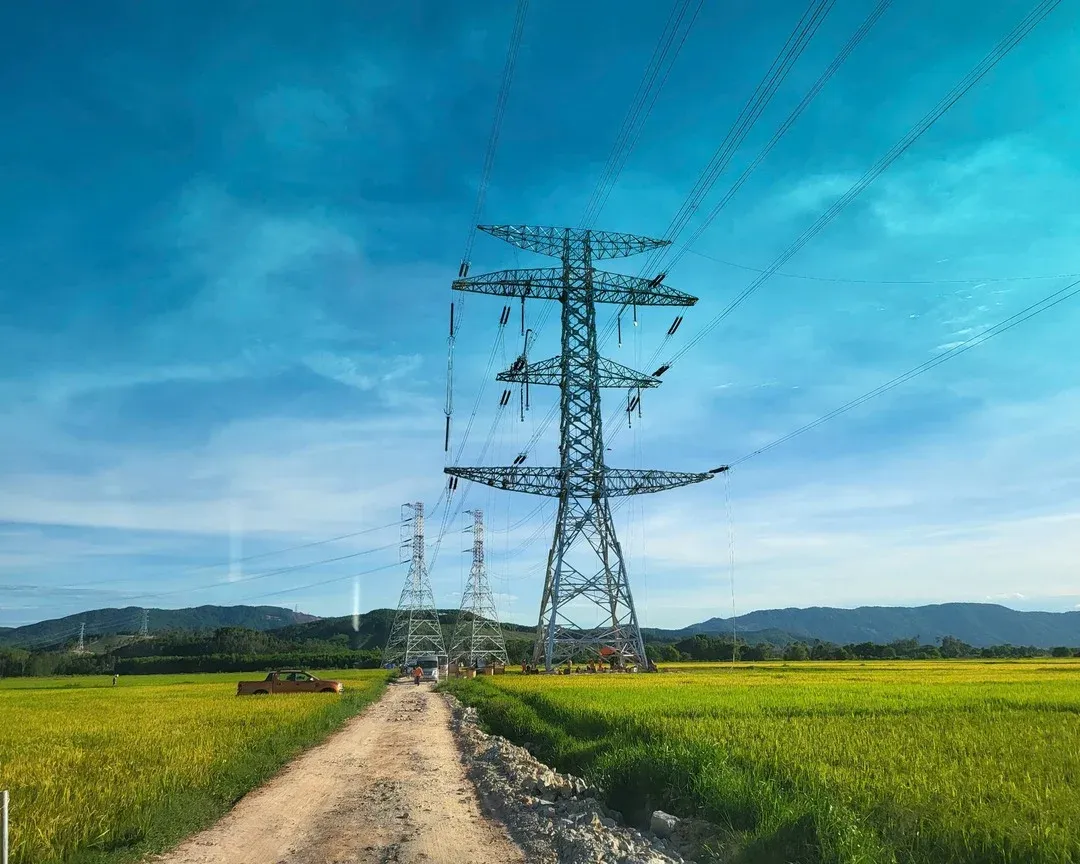

Vietnam Electricity (EVN) needs more capital just as the law forces each bank to lend less to any single borrower, year by year. Those two opposing trends are the backdrop to the proposal EVN put forward on November 10.
At the 2026 National Energy Security Forum, Nguyen Tai Anh, Deputy General Director of EVN, proposed that loans for key national power projects be excluded from the credit limits under the Law on Credit Institutions. He also called for wider access to green credit, bonds and international capital.FireAnt This is a company proposal addressed to the government and ministries, not a rule in force.

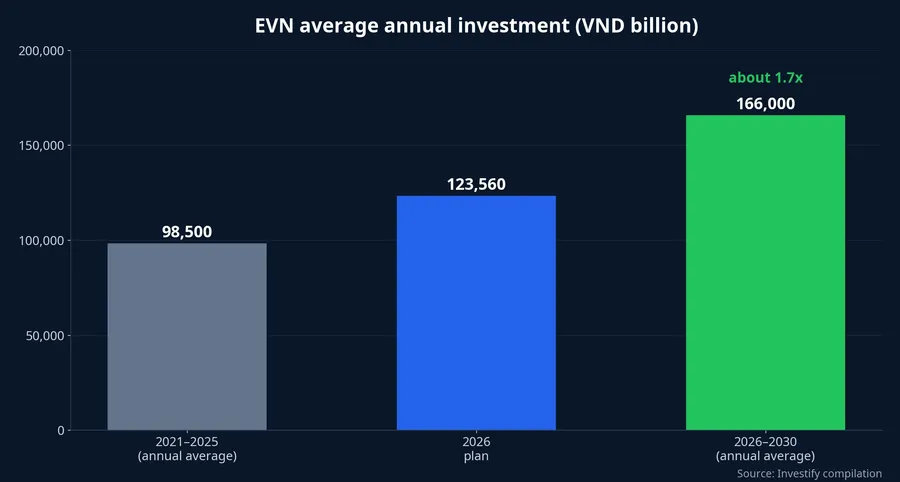
Capital needs up almost 1.7 times
According to Mr. Anh, EVN expects to invest about VND 830,000 billion over 2026–2030, an average of VND 166,000 billion a year and the largest program in the group's history.Báo Xây dựng Over 2021–2025, EVN's total investment came to VND 492,483 billion, or 102.8% of plan. Spread over five years, that is about VND 98,500 billion a year, so the new average is roughly 1.7 times higher.
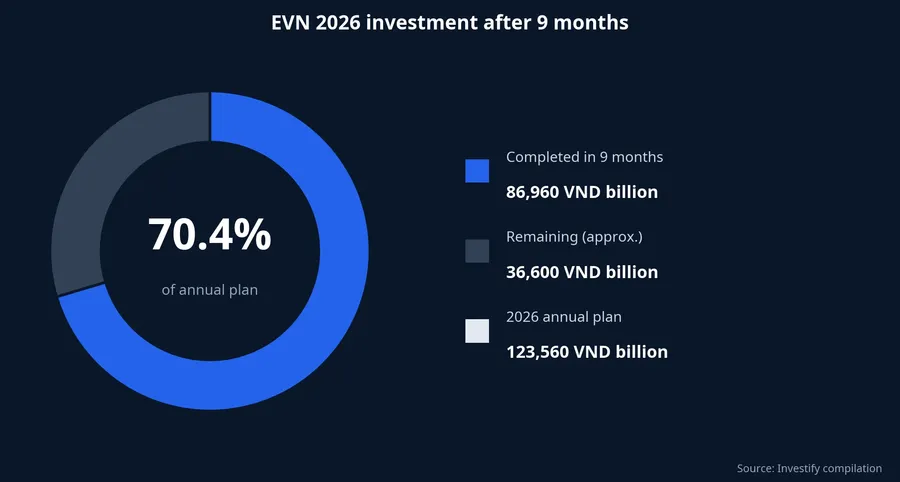
Even 2026 has not reached that level. The full-year plan is VND 123,560 billion, and VND 86,960 billion, or 70.4%, was completed in the first nine months.Báo Xây dựng To reach an average of VND 166,000 billion, annual spending would have to run about 34% above this year's plan.
The push comes from the demand side. Commercial electricity grew 9.84% in the first ten months of 2026, for the first time roughly in line with GDP growth. System peak load set a record of 57,537 MW on June 24, 2026, with the North reaching 30,279 MW, close to the safe operating limit for voltage stability.FireAnt Deputy Minister of Industry and Trade Nguyen Viet Son warned that 2027 will be difficult and 2028 harder still, with demand continuing to grow about 10% on a high base while new baseload capacity is not yet online.FireAnt
The money is spread across a large number of projects. Over 2026–2030, EVN and its units aim to complete 15 power source projects with a combined 6,066 MW. The National Power Transmission Corporation expects to finish 292 grid projects at 500–220 kV, while the power corporations are to complete about 1,320 projects at 110 kV.FireAnt
The single-borrower cap steps down every year
On the banking side, a rule runs the other way. Article 136 of the 2024 Law on Credit Institutions caps the total outstanding credit a commercial bank can extend to one customer, and to one customer plus related persons, on a declining schedule:Government Portal
- 2026: 13% of equity for one customer, 21% for one customer and related persons.
- 2027: 12% and 19%.
- 2028: 11% and 17%.
- From January 1, 2029: 10% and 15%.
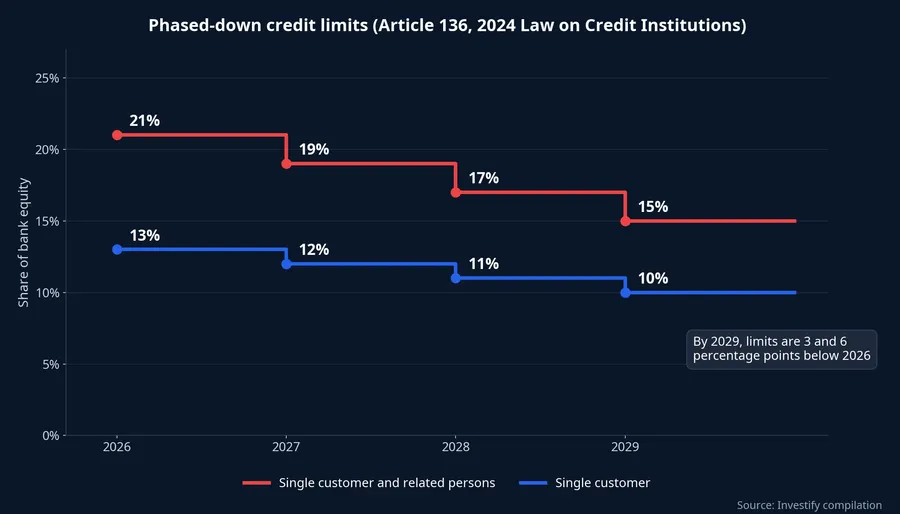
The rule exists so that no bank piles too much of its equity onto one borrower. If that borrower runs into trouble, the loss is not big enough to sink the whole bank.
For EVN, the group-level figure is the one to watch. The law defines related persons to include a parent company and its subsidiaries, and subsidiaries of the same parent.Government Portal EVN and its generation, transmission and distribution corporations therefore share a single limit at each bank.
Take a hypothetical bank with VND 100,000 billion of equity. In 2026, total lending to the whole EVN group at that bank is capped at VND 21,000 billion. From 2029, the cap is VND 15,000 billion, based on the Article 136 ratios. The ratio falls about 29% in three years, so to keep the absolute amount available to the EVN group unchanged, the bank's equity would have to grow about 40%, or roughly 12% a year.
The arithmetic cuts both ways. A bank that grows equity faster than that still gains room to lend to EVN despite the tighter ratio. A bank that grows equity more slowly sees its room shrink. The effect therefore differs from bank to bank.
Two exits already exist, EVN asks for a third
The law does not close the door on large customers. Clause 6 of Article 136 allows banks to arrange syndicated credit when a customer's needs exceed the limit, meaning several banks share one loan. Clause 7 opens another door: in special cases, for an economic and social task that syndication cannot meet, the Prime Minister decides the maximum credit above the limit case by case. Clause 8 caps that route too: a bank's total above-limit exposure may not exceed four times its equity.Government Portal
The State Bank's consolidated circular on safety limits, dated October 14, 2026, also states that for programs and projects under a Government or Prime Minister decision, the project's funding and outstanding debt are treated according to that decision when determining the limit.Government Portal
The November 10 proposal therefore differs from today's mechanism in method. At present, each loan above the cap is a separate decision, reviewed case by case. EVN wants the whole class of loans for key national power projects to sit outside the limit from the start.
Bonds do not loosen the knot by themselves
Among the channels EVN proposed, bonds carry a point that is easy to miss. Clause 4 of Article 136 says total exposure counted against the limit includes holdings of and investments in bonds issued by the customer and related persons.Government Portal EVN bonds bought by a bank are still added to the same limit as loans. The channel eases pressure on the lending cap only when buyers are funds, insurers, non-bank investors or foreign capital.
The second channel works differently. EVN proposed a reasonable transmission price mechanism to draw other economic sectors into investing in the grid under the 2024 Electricity Law, easing capital pressure on EVN and the National Power Transmission Corporation.FireAnt When private investors fund the lines themselves, the borrowing sits on another owner's books and does not add to the EVN group's total at the bank. Of the three routes, it is the only one that shrinks the EVN group's borrowing need rather than just moving where the debt is recorded.
Who gains and who carries more if the proposal is accepted
Banks that already lend to EVN gain room to disburse to a large customer with steady demand and ties to state priorities. In return, more of their loan book would sit with one group than Article 136 was designed to allow. Concentration risk does not disappear when loans fall outside the limit; it simply stops being captured by the limit ratio.
Bank shareholders therefore get both sides at once: a steadier source of credit growth, but asset quality tied more closely to the financial health of a single group. The degree varies by bank, depending on how much of its equity the EVN exposure represents.
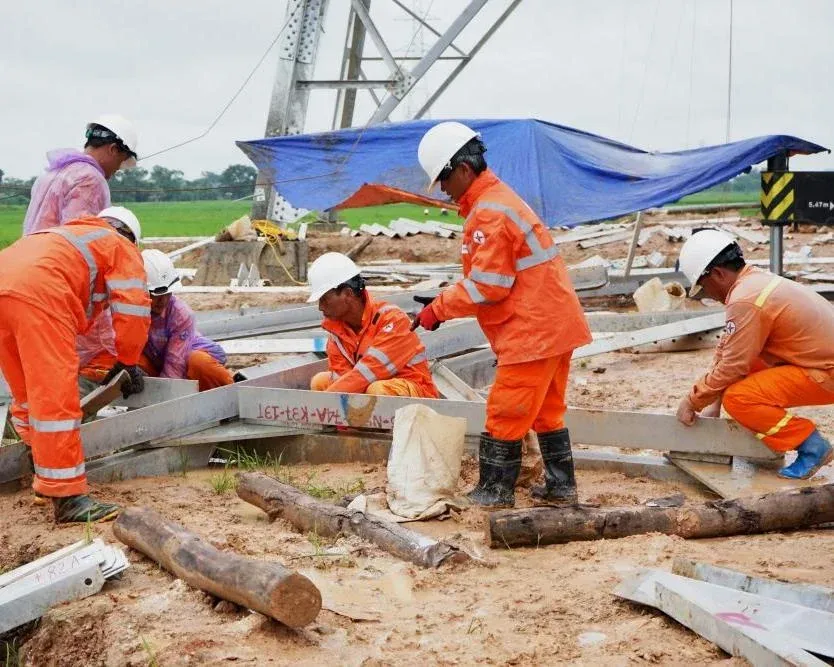
Construction and electrical equipment firms depend on projects being funded on time. With about 1,320 projects at 110 kV and 292 at 500–220 kV in the plan, their order books follow EVN's disbursement pace.FireAnt The faster the funding is arranged, the sooner orders arrive.
How to read the proposal
For holders of bank stocks, this is a proposal that raises lending room but also raises concentration risk, not one-way good news. For holders of power construction stocks, the variable to watch is EVN's disbursement pace in the final quarter. Hitting the VND 123,560 billion plan means about VND 36,600 billion still to go after VND 86,960 billion in nine months.Báo Xây dựng
Whether the mechanism is applied will be settled by a Government or State Bank document responding to the proposal.