
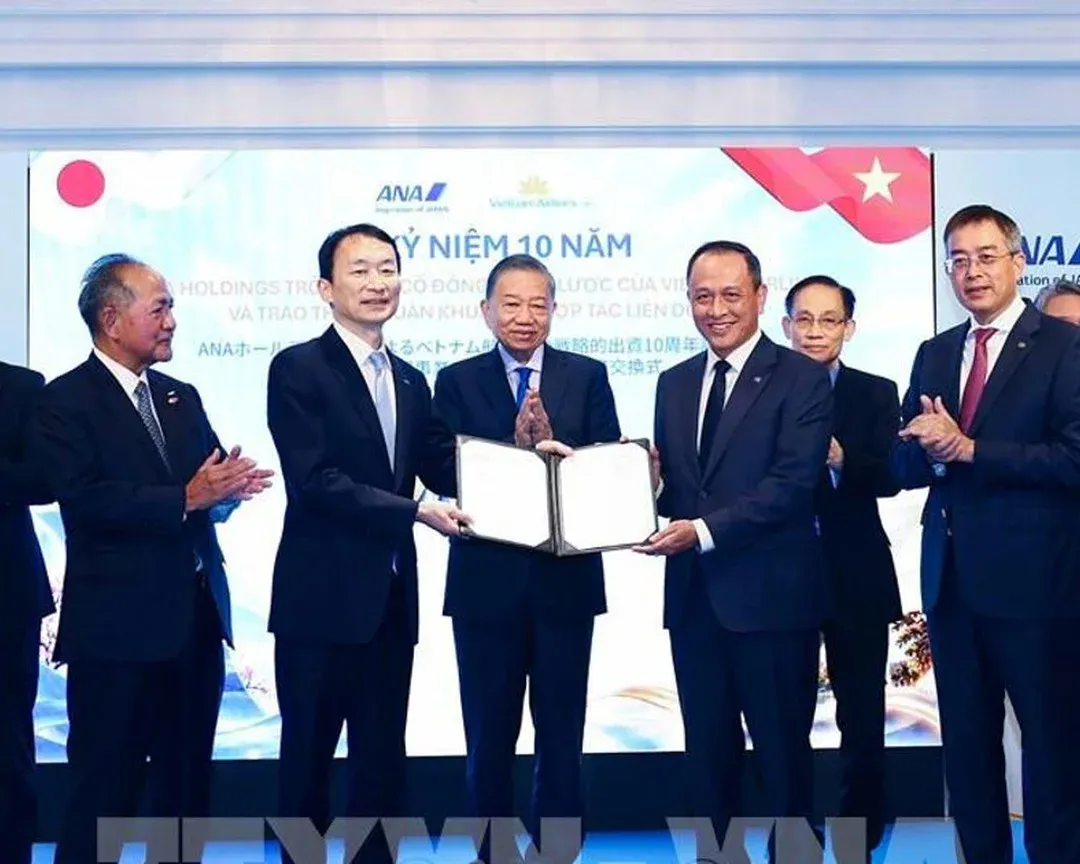

At midday on 9 November 2026 in Tokyo, Vietnam Airlines (HVN) and ANA Holdings signed a framework agreement on a joint venture covering routes between Vietnam and Japan. The signing took place at an event marking ten years of strategic cooperation between the two carriers, attended by General Secretary and State President To Lam during his official visit to Japan.Người Quan Sát
The agreement adds something the previous decade of cooperation lacked: revenue sharing. According to reports published the same day, the two airlines plan to share revenue and to coordinate schedules, fares, inventory management, sales, marketing and passenger services on routes between the two countries.VietnamNews Implementation depends on approval from the competent regulators.
Put simply, the airlines used to sell seats on each other's flights. Now they want to split the money those seats bring in. To see how big that step is, it helps to place it in the sequence of stages the two carriers have gone through since 2016.
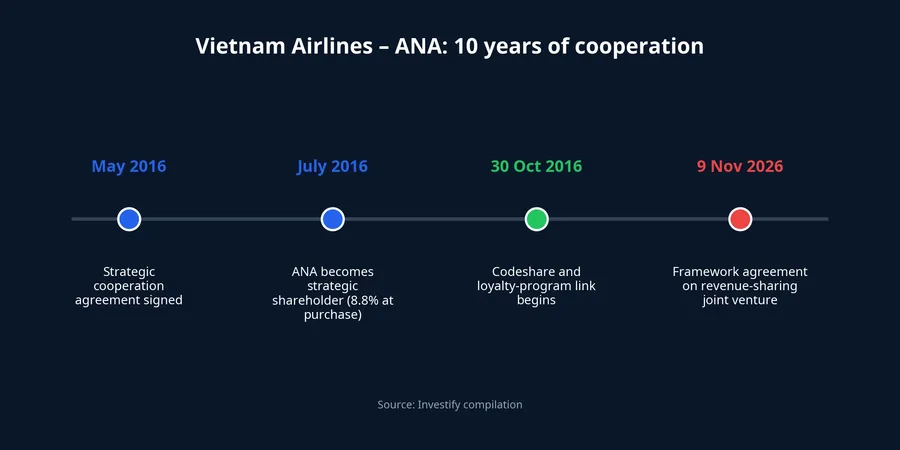
Stage one, 2016: ANA becomes a shareholder
In May 2016 the two airlines signed a strategic cooperation agreement in Tokyo. Two months later, ANA Holdings formally became a strategic shareholder of Vietnam Airlines.Nhà báo & Công luận ANA bought an 8.8% stake from the Vietnamese government.VietnamFinance
At this stage the two were tied together through equity, not ticket revenue. ANA received the benefits of a shareholder, while on each route every airline still sold its own tickets and booked the revenue from its own flights.
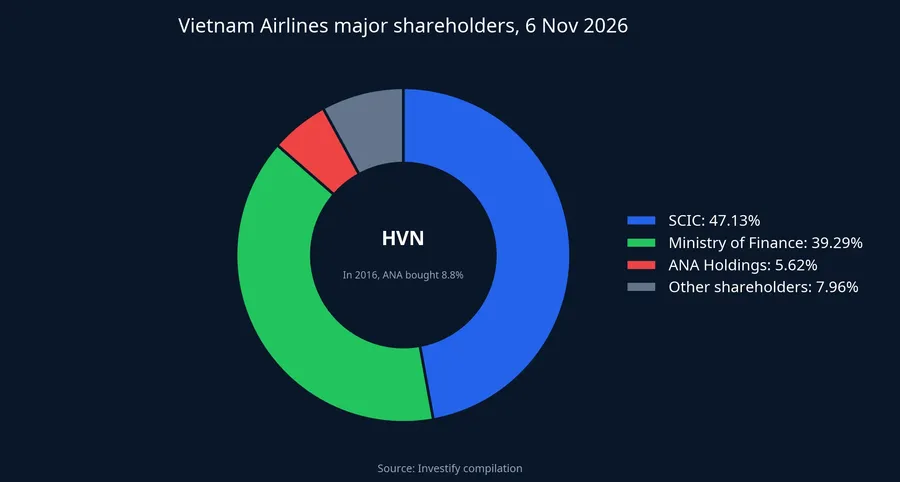
The 8.8% figure is the level at purchase. After several share issues by Vietnam Airlines over the past decade, shareholder data as of 6 November 2026 shows ANA Holdings holding 175,014,530 shares out of 3,111,498,211 outstanding, or 5.62%. The two state shareholders are SCIC at 47.13% and the Ministry of Finance at 39.29%. ANA remains the third-largest shareholder, though its stake is well below the 2016 level.
Stage two, late 2016: codeshare and loyalty link
On 30 October 2016, the first day of that year's winter schedule, the two airlines began codesharing and linked their frequent-flyer programs. According to ANA's press release, the initial codeshare covered 10 international routes between Japan and Vietnam and 25 domestic routes in the two countries. Members of ANA Mileage Club and Lotusmiles could earn miles on each other's codeshare flights.ANA
A codeshare means one airline puts its own flight number on a flight operated by the other, so it can sell extra seats on that flight. A passenger who buys an ANA ticket may sit on a Vietnam Airlines aircraft. Even so, each airline still sets the schedule and price for its own flights, and as a rule the revenue from a flight is booked mainly by the carrier that operates it. The two cooperate on selling, yet remain two separate revenue streams on the same route.
Over these ten years the two sides also worked together on engineering, maintenance, training, ground handling, catering and cargo. The technical support agreement between them was extended at the 9 November signing.VietnamNews
Stage three, 9 November 2026: toward a revenue-sharing joint venture
In aviation, the model the two airlines are moving toward is called a joint venture. According to Vietstock, citing Nikkei Asia, it lets the carriers align schedules, coordinate fares and share revenue on Japan–Vietnam routes.Vietstock Reports describe it as a business-cooperation arrangement between the two airlines, not the creation of a new company.
Compared with a codeshare, a joint venture pools the money as well. When revenue on the shared routes is split under a pre-agreed mechanism, which airline's aircraft the passenger sits on no longer decides each carrier's full take. That gives the two a reason to schedule flights so connections are easy, rather than stacking competing departures in the same time slot.
Also per Nikkei Asia, the airlines expect coordinated schedules and fares to make connecting itineraries more attractive, while reorganizing routes with overlapping schedules should optimize capacity and cut operating costs.MarketTimes For passengers, the flip side of consolidating overlapping routes is that fewer parallel flights may leave at the same hour.
This is not a new model for ANA. The Japanese carrier already runs similar joint ventures with United Airlines, Lufthansa and Singapore Airlines.VietnamFinance One notable detail: ANA belongs to Star Alliance and Vietnam Airlines to SkyTeam, so this cooperation goes further than the alliance framework each carrier sits in.
How big is the market being pulled into the shared mechanism?
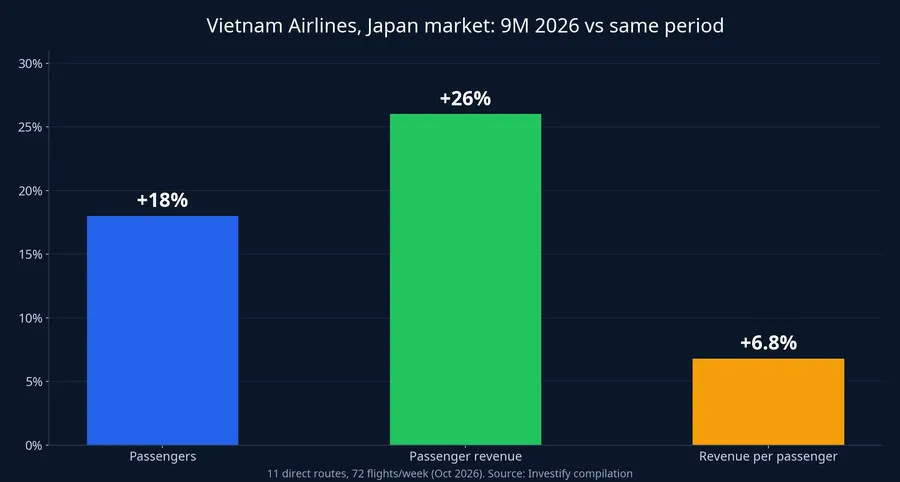
As of October 2026, Vietnam Airlines operates 11 direct routes between the two countries, with 72 flights a week. In the first nine months of 2026, its passenger numbers on the Japan market rose 18% and passenger revenue rose 26% year on year.Người Quan Sát
Revenue grew faster than passenger numbers, meaning each passenger on this market brought in more money than a year earlier. Calculated from those two figures, average revenue per passenger rose about 6.8% year on year.
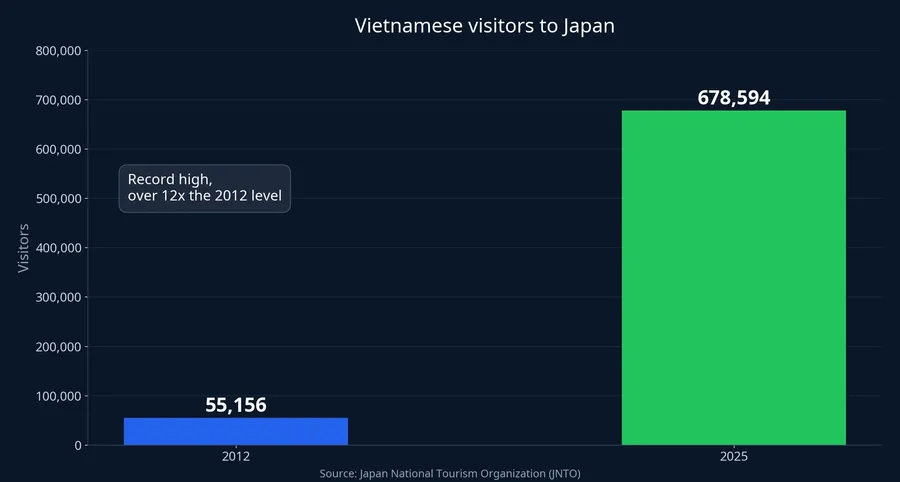
Travel demand between the two countries has also grown considerably. According to the Japan National Tourism Organization, Japan received 678,594 Vietnamese visitors in 2025, a record, versus 55,156 in 2012.MarketTimes The portion going into the shared mechanism is therefore a fast-growing international market for Vietnam Airlines, not a side route.
Context: traditional carriers in the region are moving closer
The agreement arrives while operating costs remain high. According to IATA data, the global average jet fuel price in the week ending 6 November was USD 178.95 per barrel, 98.8% above the 2025 full-year average.VietnamFinance
Other carriers in the region are also deepening cooperation. Japan Airlines, ANA's rival at home, signed a strategic partnership with Korean Air in September. Singapore Airlines and Malaysia Airlines introduced joint fares for the Singapore–Kuala Lumpur sector in June, under their joint venture.Vietstock
Mr. Le Hong Ha, General Director of Vietnam Airlines (Vietnam Airlines JSC, HVN), said the agreement focuses on the Japan–Vietnam market but could serve as a foundation for expanding cooperation to routes linking Vietnam with North America, or North America with Southeast Asia.VietnamFinance
Next step: approval in two countries
The agreement signed on 9 November is a framework. An ANA spokesperson said the two airlines still need approval from Japanese and Vietnamese authorities for an antitrust exemption before implementation.MarketTimes
Two carriers serving the same market while aligning fares and schedules need an exemption under the competition law of both countries. In Vietnam, applications for an exemption for this type of agreement go to the National Competition Commission. In Japan, for ANA's earlier joint ventures, the Ministry of Land, Infrastructure, Transport and Tourism granted the exemption. For example, ANA's cargo joint venture with United Airlines filed in November 2014 and received an exemption on 8 April 2015.ANA That is a precedent from a different joint venture, not a timeline forecast for this one.
What changes for Vietnam Airlines
Once the joint venture is approved and operating, Vietnam Airlines' Japan revenue will be tied to the combined results of both carriers on these routes, rather than depending only on flights carrying a Vietnam Airlines flight number. The 26% rise in Japan-market passenger revenue over nine months is Vietnam Airlines' result alone. After the joint venture starts, the equivalent figure will also reflect how the two carriers split schedules, seats and money.
For passengers, the agreement aims to improve booking, connections and frequent-flyer benefits.Nhà báo & Công luận These changes will appear only once the airlines publish joint schedules and fare products.
Until then, the way the two split passengers and revenue stays as it has been for ten years. The exemption decisions in both countries, together with the airlines' announcement of a start date and their revenue-split formula, will show when the joint venture begins and how the Japan business contributes to HVN under the new arrangement.