

From November 10, 2026, five individuals will be barred from trading securities for 2 years. Only one of them directly used multiple accounts to trade BCE shares. The other four lent their accounts or held shares as nominees. What stands out is that the review identified no unlawful gain, either for the trader or for the four who supplied accounts.
Why does a case with "no profit" still draw a heavy penalty, and why is someone who only lent a name barred just like the person who placed the orders? The answer matters to anyone who has ever considered letting an acquaintance use their brokerage account.
The decisions announced on November 6
On November 6, the State Securities Commission (SSC) announced penalties and preventive measures tied to trading in BCE shares, issued by Binh Duong Construction and Transportation Joint Stock Company.Thời báo Tài chính Việt Nam
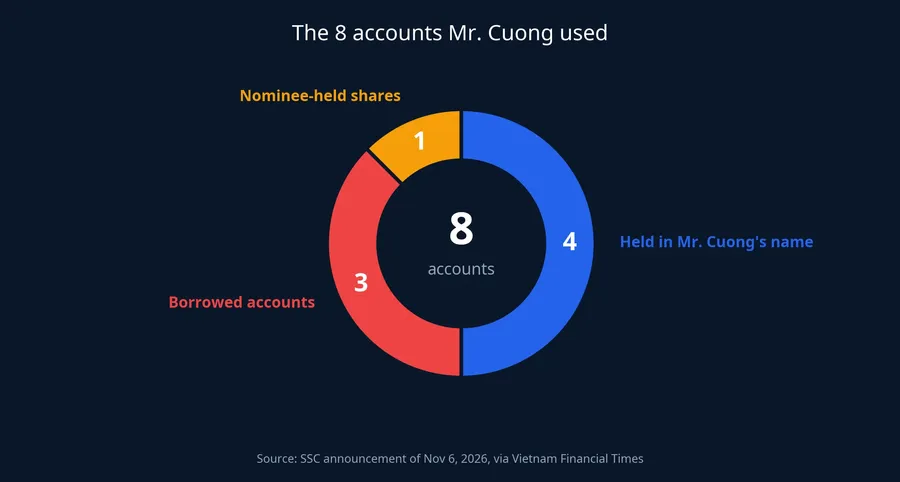
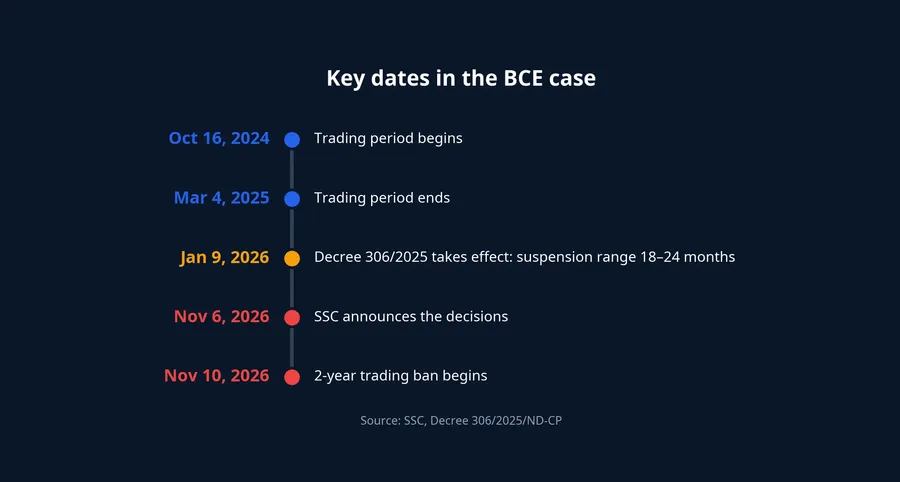
Decision 672/QĐ-XPHC fined Mr. Lê Việt Cường, an individual investor residing in Long Nguyen ward, Ho Chi Minh City, VND 1.5 billion for market manipulation. Between October 16, 2024 and March 4, 2025, he used a total of 8 accounts to trade BCE: 4 in his own name, 3 borrowed from other investors, and 1 held in another person's name on his behalf. The review and calculations found no unlawful gain from the violation.Thời báo Tài chính Việt Nam
The same day, Decision 674/QĐ-UBCK barred Mr. Cuong from trading securities for 2 years starting November 10, 2026. During that period he also cannot hold positions at securities firms, fund management companies or securities investment companies, a professional consequence and not just time spent outside the market.Thời báo Tài chính Việt Nam
The other four are Ms. Lê Mộng Thái Thương, Ms. Lê Mộng Trúc Quỳnh and Ms. Nguyen Susan Ha, who lent Mr. Cuong their accounts, and Ms. Trương Kim Duyên, who held securities in her name on his behalf. Decision 673/QĐ-XPHC suspended all four from securities trading for 9 months. Decision 675/QĐ-UBCK also bars them from trading and from the same positions for 2 years from November 10, 2026.Tin nhanh Chứng khoán All four decisions target individuals. The company that issued BCE is not named in them.
Manipulation is defined by how you trade, not by profit or loss
Many newer investors ask the same thing first: if no money was made, how is it manipulation? The answer is in the definition. Decree 156/2020/NĐ-CP describes market manipulation through a list of trading patterns. The first is using one or more accounts, your own or others', or colluding, to buy and sell continuously in order to create false supply and demand. Others include placing buy and sell orders for the same stock in a day with no real change of ownership, or trading dominant volume at the open or close to set a new price.Decree 156/2020/NĐ-CP
None of those descriptions requires the person to have made a profit. What is punished is building a picture of supply and demand that does not exist on the price board. Other investors read that board to decide whether to buy or sell, so the harm can land on them, whether the person who built the picture ended up ahead or behind. In the BCE case, the decisions specify the number of accounts and nearly five months of trading, while the financial result was calculated separately. The two are independent: no profit does not erase the conduct.
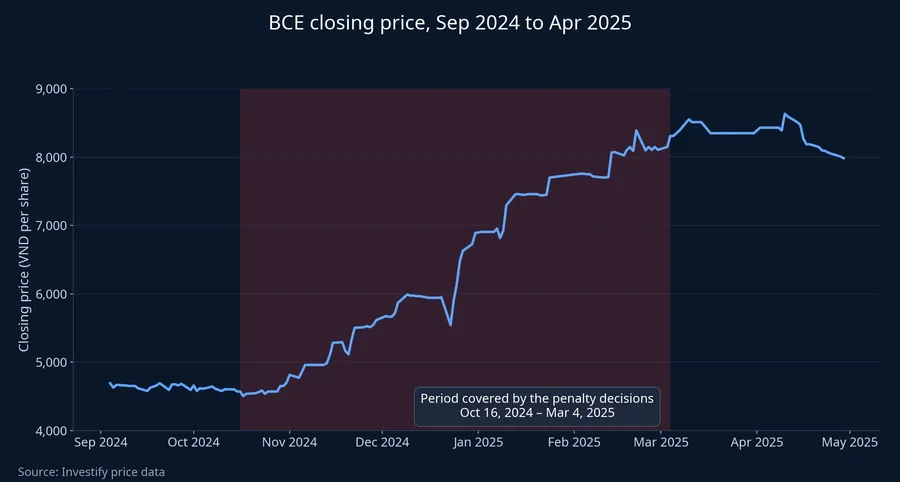
For context on price, BCE closed at VND 4,572 on October 16, 2024 and VND 8,309 on March 4, 2025, a rise of about 82%.Tin nhanh Chứng khoán That is the stock's market move over the period named in the decisions, not an impact the regulator attributed to Mr. Cuong's conduct. This post does not use the figure to explain why the price rose.
Why "no profit" still produces exactly VND 1.5 billion
Many readers will assume VND 1.5 billion is a discounted fine because there was no profit. The text says the opposite: it is the lowest fine an individual manipulator can receive.
Under Decree 156/2020 as amended by Decree 128/2021/NĐ-CP, manipulation is fined as a multiple of the unlawful gain, but not below the general maximum fine in the securities sector. That general maximum is VND 3 billion for organizations and VND 1.5 billion for individuals. The maximum multiple for manipulation is 10 times the gain for organizations and 5 times for individuals.Decree 128/2021/NĐ-CP When there is no gain, or when the fine computed from the gain falls below the general maximum, the text applies the general maximum itself. For an individual, that is VND 1.5 billion.
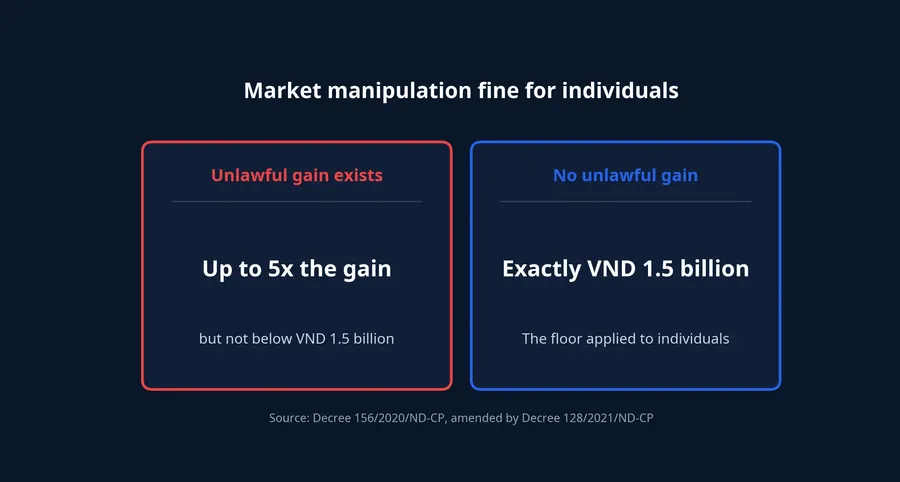
The arithmetic therefore runs one way. A manipulator with a large profit is fined by a multiple of it. One with little or no profit still pays the VND 1.5 billion floor. Losses never push the fine below that floor, so an exact VND 1.5 billion tells you nothing about how much the violator made. It only tells you the fine hit the floor.
Two roles, one framework
The second part of the case touches more individual investors: the four who supplied accounts. Lending an account means letting someone else place orders through an account in your name. Holding shares as a nominee means the shares truly belong to someone else but are recorded as yours. The roles differ in substance, yet the law puts them in the same sentence.
Under Decree 128/2021, lending an account for trading, or holding securities in your name for another person, where this leads to market manipulation, is punished with a trading suspension of 6 to 12 months.Decree 128/2021/NĐ-CP The 9 months in the BCE case sit inside that range, which was in force when the trades took place.
The condition to read closely is "leads to manipulation." The lender or nominee need not place orders and need not profit. It is enough that their account or name becomes part of the manipulation. In the BCE case none of the four was found to have an unlawful gain, yet all were suspended for 9 months and then barred for 2 years from the same November 10, 2026 date as the person who traded.
The framework is now heavier. Decree 306/2025/NĐ-CP, effective January 9, 2026, raises the suspension for lending accounts or nominee holding that leads to manipulation to 18 to 24 months, at least double the old range.Báo Pháp luật Việt Nam The BCE trades predate that date, so the 6 to 12 month range applied.
What the BCE case shows
The thesis is straightforward: having no profit is not a shield. Using several accounts, yours or someone else's, to trade back and forth in one stock is judged by method, and with no profit an individual still pays the VND 1.5 billion floor.
For the person behind an account, letting relatives or friends use it, or letting them record shares under your name, falls into the same framework when the account is used to manipulate. Here, people in those two roles lost trading rights for 2 years, just like the person who placed the orders, without receiving any gain.
The next thing to watch is how the SSC applies the 18 to 24 month suspension range of Decree 306/2025 in the first manipulation cases that occurred after January 9, 2026. Those decisions will show how heavy the penalty is in practice for someone who only lent an account.