


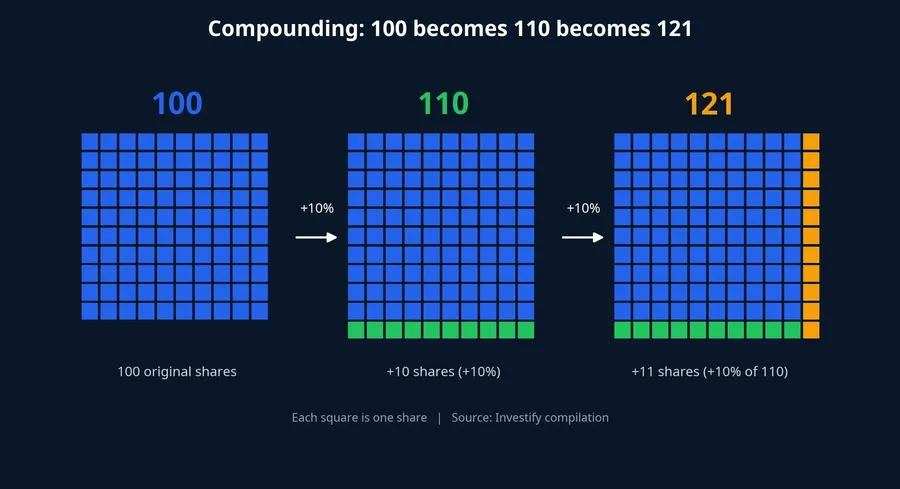
Say you have held 100 VPI shares since before September 8. After September's 10% stock dividend, your account shows 110 shares. After the second payout now coming, it shows 121. Two 10% payouts do not add up to 20%, because the second is calculated on the share count already raised by the first, so the total increase is 21%. Van Phu Real Estate Development Joint Stock Company (HoSE: VPI) pays out no cash for either round.
On operating results, the nine-month picture cuts both ways. Net revenue was about VND 1,284.4 billion, up almost 56% year on year, and gross profit rose about 69%. At the bottom line, consolidated after-tax profit fell almost 16% to VND 221 billion.Doanh Nhân Việt Nam This post walks through the second payout's calendar and shows what happens to your account at each date.
The second payout's calendar
According to Tinnhanhchungkhoan on November 5, the ex-rights date is November 10, 2026 and the record date is November 11, 2026, at a ratio of 10:1. Put simply, for every 10 shares you hold, you receive 1 new share.Tinnhanhchungkhoan
The size of the issue comes from the October 23 filing. Van Phu plans to issue 35,205,437 shares with a total par value above VND 352 billion. Charter capital would rise from VND 3,520.5 billion to just over VND 3,873 billion, and the share count from about 352.05 million to almost 387.3 million.FireAnt These are the plan's figures. The actual number issued is calculated on the shares outstanding on the record date.
September's round issued more than 32 million shares and lifted charter capital from VND 3,200 billion to VND 3,520.5 billion. At a par value of VND 10,000, VND 3,200 billion corresponds to roughly 320 million shares. So from early September until the second round is done, VPI's share count goes from about 320 million to almost 387.3 million, an increase of about 21%. Together, the two rounds distribute about VND 672 billion of profit in the form of shares.Mekong Asean
Monday, Nov 9: the last session to buy and be on the list
Shares bought on HoSE settle in your account after two working days. The record date is Wednesday, November 11, so a buy order must be matched no later than Monday's session on November 9 for the shares to be in your account on the record date.
Two cases cause the most confusion:
- Buying from the November 10 session onward: the shares settle after November 11, so the buyer is not on the list for this payout.
- Selling in the November 10 session: the seller stays on the list, because the shares only leave the account after the record date. The right to the new shares stays with them even though the old shares are gone.
In short, anyone still holding VPI when the November 9 session closes is on the list, whatever happens on November 10.
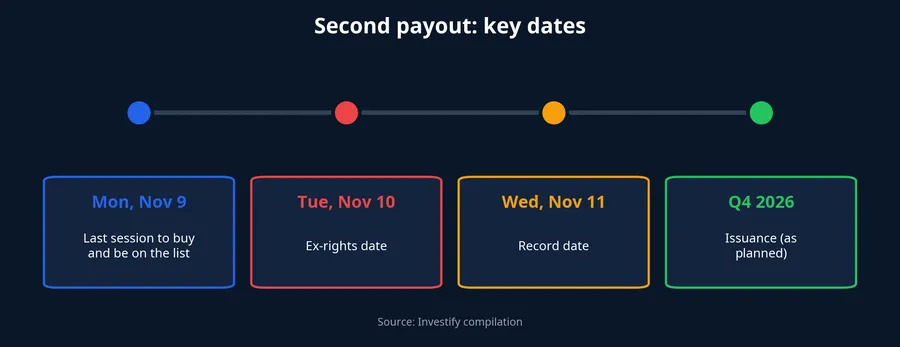
Tuesday morning, Nov 10: the reference price is divided by 1.1
When a company pays a stock dividend, the stock exchange adjusts the reference price on the ex-rights date. At a 10:1 ratio, the reference price on the morning of November 10 equals the November 9 closing price divided by 1.1. That is about 9.1% below the close, even though no order has been matched.
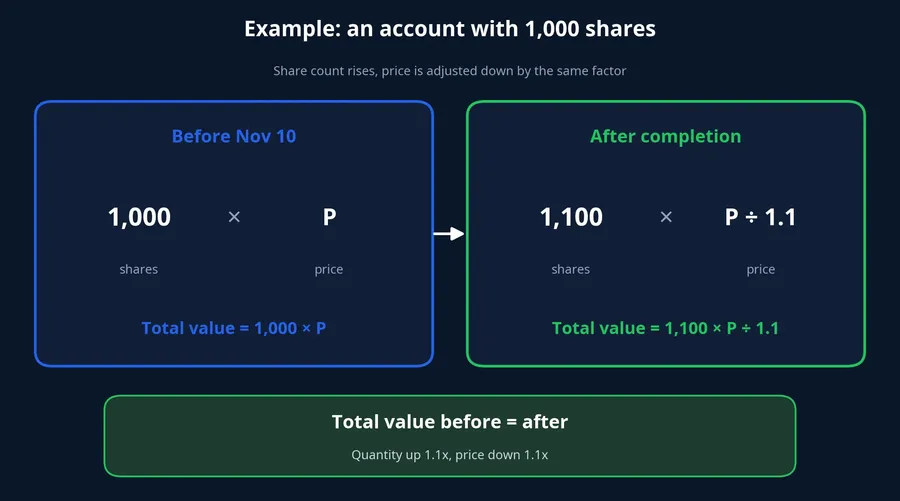
A new investor can easily look at the price board that morning and think the stock has just dropped sharply. In fact it is a division that preserves the value of your holding while the share count is about to rise by 10%. Take an account holding 1,000 VPI shares at the close on November 9, and call that day's closing price P:
- Before November 10: 1,000 shares times P.
- After the second payout is complete: 1,100 shares times P divided by 1.1.
The two calculations give the same result. The share count rises, the reference price falls by the same factor, and total value does not rise on its own. From the November 10 session onward, the account's value moves with the traded price like any other session.
There is a lag worth knowing about. From the morning of November 10 the price has already been divided, but the 100 bonus shares are not yet in your account. They usually show up under pending rights at your brokerage. The new shares can only be sold once Van Phu has finished the issuance and the shares are listed on HoSE.

Profit shared across more shares
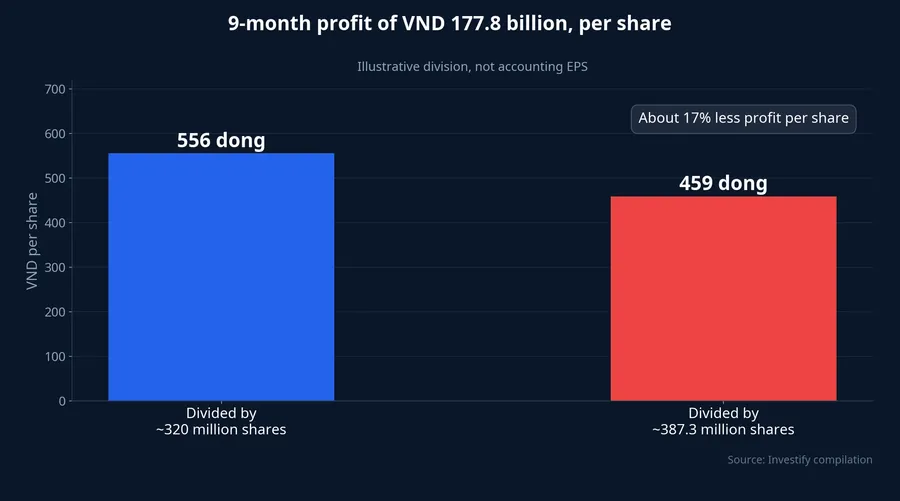
A 21% larger share count means the same profit is split over more shares. Take nine-month 2026 consolidated after-tax profit attributable to Van Phu's shareholders: VND 177.8 billion.Doanh Nhân Việt Nam Divided by about 320 million shares before September's round, that is about VND 556 per share. Divided by almost 387.3 million shares after the second round, it is about VND 459 per share, roughly 17% lower.
This is an illustrative division, not accounting EPS, because reported EPS uses the weighted average share count for the period. But the direction is clear. A shareholder does not lose any part of the pie, because they hold 21% more shares. What changes is the profit the company needs to reach to keep earnings per share unchanged: profit has to grow about 21% for each share to get the same slice as before.
Why Van Phu pays in shares
The source is undistributed after-tax profit as of December 31, 2025, per the audited 2025 standalone financial statements.Pháp luật Doanh nhân According to the October 1 shareholder consultation document, that figure was above VND 1,546 billion at the end of 2025. The company says its purpose is to prioritize cash for business operations in 2026. The second round was approved by the shareholders' meeting through written consultation on October 16, and is planned for the fourth quarter of 2026.Mekong Asean
That reason fits the company's balance sheet. Van Phu's cash is tied up in projects: nine-month operating cash flow was negative VND 1,534 billion.VnBusiness A cash dividend of around VND 672 billion would have to come out of that same pool. Paying in shares converts retained earnings into charter capital without reducing the company's cash.
Operating results next to the new share count
The opening section showed revenue and gross profit rising while consolidated after-tax profit fell. Within that, the portion attributable to Van Phu's shareholders fell more than 32%, and lower financial income was one of the factors pulling profit down.Doanh Nhân Việt Nam
In the third quarter alone, after-tax profit was VND 20.2 billion, against VND 119 billion in Q3 2025. Van Phu explains that it still booked revenue from product transfers at Vlasta Thuy Nguyen (Hai Phong) and Vlasta Sam Son (Thanh Hoa), but that elevated interest rates sharply reduced demand for property, hurting revenue and profit for the period.Doanh Nhân Việt Nam Real estate revenue follows the handover schedule, so quarterly profit tends to swing more than at a manufacturer.
What to watch after November 11
For anyone holding VPI, the mechanics of this payout are settled: you are on the list if you still hold when the November 9 session closes, the reference price is divided by 1.1 on the morning of November 10, and the new shares arrive once issuance is complete. What remains depends on whether Van Phu's profit keeps pace with a share count that has risen 21%.
Two data points will answer that. The Q4 2026 financial statements will show full-year profit and, for the first time, earnings per share calculated on the enlarged share base. Sales progress and handovers at the Vlasta projects will show whether 2027 revenue has a base to build on.
The yardstick is the same in both cases: the 21% rise in share count. If profit grows faster than that, paying in shares has kept cash for the projects without thinning each share's slice. If profit grows more slowly, each share's slice will be smaller than before September's round. The Q4 report is the first checkpoint that shows which scenario is playing out.