

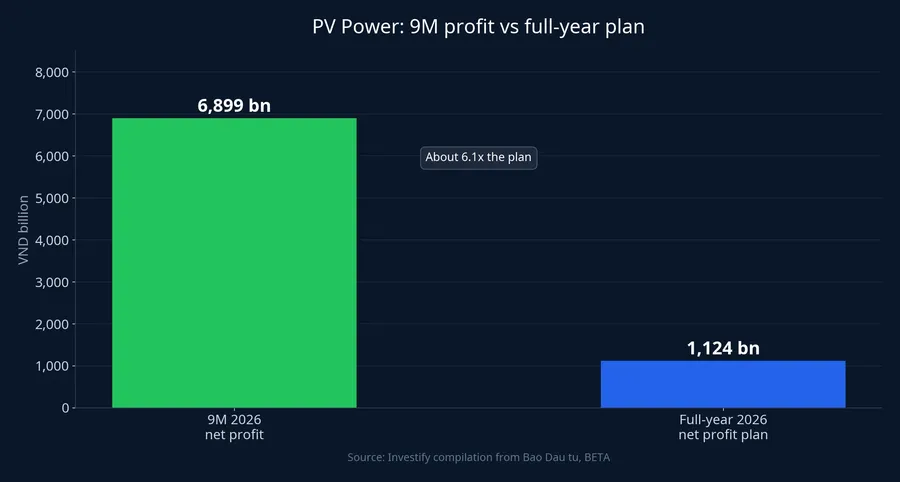
PetroVietnam Power Corporation (PV Power, ticker POW) has released its consolidated Q3 2026 financial statements. For the first nine months, consolidated net profit came to VND 6,899 billion, 3.2 times the same period last year, of which VND 6,434 billion belongs to PV Power shareholders. According to BETA Securities, that equals 614% of the full-year 2026 net profit plan, or about 6.1 times.
"More than six times the plan" is an eye-catching number. The more useful question is where the profit came from and how much of it can repeat in 2027. Peel back the report and the nine-month profit comes from three sources with very different lifespans. One point up front: even after stripping out one-off items, the core business still earns a lot, but Q3 profit was lower than Q2 and interest expense rose sharply.
How low the original plan was
At the annual general meeting on May 20, 2026, PV Power tabled a net profit plan of VND 1,124 billion, down 63% from 2025, while the consolidated revenue plan was a record VND 49,887 billion. The plan assumed oil at USD 70 a barrel and an exchange rate of VND 26,500 per dollar. This is also the first year of commercial operation for Nhon Trach 3&4, Vietnam's first two liquefied natural gas (LNG) power plants.
After nine months, consolidated net revenue reached VND 49,406 billion, up 94.5% year on year, or 99% of the full-year revenue plan. Revenue is tracking the plan, while profit has blown well past it, which means costs and other income moved very differently from the assumptions.
Source one: existing plants dispatched more
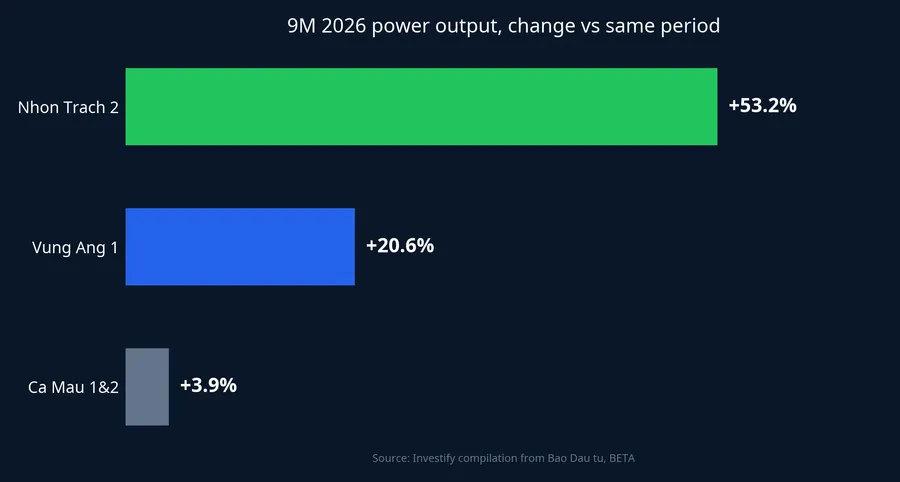
PV Power's nine-month electricity output reached 19.329 billion kWh, up 44% year on year and 21% above the nine-month plan. Vung Ang 1 coal-fired plant produced 5.739 billion kWh, up 20.6%, Nhon Trach 2 produced 3.302 billion kWh, up 53.2%, and the Ca Mau 1&2 complex grew more modestly, by 3.9%.
This source is real and comes from the core business. It does depend on how much the power system dispatches, though. Bao Dau tu notes that the dry season and El Niño also affect demand for baseload power, so a wetter hydrological year could pull this group's output down.
Source two: Nhon Trach 3&4 paid on contracted output
Per SHS Securities, Q3 revenue from the Nhon Trach 3&4 complex alone was estimated at VND 4,456 billion, or 26.6% of consolidated net revenue.
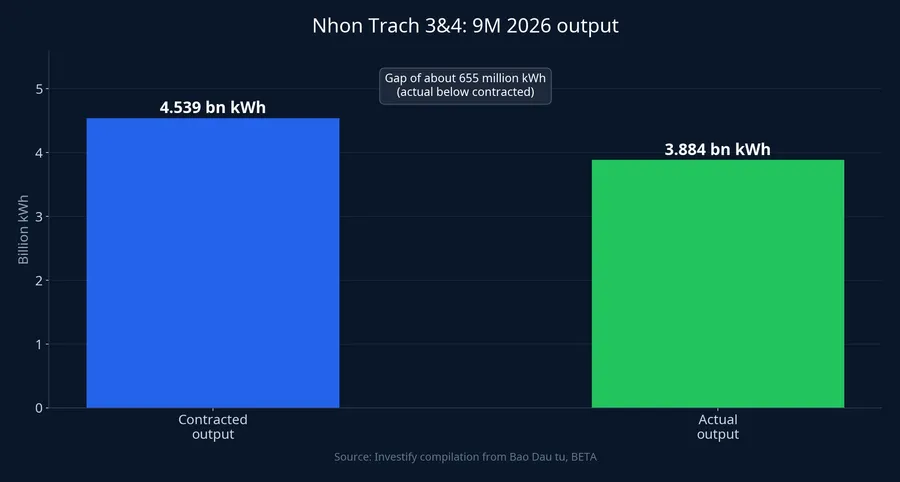
The complex's power purchase agreement works differently. The plants have a contracted output level (Qc). When the grid does not dispatch that much, the contract mechanism lets the plants be paid under the contract terms for the shortfall. Over nine months, Nhon Trach 3&4's contracted output was 4.539 billion kWh, about 655 million kWh above actual generation. SHS estimates the payment for the undispatched portion at about VND 1,463 billion. That is a securities firm's estimate, not a line item PV Power reports separately.
Per experts quoted by Bao Dau tu, LNG is fully imported and priced high, so gas-fired power is costly and hard to get dispatched when bidding against other sources.
This income is more durable than source one because it sits in a contract. Even so, a Qc payment is not net profit: the plants still pay depreciation, interest and operating costs. Its contribution also moves with the gap between contracted and actual output in each period.
Source three: one-off items
According to PV Power's explanation as relayed by Bao Dau tu, general and administrative expenses on PV Power's standalone statements fell by about VND 313 billion in Q3, mainly due to a reversal of receivable provisions tied to operations and maintenance at Ca Mau. On the consolidated figures, BETA and SHS both put this reversal at about VND 325 billion. As a result, Q3 selling and administrative expenses came in at negative VND 78 billion.
Q3 also included a net foreign-exchange gain of about VND 187 billion. BETA estimates non-recurring income over nine months at about VND 2,800 billion, again a securities firm estimate not broken down line by line.
These gains will not repeat each quarter. Strip them out, however, and the core business still earns a lot: SHS estimates Q3 core profit attributable to PV Power shareholders at about VND 1,580 billion after deducting the VND 325 billion reversal. A single quarter at that level is already above the full-year plan of VND 1,124 billion.
What changed between Q2 and Q3
Against the same period last year, Q3 was still strong: net revenue of VND 16,772 billion, up 113.5% and net profit of VND 2,073 billion, up 118.6%. Against Q2 it looks different. Per BETA, Q3 net profit fell 41% from the prior quarter, and gross margin dropped to 13.8%, from 22.6% in Q2 and 16.4% a year earlier. Over nine months, gross margin still rose to 17.6% from 12.9%.
BETA says the main cause is a larger share of LNG-fired output from Nhon Trach 3&4 at high fuel cost, together with cooler wholesale power prices than the previous quarter. SHS says fuel costs passed through into selling prices now make up a bigger share of revenue. Both readings point the same way: when LNG power takes a larger share, revenue rises faster than gross profit with fuel prices.
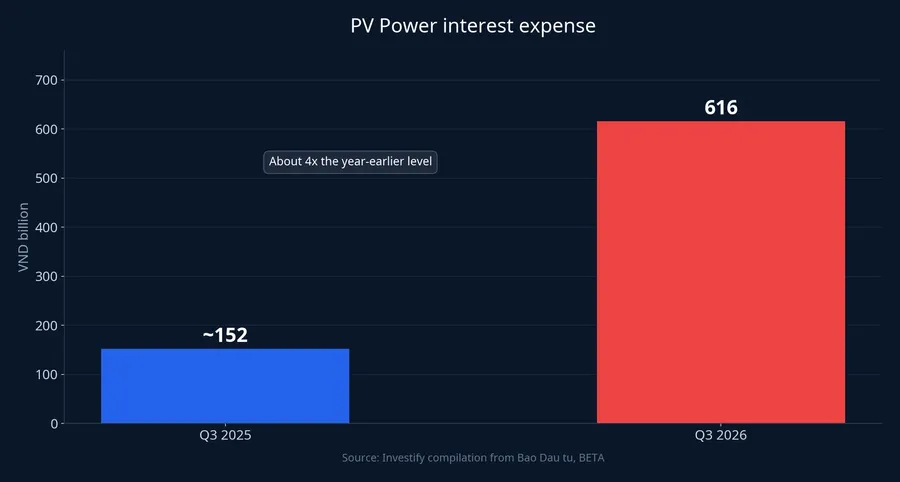
The second change sits below gross profit. Q3 interest expense was VND 616 billion, 4 times a year earlier because, per BETA, Nhon Trach 3&4's loans are no longer capitalized into project cost now that the plants are in commercial operation. For nine months, interest expense was VND 1,569 billion versus VND 411 billion.
As of September 30, PV Power's total borrowings and finance lease liabilities were about VND 37,505 billion, up nearly 30% from the start of the year. On the other side, cash and short-term financial investments stood at more than VND 30,127 billion.
Which profit level is the new base
Ranked by durability, the order is fairly clear. Nhon Trach 3&4's contract-based payment is the most stable, but it comes with interest that now hits the income statement every quarter. Output at Vung Ang 1, Nhon Trach 2 and Ca Mau depends on dispatch, so it shifts with weather and power demand. The reversal and the FX gain will not repeat.
So the VND 1,124 billion plan is no longer a useful yardstick for 2026. A better one is core profit per quarter, after removing one-offs and after counting the full interest bill of Nhon Trach 3&4. SHS's estimate of about VND 1,580 billion for Q3 meets both conditions: it excludes the reversal and already absorbs the quarter's VND 616 billion of interest.
The Q4 2026 financial statements will show whether that level holds without a large reversal. The 2027 plan that PV Power puts to shareholders will show what management itself treats as the new profit base. If Q4 core profit lands near Q3, PV Power's annual earnings base is already many times the old plan. If it falls clearly, plant dispatch at the existing plants and the Qc gap at Nhon Trach 3&4 are the two numbers to read in the report.