


On Saturday morning, 7 November, the 16th National Assembly passed the resolution on the 2027 socio-economic development plan, with 467 of 469 deputies in favor.Người Quan Sát The three headline targets are GDP growth of 10% or more, consumer price index (CPI) growth of about 4.5%, and GDP per capita of about USD 6,100.Thời báo Tài chính
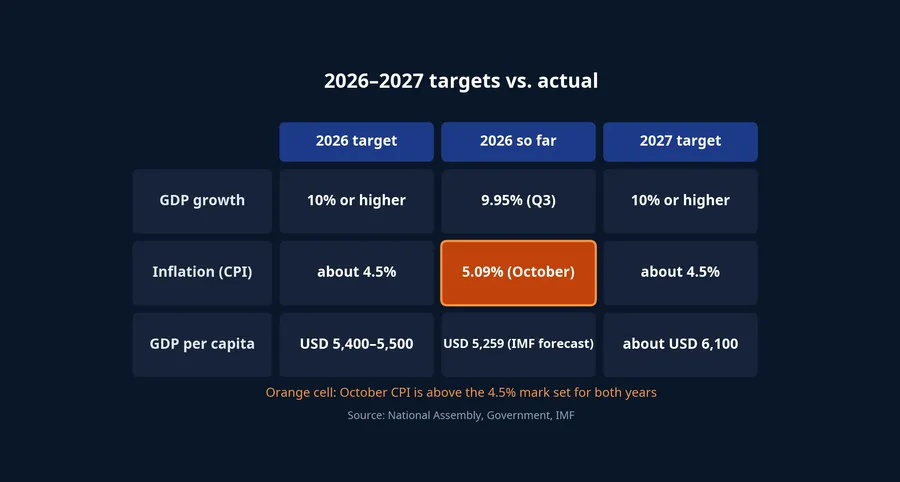
Two of those three numbers are not new. The 2026 plan, passed by the 15th National Assembly on 13 November 2025, also set growth at 10% or more and average CPI at about 4.5%.Nhà đầu tư What differs is the starting point. 2026 began with both targets still ahead of it. 2027 will begin with one of them already exceeded.
This article lines the three targets up in three columns: the 2026 target, 2026 results so far, and the 2027 target. From there it asks who each column touches: savers, home buyers and wage earners.
Growth: Q3 is already close to 10%
GDP grew 9.95% year on year in Q3 2026, after 8.81% in Q2.FireAnt That is a single-quarter figure, not a full-year result. Full-year growth still depends on Q4 and on the size of each quarter's GDP. At its regular October meeting, the Government still called for efforts to meet the target of 10% or more this year.FireAnt
The 2027 target is broken down by sector: agriculture, forestry and fisheries up 3.8% (aiming for 4%), industry and construction up 12.2%, services up 9.8%. Total social investment is set at 36–38% of GDP. The resolution also assigns local targets, such as Hanoi 11.1%, Ho Chi Minh City 10.4% and Hai Phong 13%.Thời báo Tài chính
On growth, the gap between 2026 and the 2027 target is small. The economy has shown it can run at close to 10% for one quarter. The question for 2027 is holding that pace for four quarters, and that is where the growth column meets the inflation column.
Inflation: 2027 starts above the 4.5% mark
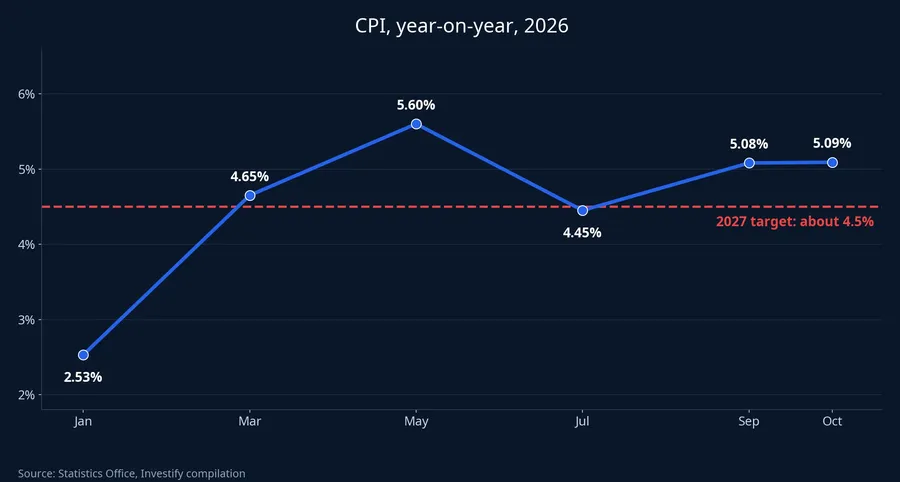
According to the Statistics Office (Ministry of Finance), as presented at the Government press briefing on 4 November, October 2026 CPI rose 5.09% year on year. The 10-month average was 4.57%, up from 3.27% in the same period of 2025.VnEconomy
The notable point is not how far 4.57% sits above 4.5%. The average looks back over ten months already gone. October's year-on-year rate is where 2027 will begin, and it is about 0.6 percentage points above the 4.5% mark. If prices do not cool in the last months of the year, 2027 will have to pull inflation from about 5% down to about 4.5%, not merely hold it steady.
The resolution places the two targets side by side deliberately: growth of 10% or more is tied to macroeconomic stability, inflation control and major balances.Người Quan Sát The two pull in opposite directions. High growth needs cheap capital and open credit, while inflation control needs monetary policy that is not too loose.
Savers: how much real return is left
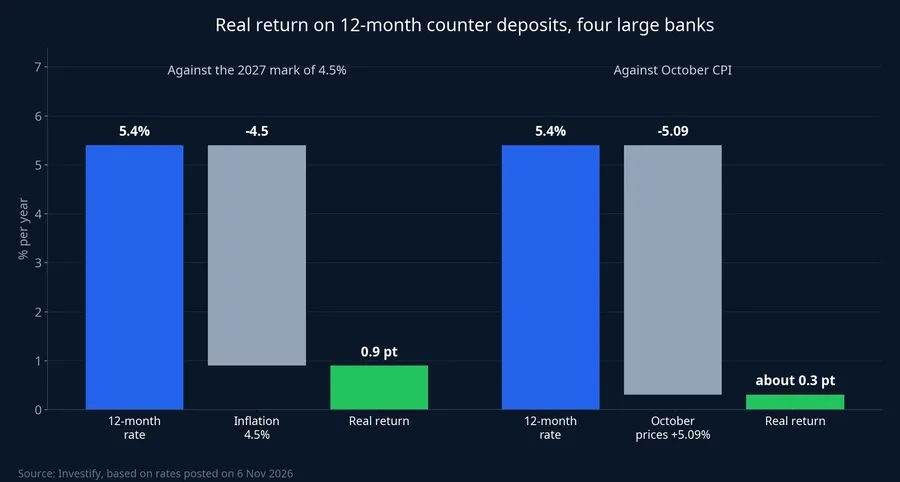
For savers, the roughly 4.5% mark is a reasonable yardstick for the real return on a 2027 deposit, meaning the interest left after price increases. On 6 November, Agribank, Vietcombank, BIDV and VietinBank all posted a 12-month counter deposit rate of 5.4% a year.FireAnt Simple subtraction gives two results:
- If 2027 inflation lands at about 4.5%, a 12-month deposit at these banks keeps a real return of about 0.9 percentage points.
- Measured against October's price increase (5.09%), the real return shrinks to about 0.3 points.
Deposit rates have also just come down. After the State Bank of Vietnam asked banks to cut costs and lower the rate level, state-owned and foreign banks trimmed posted deposit rates by a common 0.5 percentage points, and joint-stock banks by 0.5–0.7 points.FireAnt For depositors at the large banks, the cushion between the savings rate and the 2027 inflation target is thin, under 1 percentage point. The 4.5% mark is a target, not a guaranteed outcome, but it is the most sensible benchmark available when a deposit comes up for renewal.
Home buyers: what the resolution says about lending rates
On monetary policy, the resolution calls for managing interest and exchange rates in line with domestic and international conditions; lowering lending rates and directing credit to production, business and priority sectors; and controlling credit in risky areas. It also sets a goal of completing more than 176,000 social, rental and worker housing units in 2027.Thời báo Tài chính
That wording has two layers for a commercial home buyer. The first is the direction of lower lending rates. The second is its address: production, business and priority sectors. The Government's October guidance points the same way, asking the central bank to urge credit institutions to cut lending rates for production, business, priority sectors, exports and small and medium-sized enterprises.FireAnt
Home loan rates are currently 10–11% a year during the promotional period, and can rise to 12–15% once floating.FireAnt Dr. Cấn Văn Lực, Chief Economist at the Bank for Investment and Development of Vietnam (BIDV), says room to cut rates for real estate is limited, because the sector uses a lot of credit and has a long payback period. By his figures, real estate accounts for about 25% of outstanding credit, and at the end of September 2026 the gap between total credit and deposits at banks reached about VND 2 quadrillion. He added that sustainable cuts in lending rates require banks to have funding at reasonable cost.
This is where the table's columns connect. A bank's funding is deposits. Inflation around 4.5% sets a floor under deposit rates if banks want to keep savers, and lending rates are built on that cost. So for a commercial home buyer, the resolution's push for lower lending rates is a favorable signal, but not a promise on their own loan.
Other readings remain plausible. One is that inflation falls quickly in the last months of the year thanks to the fuel tax and electricity price adjustments the Government cited on 4 November,VnEconomy opening more room for broad rate cuts. Another is that large banks with lower funding costs cut lending rates first, in line with Nguyễn Anh Quê, Chairman of G6 Group, who says adjustments across banks are uneven. The available data lean toward the cautious reading: according to Mr. Quê, after the May instruction to lower rates, deposit and lending rates actually rose.FireAnt
Income: the USD 6,100 mark against outside forecasts
GDP per capita is the only one of the three targets that is clearly raised, from USD 5,400–5,500 in the 2026 target to about USD 6,100 for 2027. For reference, the International Monetary Fund (IMF) forecasts USD 5,259 for 2026 and USD 5,659 for 2027.FireAnt These are IMF forecasts, not outturns.
The USD 6,100 mark is about USD 440 above the IMF's 2027 forecast. The gap is not purely growth, because GDP per capita in dollars depends on inflation and the exchange rate as well. A year of higher inflation can lift the nominal figure without raising workers' real income by the same amount. So USD 6,100 is an economy-wide average and should be read together with the inflation that comes with it.
Conclusion: 2027 repeats the targets, not the starting point
Across the three columns, the 2027 targets nearly repeat 2026 on growth and inflation, and sharply raise the income target. The real difference is the starting position: Q3 growth is already close to 10%, while October inflation is already above 4.5%. That puts more of 2027's burden on the inflation column than on the growth column.
For savers, using 4.5% as the benchmark for 2027 real returns is reasonable. At the large banks' 5.4%, the cushion is under 1 percentage point, and thinner still against the latest price increase. For commercial home buyers, the resolution's push for lower lending rates is aimed at production, business and priority sectors, so a prudent planning figure for a loan is the post-promotion rate, 12–15% a year.
Two data points will show which way this framework tilts. The first is November CPI, due in early December: if it falls clearly toward 4.5% year on year, there is more room to cut rates in 2027; if it stays near 5%, the inflation target becomes the limit on lower rates. The second is the 2027 credit growth quota the State Bank of Vietnam assigns, which will show how far capital is allowed to expand.