
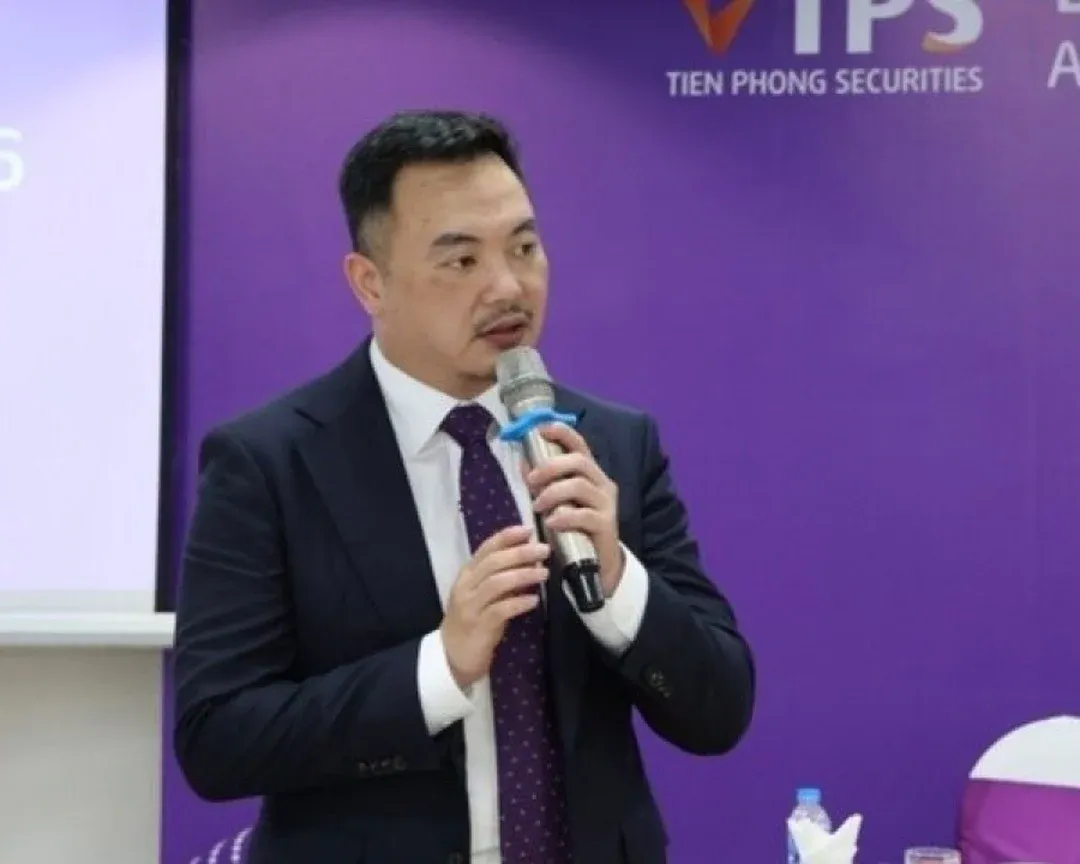

Since November 5, 2026, Tien Phong Securities JSC (TPS, ticker ORS on HoSE) has had a new person running the company. It is well placed against its plan: after nine months, pre-tax profit stood at about VND 313 billion, roughly 73% of the full-year target. What stands out in the numbers is where the profit comes from. In Q3, gains and losses on the proprietary portfolio almost cancelled each other out, and the extra income came from margin lending, held-to-maturity bonds and brokerage.
Who is leaving, who is taking over
According to CafeF, the TPS board approved the dismissal of Mr. Nguyen Chi Thanh as General Director and legal representative, effective November 5, 2026.CafeF The same day, Mr. Nguyen Trong Thanh, Deputy General Director, was named Acting General Director until the board decides otherwise. Board Chairman Nguyen Hong Quan became the legal representative.
Vietnamfinance reports that the changes rest on Board Resolution No. 20.1/2026/NQ-HĐQT, issued on November 4, 2026, and that moving the legal-representative role to the chairman matches the amended charter approved by shareholders the same day.Vietnamfinance
Mr. Chi Thanh, the former General Director of TPS, took the post on April 23, 2026, so he held it for just over six months. Born in 1980, he spent nearly 12 years at Saigon – Hanoi Securities (SHS) and served as its General Director from February 2024 until he resigned in early 2026.Mekong Asean His successor, Mr. Trong Thanh, was born in 1991 and has more than 10 years in banking and finance, specializing in credit appraisal and project financing. He was also appointed Deputy General Director on April 23, 2026, and previously headed the Investment Banking – Proprietary Trading division.Phap luat Viet Nam
TPS is a subsidiary of Tien Phong Commercial Joint Stock Bank (TPBank), which raised its stake to 51% through a private placement in late 2025.Phap luat Viet Nam

Nine months in: nearly three quarters of the plan
The results the new management inherits are not poor. In the first nine months of 2026, TPS booked operating revenue of about VND 1,125 billion, up 3% year on year. Pre-tax profit was about VND 313 billion, more than nine times the prior-year period, and after-tax profit was about VND 250 billion, nearly 12 times higher.CafeF Part of that multiple reflects a low comparison base in the first nine months of 2025.Mekong Asean
The 2026 plan calls for VND 2,250 billion in revenue and VND 428 billion in pre-tax profit. About 73% of the profit target is done. Revenue is running slower, at roughly half of the full-year goal.Phap luat Viet Nam
By quarter, TPS's pre-tax profit this year was VND 42.25 billion in Q1, VND 161.84 billion in Q2 and VND 108.5 billion in Q3. To reach VND 428 billion, Q4 needs about VND 115 billion of pre-tax profit. That is only about VND 7 billion above Q3 and well below Q2.

Q3: revenue up, profit down because of proprietary trading
Q3 is the only quarter this year in which pre-tax profit fell year on year, from VND 133.88 billion in Q3 2025. Operating revenue reached about VND 489 billion, up 37%, but pre-tax profit of about VND 108.5 billion was down nearly 19%.Mekong Asean After-tax profit was VND 86.4 billion, down 35.3% from VND 133.5 billion in Q3 2025.Vietnamfinance
The decline comes from the portfolio of financial assets measured at fair value through profit or loss, meaning the stocks and bonds TPS trades for its own account are marked to market. That group produced about VND 195 billion in gains, up 16% year on year, but losses rose 247% to about VND 191 billion.Mekong Asean The gap between the two shrank to about VND 4 billion, from VND 136.04 billion in Q2.

TPS has explained the drop. In its filing, about 55% of the profit decline came from revaluation of assets: the revaluation result swung from a VND 2.08 billion gain a year earlier to a VND 11.87 billion loss. The company said this is an unrealized loss driven by end-of-period market prices, and could reverse if the market recovers. The remaining 45% came from trading, where realized losses in this group rose by VND 109.62 billion.Mekong Asean On November 6, TPS said again that the Q3 profit swing mainly stems from this portfolio.FireAnt
What grew in the same quarter
While proprietary trading contributed almost nothing, other lines grew strongly. Interest from loans and receivables was about VND 66 billion, up 141% year on year. Income from held-to-maturity bonds and investments was about VND 45 billion, more than four times higher. Brokerage revenue was about VND 25 billion, up 31%.Mekong Asean
The balance sheet moved the same way. From the end of Q2 to September 30, the fair-value proprietary portfolio fell from about VND 5,526 billion to VND 2,895 billion, a drop of nearly 48%. Over the same period, held-to-maturity investments rose from about VND 1,609 billion to more than VND 4,170 billion, roughly 2.6 times.Mekong Asean Held-to-maturity holdings are booked at interest rates and are not marked to market each quarter-end. If this mix holds, earnings in coming quarters should swing less with stock prices.

Margin lending grew fastest. At September 30, 2026, TPS's margin loan balance was nearly VND 2,663 billion, up more than 42% in a quarter and about 86% from the start of the year. Total assets reached more than VND 17,313 billion, up 21% from year-start.Mekong Asean Including advances on securities sales, total lending exceeded VND 2,790 billion.
Cash and borrowings
Alongside the rise in lending and held-to-maturity bonds, TPS's cash fell and its debt rose. Cash and cash equivalents dropped from about VND 5,981 billion at the start of the year to VND 702 billion at September 30. Short-term borrowings rose from about VND 2,046 billion to VND 3,740 billion, with Q3 alone up nearly 60% from VND 2,339 billion at the end of Q2.Mekong Asean
Total liabilities at September 30 were about VND 9,426 billion, up more than 40% from the start of the year.Vietnamfinance Equity was about VND 7,887.6 billion, up only 3.27%. The ratio of loans to equity (including advances on sales) rose from 19.12% to 35.37%.
Extra borrowing comes with a funding cost. Interest expense was VND 141.64 billion in Q3, up from VND 118.36 billion in Q2. The income the lending business generates therefore depends on the gap between the rate TPS charges clients and the rate it pays banks.
What ORS holders and margin clients will watch
For clients with margin loans, the November 4 resolution only changes the executive and the legal representative. What matters is the new management's lending policy: the list of stocks eligible for margin, the lending ratio and the interest rate.
For shareholders, ORS closed at VND 14,300 on November 6, down 1.38%, after a 2.03% fall on November 5. Two sessions are not enough to say how the market reads the change at the top.
The thesis here is about profit structure. Q3 shows TPS leaning more on lending and held-to-maturity bonds, and less on trading gains, than in the first half. With that structure, Q4 needs only Q3's profit plus about VND 7 billion to hit the plan, even if proprietary trading keeps contributing almost nothing. The leadership change and the results came close together in time, but the material at hand does not support linking them causally.
The Q4 financial statements, due in January 2027, will show how it played out. Two lines need to be read side by side: interest income from loans and receivables versus interest expense. If the gap between them keeps widening, the rest of the plan is within reach. If interest expense grows faster than lending income, Q4 will struggle to reach VND 115 billion.