

On November 3, 2026, Vietcombank (HoSE: VCB) announced that it had received a written approval from the State Bank of Vietnam (SBV) for a capital increase through a private share placement. According to CafeF, the increase is capped at VND 5,431 billion, equal to up to 543.1 million shares, or 6.5% of shares outstanding, to be sold to professional securities investors.CafeF
This is the legal step the plan has waited on longest. The 6.5% figure has been mentioned since 2019 and the sale is still not done.Market Times For anyone holding VCB shares, the approval has a concrete meaning: they have no right to buy in this round, so if the placement completes, their ownership of the bank gets smaller. On the other side, the bank gains new capital in cash. On the operating side, Vietcombank reported consolidated net profit of VND 33,054 billion for the first nine months of 2026, up 24.4% year on year.Market Times
From 2019 to 2026: One Number, Several Missed Deadlines
The timeline below shows how this attempt differs from the earlier ones.
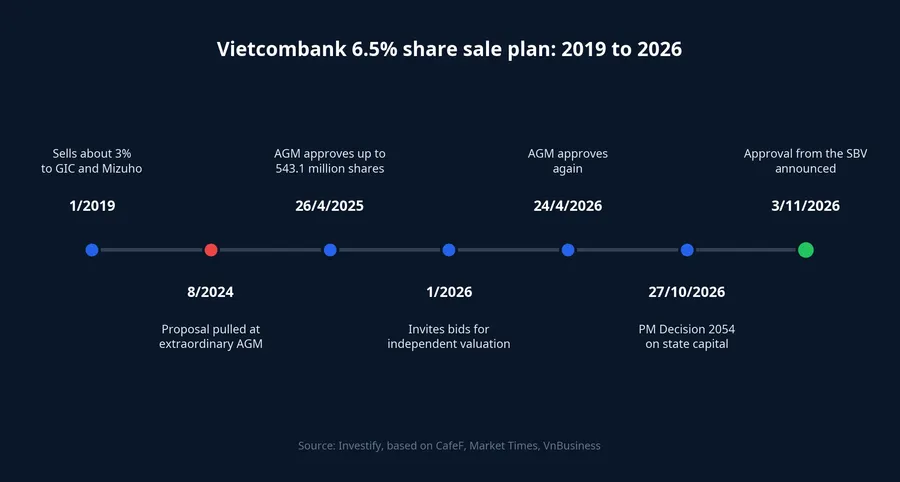
In January 2019, Vietcombank privately sold more than 94.4 million shares (2.55% of capital) to Singapore's sovereign fund GIC and more than 16.6 million shares (0.4%) to Japan's Mizuho Bank, about 3% in total. The plan to sell 6.5% was mentioned that same year.Market Times
In 2024, the private placement item was pulled from the agenda of the extraordinary shareholders' meeting in late August. Nguyen Thanh Tung, Chairman of Vietcombank's board, explained at the time that the bank had not finished the plan and hoped to complete it in the first half of 2025 if the market allowed.Tap chi Cong Thuong
On April 26, 2025, the annual general meeting approved a placement of up to 543.1 million shares to as many as 55 investors, including strategic investors and professional securities investors.CafeF The first-half 2025 target passed without a sale. In January 2026 the bank invited advisers to bid for an independent valuation, one of the inputs for setting the price.Nha Dau tu On April 24, 2026, the AGM approved the plan again. After the meeting, Mr. Tung said Mizuho would "at least take part to keep its current ownership ratio", that the bank was negotiating with several partners, and that it aimed to finish within 2026.CafeF
On October 27, 2026, the Prime Minister signed Decision 2054/QD-TTg, approving the 2026-2030 plan to restructure state capital in enterprises. Vietcombank is one of six enterprises that must restructure state capital before 2030, and the state must keep an ownership stake of at least 65% in the bank.VnBusiness
Between the missed deadline of 2025 and today, the paperwork has changed: the plan has AGM resolutions two years running, an SBV approval, and a place in the state-capital restructuring plan that the Prime Minister has signed, with the state's ownership floor now written down. The buyer side has changed less: Mizuho is still the only name the bank's leadership has mentioned.
What Still Has to Happen Before the Money Arrives
The SBV approval allows Vietcombank to raise capital, but it is not cash in the bank. Three things remain.
Setting the price. Under the plan approved at the 2025 AGM, the price must at the same time be no lower than the latest book value per share, no lower than the price set by an independent valuer, and no lower than the average VCB share price over the 10 sessions before the investor gives notice of purchase.CafeF The actual price will only be known once investors have placed orders.
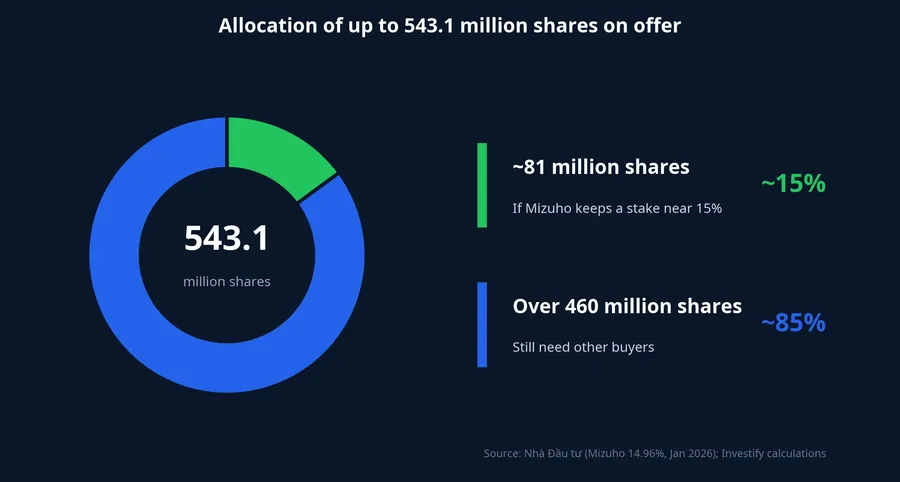
Choosing investors. Buyers are institutions, possibly including some existing Vietcombank shareholders, and must meet the conditions for investors buying shares in a private placement by a credit institution.Nha Dau tu The same outlet reported that Mizuho held about 14.96% in January 2026. If the Japanese bank keeps that ratio, it would need to buy about 81 million shares, around 15% of the offering (14.96% times 543.1 million). More than 460 million shares would still need other buyers, and that part decides how far the sale gets.
Completing the offering procedures. Once price and buyers are fixed, the placement still has to go through the steps required by securities law. The bank aims to finish in 2026, which leaves less than two months.Market Times

What Changes in a VCB Holder's Account
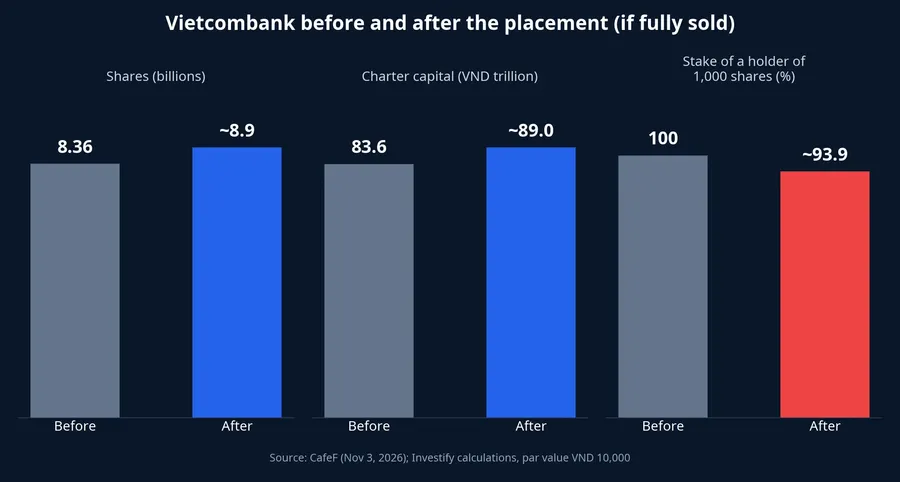
Vietcombank's charter capital at September 30, 2026 was VND 83,557 billion. At a par value of VND 10,000 per share, that is about 8.36 billion shares. If all 543.1 million shares are sold, charter capital rises to about VND 88,988 billion, or about 8.9 billion shares.CafeF
Take an investor who holds 1,000 VCB shares. After the placement they still hold exactly 1,000 shares. What changes is the denominator: those 1,000 shares were a piece of 8.36 billion and become a piece of 8.9 billion. Their ownership falls to about 93.9% of its former level, a drop of about 6.1% (1 divided by 1.065).
They cannot buy more to keep the old ratio, because the shares are sold privately to professional securities investors only. That is the difference from an offering to existing shareholders, where each holder has a right to buy pro rata.
The arithmetic has another side. Besides the private placement, Vietcombank plans to issue up to nearly 1.07 billion shares, worth up to VND 10,687 billion, from the reserve fund for supplementing charter capital.Bao Phap luat Viet Nam That issue converts money already inside the bank into charter capital and brings in nothing new. The private placement is different: new investors pay real money. The VND 5,431 billion figure is only the value at par; cash raised equals the sale price times the number of shares sold. Because the price cannot be below book value, book equity per share for existing holders is not pulled down. What gets diluted is the ownership share and earnings per share, until the new capital starts earning. Bank leadership has said the private placement comes first.CafeF
The State's Share and the Shares That Cannot Be Sold Yet
The state, through the SBV, holds about 74.8% of Vietcombank.VnBusiness The state is not buying in this round, so if all 543.1 million shares are sold, its stake falls to about 70.2% (74.8% divided by 1.065). That is still above the 65% floor in Decision 2054. According to VnBusiness, the 65% level is tied to the voting share needed to pass major resolutions under the 2020 Enterprise Law. Any sale to foreign investors must also stay within the 30% cap on total foreign ownership at a Vietnamese commercial bank.
For anyone trading VCB on the exchange, one more detail matters. Under the plan approved by the AGM, shares sold in the placement are subject to a transfer restriction of at least one year for professional securities investors and three years for strategic investors, counted from the date the offering is completed.CafeF If the sale closes in 2026, the new shares cannot reach the market for at least a year after that, so around the end of 2027.
Signals to Watch
This time the plan has the paperwork that earlier attempts lacked. Whether the sale finishes in 2026 now depends mainly on the buyers. Two pieces of information will answer that. The first is the offer price, which shows how much real money Vietcombank collects per new share. The second is the list of investors and the number of shares each takes: if Mizuho buys only enough to hold its ratio of about 15%, more than 460 million shares still need takers.
The view of this article is that procedure is no longer the main bottleneck. If the buyer list adds new names, the end-2026 target has a basis. If only Mizuho appears by year-end, the 6.5% will likely have to be split into several rounds or pushed back once more.