


At the regular government press briefing on November 4, State Bank of Vietnam (SBV) Deputy Governor Phạm Thanh Hà said that interest rates on newly originated loans in late October were 0.2–0.5 percentage points lower than in the early-October reporting period.Thời báo Ngân hàng According to SBV statistics relayed by VTV, the average rate on new loans has come down to 8.88% a year.VTV It is the first system-wide reading since the call to cut rates was issued.
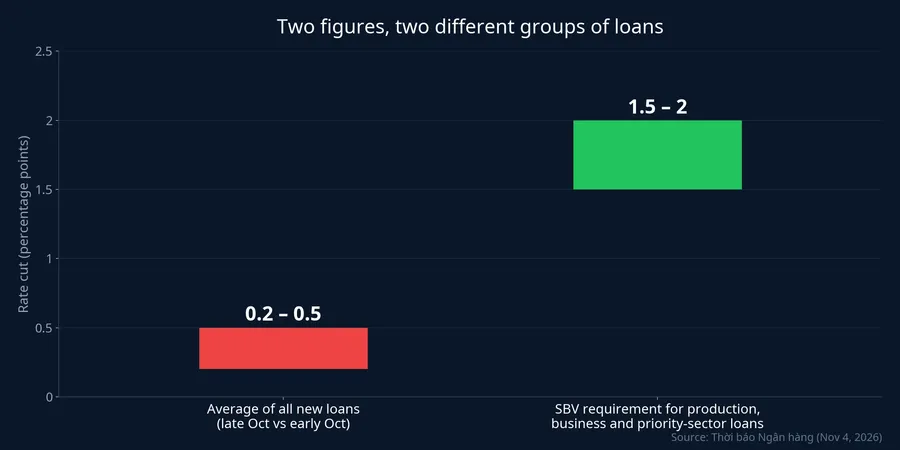
Borrowers, meanwhile, have been hearing about a far bigger cut since mid-October: 1.5–2% on loans for production, business and priority sectors. The two figures do not contradict each other. They measure different things, and this post walks through why the gap between them is so wide.
An average of all new loans, not the rate of one program
Put simply, 0.2–0.5 points is the average cut across every loan originated in the period. The 1.5–2% is the requirement for one category of loans: production, business and priority sectors. One is the broad market; the other is a specific slice of it.
Even within the priority group, cuts are uneven. According to the Deputy Governor, more than 20 banks have announced preferential credit programs for production, business and priority sectors with cuts of 0.5–2% a year.Thời báo Ngân hàng Each program has its own eligible borrowers, sectors and deadline. Vietcombank's program runs from October 19 through the end of 2026 with cuts of 1.5–2% a year, and up to 3% for some areas such as consumer trade and fuel. The bank's management says nearly 17,000 businesses, individuals and household businesses have benefited, with disbursed loans of roughly VND 100,000 billion.CafeF

Simple arithmetic explains the rest. If most new loans had been cut by 1.5–2 points, the average could not be just 0.2–0.5. A figure that low only happens when most new loans fell by much less, or barely at all: those outside the programs and outside the priority sectors.
There is one other explanation to weigh. The average on new loans is also shaped by mix. If more medium- and long-term loans, which carry higher rates than short-term ones, were written in the period, the average gets pulled up even when each individual loan got cheaper. That may shrink the average cut somewhat, but it does not replace the main explanation: the 1.5–2% programs are tied to specific borrowers and quotas, so they cannot cover the whole market.
Funding costs have fallen only about 0.4%
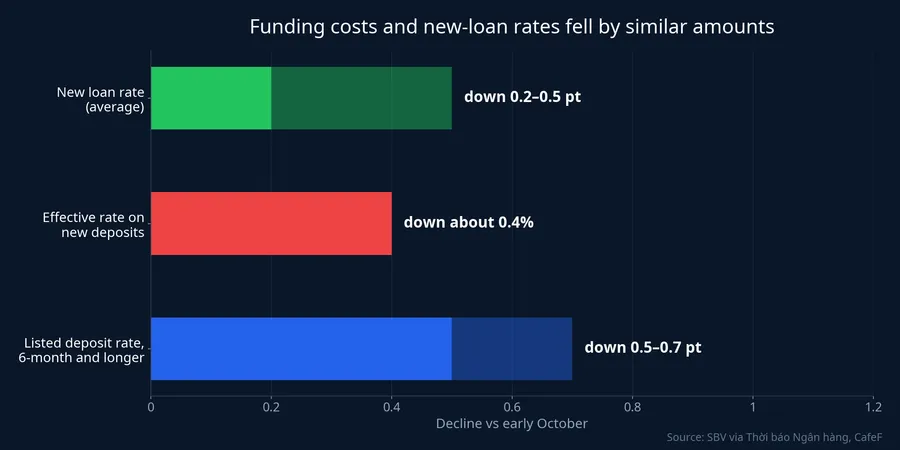
Lending rates struggle to fall faster than what banks pay for their funding. The SBV treats lower deposit rates as the basis for lower loan rates, and has asked banks to cut listed deposit rates by at least 0.5 points a year on new deposits of six months or longer.
On posted rate boards, banks have complied. State-owned and foreign banks generally cut 0.5 points a year, while joint-stock commercial banks cut 0.5–0.7 points a year.Thời báo Ngân hàng Per CafeF, citing SBV data, all 46 of 46 commercial banks have lowered listed rates on terms of six months or longer.CafeF
Rates actually paid fell less than the posted boards. By the end of October, the rate on new deposits was about 0.4% lower than at the start of the month.Thời báo Ngân hàng The decline in new funding costs and the decline in new loan rates sit fairly close together. That is an observation of two figures over the same period, not a causal measurement, but it fits how the SBV frames the problem: for loan rates to fall further, banks' funding has to get cheaper still.
The figure does not yet capture cuts on existing loans
The 0.2–0.5 point figure measures only newly originated loans, while part of the benefit of the rate cuts reaches loans already on the books. According to CafeF, Agribank's management said that by October 31 about VND 200,000 billion of existing loans had received rate cuts, with some cut by as much as 2.5% depending on the borrower. At MB, existing loans in five priority sectors are being repriced proactively by the bank when their adjustment date arrives, with no paperwork required.CafeF

So reading 0.2–0.5 points as "borrowers only got that much" would be wrong. It is better understood as the average drop for a new loan signed at the end of October.
What new tools the SBV is adding
Alongside open market operations, refinancing and short-term FX swaps, the SBV announced on November 3 that it will roll out FX-to-dong swaps with a six-month term. According to the Deputy Governor, the tool is meant to support longer-term funding for credit institutions, improve liquidity and help bring down the overall level of interest rates.
Under the plan reported by Người Quan Sát, the swap session is scheduled for November 6 with a value date of November 9, a maximum size of USD 2 billion and a 182-day term. Banks sell dollars to the SBV for dong, then buy them back at maturity. If the full quota is used, the dong supplied could come close to VND 48,800 billion.Người Quan Sát What sets it apart from earlier rounds is the term: previous swaps ran only 7–21 days. Six-month funding is steadier for banks weighing lower-rate lending.
On enforcement, the Deputy Governor said the SBV will keep directing banks to lower both deposit and lending rates, and will take measures against credit institutions that do not follow the directive seriously. Per VTV, the SBV has signaled it is ready to cut credit growth quotas for banks that deliberately compete by raising rates.VTV The SBV also said it will monitor credit closely over the last two months of the year so that capital flows into production, business and priority sectors.
What the figure means for each group
New borrowers in eligible sectors, inside a preferential program. This group sees the clearest cut, around 1.5–2% and up to 3% in places. The loan has to match the program's eligible borrowers, sector and term at the bank where they borrow.
New borrowers outside the programs. For this group, the 0.2–0.5 point average is the closest measure of how much cheaper credit has become. A 1.5–2% cut is not the default for every new loan.
Existing borrowers. The cut depends on each bank's policy for outstanding loans. Agribank and MB are two examples that have disclosed how they handle it, and the date that matters is the rate-adjustment date in one's own contract.
Savers. New deposits are earning about 0.4% less than at the start of October. This is the other side of the same round of cuts.
Signals to watch
The 0.2–0.5 point reading is only the first measurement, taken when, per VTV, the preferential programs had been running for about two weeks. The average rate on new loans in the November and December reporting periods will show whether the gap to the 1.5–2% mark narrows. If funding costs keep falling and banks make heavy use of the six-month swaps, the average has room to move lower. If the rates actually paid on deposits stall around current levels, the large cuts will most likely remain concentrated in programs with defined borrowers and quotas.