

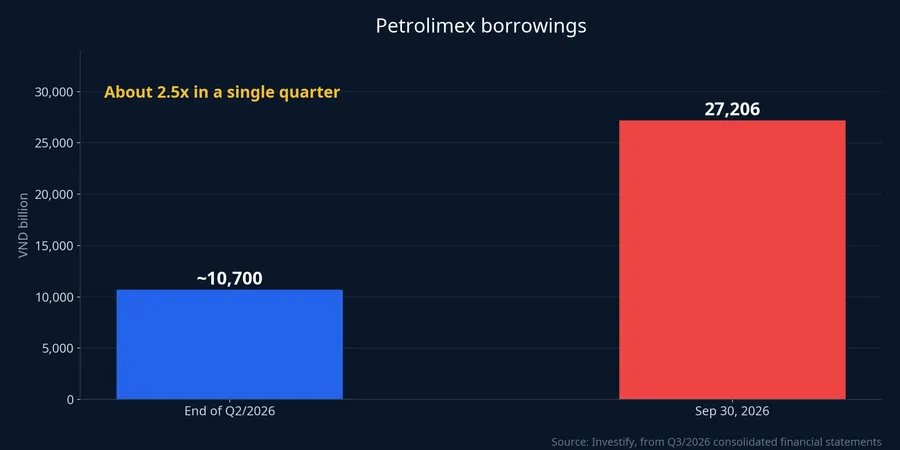
In the third quarter of 2026, Vietnam National Petroleum Group (Petrolimex, ticker PLX) reported pretax profit of VND 1,790 billion, up 122% year on year.VnBusiness Over nine months, the group has already passed its full-year profit plan. In the same three months, its borrowings rose more than 154%, about 2.5 times, to nearly VND 27,206 billion.Znews
The two facts do not contradict each other. To see why, read the balance sheet from three sides: where the assets sit, where the money to hold them came from, and how Q3 profit was made. All figures below come from the Q3/2026 consolidated financial statements, which include Petrolimex's subsidiaries, as reported by the press.
Assets: inventory has doubled since January
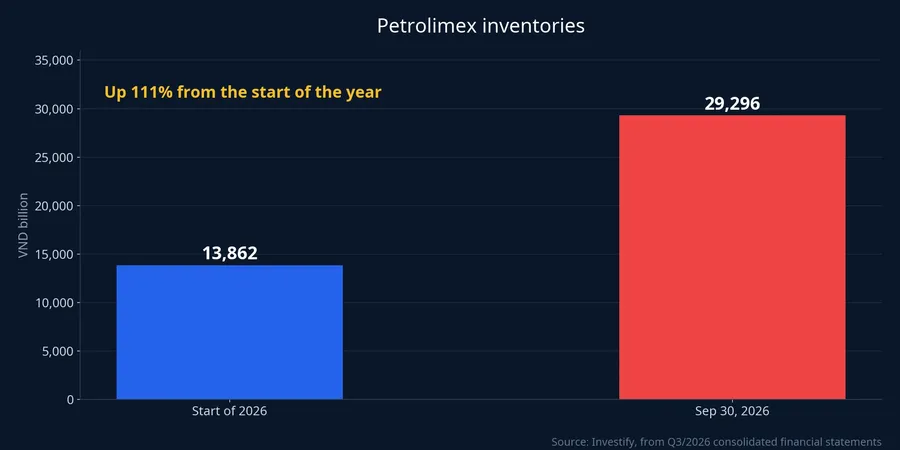
At September 30, 2026, total assets stood at VND 109,009 billion, up 27% from the start of the year. The biggest mover was inventory, which rose from VND 13,862 billion to VND 29,296 billion, up 111% and close to 27% of total assets.VnBusiness Merchandise accounts for VND 16,454 billion, finished goods VND 4,849 billion (nearly 18 times the opening balance) and raw materials VND 4,279 billion (more than four times).Người Quan Sát
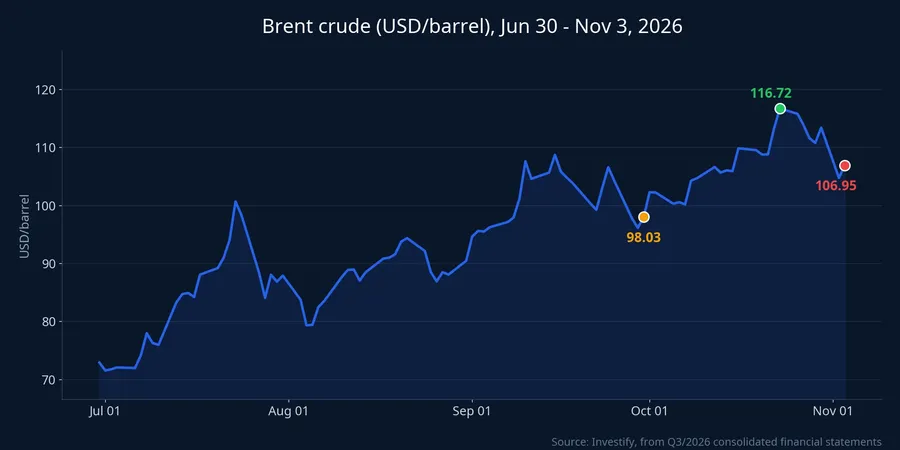
Inventory value reflects both volume and purchase price. Q3 was a rising quarter for oil: Brent went from USD 72.95 a barrel on June 30 to USD 98.03 on September 30, a gain of about 34%. Average crude prices over the quarter climbed from roughly USD 75 to USD 95, touching USD 105 at one point.VnBusiness The same litre of fuel sitting in a tank is booked at a higher value when it was bought at a higher price.
Alongside the stock of goods, Petrolimex still holds a large pile of cash. Cash and equivalents are VND 6,122 billion and short-term financial investments VND 22,286 billion, mostly bank deposits. Together that is about VND 28,407 billion, up almost VND 2,755 billion from the start of the year.Người Quan Sát
Funding: banks and suppliers both pay for the stock
The added assets were financed mainly by bank loans and by money not yet paid to suppliers. Short-term borrowings and finance leases are VND 26,595 billion and long-term ones just over VND 610 billion. Almost all of the debt is short-term, which fits the working-capital profile of fuel trading. Versus the start of the year, total borrowings are up more than VND 8,511 billion, far less than the Q3 increase, because Petrolimex paid down debt in the first half and then borrowed heavily again.Người Quan Sát
The notes to the statements show where the borrowing went:VnBusiness Vietcombank rose from about VND 2,168 billion at the end of Q2 to VND 9,945 billion at the end of September; Agribank's Lang Ha branch stands at VND 6,423 billion, with no balance there at the end of Q2; BIDV moved from about VND 1,968 billion to VND 2,235 billion.
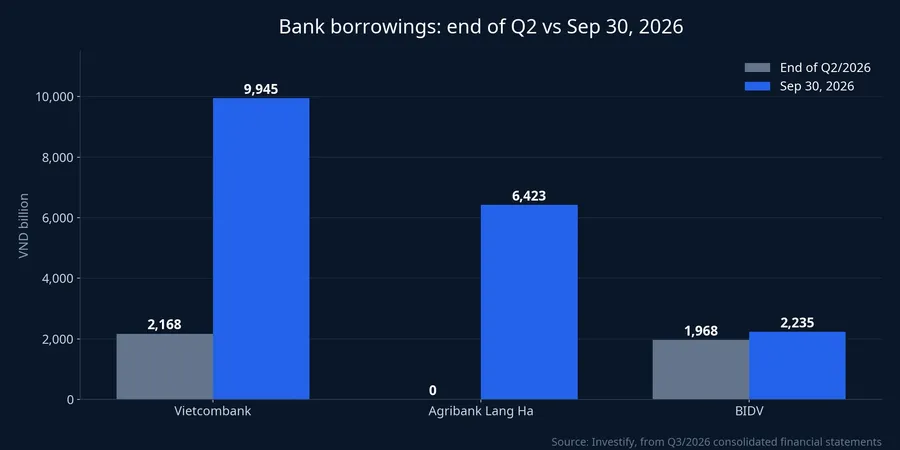
Vietcombank is now the largest creditor, with 37.4% of short-term borrowings. Vietcombank, Agribank and BIDV together hold about VND 18,604 billion, or 70%. The debt-to-equity ratio rose from 0.63x at the start of the year to 0.87x.Người Quan Sát
The second source is suppliers. Trade payables rose 73.7% to VND 41,658 billion, including almost VND 20,000 billion owed to Binh Son Refining and Petrochemical (BSR) and the distributor of Nghi Son refinery products, more than the bank debt. In other words, part of the stock in the tanks is financed by money not yet paid to the refineries themselves. Equity is VND 31,359 billion, up about VND 1,797 billion from the start of the year.
Profit: a strong Q3 on volume and gross margin
In Q3/2026, net revenue was VND 138,482 billion, up 66%; gross profit VND 7,303 billion, up 62%; and profit after tax VND 1,363 billion, up 93%. Management attributes the result to a better gross margin while crude prices rose and stayed high, together with rules on circulation reserves.Znews Fuel volumes sold in Q3 were up 18% year on year, spreading fixed costs over more units.VnBusiness
The group-wide gross margin is about 5.3%. Gross profit grew 62%, close to the 66% growth in revenue. Pretax profit grew far faster, 122%, because selling expenses rose only about 42% to VND 5,271 billion, slower than gross profit.Người Quan Sát The nine-month figures show the same mechanism: selling and administrative expenses grew about 25%, slower than gross profit.
For the nine months, Petrolimex booked revenue of VND 373,226 billion, up 64%, and pretax profit of VND 4,688 billion, up 67%. That is 118% of the full-year revenue plan (VND 315,000 billion) and nearly 139% of the pretax profit plan (VND 3,380 billion). The plan was drawn up when the company was still posting a loss in Q1/2026. Nine-month revenue edges past Vingroup's roughly VND 372,500 billion, making Petrolimex the non-financial company with the largest revenue on the exchanges.CafeF
The cost of a bigger balance sheet
Financial costs have started to shift. Q3 financial expenses rose from VND 382 billion to VND 614 billion, of which interest expense was VND 257 billion. Over nine months, interest expense is VND 679 billion, up 15.1%. The group also booked a net FX loss of about VND 416 billion, against a net gain of about VND 60 billion a year earlier, so total nine-month financial costs rose 47.5% to VND 1,496 billion.Người Quan Sát
The VND 27,206 billion of debt is only a snapshot of the end of Q3. If it stays at that level into Q4, interest will accrue on a balance larger than the Q3 average. Conversely, as the stock is sold and cash comes in, short-term borrowings can fall as fast as they rose, as they did in the first half.
Cash flow shows the same lag. Although consolidated profit after tax for nine months was VND 3,753 billion, net operating cash flow was negative VND 2,488 billion, against negative VND 1,157 billion a year earlier.Người Quan Sát Book profit has not yet fully turned into cash while inventory and working capital needs have jumped.
The second point is the value of the stock. If oil prices fall after the purchase, a company may have to write down inventory, as VnBusiness notes. Brent has since retreated from a peak of USD 116.72 on October 23 to USD 106.95 on November 3, down about 8.4%, yet it remains above the USD 98.03 of September 30, when the VND 29,296 billion of inventory was booked. The larger exposure is to goods bought in October at high prices.
This risk should be set against the cash. About VND 28,407 billion of cash and short-term investments exceeds total borrowings of VND 27,206 billion. Interest income from deposits and loans over nine months was VND 881 billion, still above the VND 679 billion of interest expense. The balance sheet is heavier, but it is not a balance sheet short of cash.
Where to look in the Q4 report
Q3 was a genuinely good quarter for Petrolimex: volumes grew, selling costs rose more slowly than gross profit, and the year-to-date total has passed the annual plan. What changed is the structure behind it. Since the end of Q3, results in coming quarters are tied more closely to two things outside the fuel pump: the price at which the nearly VND 29,300 billion of stock is sold if oil turns, and the interest on a loan book about 2.5 times its end-Q2 size. The VND 28,400 billion-plus cash pile eases that pressure but does not remove it.
The Q4/2026 report will answer through three lines. The provision for inventory write-downs shows whether the stock was marked down. Interest expense, against VND 257 billion in Q3, shows whether borrowings stayed high. Full-year operating cash flow shows whether the inventory turned into cash. If borrowings fall back toward end-Q2 levels while operating cash flow turns positive, the Q3 borrowing was working capital following the oil price. If debt stays near VND 27,000 billion and inventory does not fall, interest costs and oil-price swings will be a more permanent part of Petrolimex's earnings.