

In October, 4,777,800 PNJ shares belonging to Tran Phuong Ngoc Giao, daughter of Cao Thi Ngoc Dung, Chair of the Board of Phu Nhuan Jewelry Joint Stock Company (HoSE: PNJ), were sold in two forced margin sales.VietnamFinance In both, the sell orders came from the brokerage that had lent her the money, not from her.
Put simply, shares pledged as collateral for a loan lose value, and the cushion behind the loan gets thinner. That mechanism works the same way on any margin account.
On the company's side, PNJ is having a two-sided year. For the first nine months, net revenue came to VND 32,704 billion, up 29% year on year. Net profit was VND 471 billion, down 71%, including a third-quarter net loss of VND 258 billion.CafeF That is the backdrop for the trades below.
Two sales in 22 days
The first came in the October 8 session. VNDIRECT Securities sold 2.94 million of Giao's PNJ shares by order matching.CafeF Her holding fell from 14,644,221 to 11,704,221 shares, or from 2.86% to 2.29% of the company.VietnamFinance The forced sale equaled roughly 13.5% of that session's matched volume.
The second began with a notice. On October 30, MB Securities (MBS) announced it planned to sell 2.17 million of Giao's PNJ shares, by order matching or negotiated trades. Selling would run from October 30 until the client met her payment obligations or the account met the required margin ratio.VnBusiness
In the October 30 session itself, a trade report shows the brokerage matched 1,837,800 shares, about 332,000 fewer than planned. Giao was left with 9,866,421 shares, or 1.93% of charter capital.VietnamFinance That was nearly 19.6% of the session's matched volume, with PNJ closing at VND 15,500, down 3.43%.
Across the two sales, Giao was sold down by about 32.6% of what she held before the first one, and her stake fell from 2.86% to 1.93% in 22 days.
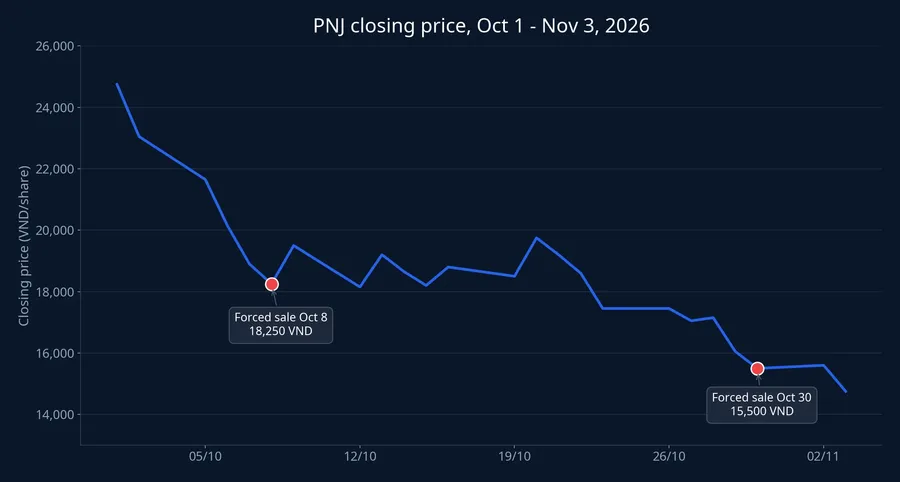
Between the two sales, PNJ went from VND 18,250 to VND 15,500, a 15.1% drop. The price had been weak since early October, so it is hard to separate what the forced sales contributed from everything else.
Why the seller is the brokerage
In margin lending, an investor pledges the shares in the account as collateral. The margin ratio is the investor's own equity as a share of total account value. When the price falls, collateral value falls with it while the debt stays put, so the ratio slides.
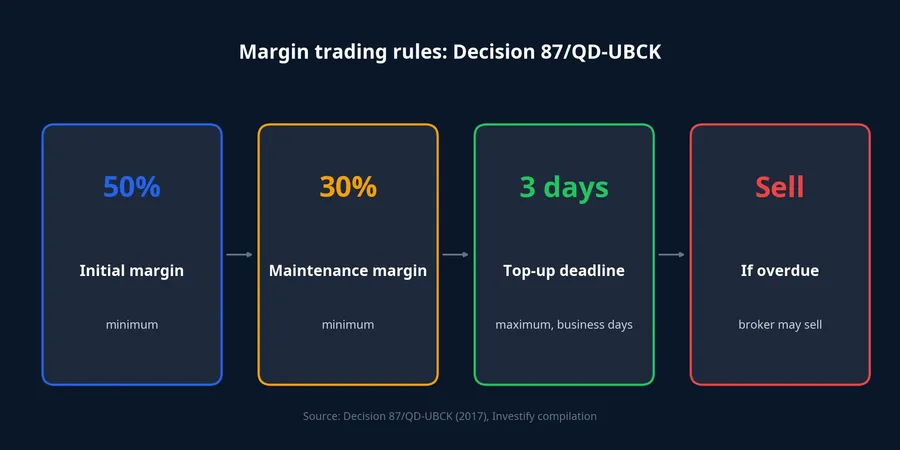
The margin rules attached to Decision 87/QD-UBCK (2017) set the frame. The initial margin ratio is set by the brokerage but may not be below 50%; the maintenance ratio may not be below 30%. When an account drops under the maintenance level, the brokerage issues a margin call and the client must top up within the deadline the brokerage sets, at most 3 business days.Luat Viet An If the client fails to top up, or tops up too little, the brokerage may sell part or all of the pledged shares to recover the loan.
The rules let a brokerage trade pledged shares only on the client's instructions, except where it must sell to recover the loan. A forced sale is that exception: the account holder's name stays on the trade report, but the decision to sell belongs to the lender.
That also explains why the October 30 volume came in below plan. MBS's notice said the actual quantity could be higher or lower, depending on price moves that change collateral value at the time of processing.Bao Phap Luat Selling may also not happen at all if the client adds assets to bring the margin ratio back to a safe level.VnBusiness The 2.17 million figure was an estimate at the time of the notice.
September and October: two different kinds of trade
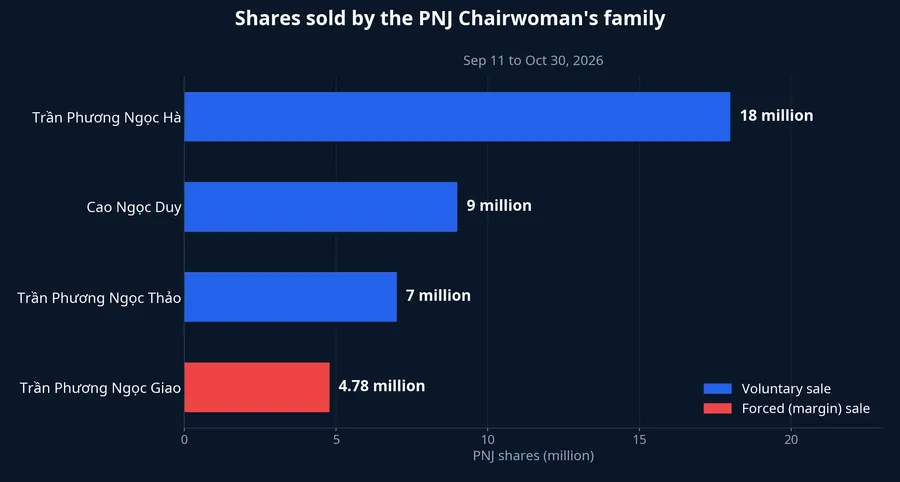
Before the forced sales, other members of the Chairwoman's family had made large sales, but those were voluntary. On September 11, Tran Phuong Ngoc Thao, Vice Chair of PNJ's board, sold 7 million shares. From September 11 to 18, Tran Phuong Ngoc Ha, another daughter of Dung, completed the sale of 18 million shares.VietnamFinance According to the disclosures, the two trades were meant to raise funds so Dung's family could lend to PNJ as working capital.CafeF
That loan is already on the books. In PNJ's Q3 2026 consolidated financial statements, the company borrowed VND 700 billion from Dung at 10% a year, maturing September 25, 2027.CafeF Cao Ngoc Duy, Dung's younger brother, sold 9 million shares across the October 1 and 2 sessions to meet personal financial needs.VnBusiness
At the extraordinary shareholders' meeting on October 21, Dung said the family sold shares to raise money to lend to the company. On her daughter's forced sale, she called it an unexpected financial-risk situation for the family, adding that the family's assets are hit when the share price falls, like any other shareholder's.Bao Phap Luat
So shares left family hands in two different ways. The September trades were registered by the account holders, who chose the timing and stated the purpose. Giao's two October sales were carried out by brokerages under her loan contracts, when the account no longer met its margin ratio.
The family's stake after seven weeks
Adding the voluntary trades and the two forced sales, family members sold or had sold nearly 38.78 million PNJ shares: 34 million voluntarily and nearly 4.78 million through forced sales.VietnamFinance Against roughly 511.7 million shares outstanding, that is about 7.6%.
Per the November 2 trade report, the three people listed still hold 35,895,903 shares combined, or 7.01% of charter capital: Dung 2.93%, Thao 2.15% and Giao 1.93%.VietnamFinance The 7.01% covers only these three people, not all related parties.
One factor is larger than all these trades. The October extraordinary meeting approved a private placement of up to 550 million shares to professional securities investors, to add working capital and repay debt.VnBusiness That ceiling exceeds the shares now outstanding, so if fully issued it would reshape the shareholder base by more than every family trade combined.
What it means for margin borrowers
Giao's account is not special mechanically. When the margin ratio falls below the agreed maintenance level, the brokerage issues a call, and if the account is still short at the deadline, it may sell.

Under the rules, the margin account contract must state the initial and maintenance ratios, the deadline for topping up and how the brokerage will contact the client for margin calls and forced sales. Before selling, the brokerage must notify the client, and afterward it must send a statement of the result.Luat Viet An
The 30% is only a floor. Each brokerage sets its own maintenance ratio, so the same portfolio can be safe at one firm and already under a margin call at another. For a borrower, the figures worth knowing by heart are the maintenance ratio, the level at which the contract lets the broker start selling, and the number of days allowed to top up. They decide whether a price drop merely thins a portfolio or becomes a sell order the account holder never placed.
The takeaway is mechanical: when prices fall and the margin ratio is not restored, the lender decides whether to sell, for Giao as for any margin account. The next milestones to watch are Giao's new trade report, which will show whether the sale under MBS's notice has stopped or continues, and the progress of the private placement of up to 550 million shares, which will determine how far PNJ's shareholder structure changes.