

In its Q3/2026 consolidated financial statements, published on 30 October, Phu Nhuan Jewelry JSC (HoSE: PNJ) reports diamond jewelry and loose diamonds in stock at a cost of about VND 5,160 billion, against which it has booked a write-down provision of VND 1,684.8 billion.PNJ Put simply, for every VND 100 of cost, the books now carry roughly VND 67.
For context, over the first nine months PNJ's net revenue reached VND 32,703.9 billion, up about 29% year on year, and net profit after tax stayed positive at VND 470.5 billion, although it fell about 71%.Người Quan Sát The write-down is already reflected in those results. This post works from that headline figure down to the mechanics: where the stock came from, why it has to be written down, what it is being used for at the banks, and what will decide whether the write-down becomes a real loss or is reversed.
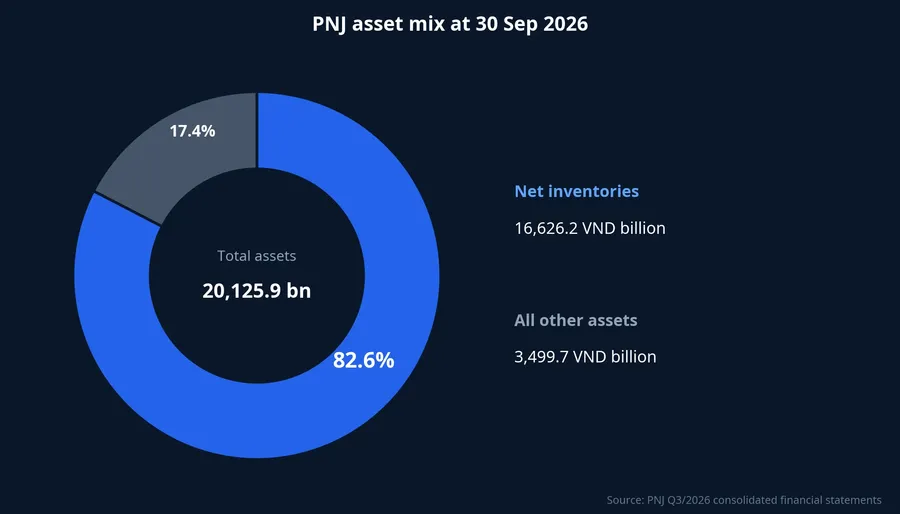
Inventory has become most of the balance sheet
At 30 September, PNJ's total assets were VND 20,125.9 billion, almost flat from VND 20,163.6 billion at the start of the year. Under that flat total, the mix has shifted clearly. Inventory net of provisions stood at VND 16,626.2 billion, about 82.6% of total assets,VietnamFinance against roughly 78.5% at the start of the year.

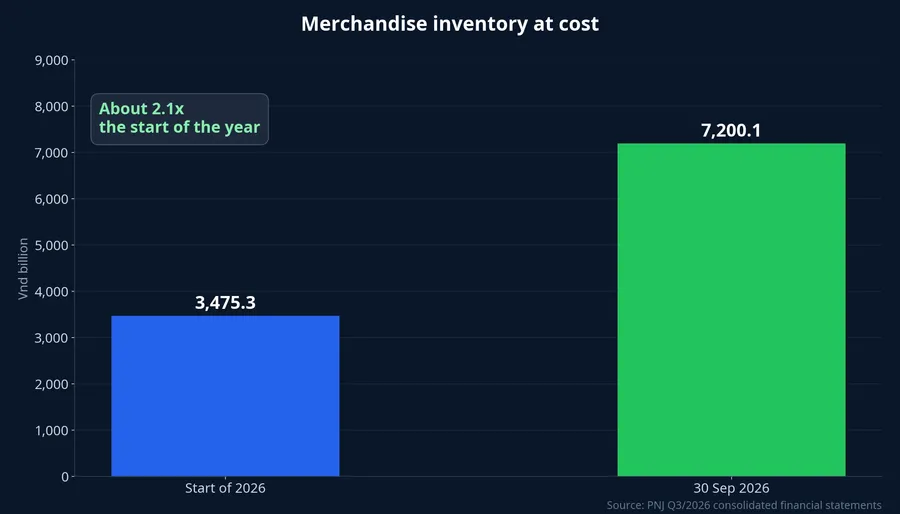
Inventory at cost rose to VND 18,855.2 billion, up about VND 2,974 billion from the start of the year.Người Quan Sát The sharpest increase is in merchandise, at a cost of VND 7,200.1 billion, about 2.1 times the VND 3,475.3 billion recorded at the start of the year.PNJ
The cash going into stock also shows in the cash flow statement. Over nine months, the inventory build alone cut operating cash flow by about VND 2,974 billion, and net operating cash flow was negative at about VND 883 billion, compared with a positive VND 1,714 billion a year earlier.VietnamFinance
Where the stock came from
The new stock comes from the company's trade-in policy. Since July, after the case involving a former director of PNJ's grading subsidiary (P-Lab), many customers have brought diamonds and diamond jewelry in to sell back. At the extraordinary shareholders' meeting in October, Phan Quốc Công, General Director of PNJ, said the wave of resales ran at about ten times the normal level, and that cumulative value under the trade-in policy for this category reached about VND 21,000 billion by the end of September.VnExpress
The mechanism is direct. Each time PNJ buys an item back under its commitment, it pays the customer and takes the item into stock: cash goes out, inventory comes in. According to the notes as compiled by Người Quan Sát, held-to-maturity term deposits fell from VND 1,909.4 billion to VND 82.6 billion in nine months, and across all bank deposits PNJ held about VND 1,307 billion, down 44.9% from the start of the year.Người Quan Sát On the other side, cash and cash equivalents rose to VND 1,242.2 billion from VND 522.3 billion, meaning part of the term deposits was moved back into cash that can be used at once.PNJ
Why a write-down is required
Under the accounting policy in the notes, inventory is carried at cost, and a provision must be set up when the recoverable value falls below cost. In other words, the books cannot carry an item above what the company estimates it can sell for. At 30 September, total inventory provisions were VND 2,229.0 billion, against VND 46.0 billion at the start of the year. Note 7 splits this by product group, and two groups are written down far more heavily than the rest.PNJ
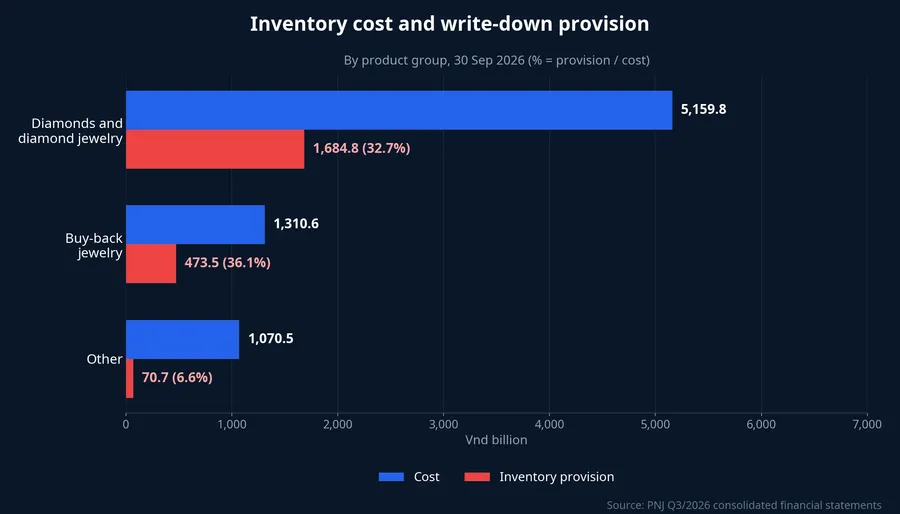
- Diamond jewelry and loose diamonds: cost VND 5,159.8 billion, provision VND 1,684.8 billion, about 32.7% of cost.
- Buy-back jewelry: cost VND 1,310.6 billion, provision VND 473.5 billion, about 36.1%.
- Other: cost VND 1,070.5 billion, provision only VND 70.7 billion, about 6.6%.
Almost the entire provision, VND 2,223.6 billion, sits in the merchandise line. Finished goods, at a cost of about VND 10,055 billion, carry a provision of only about VND 3 billion, and raw materials need almost none.
Diamonds and buy-back items are written down hardest because their cost is what PNJ actually paid, including the price paid to customers under the trade-in commitment, while the price they can fetch on resale depends on today's market. Mr. Công also said that clearing this stock will take time while consumer demand stays weak.VnExpress Unlike gold, which has a daily quoted price, diamonds have no single price list, so the gap between the price paid and the price achievable tends to be wider.
There is also a second layer for items that have not yet come back. Short-term provisions for payables stood at VND 848.0 billion on 30 September, against VND 26.6 billion at the start of the year, of which about VND 821 billion relates to the obligation to buy back products under the trade-in policy.VietnamFinance The estimated provision of VND 7,071 billion in the full-year plan is a figure for the whole year and, per VietnamFinance, is not the same as the amounts already booked at 30 September.
A write-down on paper is not cash lost
A provision is an expense booked in the income statement, but no cash has left the company because of it. The nine-month cash flow statement shows exactly this: the "provisions" line is added back by VND 2,987.9 billion when computing operating cash flow, compared with a reversal of VND 13.4 billion a year earlier.PNJ The value of the write-down is already in the balance sheet, because inventory is carried net of the provision.
What happens next depends on actual selling prices. When an item is sold:
- If the sale price is below the carrying value after provision, the difference is a new loss.
- If it is above, the excess provision is reversed into profit.
So the VND 2,229 billion write-down is PNJ's estimate at the reporting date, not a final number.
Inventory also serves as collateral
This stock is not only waiting to be sold. According to Note 7, inventory with a carrying value of VND 5,111 billion is pledged as collateral for short-term bank loans, up about 29% from VND 3,961 billion at the end of 2025.PNJ Short-term borrowings and finance lease liabilities were VND 4,320.6 billion, up 2.3% from the start of the year, of which bank loans were VND 3,616.9 billion, concentrated at five banks.Người Quan Sát
The inventory therefore plays two roles at once: it is the source of cash PNJ collects when it sells, and it is the collateral that keeps short-term loans rolling over. Interest expense in Q3 was VND 80.4 billion, about 3.3 times the VND 24.1 billion of a year earlier.Người Quan Sát
Q3: a loss, but lower operating costs
In Q3 alone, net revenue was VND 6,994.7 billion, down 14% year on year, gross margin fell to 8.7% from 19.8%, and the company posted a net loss of about VND 258 billion.Mekong ASEAN In its explanatory letter to the State Securities Commission and HoSE, PNJ said revenue fell mainly because market demand changed, while gross margin fell because of unusual gold price movements and a shift in revenue and product mix.PNJ Financial expenses rose about 170%, mainly due to interest.
On the other side, Q3 selling expenses fell 13.4% to VND 675.8 billion and administrative expenses fell 11% to VND 193.4 billion, which PNJ attributes to cost-optimization programs.Người Quan Sát At quarter-end PNJ had 424 stores and 7,123 employees, against 8,164 employees at the end of 2025.VietnamFinance
The report does not break out provisions by quarter, so it is not possible to say how much of the VND 2,229 billion fell in Q3. What is certain is that the balance at 30 September is already in the nine-month result and in book value.
The markers that will show how fast the stock clears
For a company with more than 82% of its assets in inventory, cash flow in the coming quarters is tied to two questions: whether buy-back stock and diamonds sell quickly or slowly, and at what price relative to the carrying value after provision. The thesis of this post is that inventory, not revenue, is what shapes PNJ's picture in the coming quarters. That thesis would change only if Q4 figures show inventory falling without new losses.
The Q4/2026 financial statements will answer part of this, with three lines to set beside the Q3 numbers:
- Merchandise at cost, now VND 7,200.1 billion: a decline means goods have been sold.
- The inventory provision balance, now VND 2,229 billion: if it falls in line with sales and no new loss appears, selling prices are tracking the carrying value; if it rises, PNJ is still cutting its estimate of achievable prices.
- Operating cash flow: a return to positive would show inventory starting to convert back into cash.
The second marker is the private placement. According to the subsequent-events note in the Q3 report, the extraordinary meeting approved a private placement of up to 550 million shares to add capital for operations.PNJ Its timing and outcome will show how much additional capacity PNJ has to meet trade-in commitments without a fire sale of stock.
For anyone holding diamond jewelry bought at PNJ, this story is relevant too: the buy-back stock in the warehouse is exactly the goods customers returned under the trade-in policy, and how fast PNJ clears it will affect how the company continues to meet its remaining commitments.