

Over the first nine months, Joint Stock Commercial Bank for Investment and Development of Vietnam (BIDV, ticker BID) reported consolidated pre-tax profit of VND 29,484 billion, up 24.8% year on year.CafeF Q3 on its own came in at VND 10,579 billion, up 39.3%, an increase of about VND 2,985 billion, and more than half of that increase came from a lower credit-loss provisioning charge. At the same time, bad debt grew faster than the reserve against it, so the NPL coverage ratio slid from 99.9% at the end of 2025 to 73.4%.
This article breaks the extra profit into its parts, then sets it beside what happened to bad debt. The figures come from BIDV's Q3 2026 consolidated financial statements, as analyzed by CafeF and Người Quan Sát.
What the profit figure is made of
Q3 pre-tax profit was VND 10,579 billion, up 39.3% year on year and 2.4% from Q2. A year earlier it was VND 7,594 billion.Người Quan Sát
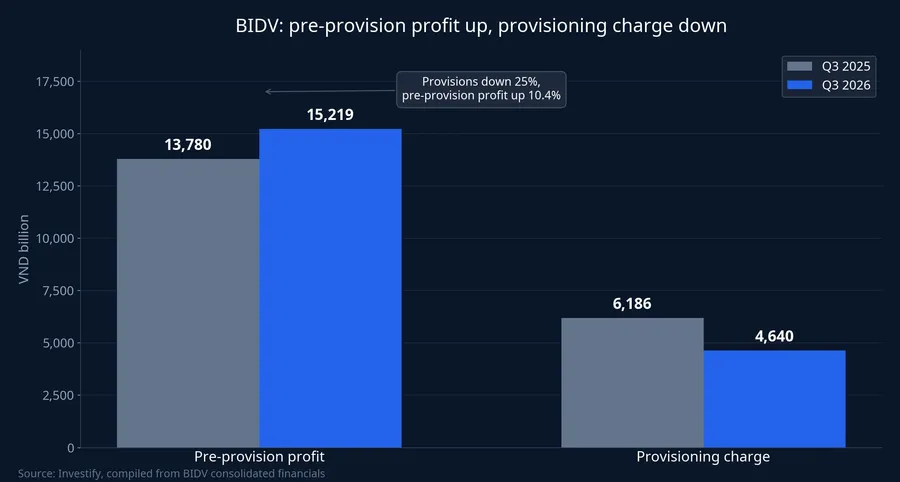
The first part is operating performance before provisions. Q3 net interest income reached VND 17,056 billion, up 12.4%. Total operating income rose 9.7% to VND 23,206 billion, while operating expenses grew only 8.3%. Pre-provision profit came to VND 15,219 billion, up 10.4%.CafeF Against VND 13,780 billion a year earlier, that is roughly VND 1,440 billion of additional profit.Người Quan Sát
The second part is the provisioning charge. It fell 25%, from VND 6,186 billion to VND 4,640 billion. That is about VND 1,545 billion less set aside, equal to roughly 52% of the quarter's increase in pre-tax profit.Người Quan Sát
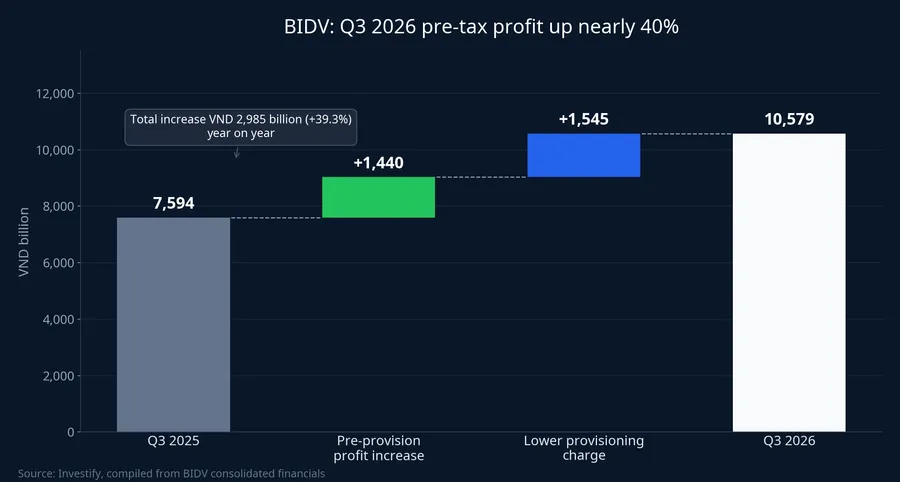
Put differently, had BIDV provisioned in Q3 at exactly the year-earlier level, pre-tax profit would still have risen, but by about 19% rather than 39.3%. The calculation uses the figures above: VND 7,594 billion plus VND 1,440 billion of extra operating profit.
Over nine months, operations carry more of the gain
A single quarter is easily skewed by the timing of provisioning, so the nine-month totals give a more balanced picture. Nine-month provisioning was VND 15,959 billion, down just 5.4% year on year.Người Quan Sát The cost-to-income ratio fell from 33.8% to 32.7%.CafeF Nine-month net interest income reached VND 50,594 billion, up 14.7%.Người Quan Sát
So over nine months, most of the profit growth came from operations. In Q3 alone, provisions account for more than half.
In its filing explaining the profit change, BIDV said results were supported by net interest income growth and a stronger push to recover written-off debts. The cash flow statement shows VND 8,296 billion collected from written-off debt over nine months, up 14.1%, while other operating income, the line that usually reflects such recoveries, reached VND 10,047 billion, up 19.8%.Người Quan Sát
Bad debt is growing faster than loans
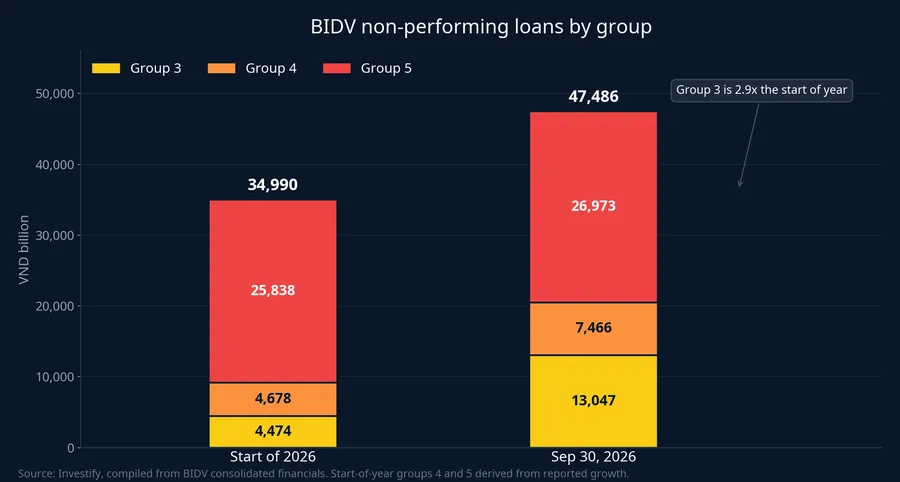
As of September 30, 2026, BIDV's on-balance-sheet bad debt stood at VND 47,486 billion, up 35.8% from the start of the year, an increase of VND 12,509 billion. Over the same period, customer loans grew 8% to VND 2.56 quadrillion.CafeF
The biggest increase was in substandard debt (Group 3), from VND 4,474 billion to VND 13,047 billion, 2.9 times the start of the year. Doubtful debt (Group 4) rose 59.6% to about VND 7,466 billion. Loss debt (Group 5) grew more slowly, up 4.4% to VND 26,973 billion, and still makes up about 56.8% of total bad debt.Người Quan Sát
One tier before bad debt, special-mention loans (Group 2) rose about 26% to VND 39,505 billion, or 1.54% of total loans.CafeF Adding Group 2 to bad debt, total loans in Groups 2 to 5 come to VND 86,991 billion, about 3.4% of loans versus 2.8% at the start of the year.Người Quan Sát Group 2 is the pool that can migrate into bad debt in later quarters. That said, comparing balances at two dates does not show which specific loans changed category.
These numbers need context. The NPL ratio at the end of Q3 was 1.85%, up from 1.47% at the start of the year but nearly flat against 1.83% at the end of Q2 and below the 1.87% of a year earlier.CafeF The start-of-year base was much lower than other quarters, so the rise since January looks bigger than it does against the year-earlier figure.
Why the reserve stood still
The loan-loss reserve for customer loans at the end of Q3 was VND 34,871 billion, almost the same as at the start of the year.CafeF That does not mean BIDV stopped provisioning. Over nine months the bank set aside roughly VND 15,940 billion and used roughly VND 16,013 billion of reserves to resolve credit risk. What flowed in and what flowed out were nearly equal, so the balance did not move.Người Quan Sát
Meanwhile, bad debt still on the books rose by more than VND 12,500 billion. The two meet in the NPL coverage ratio, the reserve divided by bad debt: it fell from 99.9% at the end of 2025 to 73.4% on September 30.Người Quan Sát Simply put, for every VND 100 of bad debt, the reserve now holds about VND 73.
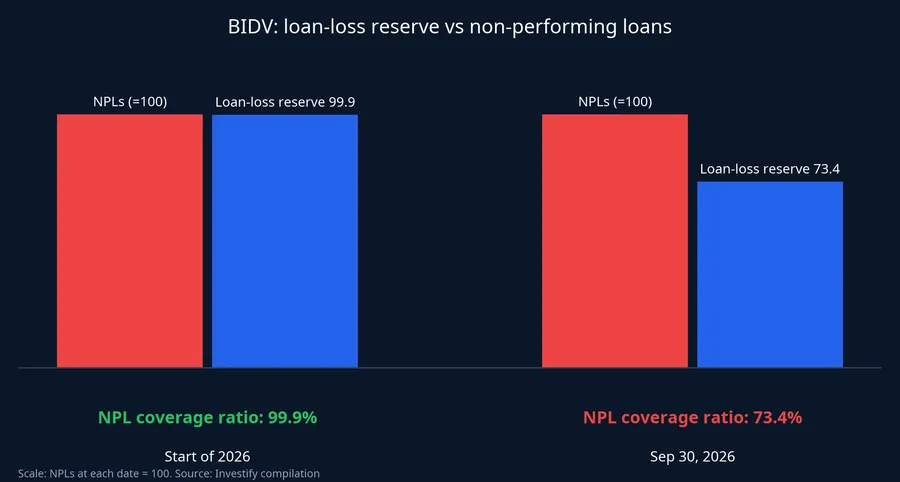
To gauge the scale, here is a mechanical calculation. With bad debt at VND 47,486 billion, each percentage point of coverage equals about VND 475 billion of reserves. To return coverage to 100%, BIDV would need roughly VND 12,600 billion more if bad debt stayed flat, nearly 2.7 times Q3's provisioning charge alone. This is not a forecast: bad debt could fall through recoveries, and the bank is under no obligation to bring coverage back to any particular level.
In the same quarter, Vietcombank made a heavy provision against a bond lot and has an NPL coverage ratio of 243%, according to Vietcap.Doanh nhân trẻ The two large banks are moving in different directions: BIDV provisioned less than a year earlier in Q3 and let coverage fall, while Vietcombank provisioned more.
What BID holders should watch
The part of Q3 profit that came from operations, meaning higher net interest income, costs growing slower than income, and more recoveries of written-off debt, rests on clear foundations. The part that came from lower provisioning is the one most sensitive to how bad debt develops. If Group 2 loans keep migrating into bad debt, the bank will have to provision more, and with reserves around the start-of-year level while bad debt has risen, extra provisioning will reach profit faster.
Conversely, if recoveries keep going well and Group 3 loans do not slide into deeper categories, bad debt could fall without heavy provisioning, and coverage would improve on its own. Both scenarios are measured by the same yardstick: which way bad debt and Group 2 loans move relative to the reserve.
The Q4 report will show which direction is playing out. Three figures worth setting side by side when it arrives are the quarter's provisioning charge, the Group 2 balance, and the coverage ratio against today's 73.4%.