
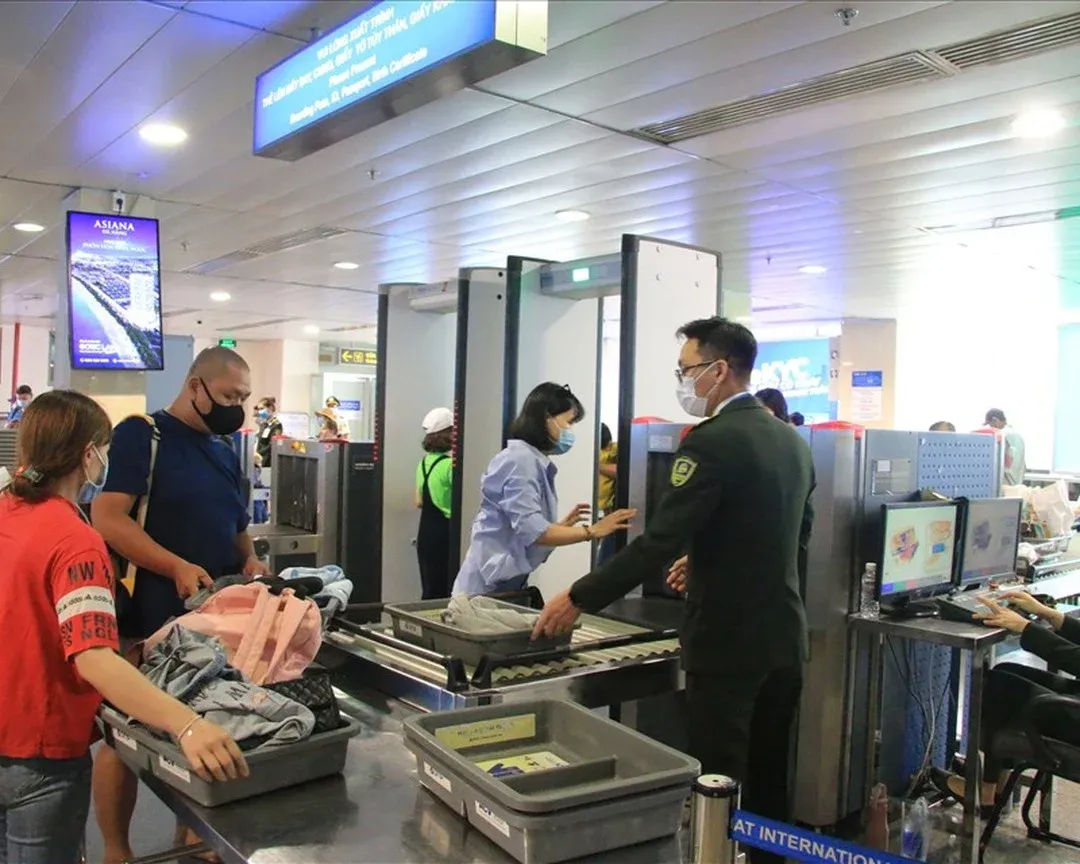

Airports Corporation of Vietnam (ACV) reported consolidated Q3 2026 pre-tax profit of VND 2,537 billion, down VND 1,438 billion, or 36%, from a year earlier.CafeF A single quarter looks heavy, but over nine months consolidated pre-tax profit still reached VND 10,780 billion, down just 2%.CafeF
Q3 was also the first quarter in which ACV no longer collected the aviation security service fee. That change is the easy explanation. Line by line, though, the lost security revenue accounts for only about one third of the profit decline. The rest comes from higher cost of sales and a reversal in the financial line.
One fact belongs up front: traffic did not fall. In Q3 the airports ACV manages handled 33.1 million passengers, up 12.7% year on year, and 198,988 takeoffs and landings, up 11.5%.FireAnt Profit dropped in a quarter when the terminals were busier.
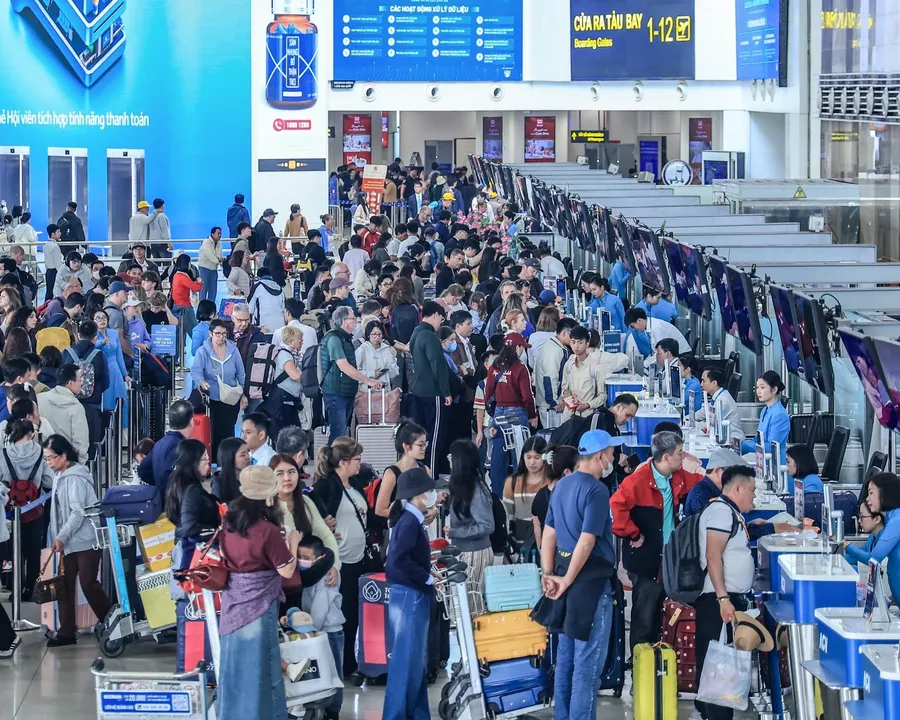
The revenue stream that left ACV on July 1
According to the financial statements as relayed by CafeF, from July 1, 2026 ACV no longer collects the aviation security service fee; collection has moved to units under the Ministry of Public Security as required by regulation. In Q3 2025 ACV's passenger and baggage security service revenue was VND 447 billion.CafeF
The footprint shows up in revenue. Net revenue for Q3 was VND 6,066 billion, down 6%. Aviation service revenue fell 8% to VND 4,943 billion, while non-aviation rose 7% to VND 908 billion, of which property leasing brought in VND 499 billion.CafeF
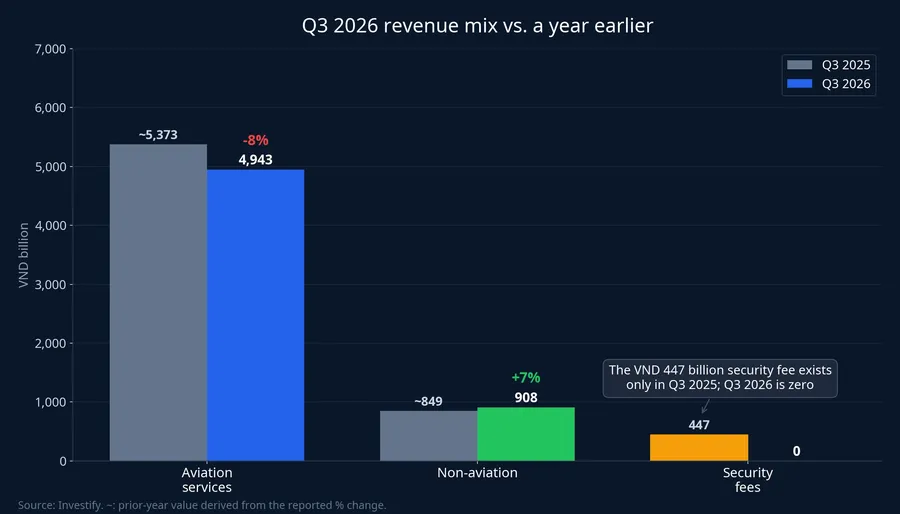
Net revenue a year earlier was about VND 6,476 billion (backed out from the 6% decline), so the shortfall is roughly VND 410 billion. That is close to the VND 447 billion security fee booked in Q3 2025. Put differently, if the security fee is removed from the comparison base, this year's Q3 revenue is almost flat on last year.
This is also unlike a seasonal pause. The collection function has moved to another body by regulation, so later quarters will not carry this revenue line in ACV's accounts.
Cost of sales up VND 714 billion: the heaviest piece
Revenue fell about VND 410 billion while cost of sales rose VND 714 billion, or 29%, to VND 3,192 billion. Together they pulled gross profit down 28% to VND 2,875 billion.CafeF The gross profit shortfall is roughly VND 1,124 billion, close to 80% of the decline in pre-tax profit.
| Q3 2026 item (consolidated) | Value | Vs. a year earlier |
|---|---|---|
| Net revenue | VND 6,066 billion | down 6% |
| Cost of sales | VND 3,192 billion | up 29% |
| Gross profit | VND 2,875 billion | down 28% |
| Financial revenue | VND 165 billion | down 56% |
| Financial expenses | VND 196 billion | from VND 41 billion |
| Pre-tax profit | VND 2,537 billion | down 36% |
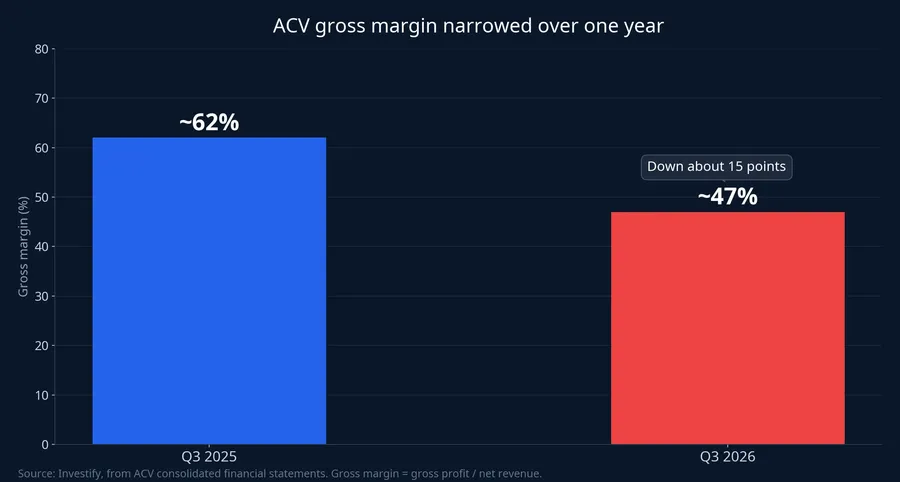
Gross margin narrowed from about 62% to about 47%.Người Quan Sát That narrowing is far larger than the security revenue that disappeared, which makes cost of sales the dominant factor in the quarter.
One data point narrows the field. According to the notes, staff costs for the quarter were about VND 864 billion, down VND 163 billion year on year,Người Quan Sát so payroll is hard to blame for the rise in cost of sales. Which items drove the VND 714 billion increase cannot be concluded from the published statements. Administrative expenses rose 10% to VND 398 billion and selling expenses fell 2% to VND 88 billion; together they thinned profit by only a few tens of billions.CafeF
The financial line flipped
The rest of the decline sits below gross profit. Financial revenue for Q3 fell 56% to VND 165 billion, and deposit interest alone dropped to VND 29 billion from VND 113 billion. At September 30, short-term financial investments stood at VND 5,182 billion, down 51% from the start of the year, while cash and equivalents were VND 4,969 billion, up 17%.CafeF These are period-end balances, not quarterly averages, so they only show that the pool of interest-earning deposits is smaller than at the start of the year. Whether the interest drop came from balances or from rates is not split out in the statements.
On the cost side, financial expenses rose from VND 41 billion to VND 196 billion, of which nearly VND 168 billion was an exchange-rate loss from period-end revaluation.CafeF A revaluation loss depends on the exchange rate on the closing date and can reverse next period if rates move the other way.
Combined, the financial line went from contributing about VND 330 billion in Q3 2025 to a loss of about VND 31 billion this quarter. The swing of roughly VND 360 billion is about a quarter of the drop in pre-tax profit.
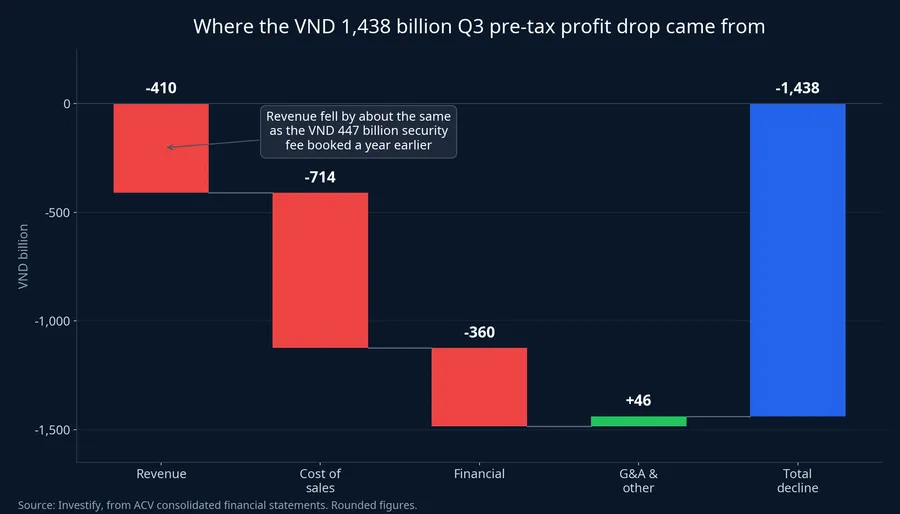
The chart sums it up in three groups: revenue down about VND 410 billion, cost of sales up VND 714 billion, and the financial line short by about VND 360 billion. All remaining items, including administrative costs and other income, net out to an offset of about VND 46 billion.
Why nine months are down only 2%
For the first nine months ACV posted net revenue of VND 19,226 billion, slightly higher, with pre-tax profit of VND 10,780 billion and after-tax profit of VND 8,742 billion, both down 2%.CafeF The gap between a 36% fall in one quarter and 2% over nine months comes from the first half. Subtracting Q3 from the nine-month figure puts H1 2026 pre-tax profit at about VND 8,240 billion, above the roughly VND 7,020 billion of H1 2025. Both early quarters still included the security fee, and the H1 gain absorbed nearly all of the Q3 shortfall.
On the plan, shareholders approved a 2026 pre-tax profit target of VND 7,011 billion.Người Quan Sát At its nine-month review, ACV said pre-tax profit had already exceeded the full-year plan by 31%, meaning the company is running ahead of plan.FireAnt That ratio follows the figures ACV presented at the review, so dividing consolidated profit of VND 10,780 billion by the plan is not appropriate; the two numbers may cover different scopes.
Upcoming reports read against a smaller base
The security fee left revenue on July 1, 2026, while earlier quarters of 2025 and the first half of 2026 still contain it. Arithmetically, every year-on-year comparison through Q2 2027 will carry a built-in structural shortfall. That decline does not by itself say airport operations are deteriorating, when passenger traffic is still growing at a double-digit pace.
The remaining factors are not of the same nature. The revaluation loss can reverse with the period-end exchange rate. Deposit interest depends on balances and rates. Cost of sales is the biggest variable, since it accounts for about half of the Q3 decline.
Our reading: ACV's Q3 profit fell because of a structural change in revenue plus a much higher cost-of-sales base, not because airports were empty. The Q4 statements, due in early 2027, should make the cost-of-sales picture clearer. If gross margin returns close to last year's level after stripping out security revenue, Q3 was a high-cost quarter. If it stays around 47%, that is the new cost base later quarters will have to carry.