

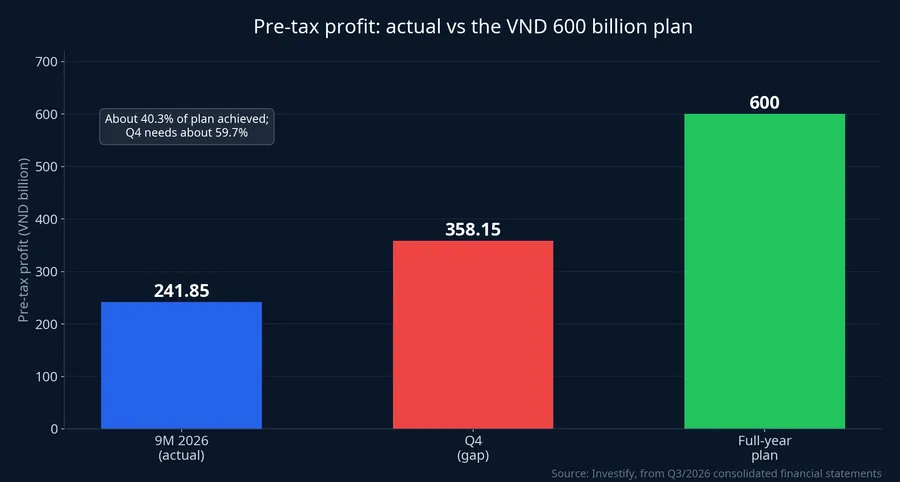
Tổng Công ty Cổ phần Đầu tư Phát triển Xây dựng (DIC Corp, ticker DIG on HoSE) enters the fourth quarter with two sets of numbers pointing in different directions. Over the first nine months, consolidated net profit came to VND 202.69 billion, up 1.4% year on year, and total borrowings are down 43.5% from the start of the year. But nine-month pre-tax profit stands at VND 241.85 billion, or 40.3% of the full-year plan of VND 600 billion.Tin nhanh Chứng khoán
The gap is about VND 358.15 billion (600 minus 241.85), more than all the pre-tax profit earned in the first nine months combined. This post walks through three layers of the Q3/2026 consolidated financial statements: the third quarter itself, the nine-month cumulative result, and the balance sheet at September 30.
Q3: Recognized Real Estate Revenue Nearly Halved
In Q3/2026, DIC Corp booked net revenue of VND 761.36 billion, down 43.2% year on year. The drop sits mainly in real estate: revenue from that segment fell from VND 1,198.03 billion in Q3/2025 to VND 640.96 billion. Gross margin was also lower, at 21% versus 24.4%. Together the two pushed gross profit down 50.9%, a loss of VND 166.36 billion, to VND 160.22 billion.Tin nhanh Chứng khoán
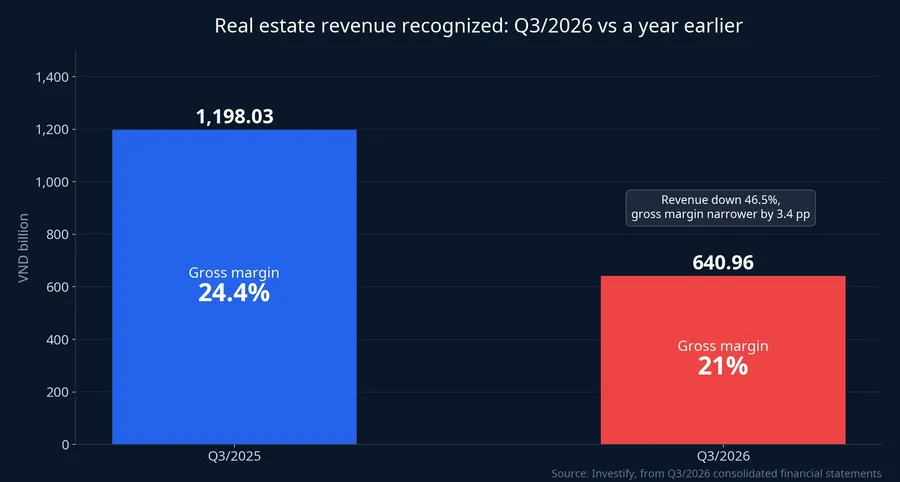
A simple calculation shows most of the shortfall comes from lower revenue. Had Q3 this year kept last year's 24.4% margin on net revenue of VND 761.36 billion, gross profit would have been about VND 186 billion. The thinner margin therefore cost only about VND 26 billion, while the remaining VND 140 billion or so is tied to recognizing less revenue. This is Investify's estimate from the reported figures, not a number published by the company.
Lines below gross profit moved in both directions. Financial revenue in Q3 reached VND 70.95 billion, 23.55 times the prior-year level, made up of almost VND 50 billion from disposing of investments and more than VND 21 billion of interest on deposits and loans.FireAnt Selling and administrative expenses fell 8.6% to VND 50.14 billion. On the other side, financial expenses rose 56% to VND 78.03 billion, and the result from joint ventures and associates swung from a VND 23.11 billion profit to a VND 8.09 billion loss.Tin nhanh Chứng khoán
Added up, Q3 pre-tax profit was VND 96 billion, down 63%, and net profit was VND 69.16 billion, down 64.2% year on year.FireAnt
Nine Months: Profit Still Slightly Above Last Year
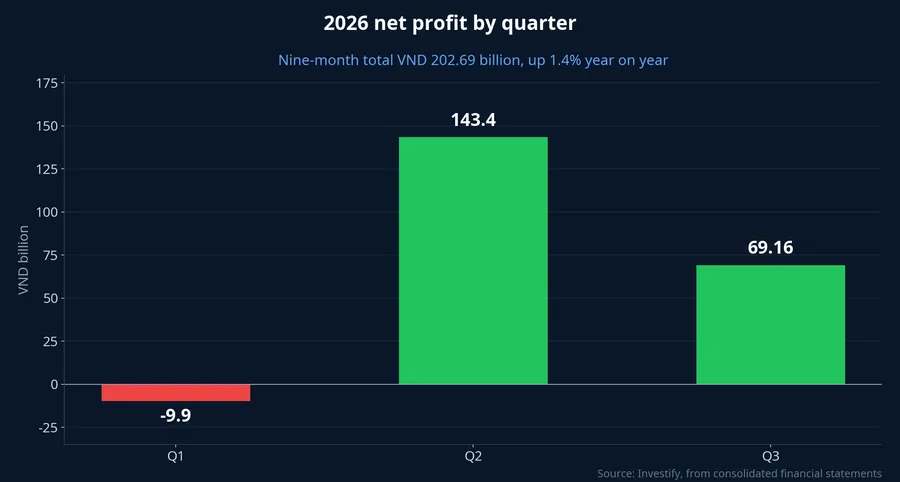
Q3 fell sharply, but over nine months DIC Corp has not gone backward. Cumulative revenue was VND 1,519.16 billion, down 14%, while net profit reached VND 202.69 billion, up 1.4% year on year.Tin nhanh Chứng khoán
The quarterly breakdown shows a different main contributor each quarter. In Q1/2026 the company posted a net loss of VND 9.9 billion, smaller than the VND 45.4 billion loss in Q1/2025.Doanh nhân Pháp luật In Q2, net profit was VND 143.4 billion, up 174.8%, even though gross profit that quarter was only VND 42.02 billion at a 6.9% margin. Most of Q2's profit came from financial revenue of VND 115.63 billion, more than 16 times the prior-year level, and over VND 40 billion of profit from joint ventures and associates.Doanh nhân Pháp luật The three quarters (a VND 9.9 billion loss, a VND 143.4 billion profit and a VND 69.16 billion profit) add up to the VND 202.69 billion cumulative figure.
In other words, DIC Corp's profit does not arrive evenly. Sometimes it is real estate, sometimes financial income, so a single quarter rarely represents the full year.
The 2026 Plan and the Q4 Benchmark From Last Year
The plan approved by shareholders calls for consolidated revenue of VND 3,000 billion (down 37% from 2025 actuals), pre-tax profit of VND 600 billion (down 27.2%) and a planned 6% dividend.Tin nhanh Chứng khoán That is a plan below last year's result, which is the context for the VND 358 billion needed in Q4.
Q4/2025 is the obvious comparison, but its origin matters. Net profit that quarter was more than VND 423 billion, mainly from completing the transfer of stakes in two subsidiaries that own the Đại Phước project, at more than VND 2,465 billion for phases 1, 2 and 3 and more than VND 489 billion for phase 7.1. For all of 2025, pre-tax profit reached 76% of the VND 718 billion target.Doanh nhân Pháp luật So most of last year's Q4 profit came from a single transfer deal, not from the usual rhythm of handing over products.
Balance Sheet: Borrowings Down 43.5%, Deposits Up Sharply
The third layer moves in a very different direction from quarterly profit. At September 30, 2026, DIC Corp's short- and long-term borrowings totaled VND 1,265.3 billion, down 43.5% from the start of the year, or VND 972.24 billion. That equals 12.3% of equity, split almost evenly between VND 632.8 billion of short-term and VND 632.5 billion of long-term debt. At the same time, cash and short-term financial investments rose 45.2%, up VND 1,672.23 billion, to VND 5,372.4 billion.Tin nhanh Chứng khoán
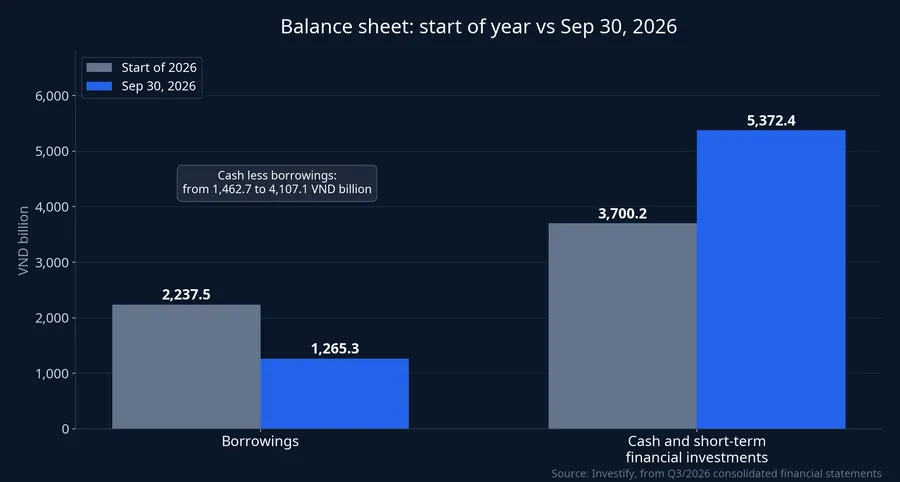
The internal mix shifted clearly. Cash and cash equivalents fell from VND 3,279 billion to VND 282 billion, while short-term financial investments rose from VND 421 billion to more than VND 5,000 billion, mostly bank deposits.FireAnt The move from current accounts into term deposits came alongside nine-month investing cash flow of negative VND 4,462.03 billion.Tin nhanh Chứng khoán
Both ends of the balance sheet show that repayment pressure has eased: cash and short-term deposits of VND 5,372.4 billion are more than four times total borrowings. Over nine months the company earned VND 127 billion of deposit interest, six times the prior-year level, while interest expense on loans fell 35% to VND 44 billion.FireAnt
Operating cash flow for nine months was positive VND 2,376.1 billion, against VND 811.58 billion a year earlier, many times the pre-tax profit of the same period. Financing cash flow was negative VND 911.6 billion, consistent with the drop in borrowings.Tin nhanh Chứng khoán On the balance sheet, customer deposits to reserve real estate rose to VND 4,546 billion, up more than VND 3,000 billion from the start of the year, while short-term prepayments from buyers were VND 2,464 billion, down more than VND 570 billion. These are liabilities, not revenue.FireAnt
Q4 Will Show Where the Annual Plan Lands
Putting the three layers together, DIC Corp's position after Q3 is fairly clear. Quarterly profit swings with the amount of real estate revenue recognized and with financial income. Cumulative nine-month profit is still slightly above last year. The balance sheet carries far less debt than at the start of the year, with deposits many times larger than borrowings.
The VND 600 billion profit plan, and the 6% dividend attached to it, depends on how much real estate revenue Q4 recognizes. Pre-tax profit for the whole company in Q3 was VND 96 billion, while Q4 needs about VND 358 billion, nearly four times as much.
There are two scenarios to watch, and the deciding factor in both is Q4 real estate revenue. If it rises sharply from Q3's VND 640.96 billion, the plan has a basis to come close to the target. If it stays around Q3's level, full-year profit will fall short of the plan, even though the balance sheet would still carry low debt. The Q4/2026 financial statements, usually published in January 2027, will answer that question.