


For 2021–2025, Ho Chi Minh City was given a domestic borrowing ceiling of VND 24,606.4 billion, meant to be raised through local government bonds. The city did not use it. According to the city People's Committee, budget revenue ran above plan and public investment disbursement fell short.VTC News Since the administrative merger, the city has also not issued local government bonds or borrowed from domestic financial institutions.VietNamNet
On 30 October 2026, at its 6th session of the 11th term, the HCMC People's Council passed mechanisms for raising capital for development investment.Người Quan Sát The city gets more types of bonds, a new group of buyers in foreign investors, and the option to borrow in foreign currency. The amount, however, is still pinned to a specific figure in the People's Committee's proposal for the whole five years. This piece looks at HCMC as a borrower: what it borrows with, how much, who repays, and where the risk lands.
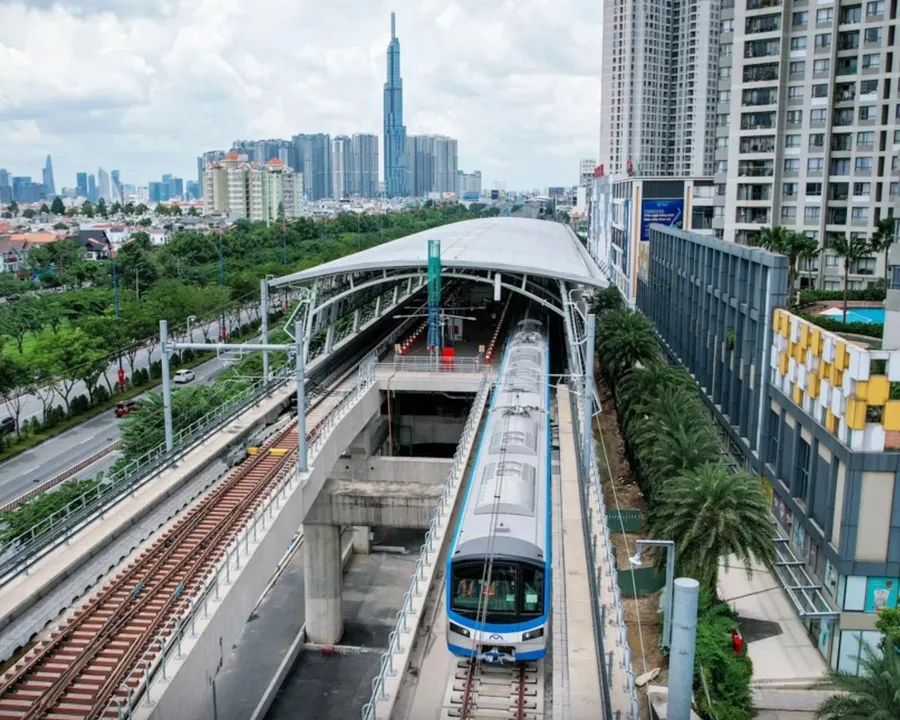
More tools: five domestic bond types and a channel in the international financial center
On the domestic market, the Council approved five bond types: local government, project, infrastructure, urban and green bonds. The city may also borrow from domestic financial institutions.Người Quan Sát Loans under this mechanism must be in dong, and anything not specified follows Decree 93/2018/ND-CP.VietNamNet
For local government bonds, the main terms are clear. They carry a maturity of at least one year and a face value of VND 100,000, are issued by auction, registered and held in custody at the Vietnam Securities Depository, then listed and traded on the stock exchange.VTC News Interest rates are set based on a range announced by the Ministry of Finance and on market conditions.Người Quan Sát
The second channel is newer. The resolution lets the People's Committee issue urban and infrastructure bonds at the International Financial Center in Vietnam, putting into practice an authority that Urban Development Law No. 18/2026/QH16, effective 1 October 2026, gives the city for the first time.Vietstock Here, bonds can be issued and settled in dong or in freely convertible foreign currency, and foreign investors may buy. Issuance can be a public or private offering, an auction, underwriting, a distribution agent or direct sale.Người Quan Sát
This is still domestic borrowing. The bonds are issued at the International Financial Center, not abroad.VietNamNet The Foreign Investment Agency (Ministry of Finance) holds that in substance these remain domestically issued local government bonds, even though some special foreign-exchange and external-debt rules apply. According to the People's Committee, the Ministry of Finance and other bodies concluded that current rules do not allow local governments to borrow from abroad, so that item is not in the draft.
More ways to borrow, not a higher borrowing limit
The figure quoted most is VND 49,291 billion. Under the People's Committee's proposal, the city plans to borrow up to VND 49,291 billion over 2026–2030 to cover the budget deficit. Of that, VND 31,732 billion is domestic borrowing, planned mainly through local government bonds, and VND 17,559 billion is Government borrowing on-lent to the city.VTC News
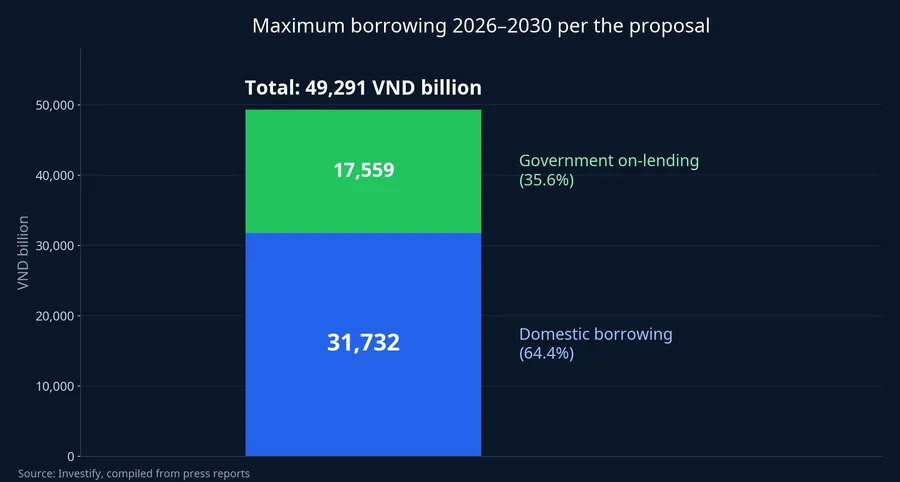
Three points are worth reading carefully.
First, this is a five-year ceiling, not an upcoming issue. Spread evenly, domestic borrowing comes to roughly VND 6,350 billion a year. For comparison, over the 18 years from 2003 to 2020, the city issued a total of VND 30,112 billion in local government bonds.VietNamNet
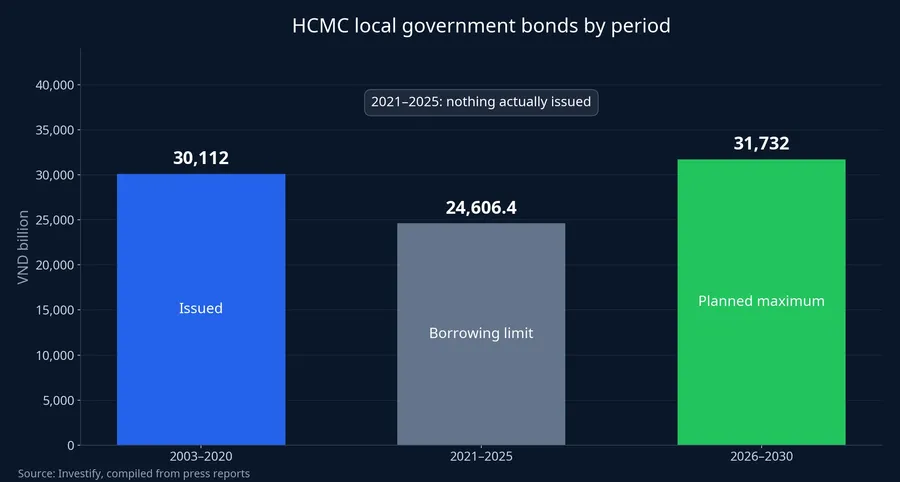
Second, this figure comes from the proposal. Outlets report it on the basis of information from that document.Báo Bảo vệ pháp luật Under the approved mechanism, issuance must stay within the approved borrowing limit, debt balance, deficit and borrowing and repayment plan. The Council approves the content and basic limits, while the People's Committee decides timing, volume, maturity, interest rate and offering method for each issue within that scope. In other words, the resolution widens how the city can borrow, not how much.
Third, the borrowing has a stopping point in outstanding debt. The city's five-year financial plan puts local government debt at about VND 74,909 billion by 2030, equal to 3.5% of budget revenue.VTC News That is a projection in the plan, not a legal ceiling.
VND 49,291 billion is not VND 1.27 quadrillion
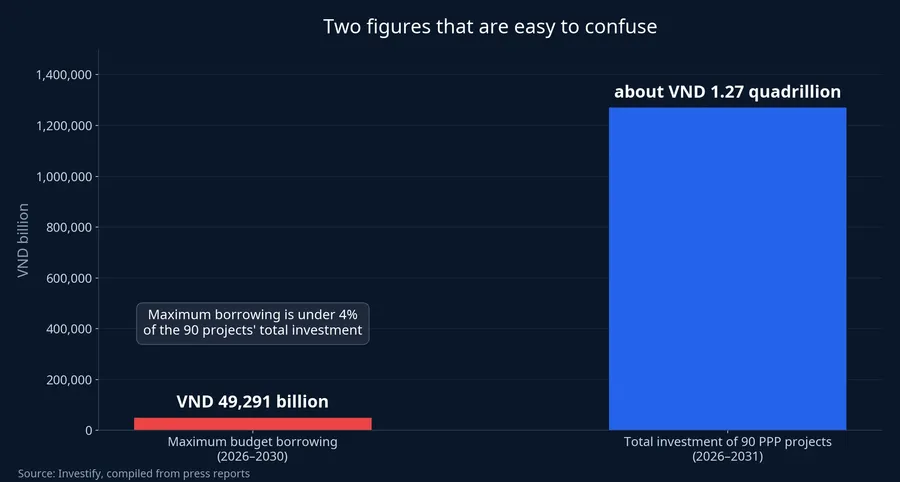
Another, much larger number is in circulation: HCMC has a list of 90 key projects seeking public-private partnership investment for 2026–2031, with total investment of about VND 1.27 quadrillion.Người Quan Sát The two figures are easy to mix up, but they sit in different pockets.
VND 49,291 billion is money the city budget borrows and must repay. VND 1.27 quadrillion is the total investment in projects the city invites investors to carry out together under public-private partnership contracts. It is not a debt of the budget. Side by side, the maximum borrowing in the proposal is under 4% of the total investment in those 90 projects.
The gap looks wider against public investment needs. According to Vietstock, city-level public investment demand for 2026–2030 is estimated at about VND 3.1 quadrillion, while budget capital is expected to cover only about 31%.Vietstock The uncovered portion is around VND 2.1 quadrillion, so the bond channel fills only a small part of that shortfall. For urban rail, ring roads and inter-regional transport in particular, the People's Committee says relying on public investment alone would make it hard to meet schedule and scale.VietNamNet
Who repays, and who carries the exchange-rate risk
For a bond buyer, the biggest difference from a corporate bond is who pays. Under the mechanism just approved, the city budget is responsible for paying principal, interest and related costs in full and on time.Người Quan Sát With corporate bonds, repayment comes from the issuer's own business. The money raised is managed centrally and goes to projects in the medium-term public investment plan that have completed investment procedures, and not to recurrent spending.Vietstock
Foreign-currency borrowing adds another layer of risk. When a bond is denominated in US dollars or another currency, the amount owed in that currency is fixed, while the city budget's revenue is in dong. If the dong weakens while the bond is outstanding, the budget has to spend more dong on the same principal and interest. The buyer receives the full foreign-currency amount under the contract, and the difference falls on the budget.
That is why there is an extra layer of control. Exchange-rate risk is a point the Ministry of Finance flagged, and any foreign-currency issuance plan must assess exchange-rate risk, interest-rate risk and the ability to balance repayment.VietNamNet The People's Committee must consult the State Bank of Vietnam and related bodies on cash-flow management, settlement accounts, reporting duties and risk control, then report annually to the Ministry of Finance, the State Bank and the city People's Council.Người Quan Sát
What to watch: the 2027 issuance plan
The People's Committee has proposed putting the bond issuance mechanism in place early to raise capital for 2027 investment needs.VietNamNet The issuance plan for each tranche will show volume, maturity, interest rate, currency and offering method: an auction for institutions or a public offering.
For people with idle cash, that document decides whether they can buy directly in an issue. For holders of construction and infrastructure stocks in HCMC, actual issuance volume, not the ceiling in the proposal, is the number that shows how much capital reaches the projects.
The lesson of 2021–2025, when a domestic borrowing limit of more than VND 24,606 billion went unused, is that a limit does not turn itself into bonds. If disbursement is still slow in 2027 and revenue again beats the budget estimate, much of the limit could sit idle as it did for the past five years. If a first issue arrives on schedule at meaningful size, it would signal that the urban rail and ring road projects have reached the stage where they need cash.