
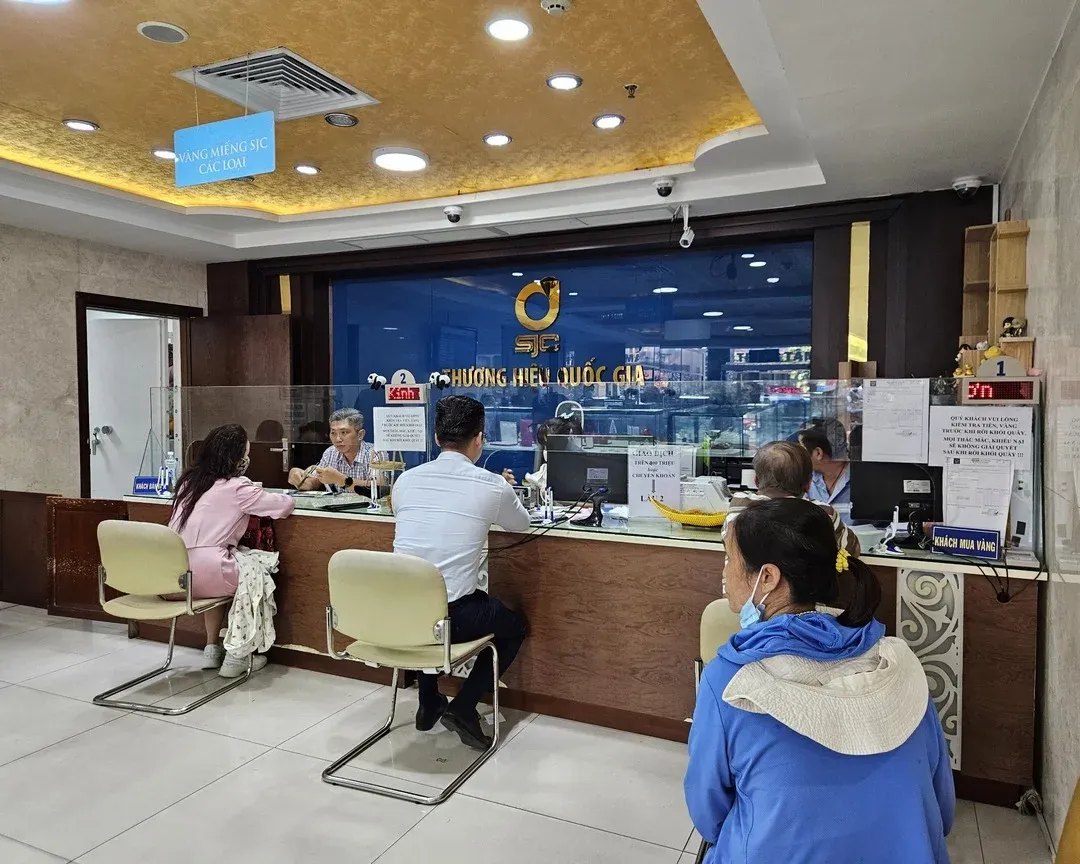

At the start of 2026, the government set a goal of getting a gold exchange running in February. Near the end of October, the latest report from the State Bank of Vietnam (SBV) to the National Assembly said the central bank had reported to and proposed that the Prime Minister not establish a gold exchange for the time being, while it keeps studying and refining the plan on a suitable timeline.Dân trí
For anyone holding gold bars or gold rings, or planning to buy more, two practical questions follow: how far did the exchange get, and what does the delay change about how they trade? Answering them means walking through the milestones on the dates they actually happened.
October 2025: a three-stage roadmap
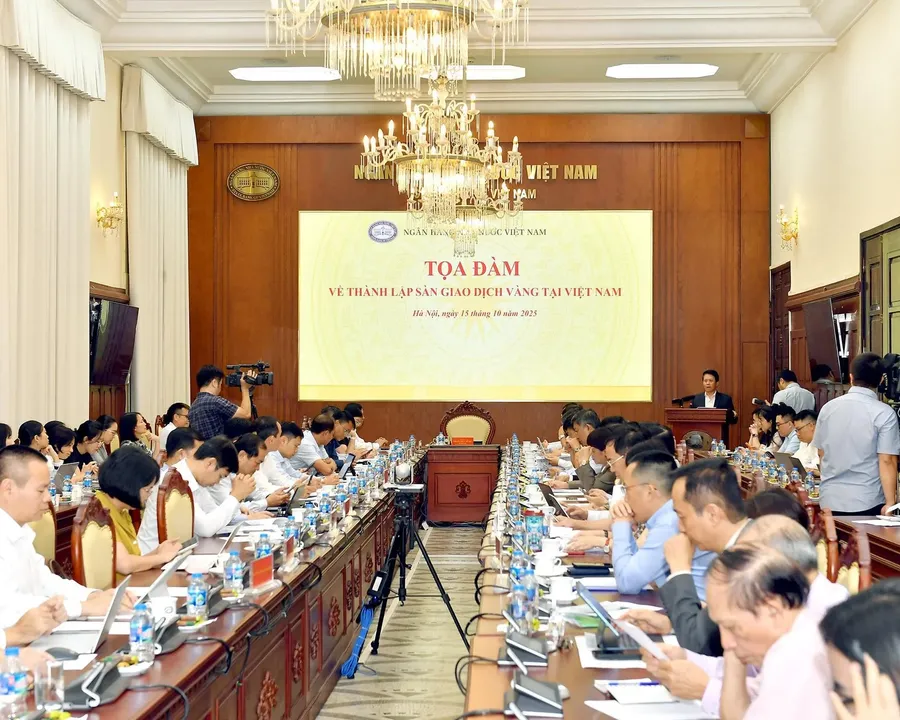
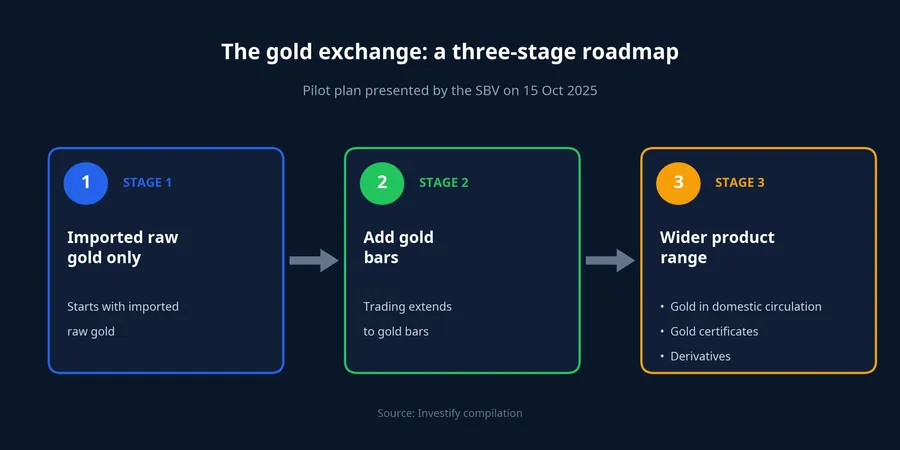
On the afternoon of 15 October 2025, the SBV held a workshop on creating a gold exchange. Its Foreign Exchange Management Department presented a pilot roadmap in three stages.VTC News Stage 1 would trade only imported raw gold, with members made up of exchange service providers, payment banks and trading members. Stage 2 would extend to gold bars. Stage 3 would add gold already circulating domestically, gold certificates and derivatives.
On structure, the SBV floated three options: a standalone national gold exchange, gold trading on the Vietnam Commodity Exchange, or an exchange inside the International Financial Centre.Soha
One detail matters later. Even on schedule, gold bars would only have entered the exchange in stage 2, and gold certificates sat in the final stage.
December 2025: the Assembly sets the task, the Prime Minister sets a deadline
On 11 December 2025 the National Assembly passed a resolution on continuing to implement its thematic oversight and questioning resolutions. For banking, it asked for urgent study and measures, on a suitable timeline, toward setting up a gold exchange.Báo Đầu tư
The same day, a representative of the Foreign Exchange Management Department said the SBV would approach the model "comprehensively, cautiously and on a roadmap": an exchange could bring benefits if well designed, but carries large risks without a full legal framework and tight supervision. Read today, that was an early signal of the direction the SBV chose ten months later.
A week later, on 17 December 2025, the Prime Minister signed Official Dispatch 241/CĐ-TTg, asking for an urgent proposal on a national gold exchange and a report to the Standing Government by 20 December.Nhà đầu tư At the time, the exchange was expected to take shape in 2026.
February 2026: a launch target, then "no further delay"
At the government press briefing on the afternoon of 4 February, the Government Office said the government was aiming to have the gold exchange running before 10 February. That date passed without an exchange. After the Lunar New Year, the Prime Minister signed Directive 06/CT-TTg, telling the SBV to report urgently on its proposal for a national gold exchange, "without further delay".Soha
This was the high point of expectations: a roadmap, a National Assembly resolution and a government deadline.
August 2026: the proposal turns
The turn came mid-year. In a report prepared for the Prime Minister's 13 August 2026 meeting with credit institutions, the SBV said it had studied the legal basis, practice and impact in full, and proposed that the Prime Minister not establish a gold exchange for the time being.Thương Trường
The same report recorded that the gap between domestic and converted world gold prices had narrowed from about VND 15 million per tael to about VND 3 million after taxes and fees, roughly 2%. The SBV also said it had submitted to the government a draft amendment to Decree 24/2012 that would drop business conditions for jewelry gold, and that it would consider issuing and allocating import quotas for gold bars and raw gold according to market developments.Thương Trường
The price gap and the proposal sit in the same document, but they should not be read as cause and effect. The stated basis for the proposal is the legal, practical and impact assessment the SBV describes in its report.
September and October 2026: the proposal reaches the Assembly
The August proposal was carried into a report by SBV Governor Phạm Đức Ấn to the National Assembly on how thematic oversight and questioning resolutions in banking have been implemented.Thanh NiênThe latest report, submitted at the session at the end of October, repeats it: no exchange for now, with the plan to be refined further.Dân trí
So the right word at this point is "proposed". The SBV has made a proposal to the Prime Minister, and the decision on it belongs to the Prime Minister. That is the next milestone.

On the afternoon of 30 October, a different path was raised on the floor. Deputy Lê Hoàng Anh, a full-time member of the National Assembly's Economic and Financial Committee, proposed studying a pilot for gold certificates as a way to channel capital, noting that households are estimated to hold around 500 tonnes of gold, roughly 12% of GDP.VnExpress The 500-tonne figure has been quoted for years, but no official statistic confirms it.Dân trí
This is one deputy's recommendation, not policy. What stands out is that gold certificates were originally stage 3 of the October 2025 roadmap. Now they are floated as a separate route that does not wait for an exchange.
The price gap: context, not the answer
The exchange was once pitched as a remedy for the gap between domestic gold bars and world prices. That gap has swung back since the SBV sent its proposal, though Investify's calculation (before taxes and fees) differs from the 2% after-tax figure in the SBV report.
On 13 August, converted world gold was around VND 136.7 million per tael, while SJC gold bars sold at VND 144.3 million, about VND 7.6 million higher. By 31 October, converted world gold was about VND 122.7 million (based on the 30 October close and an exchange rate of 25,812), while SJC sold at VND 139 million. The raw gap rose to about VND 16.3 million, or roughly 13%.
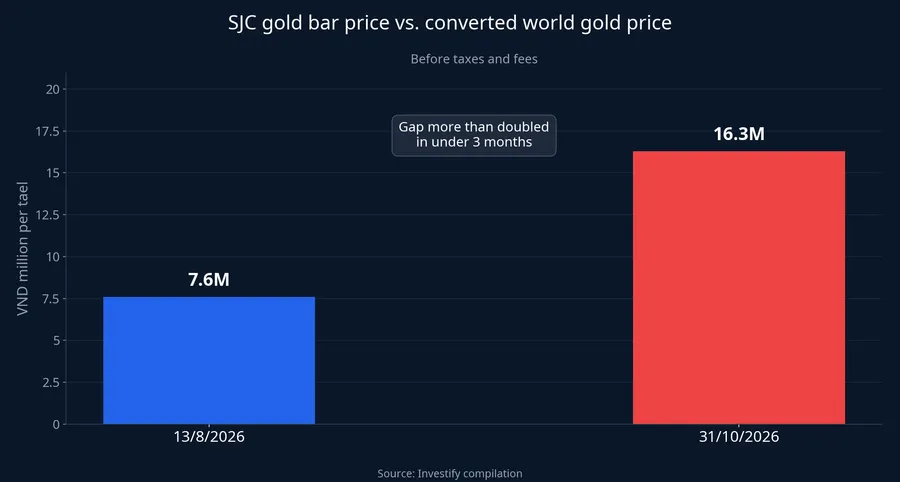
The cause is uneven declines. World gold lost about 9.3% from 13 August to 30 October, while the SJC selling price fell only about 3.7% through 31 October. The gap did not stay at the 2% the August report recorded.
What it means for people holding gold
Without an exchange, the ways to trade gold stay as they are: through licensed banks and businesses, at each one's quoted price. On 31 October, SJC gold bars were bought at VND 136 million and sold at VND 139 million per tael, a spread of VND 3 million. SJC 99.99% rings were bought at VND 129.8 million and sold at VND 134.8 million, a spread of VND 5 million. That buy-sell spread is a fixed cost each time you go in and out.
The direct effect of the delay should not be overstated either. Under the October 2025 roadmap, the first stage would trade only imported raw gold, with institutions as members. Even if the exchange had opened on time in February, holders of gold bars could not have traded on it right away. The nearest effect of a stage-1 exchange would run through raw gold supply and only then reach prices.
So over the coming months the gap is more likely to depend on supply than on the exchange. The August report already named a clear tool: issuing and allocating import quotas for gold bars and raw gold according to market developments. Decisions like that can move the gap faster than an exchange that still has several stages to pass through.
What to watch next
The thesis here is simple: a national gold exchange is in a "proposed not to set up for now" state, not a cancelled one, and for gold holders supply matters more in practice than the exchange roadmap. The next milestone is the Prime Minister's decision on the SBV's proposal. If the Prime Minister agrees, an exchange will most likely not appear in 2026. If the government asks to continue, the three-stage roadmap resumes, starting with raw gold.
Two signals to watch: the Prime Minister's written response to the August proposal, and whether the gold certificate pilot is taken up for study.