

The Government signed Decree 398/2026/ND-CP on October 29, 2026, detailing National Assembly Resolution 43/2026/QH16 on income tax cuts. The decree took effect on the day it was signed and applies to the 2026 and 2027 tax periods.Government Portal Individual traders, household businesses and companies with annual revenue of no more than VND 10 billion get a 30% cut in the income tax they owe.
The cut does not wait for a year-end claim. You deduct it on the return for each filing period. In return, you track your own revenue and repay the cut if the full year ends above the threshold. This article walks through the steps, from how much money a shop keeps to what crossing VND 10 billion costs.
How much one shop keeps
Take an illustrative example. A grocery shop earns about VND 4 billion a year and pays VND 10 million of personal income tax each quarter. With the 30% cut, it pays VND 7 million a quarter. Over a year, the owner keeps VND 12 million.
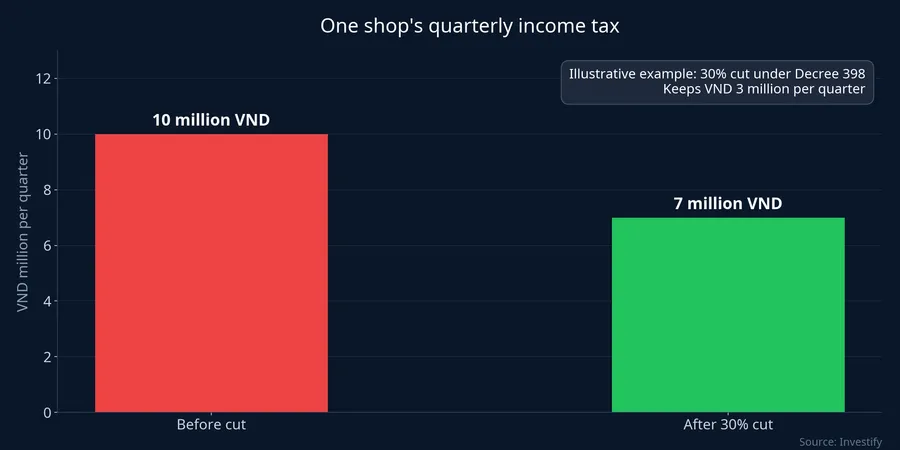
The cut applies to the tax owed, not to revenue or the tax rate. Under Decree 398, it is calculated on tax arising from all of an individual's business income, regardless of the tax method.Government Portal A household taxed as a percentage of revenue and one taxed on profit get the same cut.
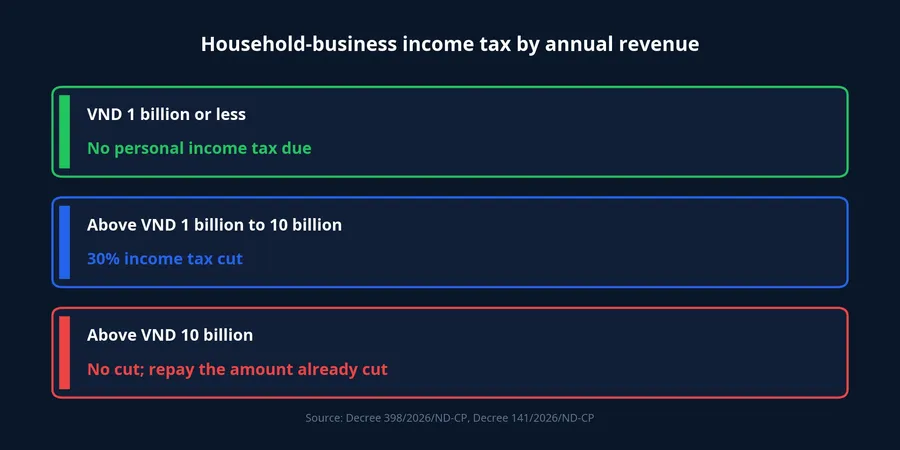
Do not confuse the VND 10 billion ceiling with the tax-exemption floor. Decree 141/2026/ND-CP exempts households and individual traders with revenue of VND 1 billion a year or less from personal income tax.Vietstock That group has no tax to cut. The real beneficiaries are businesses with revenue above VND 1 billion and up to VND 10 billion.
The cut covers income tax only. Value-added tax is unchanged.VnExpress For a household paying a percentage of revenue, the return often carries both taxes, so the actual saving is smaller than 30% of the total tax shown.
How individuals and households file next period
The rule covers resident individuals with production or business activity, including the person registered as head of a household business or a representative authorized by its members. Annual revenue for eligibility follows Articles 4 and 5 of Decree 68/2026/ND-CP on household-business tax.Government Portal
The procedure has three steps.
Step one: estimate full-year revenue. If you expect 2026 revenue of no more than VND 10 billion, declare the cut on Form 01 in the decree's appendix. It is filed with the quarterly, first-half, second-half or annual return, depending on your filing cycle.
Step two: tax paid on your behalf. When an organization or individual withholds, files or pays income tax for a trader, a tenant of a rented property for example, that party also cuts the tax to be withheld by 30%, monthly, quarterly or per transaction. The condition is that revenue within the withholding scope does not exceed VND 10 billion. The withholding party declares on Form 02, filed with its own personal income tax return.
Step three: periods already paid in full in 2026. Resolution 43 took effect on August 24, 2026, while the implementing decree only arrived on October 29, so many households already filed and paid earlier quarters in full. The decree offers two routes: amend or supplement the filed return, or settle the cut at annual finalization. A household taxed on a percentage of revenue that overpaid gets the excess offset or refunded at year-end under the tax administration law.Government Portal
If you later file an amended return, or tax inspectors raise the tax owed, the added amount still gets the 30% cut as long as you remain eligible. If the tax owed falls, the cut is recalculated accordingly.
Companies deduct when paying quarterly
On the corporate side, the rule covers companies formed under Vietnamese law, cooperatives, cooperative unions, public service units and other organizations with income-generating activity. A company expecting annual revenue of no more than VND 10 billion calculates its own cut when making quarterly provisional corporate income tax payments.Government Portal
Companies already enjoying tax incentives still get the further cut, applied to the tax left after incentives. In VnExpress's example, a company that owes VND 100 million of income tax after incentives gets VND 30 million off and pays VND 70 million.VnExpress
Revenue for eligibility is broader than many assume. The decree requires adding sales and service revenue (net of revenue deductions), financial income and other income. A company with branches, dependent units or business locations must add their revenue on the annual consolidated financial statements.Government Portal A firm selling VND 9 billion of goods that also books a large asset disposal or heavy deposit interest can easily cross the line.
The decree also blocks splitting a company to slip under the threshold. A business formed by a split after August 24, 2026 gets no cut if the combined revenue of all resulting businesses exceeds VND 10 billion.
Cross VND 10 billion and you repay
Businesses near the line should read this part closely. Eligibility is judged on actual full-year revenue, not on the figure you estimated when filing.
For individual traders, the test is total actual revenue across all business activity. If it exceeds VND 10 billion, you lose the cut and must pay back the entire amount cut.Government Portal The adjustment goes on Form 03, filed with the return for the very period in which cumulative revenue from the start of the year passes VND 10 billion. The repayment carries no late-payment interest up to the filing deadline for that period. Pay on time for the period you cross the line and you return only what was cut, with no extra penalty.
For companies, the decree reads differently. A company whose actual revenue exceeds VND 10 billion must pay the tax shortfall in full, and late-payment interest follows clause 3, Article 24 of Decree 252/2026/ND-CP guiding the Law on Tax Administration. There is no late-interest waiver as for individuals.
An illustration: a seller has VND 8 billion of cumulative revenue after nine months and has taken the 30% cut in earlier periods. A strong year-end season pushes annual revenue to VND 10.5 billion. The seller files Form 03 with the fourth-quarter return and repays the cut for the whole year, not just the fourth quarter.
What business owners can consider
For a household with expected annual revenue from above VND 1 billion to about VND 8 billion, the risk of repayment is low. The task is to attach Form 01 to the next return, then choose between amending earlier periods and waiting for annual finalization.
For households and companies expecting revenue close to VND 10 billion, the cut is money held temporarily. Each filing period, the prudent habit is to add up year-to-date revenue from every activity: every shop, every sales channel and, for companies, financial income, other income and branches. While the running total is far from the line, the cut is safe. If it nears VND 10 billion with a quarter still to go, set aside the amount you may have to repay.
What to watch
The decree is signed and in force, so the deciding number for each taxpayer is one figure: actual full-year revenue against VND 10 billion. Below it, you keep 30% of the income tax. Above it, you repay the whole cut in the period you cross. The tax authority's detailed guidance on how to submit the declaration forms will settle the practical mechanics for the next filing period.