


Nine months into 2026, average consumer prices are up 4.52% from a year earlier.Người Quan Sát That already matches the average CPI target of about 4.5% the National Assembly set for the whole year.FireAnt In practice, the last three months have almost no room left for prices to rise without pushing the annual average over the line.
Put simply, the target is measured as a full-year average, so every remaining month eats into headroom that is nearly gone. October's CPI, which the Statistics Office is expected to publish in early November, therefore carries far more weight than any earlier month.
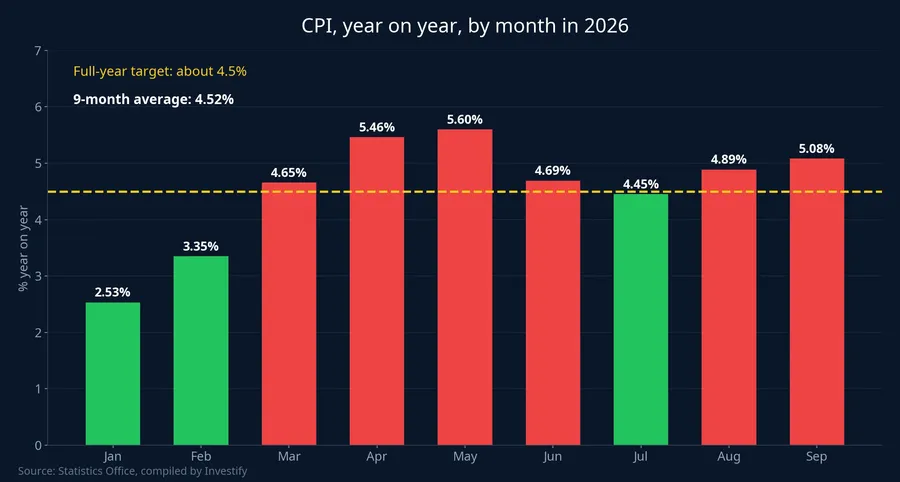
Why nine months already equal the target
According to the Statistics Office release of 3 October, September CPI rose 0.62% from August and 5.08% from a year earlier.Fili Core inflation, which strips out fresh food, energy and state-administered prices, averaged 4.26% over nine months. So the pressure does not come from fuel alone: the core of the price basket is also close to the target.
In September alone, transport rose 3.97% month on month and contributed 0.40 percentage points to the overall 0.62% increase. Petrol in the CPI basket rose 9.39% and diesel 4.53%, following domestic price adjustments. Education rose 1.41% on new-school-year tuition. Roughly two-thirds of September's price increase came from transport alone.
October's threshold of about 4.3%
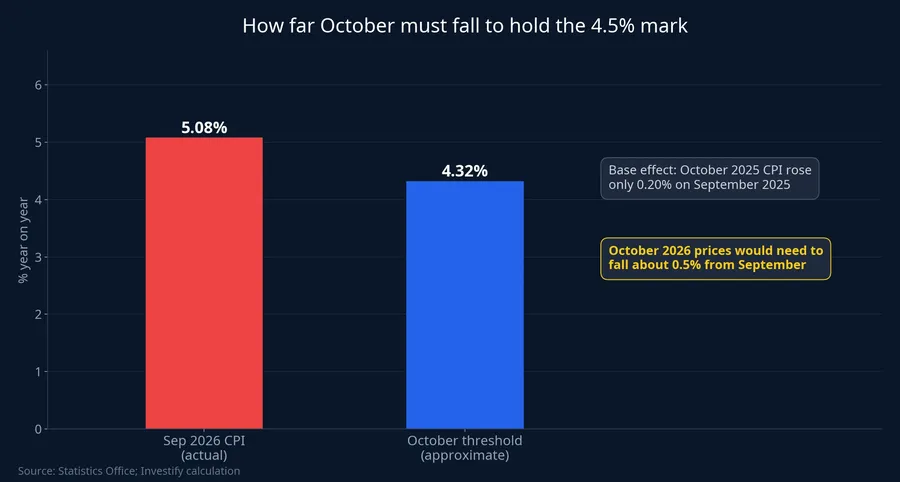
A rough calculation is possible by adding up each month's year-on-year increase and averaging. The nine-month average of 4.52% equals a total of about 40.68 percentage points. For the ten-month average to stay at or below 4.5%, the ten-month total must stay under 45 points, which leaves about 4.32% for October. This is Investify's own calculation from Statistics Office data, not a figure published by the agency, and the way the office averages price indices may shift the result slightly.
Going from September's 5.08% to about 4.3% is a sizeable drop. The base matters here: in October 2025, CPI rose only 0.20% from September 2025NSO and 3.25% year on year.Mekong ASEAN Last year's base is not high, so for the year-on-year rate to fall to about 4.3%, prices in October 2026 would need to drop roughly 0.5% from September, by the same rough calculation.
The longer view is tighter still. To keep the 12-month average near 4.5%, the full-year total must stay under 54 points. That leaves about 13.32 points for the last three months, or roughly 4.44% a month year on year. If all three months simply repeat September's 5.08%, the annual average lands near 4.66%.
What October puts into the basket
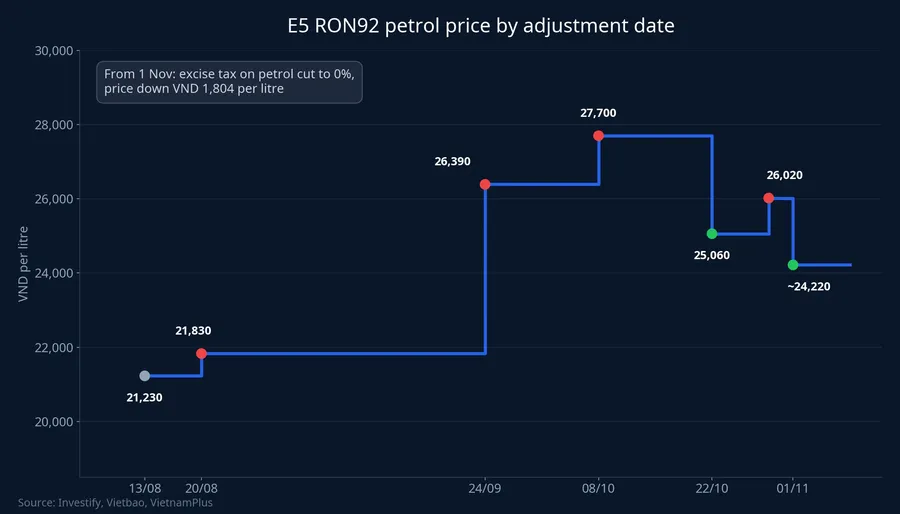
Fuel remains the biggest variable. Prices were adjusted weekly during October. E5 RON92 petrol rose to VND 27,700 per litre on 8 October, fell to VND 25,060 on 22 October, then climbed again to VND 26,020 on 29 October. Diesel moved the other way: after two consecutive increases it reached VND 30,240 per litre.Vietbao Earlier, the 24 September adjustment lifted E5 RON92 from VND 21,830 to VND 26,390, so October's average petrol price sat well above most of September.
World oil offers no relief either: Brent closed at USD 112.91 per barrel on 30 October. The monthly index reflects average daily prices, so a late-month cut moves it only slightly.

The two biggest price cuts land in November. From midnight on 1 November, E5 RON92 falls VND 1,804 per litre as the special consumption tax on petrol drops to 0% under Resolution 45/2026/NQ-CP, in force until 31 March 2027.VietnamPlus Diesel is unchanged because it does not carry that tax. The average retail electricity price also falls about 2% from 1 November. Neither appears in the October data.
Speaking to the National Assembly on the morning of 31 October, Deputy Prime Minister Nguyen Van Thang said the petrol tax cut and the electricity price cut are expected to create about 0.07 percentage points of additional room to keep inflation on target.Người Quan Sát Set 0.07 points against the 0.16-point gap (from the 4.66% in the keep-September's-pace case down to 4.5%) and the two measures cover only part of it.
Two branches, one number
Branch one: October CPI stays above about 4.3%. This happens if prices in October do not fall by roughly 0.5% from September. The conditions: petrol stays above September's level, as the October adjustments suggest; diesel above VND 30,000 per litre keeps freight costs high; and food and services do not ease. The ten-month average then breaks 4.5%, and the final two months must pull it back, helped by cheaper petrol and electricity from 1 November. Standard Chartered's latest forecast, published on 30 October, leans this way: the bank raised its 2026 average inflation forecast from 4.4% to 4.7% and estimates fourth-quarter inflation at about 5.2% year on year.VietnamFinance
Branch two: October CPI falls below about 4.3%. This happens if October prices drop roughly 0.5% or more from September, with late-month petrol cuts pulling the monthly average below September's and food prices easing. The ten-month average then holds near 4.5%, and the November measures become a cushion rather than a rescue.
Either way, the full-year target is not settled in October. But branch one forces November and December to cool much faster than branch two does.
Savers and borrowers
For savers, what matters is the interest left after inflation. At the end of October, Agribank, BIDV, Vietcombank and VietinBank still held online deposit rates at 6.8% a year for terms of 12 months and above, even after cutting counter rates. Under Official Letter 9736/NHNN-CSTT, average deposit rates on new transactions of six months or longer must fall by at least 0.5% a year from each bank's own level during 11 to 20 October.Báo Gia Lai
Set 6.8% against September's 5.08% price growth and the gap is about 1.7 percentage points. If online rates fall exactly 0.5 points while prices keep rising around 5%, the gap narrows to about 1.2 points. In branch one, that thin real return persists to year-end. In branch two, prices ease faster than rates, so the real return widens somewhat.

For borrowers, lending rates are being pushed down, and VietinBank and Agribank have programmes cutting loan rates by up to 2% a year for production and business. Price pressure has not changed policy direction in the short term: Standard Chartered only expects the refinancing rate to rise from 4.5% to 4.75% in the fourth quarter of 2027. Still, the longer inflation stays above target, the narrower the room to keep loan rates low, and long-term borrowers on floating rates should factor that in. For households, the October reading will still carry high petrol prices and new tuition, while the petrol and electricity cuts show up in bills and data only from November.
What to watch
When October's data arrives, the number to place on the table is year-on-year CPI against the threshold of about 4.3%. Above it, the full-year target depends on how much November and December can bring down through cheaper petrol and electricity. Below it, 4.5% stays within reach. The second figure worth checking is core inflation: if it keeps rising, price pressure is no longer confined to fuel and will be harder to ease with tax measures.