


From November 1, 2026, the average retail electricity price falls to VND 2,159.9037/kWh before value-added tax, 2% below the current level. The old price, VND 2,204.0655/kWh, had been in force since May 10, 2025. Each kWh therefore gets cheaper by about VND 44.16 on average.VietNamNet
It is the first time the average retail price has gone down after four consecutive increases since May 2023.VietNamNet Anyone who pays an electricity bill tends to ask three things: how much the cut is worth, why it is possible now, and how long the new price can hold. The cost figures EVN has published answer most of that.
Which documents were issued, and who they cover
On the evening of October 31, Vietnam Electricity (EVN) announced the adjustment to the average retail price under Decision 1305/QĐ-EVN dated October 30, 2026.VietNamNet The same day, the Ministry of Industry and Trade issued Decision 2892/QĐ-BCT, which sets retail prices for each customer group and the prices charged to retail distributors, effective November 1, 2026.Báo Chính phủ
According to the government news portal, the adjustment rests on Decree 72/2025/NĐ-CP on the mechanism for adjusting the average retail price, Decree 278/2026/NĐ-CP amending it, Decision 14/2025/QĐ-TTg on tariff structure and Circular 60/2025/TT-BCT. As for the policy direction, the cut follows Notice 557/TB-VPCP of October 27, 2026, the conclusions of Deputy Prime Minister Nguyễn Văn Thắng at a meeting on scenarios for managing fuel and electricity prices.Báo Chính phủ
On the morning of October 31, during a discussion on the socio-economic situation, Mr. Thắng, Deputy Prime Minister, said the government is directing EVN to review and cut costs as far as possible so that the average retail price can fall by about 2% between now and March 31, 2027.Tuổi Trẻ

What changes on your bill
The 2% figure is a system-wide average across every customer group: households, commercial users, industry and public agencies. Households do not pay the average. They pay on a tiered schedule where each extra block of electricity costs more. So the real saving on any one bill depends on the rate for each tier under Decision 2892/QĐ-BCT and on how much power that home uses each month.
To get a sense of scale, convert at the average price. A cut of about VND 44.16/kWh is roughly VND 4,400 per 100 kWh before tax. A household using 300 kWh a month would see a saving of about VND 13,000 on that basis.VietNamNet This is a back-of-envelope figure to show magnitude, not the exact amount on any particular tier.
Shops, restaurants and small workshops on commercial and industrial tariffs use far more electricity each month, so their absolute saving is larger. The November billing cycle is the first to reflect the new price.
Why the cut is possible: the gap between price and cost
EVN's figures show total electricity production and business costs in 2025 of VND 601,680.1 billion, against 287.51 billion kWh of commercial electricity sold.Tuổi Trẻ That works out to a 2025 unit cost of VND 2,092.70/kWh.VietNamNet Generation alone costs VND 1,733.35/kWh, about 83% of the total, which is the cost of buying and producing power from the plants.Tuổi Trẻ
Against the old selling price, EVN was charging about VND 111.37/kWh above its 2025 cost, or 5.32%.Tuổi Trẻ After the cut, the new average price is still about VND 67.2/kWh above 2025 cost, roughly 3.2%.VietNamNet The VND 44.16 reduction consumes about 40% of the old gap, and what remains is still positive.
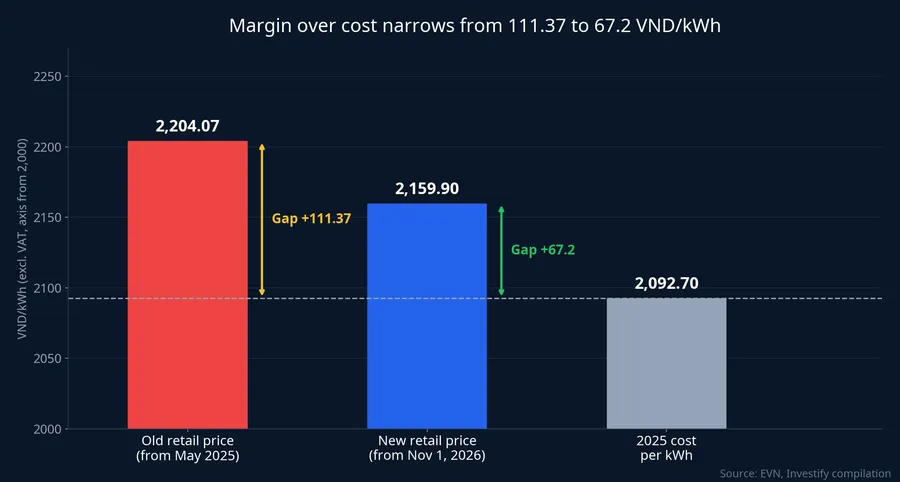
Two forces lead to this cut. The first is the government's price-management direction, expressed in Notice 557/TB-VPCP and the instruction to EVN to save costs. The second is the gap between selling price and 2025 cost, which gives that direction room to work without pushing the price below cost. Without the gap, a cut would mean selling at a loss. Without the directive, the gap could be used for something else. The numbers suggest both were needed.
The scope of the comparison matters. VND 2,092.70/kWh is the cost for 2025, while the new price applies from November 2026. Fuel and power purchase costs in 2026 may differ from 2025.
A rough calculation at the 2025 average of about 24 billion kWh a month puts the VND 44.16/kWh cut at about VND 1,060 billion of revenue per month that EVN no longer collects.Tuổi Trẻ That amount stays with electricity users.
The VND 17,506 billion still outside the cost base
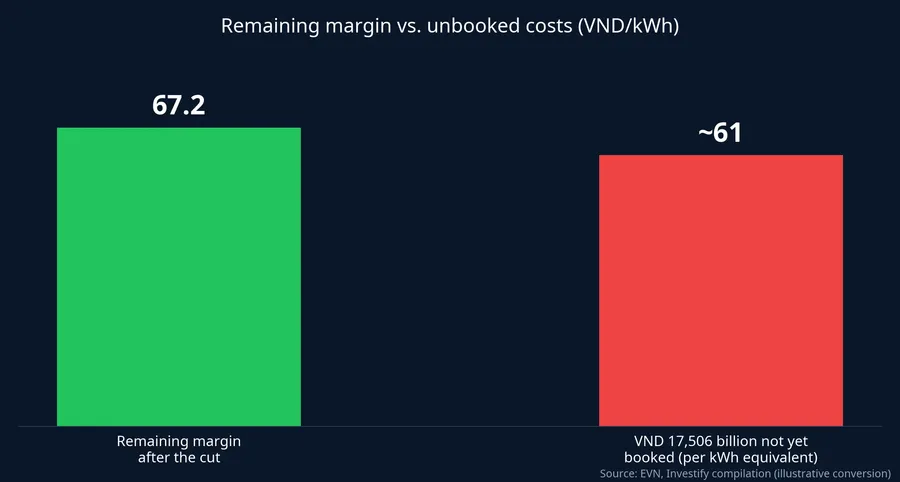
Besides the gap, EVN says more than VND 17,506 billion of costs, mostly exchange-rate differences, had not been booked into the electricity cost base as of the end of 2025.VietNamNet The sum covers the remaining 2021 exchange-rate difference and amounts arising between 2022 and 2025 in payments to power plants.Tuổi Trẻ
Divided by 2025 commercial sales, VND 17,506 billion equals about VND 61 for every kWh sold in a year.Tuổi Trẻ That is close to the VND 67.2/kWh gap that remains after the cut. Put differently, today's gap exists while the exchange-rate difference remains outside the cost base. This is a side-by-side comparison to show scale, not a forecast of how or when the amount will be reflected in prices.
How much of the increases 2% takes back
The four increases since May 2023 were 3% to VND 1,920.37/kWh (May 2023), 4.5% to VND 2,006.79/kWh (November 2023), 4.8% to VND 2,103.12/kWh (October 2024) and 4.8% to VND 2,204.0655/kWh (May 2025).VietNamNet According to Báo Xây dựng, the average price rose by about VND 340/kWh in total, more than 18% above the level before May 2023.Báo Xây dựng
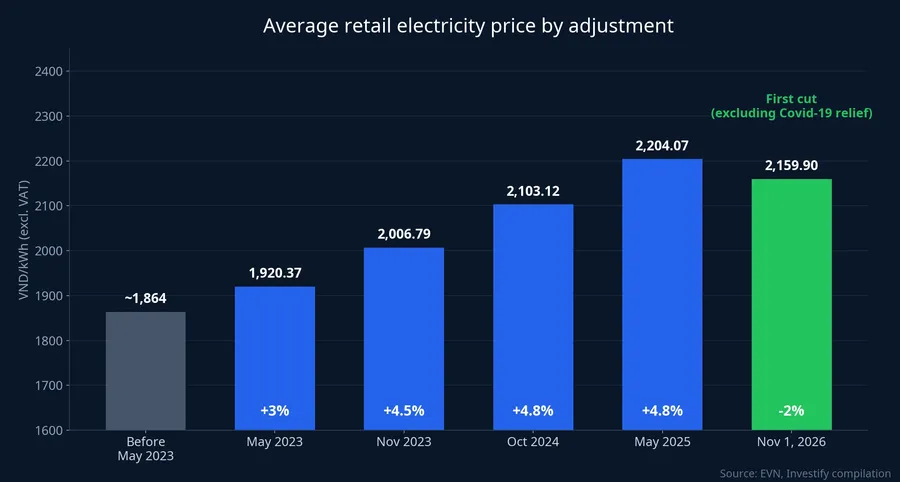
The cut of about VND 44.16 therefore recovers roughly 13% of the increase. The new VND 2,159.9037/kWh is still above the VND 2,103.12/kWh set in October 2024, so the price has only slipped back to somewhere between the last two increases.
Setting aside five rounds of electricity price cuts and bill support during the Covid-19 pandemic in 2020 to 2021, which totaled nearly VND 17,000 billion, this is the first downward adjustment of the average retail price.VietNamNet Unlike those support rounds, this time the average price itself falls, rather than a time-limited bill waiver for particular customer groups.

What users get now, and what waits beyond March 31, 2027
The first to benefit are households, shops and businesses that pay for electricity each month: from the November billing cycle, each kWh costs about VND 44 less on average. EVN still sells above its 2025 cost, but the gap has thinned to about VND 67/kWh, while the accumulated exchange-rate difference of more than VND 17,506 billion is still outside the cost base. The thesis of this piece is therefore plain: the cut stands on the numbers, but the footing is thin and tied to the government-directed reduction period running through March 31, 2027.
After that date, the next price decision from EVN and the Ministry of Industry and Trade will show whether VND 2,159.9037/kWh is kept, adjusted again or reversed. Two signals are worth watching until then: the 2026 unit cost once EVN publishes it, and how the VND 17,506 billion is handled.