

At nine o'clock on Monday, Nov 2, the HoSE price board opens its first session of the week as it does every Monday. For 17 people named in a State Securities Commission decision, it is the first day of two years without trading securities. They are not the ones who placed the orders that manipulated Kido Group's KDC shares. They are the owners of the accounts those orders were placed from.
The risk here does not sit in the market. It sits in one very small act: handing the account in your name to someone else.
Who the Oct 28 decisions cover
On Oct 28, 2026, the State Securities Commission issued four decisions on the manipulation of KDC shares.Vietnam Financial Times
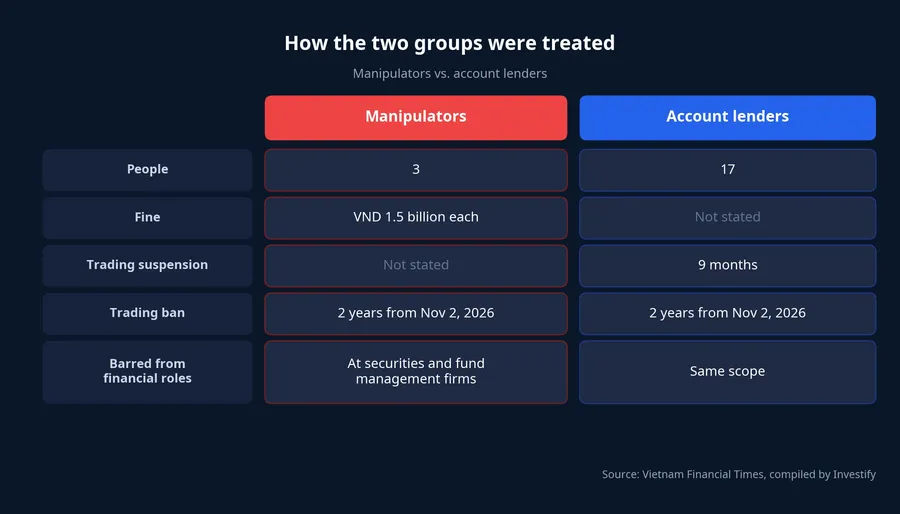
Decision 654/QĐ-XPHC fined Mr. Thang Phú Minh, Ms. Lâm Thúy Hằng and Ms. Dương Thái Phương Thảo, three individual investors, VND 1.5 billion each, VND 4.5 billion in total. Between May 2, 2024 and Jan 6, 2025, the three used a combined 61 securities accounts to buy and sell KDC repeatedly and create artificial supply and demand. According to the Commission's inspection, no unlawful proceeds could be determined. Decision 656/QĐ-UBCK added preventive measures: the three are barred from trading securities for two years from Nov 2, 2026, and, for the same period, from holding positions at securities firms, fund management companies and related institutions.Vietnam Financial Times
The other two decisions concern the 17 account lenders. Decision 655/QĐ-XPHC suspended their securities trading for 9 months for lending accounts to others in a way that led to manipulation. Decision 657/QĐ-UBCK bars all 17 from trading securities for two years from Nov 2, 2026, with the same ban on holding positions at those institutions. The Commission has no basis yet to determine that these 17 made illegal gains.Vietnam Financial Times
Side by side, the lenders' ban term matches that of the three who used the accounts. That is why several outlets, Tuổi Trẻ among them, put "20 people banned from trading securities" in the headline.Tuổi Trẻ
One point needs to be clear: Kido Group Corporation is the company whose shares were manipulated. The decisions target individuals. Kido is not a penalized party in this case.
Why 61 accounts were needed
To fake supply and demand on a price board, a manipulator needs many different names on both the buy and sell sides. When orders match back and forth between many accounts, the board looks as if many independent buyers and sellers are active, while one group is steering every order. A few accounts trading with each other are easy to spot. Dozens of accounts under dozens of names are much harder to see.
That makes accounts held in other people's names indispensable. Of the 61 accounts in the KDC case, 56 were lent by the 17 people, more than nine in ten. The split was uneven. On Mr. Minh's side, 8 people lent 8 accounts, one each. On Ms. Hằng's side, 9 people lent 48 accounts, more than five per person on average.Vietnam Financial Times
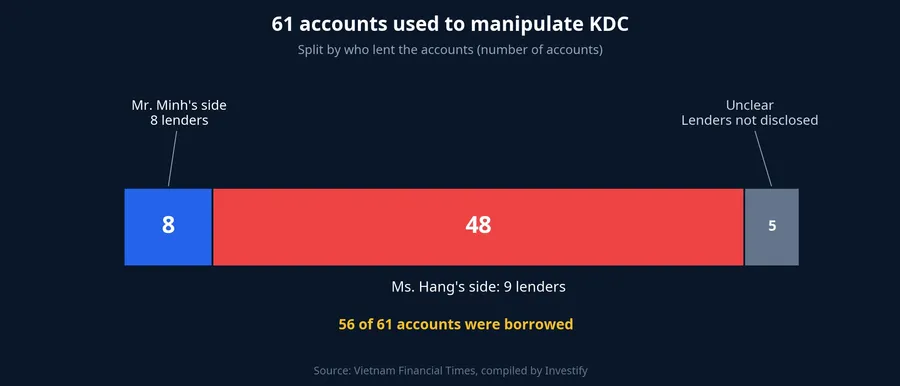
The second figure shows that lending an account is not always a one-off favor of sharing a password with an acquaintance. Some people lent several accounts in their own names at once. For them, the Oct 28 decision counts people, not accounts: one two-year ban lands on the account owner, whether they lent one account or many.
A rule that was already there
This is not a newly invented offense. Article 12 of the 2019 Securities Law lists conduct prohibited in the securities market. Clause 6 states it plainly: lending an account to another person to trade securities, or holding securities in your name on someone's behalf, in a way that leads to securities price manipulation.Securities Law 2019
The wording carries an important condition: "leads to manipulation". The law targets lending when the account is then used to manipulate. But a lender usually cannot control what the borrower will order. Once the account is handed over, so is the decision about what the account in your name gets tied to.
Consequences arrive after almost two years
One easily missed detail is the delay. The violation period ended on Jan 6, 2025, and the decisions were issued on Oct 28, 2026, almost 22 months later. The ban takes effect on Nov 2, 2026 and runs for two years, to Nov 2, 2028.Vietnam Financial Times
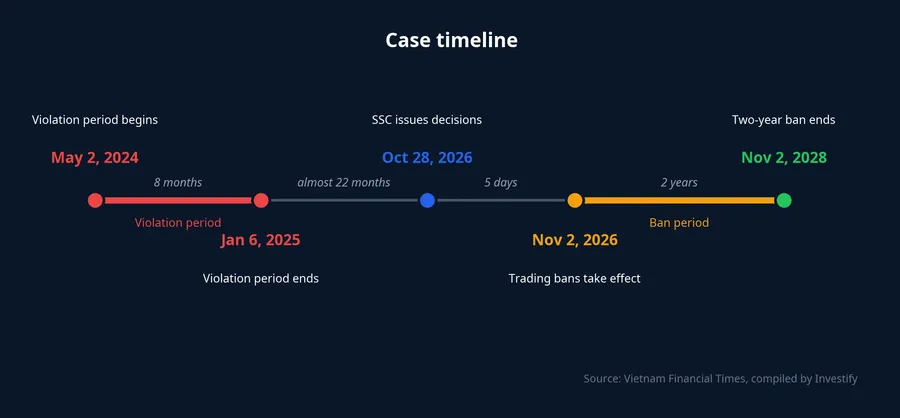
So someone who lent an account in mid-2024 may have long forgotten it, and learned the consequences only when the decisions were published in late October 2026. Measured from the moment the account was handed over, the period in which the lender carries consequences is far longer than the few months it was in someone else's hands.
The ban also reaches beyond one stock. It is a ban on trading securities in general, not limited to KDC.Tiền Phong It comes with a bar on holding positions at securities firms and fund management companies. For someone working in, or planning to work in, the securities industry, the second ban may weigh more than the first.
People who traded KDC in that period
For shareholders and traders in KDC between May 2024 and early January 2025, the decisions indicate that, during that period, part of the supply and demand shown on the board was artificial, produced by a group of accounts trading back and forth. The matched volume investors saw at the time did not fully reflect real demand.
Because the Commission could not determine unlawful proceeds, there is no basis for attributing KDC's price moves in that period to this group of accounts alone. This post also makes no assessment of KDC's current share price. The takeaway is a general warning: the liquidity of a stock can be faked, and the tools used to fake it were the accounts of ordinary individual investors.
Your account, your name, your ban
In the KDC case, the decisions put lenders under the same ban term as those who used the accounts. The three manipulators also face a VND 1.5 billion fine each. On the right to trade, all 20 people are barred from this Monday.
For new investors, a securities account is easily seen as a tool someone else can operate on your behalf: a relative placing orders, a "team" managing it for you, an acquaintance borrowing it briefly. The KDC case shows the regulator looks at an account by the name on it. If the account is used to manipulate, the named owner can lose trading rights for years without placing a single order.
The thesis stops there, within the scope of one case: in KDC, account owners who lent them out received the same ban term as the manipulators. Whether anyone would be treated the same way in every case depends on the file and on the "leads to manipulation" condition the law sets. The question worth asking yourself right now is who holds the right to place orders on the account in your name.