


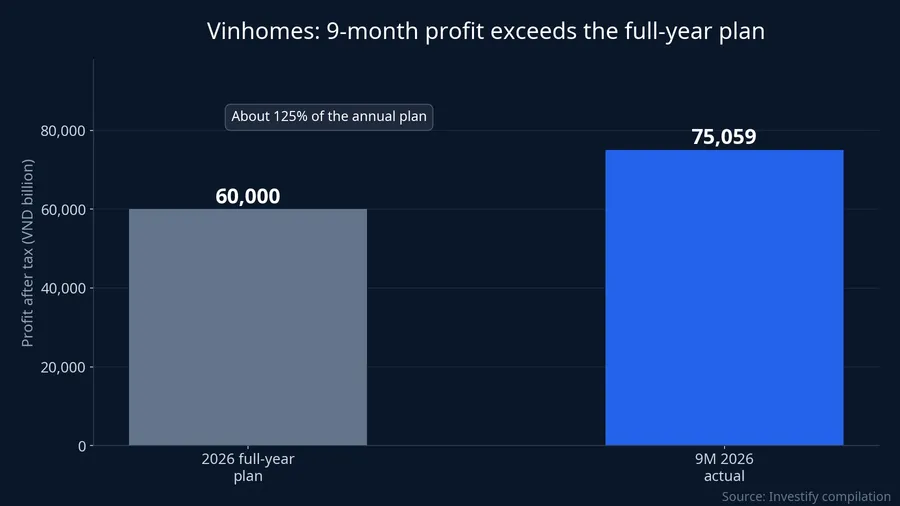
On October 30, Vinhomes JSC (VHM) released its consolidated financial statements for Q3 2026. Profit after tax for the first nine months came to VND 75,059 billion, up 390% year on year. The full-year profit-after-tax plan approved at the annual shareholder meeting is VND 60,000 billion, so after three quarters the company has delivered about 125% of its target.
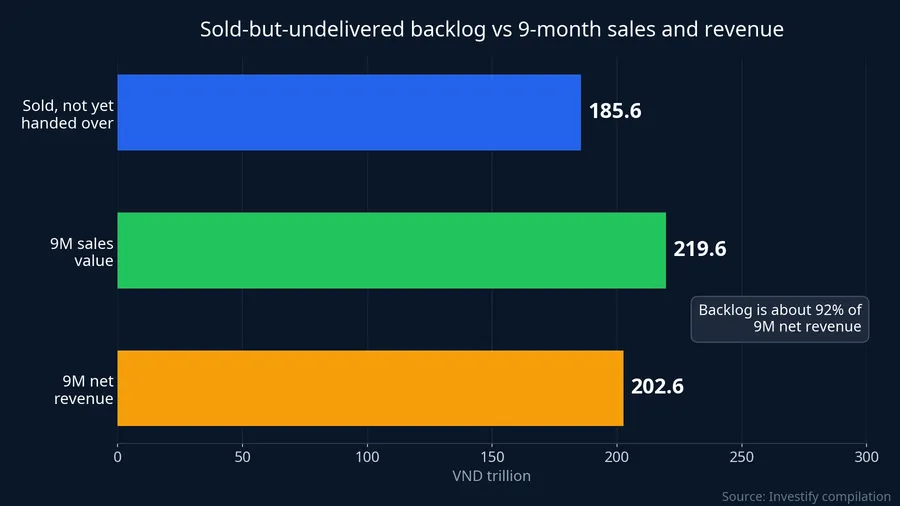
Booked profit, though, is only half the story. The other half sits in homes that have been sold but not handed over. At the end of September that backlog stood at VND 185.6 trillion, roughly 1.7 times the 2021–2025 average and about 92% of the nine-month net revenue just reported. This post walks through profit, margins, the backlog and the balance sheet to see what drives profit in the coming quarters.
What Q3 added to nine-month profit
Q3 net revenue alone was VND 85,364 billion, up 420% year on year. Profit after tax for the quarter was VND 23,021 billion, up 419%. That is about 31% of the nine-month total, so the first two quarters carried more of the load: H1 profit was VND 52,092 billion, made up of VND 25,625 billion in Q1 and VND 26,467 billion in Q2. Even so, Q3 profit was more than five times the same quarter of 2025, and the nine-month figure is nearly five times last year's. Handover volume this year is clearly on a different scale from 2025.
Q3 revenue came almost entirely from selling land and homes. Real estate transfers brought in VND 75,749 billion, or 88.7% of net revenue, more than 20 times the prior-year quarter. The rest came from general contracting (VND 6,056 billion), brokerage and consulting (VND 2,013 billion) and management services (VND 1,543 billion). Vinhomes attributes this year's growth to Vinhomes Green Paradise, Vinhomes Global Gate Ha Long, and Vinhomes Ocean Park 2 and 3, along with other projects.
A 60.3% gross margin, 36 points above a year earlier
Q3 gross profit was VND 51,490 billion, nearly 13 times the VND 3,983 billion of Q3 2025. The gross margin reached 60.3%, against roughly 24% a year earlier.
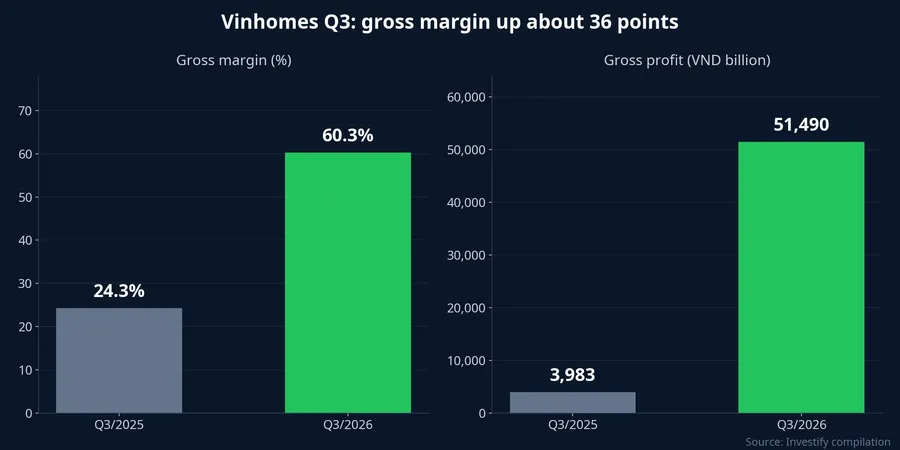
For a property developer, gross margin follows the mix of projects handed over in the period. Projects with low land cost relative to selling price earn high margins; projects with higher costs earn less. The 60.3% is therefore best read as the result of the project mix delivered in Q3, not as a fixed level for later quarters.
VND 185.6 trillion of homes sold: profit not yet booked
Nine-month sales value reached VND 219.6 trillion, up 35% year on year. Q3 alone brought VND 71.5 trillion, 81% of it through retail channels, with contributions from Vinhomes Saigon Park and Vinhomes Global Gate Ha Long.
Two concepts need separating. Sales value is the value of contracts signed; revenue is recorded only when a home is handed over. Contracts signed but not yet delivered, accumulated over several years, form the backlog: VND 185.6 trillion as of September 30. Against nine-month net revenue of VND 202,586 billion, the backlog equals about 92% of the past three quarters' revenue.
On the balance sheet, short-term customer prepayments stand at VND 125,460 billion, up 43% since the start of the year. This is cash customers have paid on schedule, only a portion of contract value, so it is not added on top of the VND 185.6 trillion.
That shifts the question about Q4 and 2027 profit. With a large book of contracts already in hand, profit in coming quarters depends more on the pace of completion and handover than on new sales. According to Vinhomes, Green Paradise and Global Gate Ha Long are accelerating construction, with low-rise blocks nearing completion.
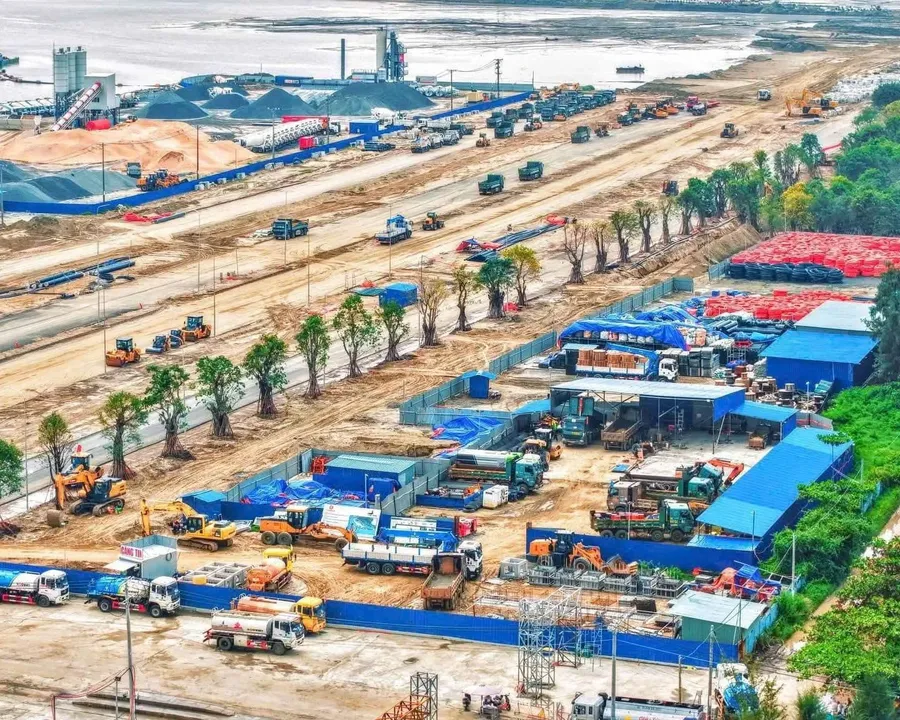
Handover timing is also where the risk sits. When deliveries concentrate in a handful of mega-projects, quarterly profit can swing sharply depending on which projects are ready to hand over in a given quarter.
Assets up 69%: how much debt
At September 30, Vinhomes' total assets were VND 1,339,199 billion, up 69% from the start of the year. Equity was VND 307,792 billion, up 24%. Over nine months the company raised charter capital to VND 82,148 billion by issuing shares as a 100% stock dividend, and also paid VND 24,644 billion in cash dividends.
Inventory rose 88% to VND 247,302 billion, mostly work-in-progress costs at projects held for sale such as Global Gate Ha Long, Vinhomes City Royal, the Cam Ranh Bay-front urban area, Green Paradise and Ocean Park 2–3. Vinhomes explains that about 85% of inventory is land-use fees, site clearance and construction costs for flagship projects, while completed properties for sale account for only about 2%.
On funding, total borrowings at the end of September were VND 240,622 billion, up 64% from the start of the year. Bonds make up VND 115,402 billion of that, with VND 6,078 billion due within a year. Borrowings come to 0.18 times total assets, and 99% of debt is in dong. The interest coverage ratio is 11.3 times, which Vinhomes says is an improvement on 2025.
Q3 financial expenses were VND 24,398 billion, versus VND 4,965 billion a year earlier, while financial income was VND 5,063 billion, down 36%. The quarter's gross profit of VND 51,490 billion is still more than twice the financial expense. Both lines are worth reading alongside debt when the Q4 report arrives.
Next to Vingroup, and the October 30 session
The same day, Vingroup (VIC) reported nine-month consolidated profit after tax of VND 43.7 trillion, nearly six times a year earlier and 125% of its annual plan. Vinhomes' own nine-month profit is higher than that figure, a detail that points to how much the property business weighs in the group's results.
In the October 30 session VHM rose 1.45% to VND 63,000 per share on volume of about 13.5 million shares, double the previous session. The VN-Index fell 0.80% to 1,741.62 points, and VIC closed flat at VND 241,000.
What to watch
Vinhomes is a quarter ahead of its annual plan, and the VND 185.6 trillion backlog shows that revenue for coming quarters has a ready source. The thesis here: the next leg of profit depends on how fast contracts convert into revenue, not on selling more. Uneven handover timing and project-specific margins will make quarterly profit volatile, but they do not reverse this thesis unless construction at the mega-projects slows clearly.
The Q4 report will answer with two numbers: the quarter's handover revenue and the year-end backlog. If Q4 revenue holds near Q3's while the backlog shrinks, homes are being delivered steadily and sold profit is being booked. If Q4 revenue drops sharply while the backlog keeps growing, profit is being booked more slowly than sales, and 2027 will lean more on the completion schedules of Green Paradise and Global Gate Ha Long.