

On the morning of 30/10, shares of Kosy Joint Stock Company (KOS) opened at the floor price of VND 3,540. Before 9:25, more than 61.4 million shares had already traded at that level.Người Quan Sát For scale: across the first 28 floor-price sessions of the slide, total volume was only about 5.7 million shares.CafeF
The session is still running. As of early afternoon KOS sat at its ceiling of VND 4,060, up 6.84%, with 75,445,300 shares traded. Kosy has roughly 216.5 million shares outstanding,CafeF so more than a third of the company's shares changed hands in a single morning. Meanwhile the VN-Index was down 1.27% at 1,733.40 points.
One point up front. According to the company's reports, Kosy's first-half 2026 net revenue was VND 722 billion and profit after tax nearly VND 15.4 billion, up 9% and 120% year on year.CafeF This article walks through each milestone from 18/9 to this morning to answer two questions: why sell orders barely matched for more than a month, and what changed on 30/10.
From VND 30,050 to the first floor session
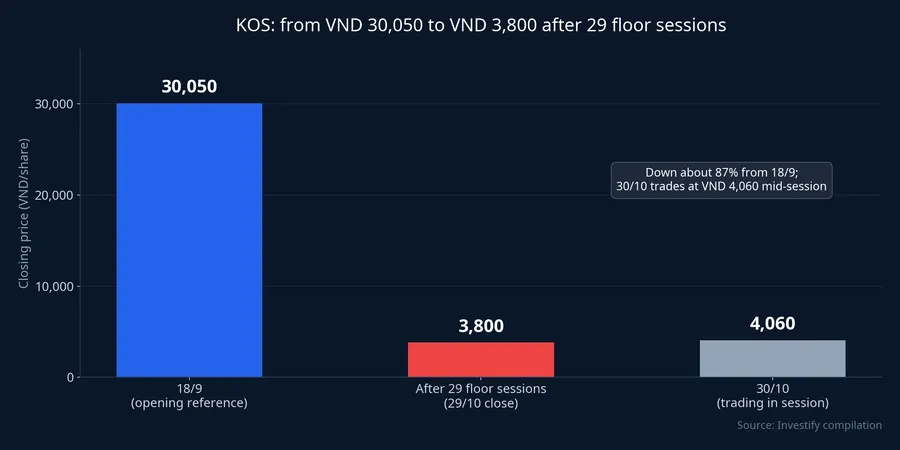
On 18/9 KOS closed at VND 30,050. On 21/9 it fell by the full daily limit to VND 27,950, starting the streak. From then through the 29/10 close, KOS finished at the floor 29 sessions in a rowCafeF at VND 3,800, down 87.35% from the 18/9 close. Kosy's market capitalization shrank from over VND 6,500 billion to about VND 823 billion.
Before the floor streak began, Chairman Nguyễn Việt Cường of Kosy sold more than 4.26 million shares between late August and 24/9, according to Vietstock's tally.Vietstock
Limit-down, yet almost no one could sell
What stands out is liquidity. Over the first 28 floor sessions, average volume was only a little over 200,000 shares a session, and on 29/9 just 1,400 shares changed hands. At one point nearly 100 million shares were queued to sell at the floor, over 40% of shares outstanding.CafeF At 9:40 on 26/10, sell-side volume left unfilled was close to 91 million shares, 168 times the volume matched in the session.Vietstock
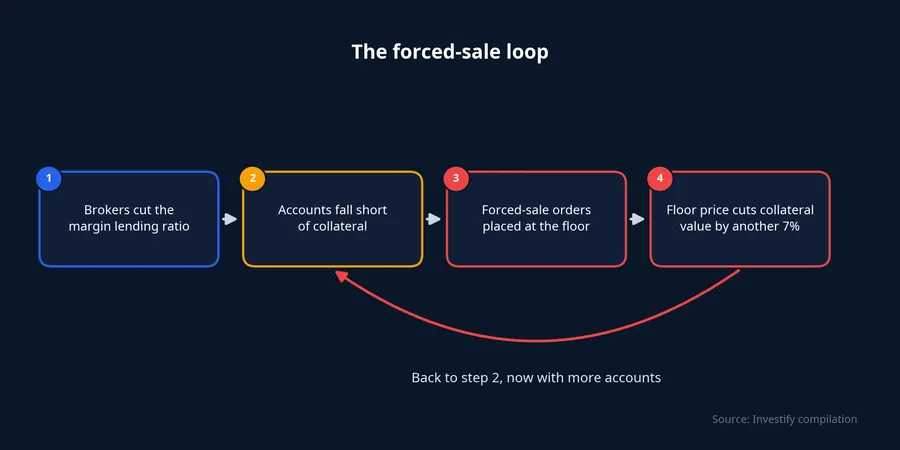
Kosy explained the source of this supply in filings to HoSE: market momentum created selling pressure, and brokerages cut margin lending ratios on KOS and force-sold in unison, adding to the pressure.CafeF The mechanism works as a loop. When a broker lowers the lending ratio on a stock, accounts that use it as collateral fall short of margin. Borrowers must add cash or face a forced sale. Sell orders pour in at the floor with almost no buyers, and today's floor price cuts collateral value by another 7% for tomorrow, pulling a further layer of accounts below the threshold.
For KOS the loop is heavier because the largest shareholders also borrowed against KOS shares. Per Vietstock, the Chairman's family holds about 45% of KOS, not counting stakes held through related entities.Vietstock When blocks that large are put up for forced sale, the floor queue swells by tens of millions of shares while daily volume is counted in thousands or hundreds of thousands. Forced sales completed in this period total only about 2.44 million shares, and many attempts failed for lack of counterparties.CafeF
October: a hydropower sale, a purchase plan and forced sales
While the price stayed at the floor, the company and its large shareholders moved in opposite directions. In early October Kosy completed the sale of its entire stake in Hydropower Investment and Construction Consulting JSC, owner of the Nậm Pạc 1 and 2 plants with combined capacity of 34 MW. The stake had a remaining book value of over VND 950 billion at end-June 2026.CafeF After the deal Kosy has no subsidiaries and publishes standalone financial statements only.
On the buy side, Ms. Hoàng Thị Yến, wife of Mr. Nguyễn Trung Kiên (Mr. Cường's younger brother), registered to buy 8 million KOS shares between 15/10 and 13/11. If completed, her stake would rise from just over 32,000 shares to about 3.71% of charter capital.Vietstock That is a registered plan, not shares already bought.
On the sell side, insider trading reports show accounts of Mr. Cường and related companies were force-sold in turn:FireAnt
- Mr. Nguyễn Việt Cường: 175,287 shares from 19/10 to 23/10, stake down from 33.17% to 33.09%.
- Kosy Real Estate Investment Co., Ltd., where Mr. Cường is Chairman of the Members' Council: 445,500 shares from 16/10 to 22/10, stake down to 4.05%.
- Leo Regulus Investment JSC, where Mr. Cường is Chairman of the Board: 175,870 shares, stake down to 10.17%.
Relative to holdings these amounts are small, because large accounts' forced-sale orders also queue at the floor like any other. Vietstock noted that Ms. Nguyễn Thị Hằng, Vice Chairwoman of Kosy, and a Deputy General Director from the Chairman's family had brokers place forced-sale orders for millions of shares several times between 23/9 and 23/10, none of which filled.Vietstock
The final sessions: the queue thins
From mid-October, volume at the floor rose: 311,400 shares on 20/10, 842,400 on 27/10 and 1,387,300 on 29/10. Meanwhile unfilled sell volume fell from nearly 91 million shares on the morning of 26/10 to over 63 million at the close of 29/10.CafeF The direction suggests buyers began appearing at the floor before the 30/10 session.
Morning of 30/10: the queue meets buyers
KOS opened at the floor of VND 3,540. More than 61.4 million shares traded at that price, with about 94% of the volume coming from active buyers. The price then recovered to the VND 3,800 reference and rose to the VND 4,060 ceiling; cumulative volume at 9:35 was about 74 million shares.Người Quan Sát
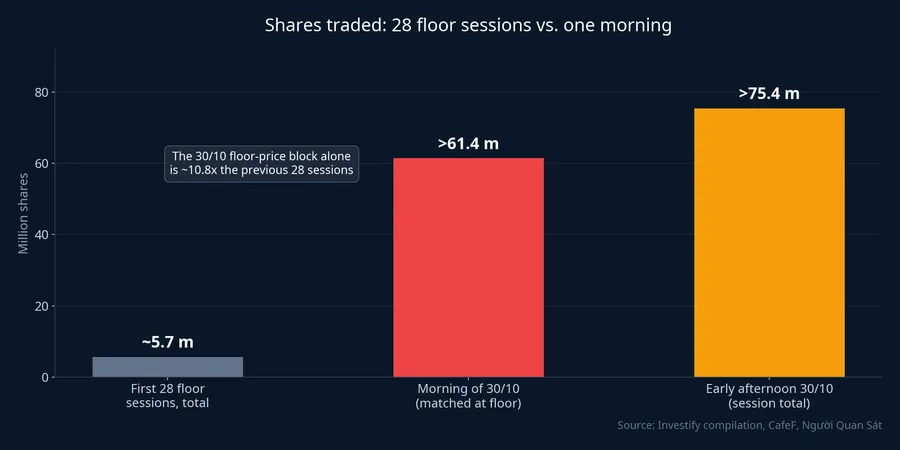
The sequence matters to holders. Most of the backlog was not sold at the ceiling but at the new floor of VND 3,540, 6.84% below the 29/10 close. The ceiling appeared only after the queue was absorbed: from about 74 million shares at 9:35 to 75,445,300 by early afternoon, only a little over a million more shares in the hours after. One caveat: unmatched orders expire at the end of each session and must be re-entered, so the 61.4 million shares cannot be treated as the same block as the 63 million unfilled at the close of 29/10.
Per Người Quan Sát, foreign investors were not the main force in the session.Người Quan Sát The 8 million shares Ms. Yến registered to buy are only a small part of the 75 million-plus shares traded.
Where the business stands
In its filings Kosy states that investment, real estate development, renewable energy and project operations continue as planned with no unusual internal developments.CafeF The first-half figures above are consolidated, from when Kosy still owned the hydropower company. The company has completed 39% of its full-year revenue plan and 13% of its profit plan, meaning most planned profit sits in the second half.
On the balance sheet, at end-June total assets were nearly VND 5,000 billion, of which inventory was nearly VND 2,780 billion, almost 55%, mostly work in progress at real estate projects. Kosy says its main projects are essentially complete and eligible for sale. Total borrowings were nearly VND 2,000 billion, equal to 85% of equity, with short-term debt of VND 878 billion.CafeF
Two readings of the slide coexist. Kosy's own: the supply came from lower lending ratios and forced sales, not from the business. The other: the market is focused on large inventory and debt at 85% of equity. The liquidity data leans toward the first: 29 floor sessions with volume of a few hundred thousand shares and tens of millions queued to sell look more like forced selling than investors choosing their exit. That is an inference from trading data; no document confirms the share of each source of selling.
What changed for KOS holders
For someone holding KOS with their own cash, 30/10 is the first session in over a month with buyers large enough for the backlog. For margin borrowers, collateral is valued at market price; with the stock at VND 4,060 rather than a new floor, this session does not push another layer of accounts below the sale threshold. The price is still 86% below 18/9, though, and lending ratios that brokers cut are not automatically restored.
The thesis: the floor queue was absorbed on the morning of 30/10, but one session is not enough to conclude forced-sale supply is exhausted. The milestones that will answer it:
- The coming sessions: whether unfilled sell volume at the floor returns to tens of millions of shares. If so, forced-sale supply is not exhausted; if the price holds on normal volume, the queue has been absorbed.
- Insider and related-party trading reports in the coming days, showing how much was sold from the accounts of Mr. Cường, Kosy Real Estate, Leo Regulus and family members on 30/10.
- 13/11, the end of Ms. Yến's purchase window: the results report will show how much of the 8 million registered shares she bought.