

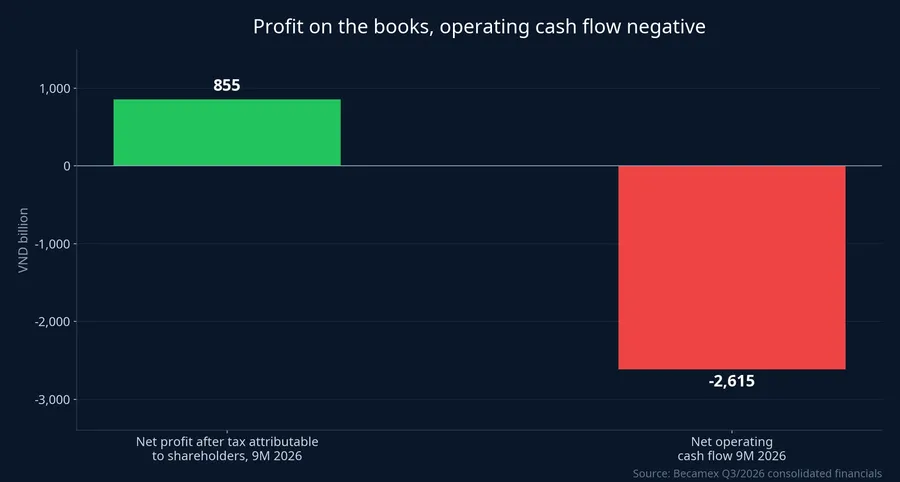
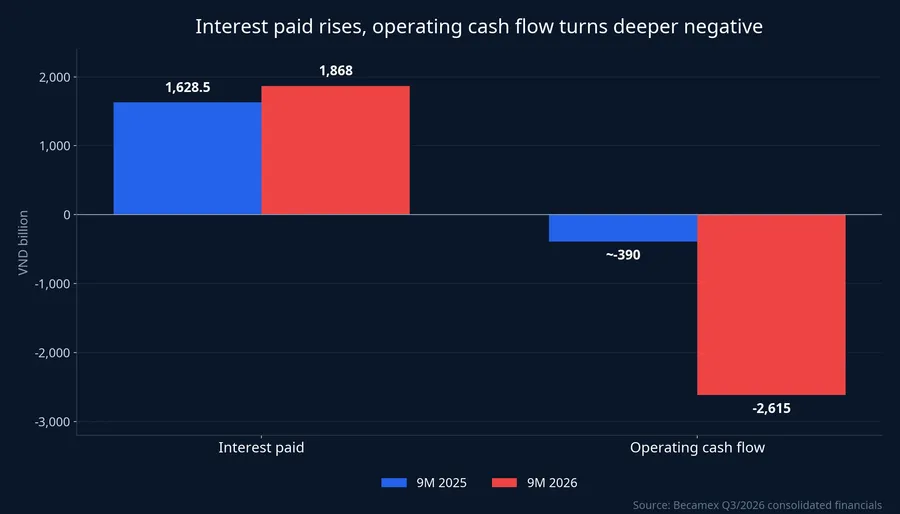
Becamex IDC (HoSE: BCM) has reported consolidated Q3/2026 results with two figures pointing in opposite directions. Profit after tax attributable to shareholders came to VND 563 billion in the quarter, up 35.5% year on year. Yet net operating cash flow for the first nine months was negative VND 2,615 billion, against roughly negative VND 390 billion a year earlier.Nhịp sống nhà đất
The two numbers do not contradict each other. They measure different things: profit is what the company books, while cash flow is the money that actually moves through its accounts. This post separates the layers to show where the gap comes from and how Becamex is handling it.
Q3 is up, but nine months remain below last year
Start with the right time frame. Net revenue in Q3 was VND 941 billion, up 13.6%, with real estate contributing VND 578 billion, up 25.3%.Nhịp sống nhà đất
The nine-month picture is different. Net revenue was VND 2,591 billion, down 53.5%, and profit after tax attributable to shareholders was VND 855 billion, down 62%. The 2025 base is high: in the first nine months of last year Becamex booked net revenue of VND 5,574.5 billion.Nhịp sống nhà đất
Against the full-year plan, Becamex targets consolidated profit after tax of VND 3,883 billion and has completed roughly 22.8% after nine months. Hitting the plan requires about VND 2,997 billion in Q4 alone. One caveat on revenue: the "total revenue" plan of VND 10,230 billion includes financial income, profit from joint ventures and associates, and other income, so dividing net revenue by that figure understates progress.Nhịp sống nhà đất
Layer one: JV and associate profit is booked by ownership share
Becamex does not just sell land and homes. A large part of the group's value sits in jointly owned companies such as the Vietnam Singapore Industrial Park JV (VSIP), BW Industrial, Becamex IJC and Becamex Tokyu. At September 30, investments in this group were carried at VND 24,718 billion, about 39% of total assets, with VSIP alone at VND 8,862 billion.Nhịp sống nhà đất
For these companies Becamex recognizes profit in proportion to its stake. Whatever the joint venture earns, Becamex adds its share to its own profit, even though the cash stays inside that company. Cash reaches Becamex only when the venture pays dividends or distributes profit.
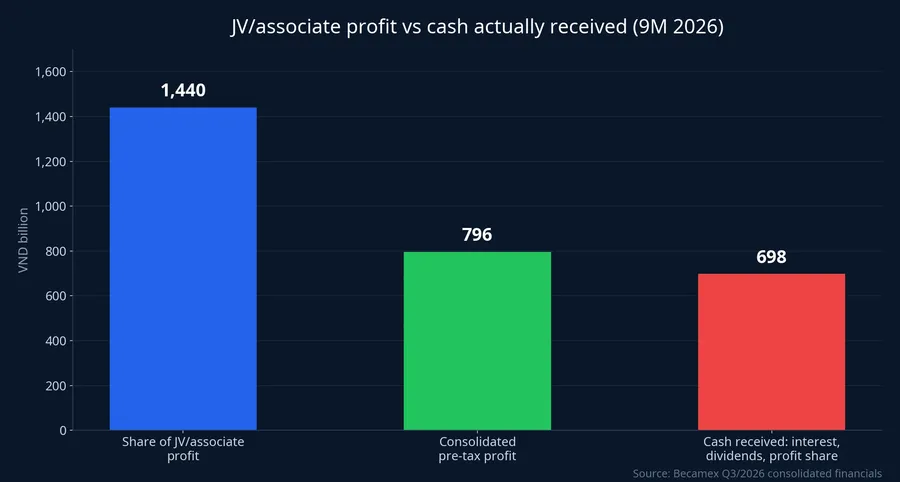
In Q3, profit from joint ventures and associates was VND 707 billion, up 33.4%, higher than the quarter's consolidated pre-tax profit of VND 542 billion. For nine months it was VND 1,440 billion, up 7.1%, again above consolidated pre-tax profit of VND 796 billion.Nhịp sống nhà đất Financial expenses rose to VND 373 billion in Q3, which is why pre-tax profit grew more slowly than the JV and associate line.
None of this is new at Becamex. The group's model has long been tied to a jointly owned industrial park ecosystem, and this line grew year on year over nine months. What needs adding is the cash. The nine-month cash flow statement shows total cash received from loan interest, dividends and distributed profit of VND 698 billion. That is a combined figure that does not isolate joint ventures and associates, but it shows cash actually received from investments is far below the VND 1,440 billion of profit booked.Nhịp sống nhà đất
Layer two: sales proceeds still sit in receivables
Real estate revenue rose in Q3, but part of it has not turned into cash. Short-term trade receivables at September 30 were VND 5,786 billion, up 31.5% from the start of the year, and total short-term receivables reached VND 7,884 billion. On the cash flow statement, changes in receivables reduced operating cash flow by about VND 1,623 billion.Nhịp sống nhà đất
Inventory also rose 5.9% to VND 23,497 billion, of which work in progress is VND 21,318 billion, mostly compensation, site clearance and project infrastructure spending. That is cash paid up front for projects to be sold later. On the favorable side, long-term unearned revenue rose from VND 1,399 billion to VND 2,460 billion. This is typically cash customers have prepaid, to be recognized as revenue over time under contract terms.Nhịp sống nhà đất
Layer three: interest is paid in real cash
The last layer has no lag. Over nine months Becamex paid nearly VND 1,868 billion in borrowing costs, about 14.7% more than the VND 1,628.5 billion of the same period last year.Nhịp sống nhà đất That differs from the borrowing cost in the income statement (VND 1,255 billion, up 29.6%), because one is cash paid in the period and the other is expense charged to the period.
Under the report's presentation, interest paid sits inside operating cash flow. Adding it back, nine-month operating cash flow is still negative by about VND 747 billion, whereas the same calculation last year gives a positive figure of about VND 1,241 billion. In other words, even before interest, cash collected from sales and services this year did not cover cash spent on projects plus the amount still sitting in receivables.
Borrowing and bonds fill the gap
When operating cash is negative, the shortfall is covered by financing. Over nine months Becamex drew VND 10,907.8 billion in new borrowings and repaid VND 8,642.4 billion of principal. Total borrowings and finance leases at the end of Q3 were VND 26,259 billion, up 9.6% from the start of the year, or about 1.14 times equity.Nhịp sống nhà đất
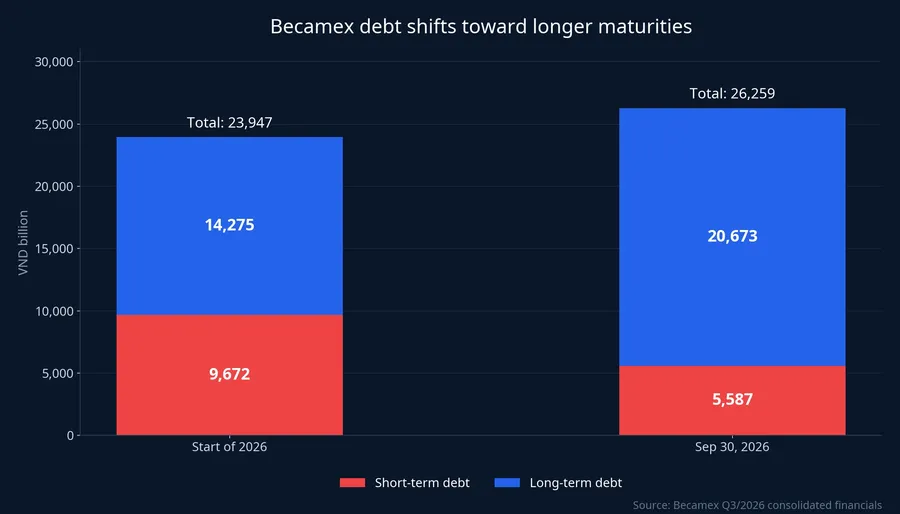
Maturities have shifted longer. Short-term debt fell from VND 9,672 billion to VND 5,587 billion, while long-term debt rose from VND 14,275 billion to VND 20,673 billion. Cash and equivalents at period end were VND 1,063 billion; including short-term held-to-maturity investments, about VND 1,629 billion.
Bonds are a main channel for this maturity swap. On September 15, Becamex paid VND 2,500 billion in principal and nearly VND 69 billion in interest to settle bond lot BCMH2126005. Earlier, from August 28 to September 15, it issued lot BCML12601 worth VND 710 billion, with a three-year tenor and a fixed 11% annual rate for the first two periods, secured by land-use rights. All proceeds went to repay short-term loans at BIDV and Vietcombank.Doanh nhân & Pháp luật
In an October 21 disclosure, Becamex approved a second private bond plan for 2026, code BCML12602, of up to VND 1,200 billion, with a 36-month tenor, a fixed 12.5% annual rate for the first four periods and no collateral, to restructure some bank debt. This is a plan only; no issuance result has been reported. The rate is 1.5 percentage points above the VND 710 billion lot.Doanh nhân & Pháp luật A maturity schedule lies ahead: per the issuance filings, Becamex bonds maturing in 2027 total about VND 2,059.4 billion, calculated as volume times face value and before any early buybacks.
What the Q4 report will answer
Profit from joint ventures and associates is legitimate, and VSIP and BW Industrial are valuable assets. What stands out is that cash from those assets and from the land bank arrives more slowly than cash owed to banks and bondholders. That gap is currently covered by new borrowing on longer maturities, and the bond now being prepared carries a higher rate than the last one. The thesis that follows: for Becamex at this point, cash flow, not reported profit, is the measure that matters.
The Q4/2026 report, expected at the end of January 2027, will answer two things at once. First, whether Q4 contributes most of the roughly VND 2,997 billion of plan profit after tax still outstanding. Second, and more important, whether full-year operating cash flow narrows from the negative VND 2,615 billion of the first nine months.
If trade receivables fall from VND 5,786 billion and Q4 operating cash flow turns positive, profit is converting into cash and the need for new borrowing to repay old debt will shrink. If receivables keep rising and operating cash flow stays negative, the money for 2027 interest and principal will keep coming from new loans and bonds, at a cost of capital of 12.5% a year like the lot now being prepared.