


Deputy Prime Minister Nguyễn Văn Thắng signed Decision 2054/QĐ-TTg on October 27, 2026, approving the plan to restructure state capital in enterprises for 2026–2030.Fili It implements Decision 40/2026/QĐ-TTg on enterprise classification criteria and Decree 57/2026/NĐ-CP on restructuring state capital.
For anyone holding shares, the part worth reading is the appendix. Each company has one column for the state's current stake and one for the stake it must reach by 2030. Among the large listed names, GVR, HVN, CTG, VCB and BID are on the list of companies that must change. Read side by side, the five tickers move in very different directions, and so does what each means for minority shareholders.
Two groups, three directions
According to FireAnt, the decision splits companies into two lists. The first covers 15 enterprises under the Ministry of Finance and the State Bank of Vietnam (SBV) that keep their state stake unchanged through 2030, including PVN, EVN, TKV, VNPT, SCIC, VEC and Agribank. Three familiar listed names also sit in this group: the state keeps 95.4% of ACV, 67.98% of Bảo Việt (BVH) and 75.87% of Petrolimex (PLX).FireAnt Holders of those three have nothing new to track from this decision.
The second list has three companies and three banks that must change their ratios. GVR falls from 96.77% to 75%. Vietnam Maritime Corporation (VIMC, ticker MVN on UPCoM) falls from 99.469% to 65%. Vietnam Airlines (HVN) rises from 39.29% to 86.42%. VietinBank (CTG) edges up from 64.46% to 65%. Vietcombank (VCB, now at 74.8%) and BIDV (BID, now at 76.73%) only face a floor of at least 65%.FireAnt
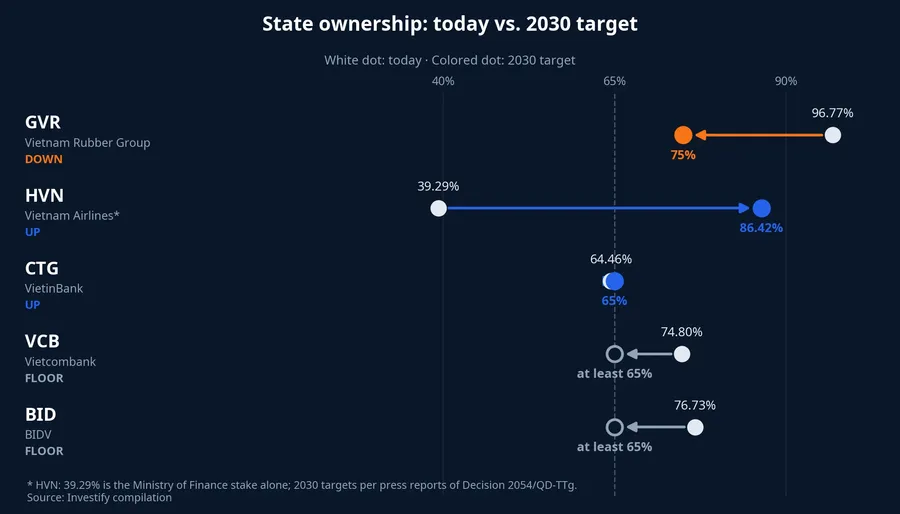
The chart shows three directions: the state reduces at GVR, increases at HVN and CTG, and holds a floor at VCB and BID. HVN's figure looks like the biggest jump, but it only makes sense next to the actual shareholder structure, as the section below shows.
GVR: the non-state stake grows almost eightfold
GVR has the largest change for anyone outside the state. The Ministry of Finance holds 96.77% of the voting shares, and every other shareholder together holds 3.23%. That is so low that GVR was reported as not meeting the public-company requirement of at least 10% of voting shares held by at least 100 investors who are not major shareholders. According to CafeF, a transitional rule for companies carrying out an approved restructuring plan lets GVR keep its public status.CafeF Decision 2054 is that plan, and it sets the 75% target.

Taking the state from 96.77% to 75% means the stake outside state hands goes from 3.23% to 25%. GVR has roughly 4 billion shares outstanding, so there are two routes to the target, and each affects GVR holders differently.
The first route is for the state to sell part of what it owns. If the share count stays the same, the Ministry of Finance would have to sell roughly 870 million shares. At the morning-session price of VND 32,150 on October 29, that is worth roughly VND 28,000 billion. Existing shareholders are not diluted, but the market has to absorb a very large block.
The second route is for GVR to issue new shares to non-state investors. For the state's stake to fall to 75% without selling a single share, GVR would have to issue roughly 1.16 billion new shares, an increase of about 29% in the share count. That brings money into the company, but each existing shareholder's percentage shrinks unless they buy more.
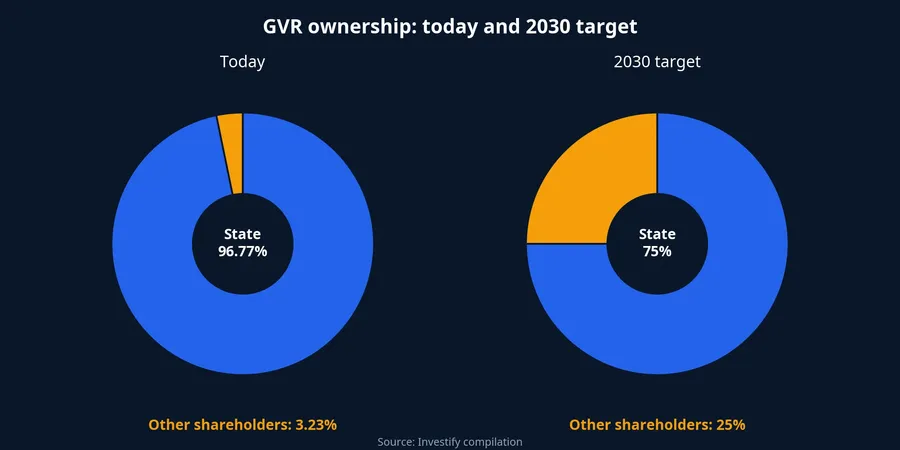
The decision does not pick a route. It leaves the Ministry of Finance and the SBV to choose timing and form.Fili
On voting power, 25% is a big step for minority holders but does not change who decides. Under the 2020 Enterprise Law, many important shareholder-meeting resolutions need at least 65% of the votes of attending shareholders.Hệ thống pháp luật At 75%, the state can still pass those resolutions alone. The real change is in the number of shares that can trade outside state hands.
HVN: the 86.42% figure is already in the shareholder register
At a glance, Vietnam Airlines looks like where the state raises its stake the most, from 39.29% to 86.42%. Reading that as the state about to buy another 47 percentage points of HVN on the market would be a mistake.
Vietnam Airlines has two state shareholders. After the 2025 share offering, the Ministry of Finance holds 39.29% and SCIC holds 47.13%, because the Ministry transferred its subscription rights to SCIC, making SCIC the largest shareholder.Thị trường tài chính tiền tệ Ownership data updated on October 28, 2026 still shows these same two figures.
Added together, 39.29% and 47.13% equal exactly 86.42%, the 2030 target. The 39.29% in the decision is the Ministry of Finance's own stake, while the two state holders combined are already at 86.42%. The remaining roughly 13.58% includes Japan's ANA Holdings at 5.62%.
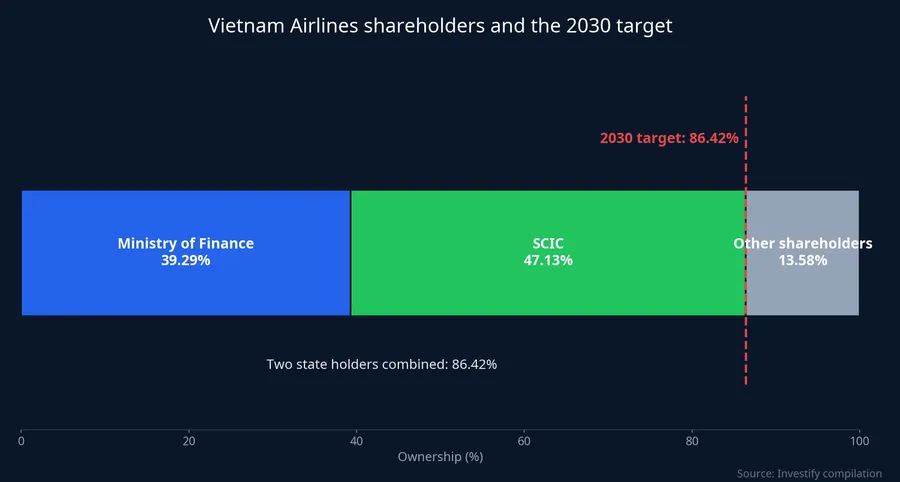
If the 86.42% target is measured as the sum of the two state holders, minority shareholders at HVN need not change anything for the plan to hit its goal. The consolidation into one holder would then be an arrangement between the Ministry of Finance and SCIC. The specifics should become clearer once the Ministry puts forward its plan for Vietnam Airlines.
CTG: only 0.54 percentage points short, but heading up
VietinBank is the only one of the three banks where the state must hold more than it does now, going from 64.46% to 65%.FireAnt The gap is just 0.54 percentage points, but the direction differs from the other two banks.
The arithmetic is simple. Stock dividends are distributed in proportion to existing holdings, so the state's percentage stays put no matter how many rounds VietinBank pays. It only rises if the state receives shares that other shareholders do not receive in proportion. Conversely, a private placement to outside investors without state participation would push the state's stake further below 65%. For minority shareholders, 0.54 points barely changes their holdings. What deserves attention is the form of capital raising the plan allows VietinBank to use.
VCB and BID: a floor, not a target
For Vietcombank (74.8%) and BIDV (76.73%), the decision says to maintain at least 65%.FireAnt This is a floor, and it does not require the ratio to fall or rise.
The distance from today's level to the floor is 9.8 percentage points at Vietcombank and 11.73 at BIDV. Arithmetically, that is room for the two banks to issue new shares to outside investors while the state still holds more than 65%. If such an issue happens, existing holders would be diluted, in exchange for more capital to lend. The decision sets only the floor and names no offering.
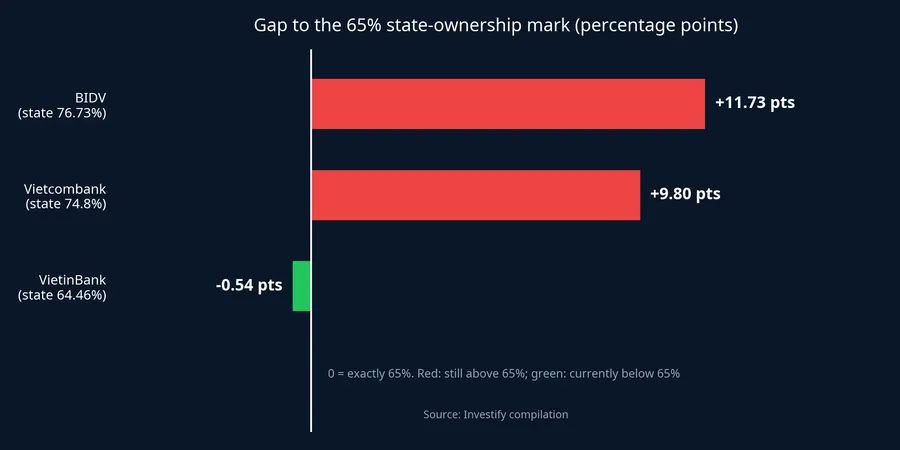
Compared with VietinBank, the two banks are in a much more comfortable position: VietinBank is below 65%, while Vietcombank and BIDV have nearly 10 percentage points or more to work with.
The decision fixes the target; the Ministry of Finance and the SBV pick the schedule
Decision 2054 fixes the 2030 target but not the timetable. The Ministry of Finance and the SBV are tasked with implementation and may choose timing and form. The document also says that if a ratio is not reached, or cannot be done within 2026–2030, the causes and the responsibility of the collectives and individuals involved must be clarified. Every year, before January 31, the units submit an implementation report to the Ministry of Finance, so the first report falls before January 31, 2027.Fili
The thesis is straightforward: this decision is a map of each ticker's direction, while the effect on minority shareholders' wallets depends on how it is carried out. Ticker by ticker:
- GVR is the only one of the five where the plan needs a large number of shares to leave state hands before 2030. The form decides the impact: the Ministry of Finance selling down its stake, or GVR issuing new shares.
- HVN already has the two state holders' combined stake equal to the 86.42% target. If the target is measured as that sum, the plan does not call for a large purchase on the market.
- CTG edges up to 65%, so its capital raising has to keep the state's stake from falling below that mark.
- VCB and BID have nearly 10 percentage points or more of room above the floor.
The earliest things to check are the plans the Ministry of Finance and the SBV put forward for each company, and the first implementation report due before January 31, 2027. Those documents will show when and in what form each actual sale or purchase takes place.