
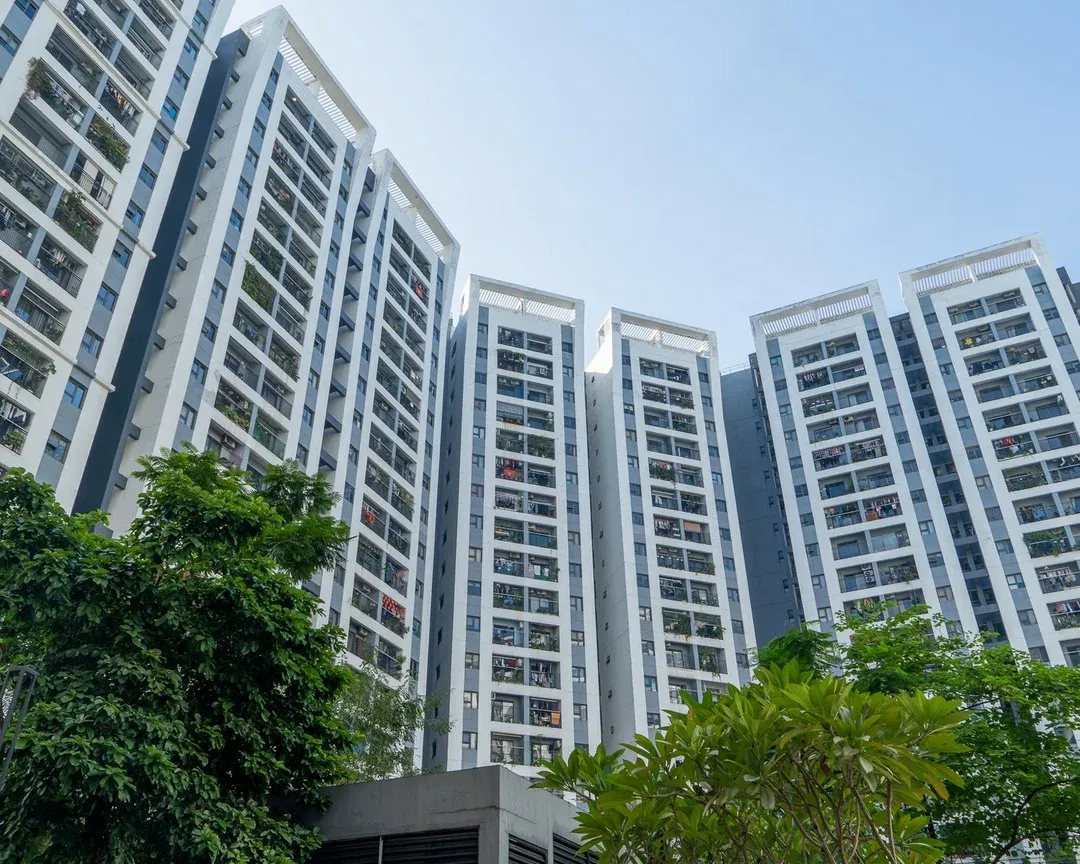

Under Vietnam's 2023 Housing Law, a buyer of social housing can resell the home at market price after five years. The draft amendment to the Housing Law points the opposite way. On the afternoon of October 28, during the National Assembly's floor debate, Construction Minister Tran Hong Minh told lawmakers that buyers of social housing "cannot buy, wait five years and then sell at the market price."Thời báo Tài chính Việt Nam
One caveat first: this is still a draft. The Assembly has not voted, and every transaction today is governed by the 2023 law. But the direction is clear enough, and it bears directly on the value of the home for two groups: households that already own social housing, and eligible buyers waiting in line. This article sets the two rulebooks side by side, question by question.

Who Can Buy the Home
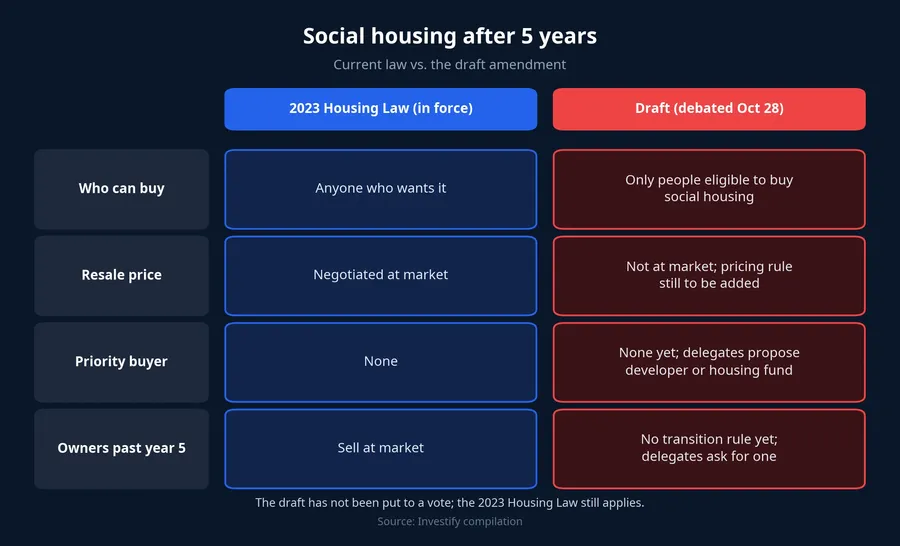
Under point e, clause 1, Article 89 of the 2023 Housing Law, once five years have passed since the buyer paid in full and received a title certificate, the owner may resell "under market mechanisms to anyone who needs it." The Ministry of Construction quoted this wording in full when replying to a company.FireAnt In plain terms, the next buyer does not have to qualify for social housing.
Point e, clause 1, Article 68 of the draft, as cited by delegates in group discussions on October 22, keeps the five-year mark but changes who can buy: after that period, the owner may only resell to someone eligible to buy social housing.Báo Đại biểu Nhân dân The pool of buyers narrows from "anyone who needs it" to people who meet the policy's eligibility and income conditions. The first five years stay as they are: resale only to the developer or an eligible buyer, at no more than the original contract price.FireAnt
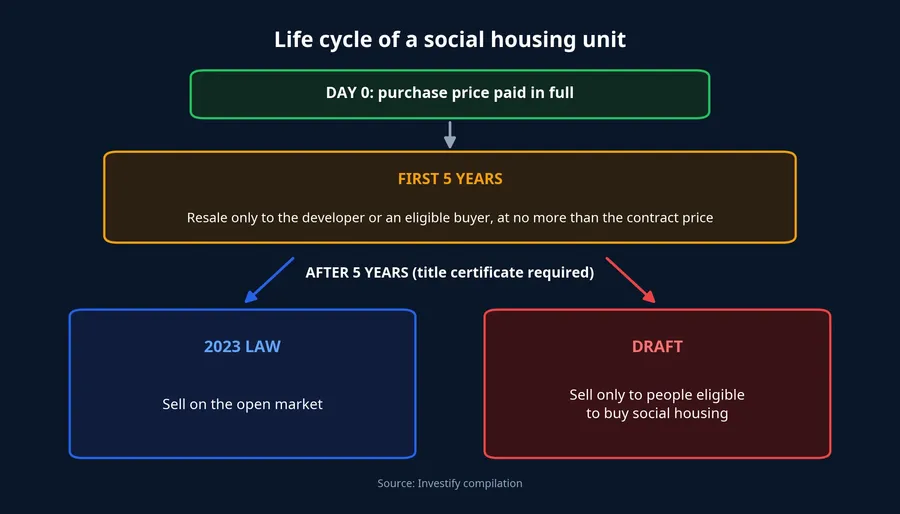
On the reasoning, Minister Minh said social housing is a support policy, so when residents no longer want to live there, resale must carry conditions or it becomes a way to profit from the policy.Thời báo Tài chính Việt Nam
How the Resale Price Is Set
Under current law, after five years the price is negotiated between the two parties at market rates. A seller of an apartment owes no land-use fee, only income tax under the tax law. Only when the social housing unit is a standalone house must the seller pay a land-use fee under government rules.FireAnt
For the draft, this is the most contested cell. National Assembly delegate Ly Anh Thu (An Giang delegation) argued that the draft requires sales to eligible buyers but has no principle for setting the resale price.Markettimes
Accounts of the minister's remarks differ. One FireAnt report has him saying the transfer price should not exceed the price at purchase.FireAnt Thời báo Tài chính Việt Nam instead describes a cap on resale prices as one of the suggestions put to him. So the only thing that can be said firmly today is the policy direction: no sales at market price. The exact cap will be set by the final text.
Ms. Thu proposed a formula: the original purchase price plus an adjustment coefficient set by the competent authority, allowing for reasonable changes in construction costs. Her argument is that if the resale price drifts toward commercial prices, the seller pockets a policy-created gain while the next buyer pays dearly. Delegate Thach Phuoc Binh (Vinh Long delegation) described the other side of the same problem: pure market pricing could put homes out of reach of the people the policy is meant for, while a cap set too low would restrict owners' property rights too much.FireAnt
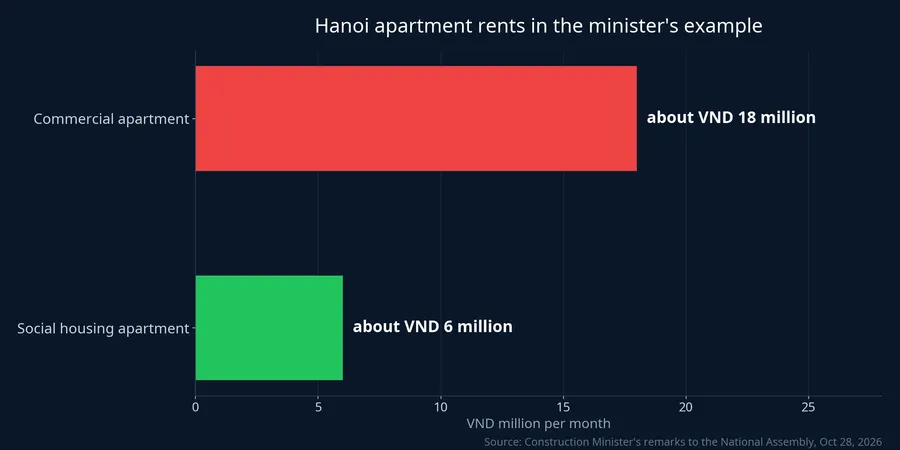
To give a sense of the gap under discussion, the minister said social housing prices have recently ranged from about VND 15-29 million per square meter depending on location. On rentals, he gave a Hanoi example: a commercial apartment rents for about VND 18 million a month, while a social housing apartment let to eligible tenants rents for about VND 6 million.Thời báo Tài chính Việt Nam That distance between policy price and market price is the gain the draft wants to keep inside the housing stock rather than let the first seller walk away with it.
Who Gets First Right to Buy Back
Current law gives nobody priority after five years. The home goes onto the market like any other apartment. The draft as cited in the debates only defines the pool of buyers and sets no priority buyer.
Delegates are proposing additions. Delegate Binh suggested giving the developer, a housing fund or a state-designated body the first right to buy back, so that the home returns to the policy housing stock transparently. Other views suggest sellers first transfer the home to the developer, which then resells to an eligible buyer, so that transactions are controlled rather than left to residents trading among themselves.Markettimes
The difference matters in practice. With a designated buyer, the seller has a guaranteed exit at a price set by the rules. Without one, the seller must find a buyer in a narrower pool, where every buyer has to pass screening on eligibility and income before the deal can close.
Owners Already at or Near Year Five
Owners who have paid in full for five years or more and hold a title certificate can still sell at market today, because the 2023 law is in force. The question is what happens when a new law takes over.
National Assembly delegate Nguyen Khanh Vu said the draft lacks transitional provisions, leaving owners who have reached or are nearing five years unsure how to transfer, which risks inconsistent enforcement across provinces and disputes. Mr. Vu proposed letting those already eligible to sell before the new law takes effect keep transferring for a transition period. Mr. Binh likewise called for transitional rules for people who bought under existing law, to avoid retroactive harm to property rights lawfully established.Markettimes
These are delegates' proposals, not rules. For current owners, this is where the two outcomes differ most. With a grandfathering clause, those who reach five years before the effective date keep a market-price exit for a set period. Without one, their homes move to conditional-sale status as soon as the new law applies.
Winners and Losers if the Draft Passes As Is
The clearest losers are buyers who planned to wait out five years and sell for a gain. Their expected profit sits precisely in the gap between policy price and market price, and that is what the draft targets.
Indirectly affected are households that bought to live in the home. They do not plan to sell, but if they must move for work or relocate, the home's value will be tied to a narrower pool of buyers and possibly a capped price. A delegate from the Ca Mau delegation raised exactly this case: a buyer forced to relocate for work who can only resell at the original contract price may struggle financially when settling in a new place.Báo Đại biểu Nhân dân
The winners are eligible buyers on the waiting list. Besides new units from projects, they would gain a supply of resale homes without competing against buyers who have cash on the open market.
For anyone weighing social housing as an investment, the picture after the amendment is simpler. If the draft passes in this direction, social housing is a home with conditions attached, not an asset that can be sold at market price after five years.
Two Provisions to Watch
According to the minister, the drafting board will keep working with National Assembly bodies to refine the draft before submitting it for a vote.Thời báo Tài chính Việt Nam The policy direction is clear: resale of social housing after five years will no longer be at market price to any buyer. What remains open are two provisions the final text will have to fill.
The first is the resale price principle. The original price plus an adjustment coefficient would let sellers recover part of the price drift, while a cap at exactly the purchase price would leave the home nearly frozen in nominal terms after years. The second is the transition rule: with grandfathering, owners who hit five years before the effective date keep a window to sell under the old regime; without it, the new law applies at once to every social housing unit already sold. Until the new law takes effect, every transaction still follows the 2023 Housing Law.