

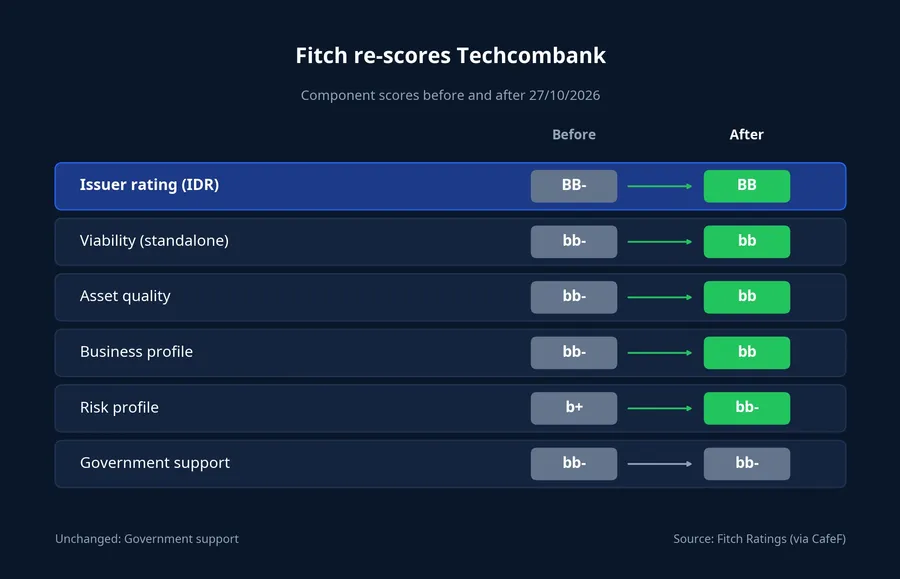
On 27/10/2026, Fitch Ratings upgraded Techcombank's (HoSE: TCB) long-term foreign- and local-currency issuer default ratings from BB- to BB, with a Stable outlook. The detail worth reading is in the component scores: the bank's standalone viability score rose from bb- to bb, while the government support score stayed at bb-. According to Fitch, the higher overall rating is the result of the viability upgrade.
Read the scorecard and the message is clear: the new rating does not come from Fitch expecting more backing from the State. It comes from how the bank earns, manages risk and holds capital. For anyone holding TCB shares, the most direct way a rating touches them is the cost of borrowing abroad, which is also where management says pressure has not eased.
What Fitch re-scored
As CafeF reported from the Fitch release, the asset quality score and the business profile score both rose from bb- to bb, and the risk profile score rose from b+ to bb-.CafeF Fitch said credit underwriting standards were essentially unchanged, so this is the old lending approach holding up for another year, not a new approach being rewarded.
Risk profile: a large property book still earned an upgrade. This is the lowest score in the table and the most interesting. Fitch noted that Techcombank's property exposure remains large relative to peers, but did not treat that size as a reason to hold the score. It acknowledged that the bank's property risk management has been proven through the credit cycle. Fitch expects underwriting discipline, conservative collateral practices and a gradual shift toward retail, SME and infrastructure lending to balance the portfolio over time.
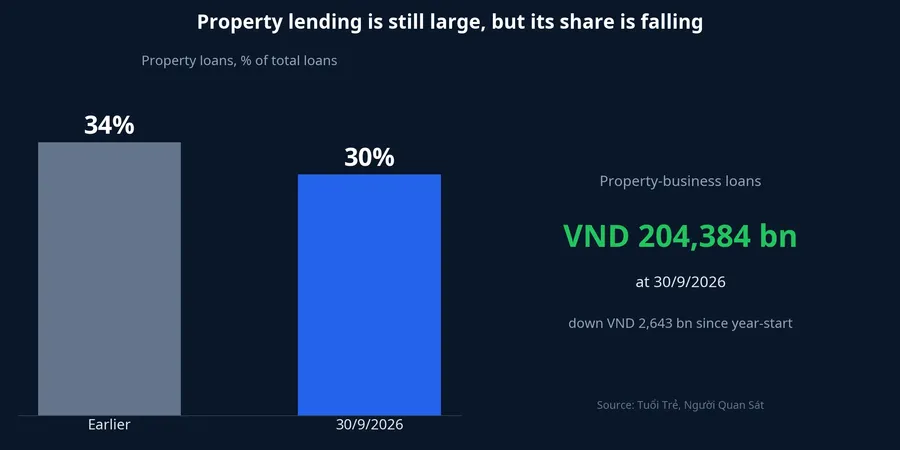
The bank's own figures point the same way. At 30/9/2026, Techcombank's property-business loans stood at VND 204,384 billion, down VND 2,643 billion from the start of the year.Người Quan Sát Per Tuổi Trẻ, the bank cut property's share of total loans from 34% to 30%, while infrastructure project financing rose 153% from the start of the year.Tuổi Trẻ The risk profile score, at bb-, is still one notch below the other two: Fitch has not treated the size of this portfolio as a closed chapter.
Business profile: demand deposits and fees. Fitch credits the bank's digital and transaction banking platforms with keeping its share of demand deposits above that of peers. Fee income makes revenue steadier through market cycles. Operating profit over risk-weighted assets rose to 2.9% in the first half of 2026 from 2.6% in 2025, driven by net interest income and fees from transaction banking, insurance and capital markets.CafeF
Asset quality: stable bad debt, with one caveat. Fitch expects Techcombank's NPL ratio to stay broadly stable over the next 12 months. It also said the ratio could face mild pressure from higher funding costs and from loans disbursed during the recent growth phase. That caveat matters most for this post and returns in the closing section.
Tier 1 capital holds while lending runs fast
Capital was not among the scores raised this time, but Fitch calls it a credit strength for Techcombank. The Tier 1 ratio was 14.1% in Q3/2026, almost unchanged from a year earlier.CafeF Fitch says the bank kept it there despite fast credit growth and continued cash dividends, thanks to steady profit generation.
The mechanism is simple. More lending inflates risk-weighted assets, and the capital ratio slips unless equity grows with it. A bank that has to raise outside capital to hold the ratio dilutes its shareholders. Techcombank holds it with its own retained earnings, the same thread as the viability score: the bank funds its own growth.
Where a higher rating bites
A credit rating is the yardstick foreign institutions use when lending to a Vietnamese bank. A higher rating usually comes with a lower risk premium and longer tenors.
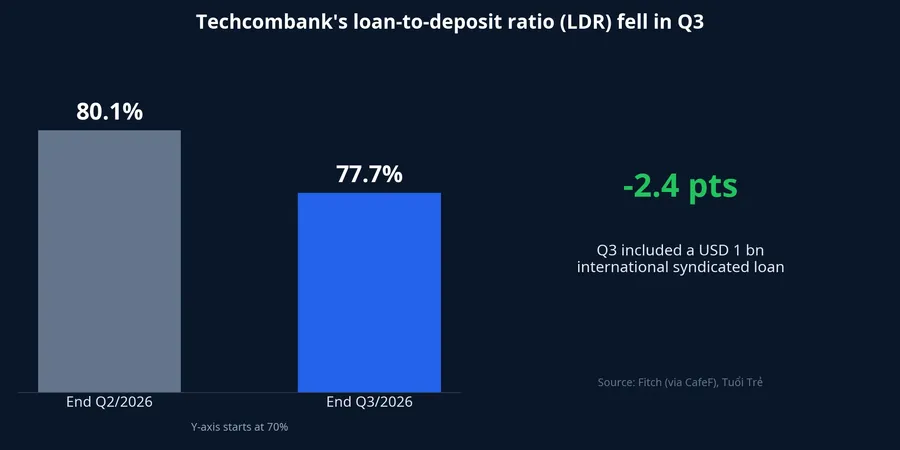
At the institutional investor results briefing, Alex Macaire, Group Chief Financial Officer of Techcombank, said the bank had raised funds in overseas markets at a cost among the lowest in the banking sector.CafeF In Q3 the bank took a USD 1 billion international syndicated loan.Tuổi Trẻ The loan-to-deposit ratio (LDR) fell from 80.1% at the end of Q2 to 77.7% at the end of Q3/2026, and Macaire said overseas funding contributed to the drop.
Macaire was also frank about the limits. Short-term liquidity pressure has eased somewhat, he said, but pressure on long-term funding remains fully in place. Chief Executive Officer Jens Lottner said the bank's funding mixes deposits, wholesale funding and USD funding. Over the long term, the bank will look for partners to co-lend or refinance these loans, while widening ties with international financial institutions.
Put together, the two comments show the BB rating arriving at the right moment. Long-dated funding is what household deposits struggle to supply, while international borrowing can, and its price depends directly on the rating. The benefit of the new rating therefore is not in the Q3 report; it will show up in the pricing of the next loan or refinancing.
Keep the upgrade in proportion. BB is still below investment grade. Fitch has only caught up with S&P, which upgraded Techcombank to BB on 25/8/2025, according to CafeF.CafeF
Perhaps Fitch was simply matching S&P after more than a year. But then it would not have needed to re-score the risk profile and asset quality separately, the two scores tied directly to the property book. The evidence leans toward Fitch re-assessing that portfolio itself.
What would change the view
The thesis: the BB rating reflects Techcombank's own strength, and Fitch is placing its trust in how the bank manages a property book larger than its peers'. The weak point in that thesis is Fitch's own caveat on bad debt.
At the end of Q3 the bank's NPL ratio was 1.36%, or 1.26% excluding the CIC effect, with a trailing 12-month credit cost of 0.4%.Tuổi Trẻ Fitch forecasts broadly stable NPLs. But if bad debt keeps edging up while funding costs stay high, and the loans disbursed during the fast-growth phase start to come due, the base assumption behind the bb asset quality score weakens. The Q4/2026 financial statements, expected at the end of January 2027, are the first checkpoint for comparing Fitch's forecast with real numbers.
29/10 session: the board price changes, account value does not
Today, 29/10/2026, is the ex-rights date for TCB's 50% stock dividend. The last registration date is 30/10/2026, with more than 3.54 billion shares expected to be issued.Vietstock
TCB closed the 28/10 session at VND 33,500. On the ex-rights day the reference price is adjusted for the ratio, to around VND 22,300 (33,500 divided by 1.5). A holder of 1,000 shares before the session becomes entitled to another 500, so total value at the reference price stays at about VND 33.5 million. A board price drop of roughly one third is not a loss. The bonus shares sit in a pending-rights line until they are allocated to the account.
A stock dividend creates no extra economic value for shareholders, since earnings per share are spread over a larger share count. Fitch's new rating and the share dividend are two events that happen to share a week, with no causal link between them.