
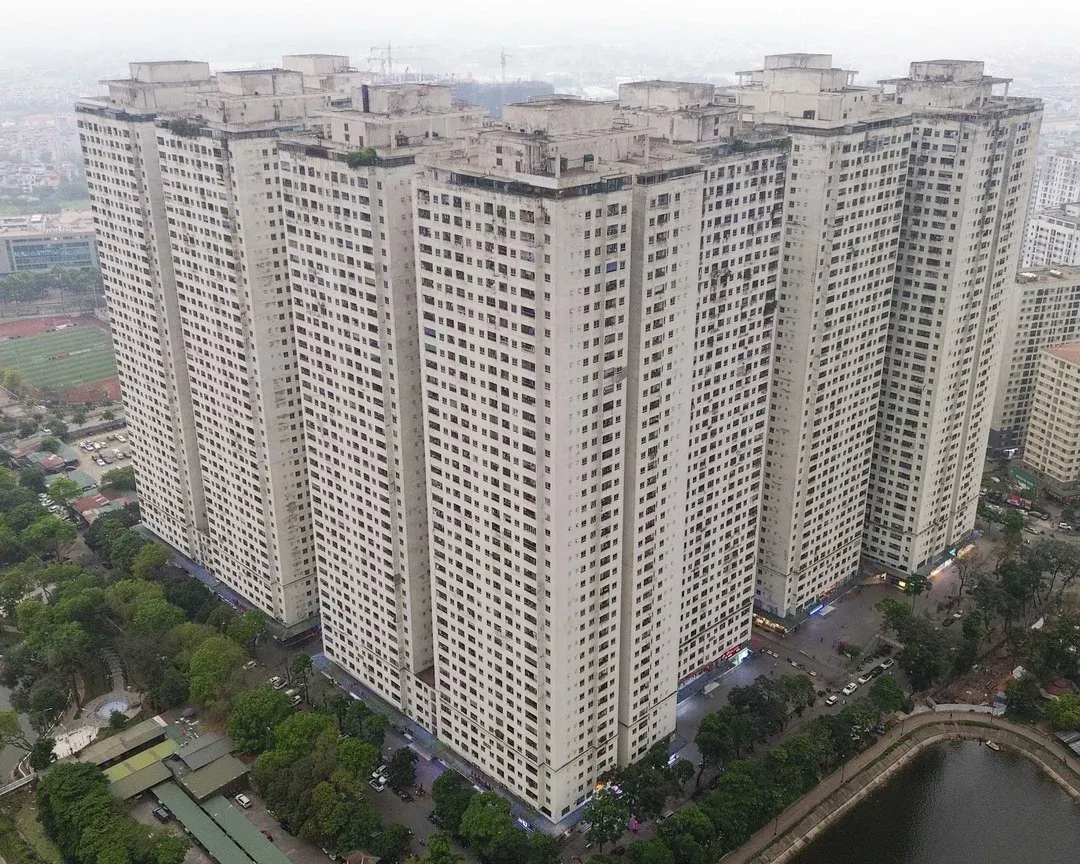

On the morning of Oct 28, at its seventh session, the Hanoi People's Council passed, with a majority of delegates present in favor, a resolution setting special mechanisms, policies and remedial measures for 12 projects of the Muong Thanh Group.Dan Tri For anyone living in, selling or thinking of buying an apartment at HH Linh Dam, Kien Hung, Tan Trieu, Xa La or Kim Van - Kim Lu, the biggest change is how towers are sorted. Each building now lands in one of two groups: retained with conditions, or demolished. The "keep as is" group that appeared in the draft is gone.
This piece walks through the milestones, from the early-October draft to the steps residents still have to wait for.

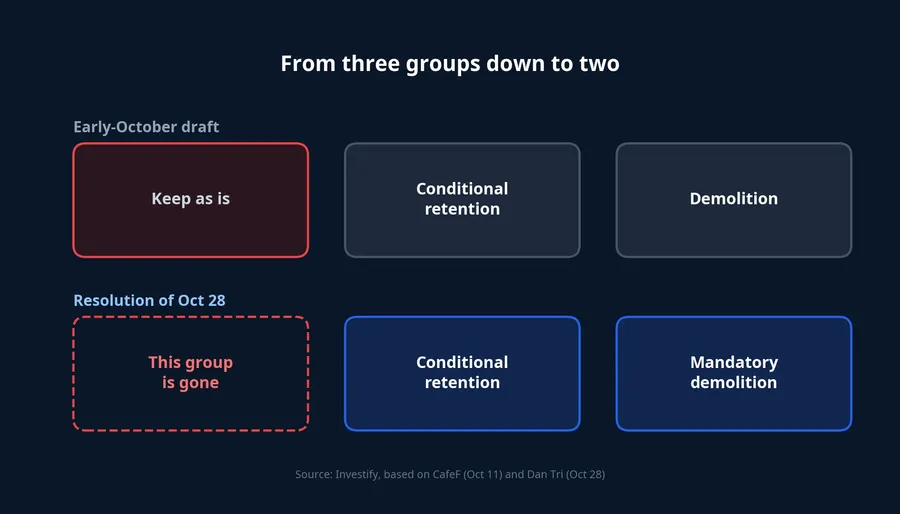
Milestone 1: The early-October draft had three groups
According to CafeF on Oct 11, the draft put out for comment split the non-compliant buildings into three groups.CafeF The best group was "keep as is", for buildings that were finished and occupied, structurally safe, fire-compliant, equipped with infrastructure matching the real population, and clear of the building line. The middle group was conditional retention, the last was demolition.
Even in the draft, "as is" did not mean nobody had to leave: residents in the podium, technical floors and community rooms built in breach of the rules still had to move out. For many households on the upper floors, though, it was the easiest scenario.
Milestone 2: On Oct 28, the resolution keeps only two groups
According to the proposal presented at the session by Mr. Duong Duc Tuan, Standing Vice Chairman of the Hanoi People's Committee, Article 4 of the resolution sets two groups.Dan Tri Group 1 is conditional retention. Group 2 is mandatory demolition, covering buildings that fail the Group 1 criteria. Any tower that wants to stay has to pass the same test.
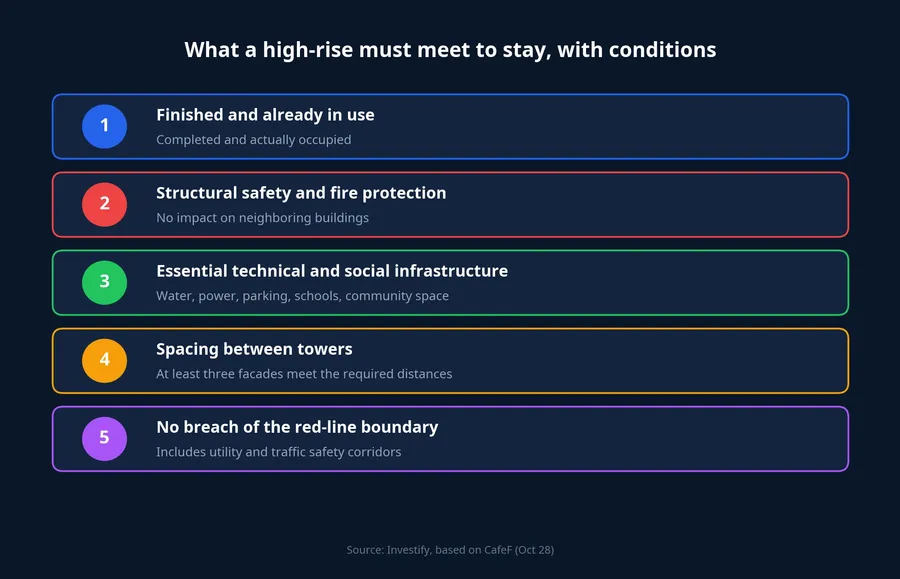
For high-rises, CafeF on Oct 28 reported the Group 1 criteria as follows:CafeF
- The building is finished and actually in use.
- It is structurally safe, meets fire prevention and rescue requirements, and does not affect neighboring buildings.
- It meets minimum standards for technical infrastructure (water, power, parking) and social infrastructure (schools, community space), under the zoning plan or an approved supplementary plan.
- At least three facades of each tower meet the spacing required by the standards in force when it was built: no less than 17.5 m between two long sides, and no less than 10.5 m from a gable end to a gable end or to the long side of another tower.
- It does not breach the red-line boundary, the protection corridors of technical infrastructure, or traffic safety corridors.
The infrastructure criterion leaves one door open: a high-rise lacking infrastructure can still be considered if it meets the other criteria and has a remediation plan the competent authority judges feasible. A building that fails on structure, fire safety or the building line has no such door and falls into demolition. For low-rise houses the test is simpler: the house must not sit on land zoned for infrastructure.
The scale is large. According to the proposal, the projects were approved for 6,759 units but 24,943 were actually built, leaving 18,184 non-compliant units.Dan Tri In the debate, delegate Vo Dang Dung, Party Secretary of Khuong Dinh ward, cited an expected figure of more than 3,900 high-rise apartments to be demolished.CafeBiz That is one delegate's estimate, not the city's official list.
On principle, the developer bears all remediation costs. Buyers who are not at fault bear no loss.Nguoi Quan Sat
Milestone 3: The city committee assigns each tower to a group
The resolution only sets the rules. Which tower falls into which group will be set out in a decision by the Hanoi People's Committee, based on reviews by specialist agencies.Dan Tri That decision will specify which parts may stay with conditions and which must be demolished, renovated or converted to another use.
Even when a tower lands in Group 1, not every unit stays put. Under Article 5, residents in non-compliant podium areas, technical floors and community space must still relocate so the space can be returned to its planned use or turned to public functions.Dan Tri For a Group 2 tower, all residents and their belongings must leave.
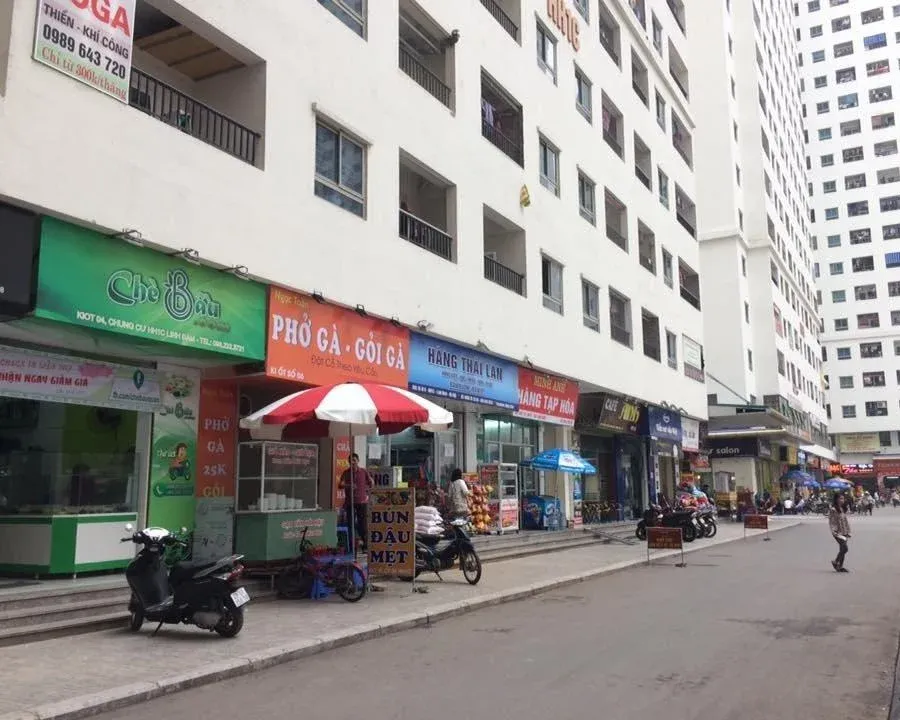
Before anyone moves, the ward People's Committee and the developer draw up a list of every affected unit and area and identify the owners and users. The relocation plan must be made public for residents to comment on.
Milestone 4: 30 days for a demolition plan, 90 days for compensation
For parts ordered demolished, the developer must draw up a safe demolition plan within 30 days.Nguoi Quan Sat If the developer does not comply voluntarily, the authorities will enforce it.
Residents who must move out receive compensation within 90 days. They may also negotiate to buy an apartment or house in another project by the same developer, and those eligible for social housing get priority to buy the developer's social housing without a lottery.Nguoi Quan Sat The developer is responsible for organizing compensation and support and for securing the funds.Dan Tri
Milestone 5: Residents who stay wait for the pink book
Residents who do not have to relocate continue with the contracts they signed and do not pay remediation fees on the developer's behalf. They receive their ownership certificate after completing their financial obligations.Dan Tri
The resolution requires the developer to finish remedial measures first, and only then can zoning updates, land allocation and certificates be considered. In other words, the pink book of a resident who stays follows the developer's work rather than running in parallel with it.
Who is best protected, and who carries the most risk
Put side by side, the milestones protect buyers fairly clearly on paper: residents who stay pay no remediation costs, residents who leave have a 90-day window for payment, and all costs sit with the developer.
That is also where buyers' biggest risk comes from. The pink book of a resident who stays waits on the developer finishing remediation, and the compensation for a resident who leaves is paid by the developer. Enforcement can deal with a developer that refuses to demolish, but compensation still has to come from the developer itself.
The most exposed are residents of non-compliant podium areas, technical floors and community space, and those in towers that may fail the criteria. For anyone considering buying a resale unit in the 12 projects, which group it belongs to will only be clear once the city committee issues its decision.
What to watch next
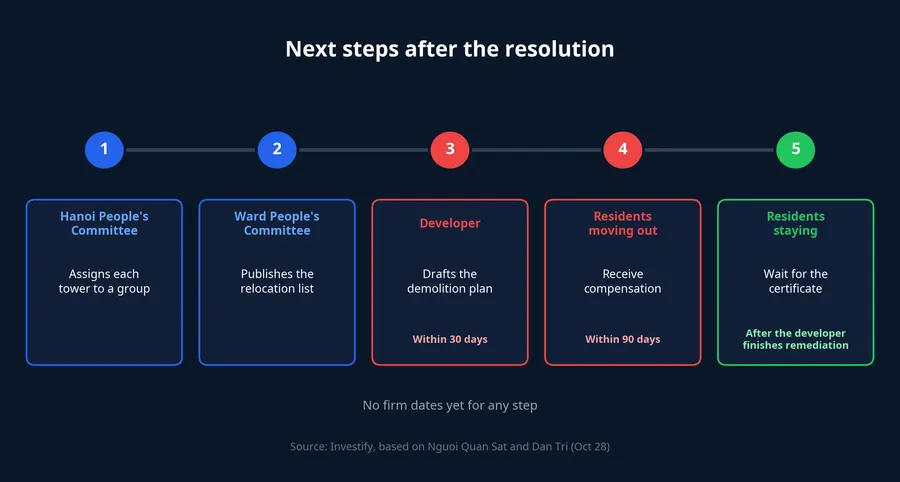
What decides each household's fate is the Hanoi People's Committee's decision assigning every tower to a group. Once it is out, residents can check their tower against the five criteria above, then look at the relocation list the ward committee makes public. For towers that stay, the next milestone is the developer completing remediation so certificate applications can be considered. For residents who must leave, it is whether compensation arrives within the 90-day deadline.